
Published 7 September 2026 · Updated 29 September 2026 · By Jatin Dua, Broker of Record, RE/MAX Quantum Realty
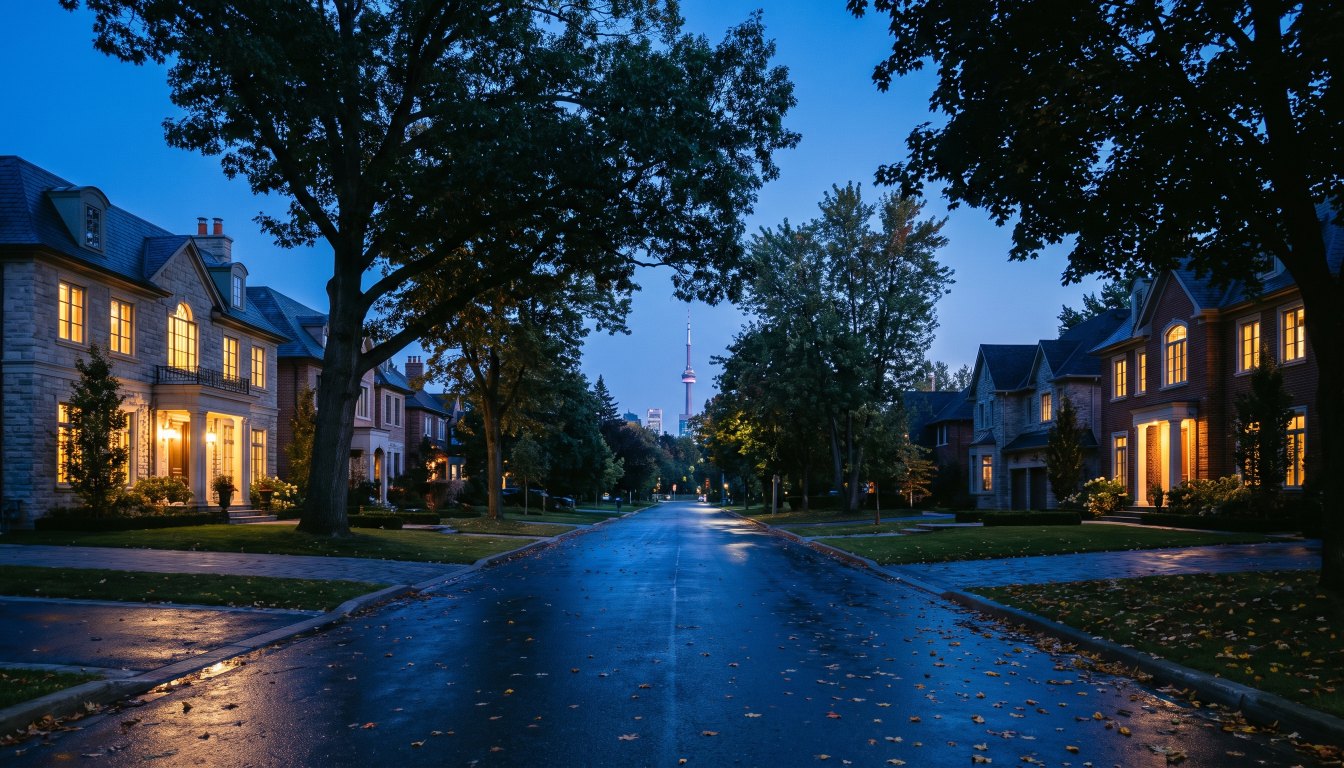
Toronto’s overall market and Toronto’s luxury market are moving on different clocks. Across the GTA in August 2026, 5,057 homes sold at an average of $993,410, down 2.7% from a year earlier, with the MLS Home Price Index down 4.5%. In the luxury bands, RE/MAX counted 300 sales above $3 million in the GTA between January and April 2026, down 17% from 361 in the same months of 2025 — while the $5 million-plus band held almost perfectly flat at 62 sales versus 63.
That combination — a soft middle, a shrinking $3M–$5M band, and a stable ultra-top — is the whole story of 2026. And on 1 April 2026 the City of Toronto raised its land transfer tax again on everything above $3 million, which added roughly $9,000 at a $4 million purchase and $68,500 at $10 million.
Two markets, one city
If you read one headline about Toronto real estate in 2026 and stopped there, you probably came away with the wrong picture. The number that gets quoted is the average across every home in the Greater Toronto Area, and that average is dominated by hundreds of condo apartments and suburban semis. It tells you almost nothing about what is happening to a $4 million house in Lawrence Park.
So let us separate them properly.
What the whole market did
TRREB’s August 2026 Market Watch, released on 4 September 2026, reported the following for the Greater Toronto Area:
- 5,057 sales, down 2.1% from August 2025
- 12,075 new listings, down 14.1% year over year
- Average selling price of $993,410, down 2.7% year over year
- Median price of $850,000
- MLS Home Price Index composite benchmark down 4.5% year over year
- 35 days average time on market and a 97% average sale-to-list ratio
The important line in that list is the one people skip: new listings fell 14.1% while sales fell only 2.1%. Supply is leaving the market faster than demand is. That is the mechanic behind TRREB’s own comment that inventory is tightening.
What the top end did
RE/MAX Canada’s 2026 Spotlight on Luxury Real Estate, published 17 June 2026, counted actual transactions in the GTA over the January to April window and compared them with the same four months of 2025. Here is what it found.
| Price band | Jan–Apr 2026 | Jan–Apr 2025 | Change |
|---|---|---|---|
| $2M – $3M | Just over 400 sales | Slightly fewer | Modestly up |
| $3M+ (freehold and condo) | 300 sales | 361 sales | Down 17% |
| $5M+ | 62 sales | 63 sales | Essentially flat |
| $5M – $7.499M, City of Toronto only | 39 homes | 37 homes | Up 5.4% |
| $5M+ condos, Toronto core | 4 sales (one above $10M) | 2 sales | Doubled |
Read the shape of that table rather than the percentages. The bottom of the luxury market grew slightly. The $3M–$5M band, which is where most of Toronto’s genuinely large family houses trade, shrank. The very top held.
Why a 17% drop is not what it sounds like
Three hundred sales versus three hundred and sixty-one is a difference of sixty-one transactions spread across the entire Greater Toronto Area over four months. That is roughly fifteen houses a month. At that sample size, a handful of families deciding to renovate instead of move can produce a double-digit percentage swing that means nothing about value.
A shrinking count in the upper bands almost always means fewer listings, not falling prices. Owners of $4 million homes are rarely forced sellers. When conditions are uncertain, they simply do not list, and the transaction count falls while the value of the asset does not.
Where the $3 million-plus sales actually happened
The same RE/MAX count broke the $3 million-plus sales down by neighbourhood for the year to date:
| Area | $3M+ sales, YTD 2026 |
|---|---|
| Rosedale | 20 |
| Lawrence Park | 20 |
| Bridle Path – Sunnybrook – York Mills | 14 |
| Forest Hill South | 11 |
| Kingsway South | 9 |
| West end of Toronto, all neighbourhoods | 31 |
| York Region | 35 |
| Peel Region | 24 |
Two things jump out of that table. First, the traditional core — Rosedale, Lawrence Park, the Bridle Path, Forest Hill — still accounts for the majority of top-end trades. Second, the west end of Toronto, taken as a whole, now produces roughly the same number of $3 million-plus sales as York Region. The Kingsway, Baby Point, Humber Valley Village and the Old Mill area are no longer a footnote in this conversation.
The condo market is two different markets
This is where 2026 gets genuinely strange. In the first quarter of 2026, the Greater Toronto and Hamilton Area recorded zero new condominium project launches — the first quarter in thirty years with none. New condo sales came to 246 units, down 52% year over year and 94% below the ten-year average. Completed but unsold inventory hit a record 4,295 units, more than double a year earlier, with another 8,629 unsold units still under construction.
Pricing split with it. New construction averaged $1,189 per square foot, down 5% year over year, while resale averaged $859 per square foot, down about 25% from the early-2022 peak. That is a record 38% gap between what a new unit costs and what an existing one trades for.
And yet, in the same period, $3 million-plus condo sales in the Toronto core were flat year over year and $5 million-plus core condo sales doubled. A two-bedroom investor unit in a 2019 tower and a full-floor residence on Bloor Street share a property type and nothing else. If you own one and read statistics about the other, you will reach the wrong conclusion.
The tax that changed the math on 1 April 2026
Toronto is the only municipality in Ontario that charges its own land transfer tax on top of the provincial one, and on 1 April 2026 the City increased its rates again on homes above $3 million. The current municipal rates for a property with one or two single-family residences are:
| Portion of purchase price | Toronto MLTT rate | Previous rate (Jan 2024 – Mar 2026) |
|---|---|---|
| Up to $2,000,000 | 0.5% to 2.0% graduated | Unchanged |
| $2,000,000.01 – $3,000,000 | 2.5% | 2.5% |
| $3,000,000.01 – $4,000,000 | 4.40% | 3.5% |
| $4,000,000.01 – $5,000,000 | 5.45% | 4.5% |
| $5,000,000.01 – $10,000,000 | 6.50% | 5.5% |
| $10,000,000.01 – $20,000,000 | 7.55% | 6.5% |
| Over $20,000,000 | 8.60% | 7.5% |
Ontario’s own land transfer tax sits on top of that, at 2.0% on the portion between $400,000 and $2,000,000 and 2.5% on everything above $2,000,000 for a single-family residence. Put the two together and this is what actually leaves your account on closing day:
| Purchase price | Ontario LTT | Toronto MLTT | Total on closing | Increase since 31 Mar 2026 |
|---|---|---|---|---|
| $3,000,000 | $61,475 | $61,475 | $122,950 | No change |
| $4,000,000 | $86,475 | $105,475 | $191,950 | +$9,000 |
| $5,000,000 | $111,475 | $159,975 | $271,450 | +$18,500 |
| $10,000,000 | $236,475 | $484,975 | $721,450 | +$68,500 |
At $5 million, land transfer tax alone is now more than a quarter of a million dollars, paid in cash on closing, on top of your down payment. It is not financeable, it is not refundable, and the first-time buyer rebates — $4,000 provincially and $4,475 municipally — are irrelevant at this level.
The practical takeaway
If you are buying above $3 million in Toronto, the transfer tax is now large enough to be a real variable in where you buy, not just a line item. The same $5 million house in Mississauga, Oakville or Vaughan attracts the Ontario tax of $111,475 and no municipal land transfer tax at all — a $159,975 difference on day one. That does not mean you should buy outside Toronto. It does mean the number belongs in the conversation before you fall in love with an address.
What this means if you are selling
Thin listing counts in your price band are your friend, not your problem. With 300 sales above $3 million across four months in the whole GTA, a well-prepared, correctly priced house in a top neighbourhood is competing against a very short list. The mistake is treating that scarcity as licence to overprice: at this level buyers are patient, well advised, and entirely willing to wait you out. Overpricing at $4 million does not produce a slow sale. It produces no sale, then a price reduction that reads as weakness.
What this means if you are buying
Your leverage is real but narrow. In the $3M–$5M band, where volume fell hardest, sellers who are genuinely motivated are negotiable in a way they were not two years ago. Above $5 million, and in the top core neighbourhoods, that is much less true — those sales held. And whatever you negotiate, budget the closing tax honestly. A $200,000 discount that you celebrate is worth less than it looks once you have written a $271,450 cheque to two levels of government.
Frequently asked questions
Is the Toronto luxury market crashing in 2026?
No. Sales volume in the $3 million-plus band fell 17% year over year in the January to April 2026 period, but that is 300 sales versus 361 — a difference of 61 transactions across the entire GTA. The $5 million-plus band was essentially unchanged at 62 sales versus 63. Fewer trades at the top end usually means fewer sellers willing to test the market, not a collapse in value.
What price counts as luxury in Toronto?
There is no official threshold. RE/MAX used $3 million as the luxury benchmark for the GTA in its 2026 report, while using $1.5 million for Edmonton. Practically, the Toronto market behaves differently above roughly $2.5 million to $3 million, because that is where the buyer pool thins out, financing changes character, and the Toronto land transfer tax rate starts climbing steeply.
How much land transfer tax do I pay on a $5 million home in Toronto?
Under the rates in effect since 1 April 2026, Ontario land transfer tax on a $5,000,000 single-family purchase is $111,475 and Toronto’s municipal land transfer tax is $159,975, for a combined $271,450 payable on closing. Verify your own numbers with your lawyer, since the calculation depends on the property type and the exact price.
Which Toronto neighbourhoods had the most $3 million-plus sales in 2026?
In RE/MAX’s January to April 2026 count, Rosedale and Lawrence Park tied at 20 sales each, followed by Bridle Path–Sunnybrook–York Mills at 14, Forest Hill South at 11 and Kingsway South at 9. The west end of Toronto totalled 31 sales above $3 million, York Region 35 and Peel Region 24.
Are luxury condos in Toronto still selling?
The core luxury condo market and the broader condo market are behaving very differently. RE/MAX reported that $3 million-plus condo sales in the Toronto core were on par with the prior year, and that $5 million-plus condo sales actually doubled from two to four, one of them above $10 million. Meanwhile the new-construction condo market recorded zero project launches in the GTHA in the first quarter of 2026 and a record 4,295 completed but unsold units.
Should I wait until 2027 to buy a luxury home in Toronto?
Nobody can answer that honestly with a forecast. What can be said factually is that the federal ban on residential purchases by non-Canadians is currently set to expire on 1 January 2027, that Toronto’s municipal land transfer tax on high-value homes went up on 1 April 2026, and that inventory in the top bands is thin. Those are the levers to watch, not a prediction.
Thinking about buying or selling at the top end?
Send me the address, or the shortlist you are considering. I will tell you what the property is actually worth today, what the land is worth without the house, what the transfer tax and carrying costs will be, and whether the deal makes sense. Confidential, always.
[email protected] · 833-330-1925 · Book a free consultation
Confidential. Read personally and answered within 24 hours. I never share, sell or distribute your information.
Related reading
- What actually moves house value in Toronto and the GTA
- Should I sell my house in 2026? An honest read of the GTA market
- Your Toronto condo is worth less than you paid. What to do about it
- What is my condo worth? Floor, view and parking, priced
- Free AI home valuation for Toronto and the GTA
Sources
Everything above that is a rule, a rate or a published number comes from these. Verify anything that matters to your own deal.
- Toronto Regional Real Estate Board — Market Watch, August 2026
- RE/MAX Canada — 2026 Spotlight on Luxury Real Estate, Greater Toronto
- City of Toronto — Municipal Land Transfer Tax rates and fees
- Government of Ontario — Calculating land transfer tax
- Real Estate Magazine — No new condo projects launched in Q1 2026 (Urbanation data)
About the author — Jatin Dua, Broker of Record
I’m the Broker of Record at RE/MAX Quantum Realty, 799 The Queensway in Etobicoke, and I work with buyers, sellers and investors across Toronto and the west GTA. A large part of my work sits in the upper end of the market, where the comparables are thin, the rules are heavier and the cost of a wrong number is measured in hundreds of thousands of dollars.
The free estimators on this site are mine. I built them because the first question every owner asks is “what is it worth?” and the honest answer starts with a number you can check yourself. [email protected] or 833-330-1925.