
Published 7 September 2026 · Updated 29 September 2026 · By Jatin Dua, Broker of Record, RE/MAX Quantum Realty
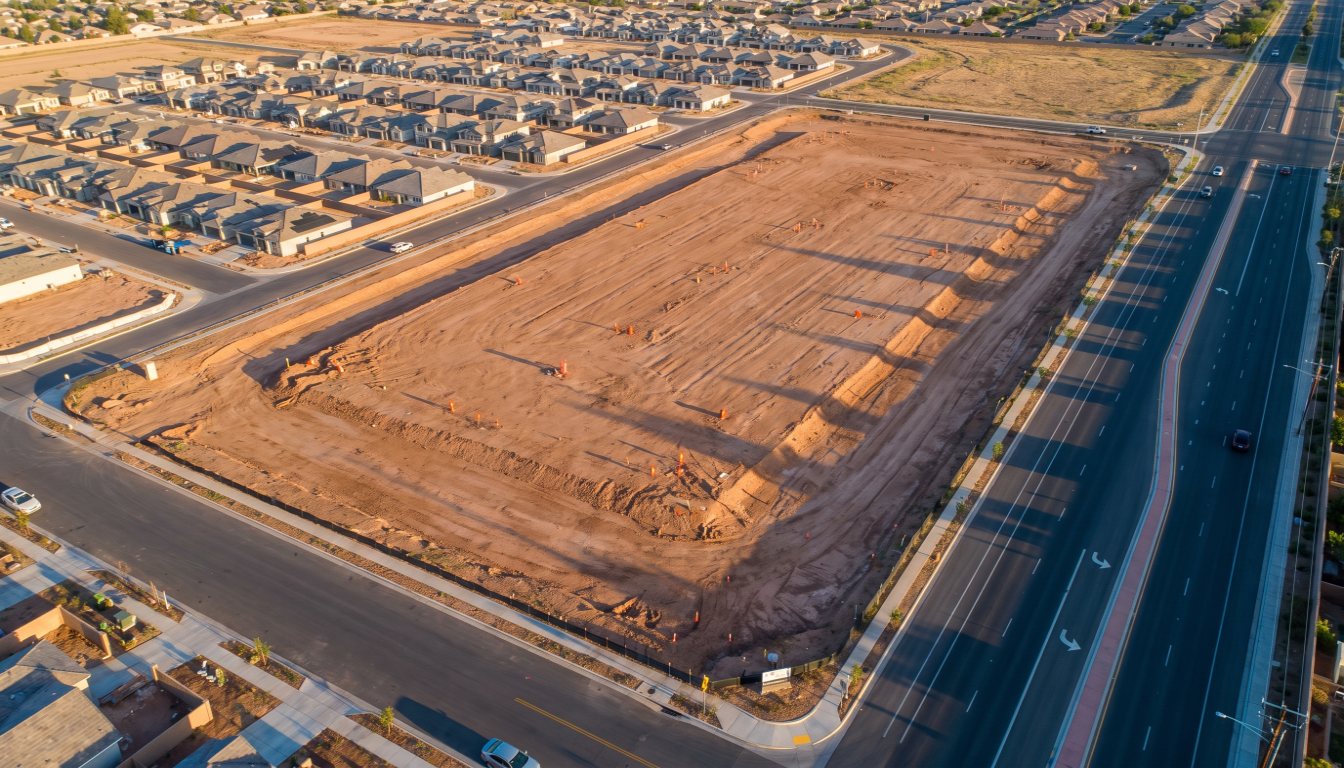
Developers do not price land by the acre unless it is industrial or subdivision land; they price it by what they can build on it. A mid-rise or tower site is priced per buildable square foot — roughly $90 per buildable foot for high-rise sites in the City of Toronto and under $40 in the 905 as of mid-2025, both down about 37 percent from the 2021 peak — while industrial and low-density land trades per acre, from around $1 million an acre in Barrie to $3 million and up in Brampton and Mississauga. On every kind of land, the approval stage moves the number more than anything else. The free AI land value estimator applies all three methods and shows what each next approval step would add to your parcel.
Three ways land gets priced
1. Per buildable square foot — density sites
If your land is designated for mid-rise or high-rise residential or mixed-use, a developer starts from how much gross floor area the site can carry: lot area times the floor space index the zoning allows or the application seeks. Then they apply a price per buildable square foot that reflects what condos or purpose-built rental sell or lease for in that location, less construction, development charges, soft costs and profit. The land is what is left.
That is why a 0.3-acre site downtown can be worth more than 5 acres in Barrie. Bullpen and Batory’s tracking put City of Toronto high-rise land at about $92 per buildable foot in Q2 2025 — down 14 percent year over year and 37 percent from the 2021 peak of $146 — and 905 high-rise land at about $37, down 38 percent from peak. Toronto mid-rise sites tracked higher, around $118, because mid-rise is cheaper to build. The estimator carries separate mid-rise and high-rise baselines for each municipality and derives the buildable area from the storeys you enter.
2. Per acre — industrial, commercial, subdivision and rural land
Industrial and employment land trades per acre because what gets built on it is roughly the same everywhere: a warehouse at a coverage the zoning allows. Reported GTA industrial land sales in 2024 ranged from about $1.1 million an acre for Vaughan employment lands and $1.5 million in Innisfil to $1.77 million in Burlington and just over $4 million an acre for a Brampton cross-dock site. Subdivision land is priced per acre by the lots it will yield; farmland and greenbelt trade per acre on a different, much lower scale that barely moves with planning applications.
3. Residual value — the check on both
Whatever the method, a serious buyer runs a residual: projected revenue from the finished project, less every cost including their margin, equals what they can pay for the land. If your asking price is above that residual, they do not buy, whatever the comparables say. That is why land values fell so far when construction costs and rates rose: the revenue side stopped covering the cost side, and the land absorbed the difference.
Approvals are the biggest lever, by far
Location sets the baseline. Approvals set the multiple. A site with nothing filed is priced with all the planning risk and time on the buyer; a site with a zoning by-law amendment in force has removed most of that risk, and a site with site plan or draft plan approval is something a builder can finance. In my estimator the same per-acre parcel moves from a base of 1.0 with nothing filed, to about 1.3 with zoning in force, 1.5 with site plan approval and 1.6 shovel-ready; density sites move on a similar curve. Those are calibrations, not statistics, but they line up with what I see in offers: the jump from “application filed” to “zoning approved” is usually the single largest step in a parcel’s value.
| Land type | Priced by | Typical 2026 range in the model (calibration) | What moves it most |
|---|---|---|---|
| High-rise residential, Toronto | Per buildable sq ft | $50–$105 depending on district | Approvals, transit, permitted height |
| High-rise / mid-rise, 905 | Per buildable sq ft | $20–$50 | Approvals, GO station proximity |
| Industrial / employment | Per acre | $0.5M (Orillia) to $3M+ (Brampton, Mississauga, Toronto) | Highway exposure, servicing, parcel size |
| Low-density residential | Per acre | $1.3M (Barrie) to $4M+ (Mississauga) | Draft plan approval, servicing allocation |
| Commercial / tourist commercial | Per acre | $0.6M–$7.5M | End-user demand, exposure, approvals |
| Agricultural / whitebelt | Per acre | $20k–$450k | Urban boundary decisions, frontage |
| Greenbelt / conservation | Per acre | $12k–$35k | Almost nothing; designation is the ceiling |
Servicing, size, exposure and the rest
After approvals, servicing is the next question: municipal water and sewer at the lot line, or not. Unserviced land in an urban designation is discounted by roughly a third in the model, because the buyer has to bring services and get an allocation, and allocation is not guaranteed. Parcel size cuts the other way from what owners expect: bigger parcels trade for less per acre, because fewer buyers can write the cheque and absorption takes longer. Highway or arterial exposure adds for industrial and commercial land, and rapid transit within a kilometre adds materially for residential density. Holding income on the site helps a little; a known floodplain, contamination or easement problem takes about 15 percent off until it is cleared.
What the estimator is doing
It takes the baseline for your municipality and designation, prices the parcel per acre or per buildable foot depending on the use, applies the approval stage, servicing, size, frontage, transit, exposure, income and constraints, compresses the stacked adjustments, and returns a range with the most likely figure, the value per acre and, for density sites, the value per buildable foot and a unit count. Then it re-runs itself for each later approval stage and shows what each step is worth on your parcel. Where I have sold comparables for your municipality and land type, they are blended into the baseline.
How to use the number
If you own land, run the tool and look at the “what would raise it” list before you decide whether to sell now or get approvals first. Often the next step is worth more than the cost and time of doing it, and sometimes it is not. If you are a developer or investor, use it to sanity-check an asking price against a residual before you spend money on due diligence. Either way, send me the parcel and I will tell you what the market is actually paying this quarter.
Free tool — AI land value estimator
Land Valuation
What’s your land
worth today?
Three quick steps. Land doesn’t price like a house — what you’re allowed to build on it, how far along the approvals are, and whether services reach the lot line move the number more than anything else. This weighs all of them.
Reading recent land sales…
Estimated land value
—
$0–$0
Most likely $0 · about $0 per acre · $0 per buildable sq ft
What moved the number
Starting from what comparable land in your municipality trades for, here’s what your specifics added or subtracted.
What would raise it
Approvals are the biggest lever on land. Here is what each next step is worth on this parcel.
—
Development sites are listed at $1
for a reason.
Sellers let the market price them — and the market only pays for what it can see: the planning file, the servicing letter, the environmental reports. A model can’t read your file. I can, and I know which developers are buying right now.
Frequently asked questions
How is development land valued in Ontario?
Density sites are valued per buildable square foot: lot area times the permitted floor space index, times a price per buildable foot for that location. Industrial, subdivision, commercial and rural land are valued per acre. Serious buyers check both against a residual land value analysis that starts from finished-project revenue and subtracts every cost, including profit.
What is land worth per buildable square foot in Toronto?
Bullpen and Batory tracked City of Toronto high-rise land at about $92 per buildable square foot in Q2 2025, down 37 percent from the 2021 peak of $146, with mid-rise sites around $118. Suburban 905 high-rise land was about $37. Values have continued to soften into 2026.
How much is industrial land per acre in the GTA?
Reported 2024 sales ranged from roughly $1.1 million an acre for Vaughan employment lands and $1.5 million in Innisfil to $1.77 million in Burlington and just over $4 million an acre for a prime Brampton site. Highway exposure, servicing and parcel size explain most of the spread.
Does getting zoning approved increase land value?
Yes, more than any other single step. A parcel with a zoning by-law amendment in force has removed most of the planning risk and time a buyer would otherwise price in. In my estimator the jump from nothing filed to zoning approved is roughly 30 percent on per-acre land, and site plan approval adds again.
Do I need to give my details to get a land estimate?
Yes. Your name, phone and email are required to see the range, because the report is prepared for you and I follow up personally with land owners and developers. Your details are never sold or shared, and there is no cost or obligation.
Want to know what a developer would pay for your land?
Run the estimator, then send me the address. I will tell you what comparable land is actually trading for this quarter, whether to sell now or get approvals first, and which developers are buying your kind of site.
[email protected] · 833-330-1925 · Book a free consultation
Confidential. Read personally and answered within 24 hours. I never share, sell or distribute your information.
Related reading
- Free AI Land Value Estimator
- Why development sites are listed at $1
- Conservation authority regulated land in the west GTA
- All free calculators and tools
Sources
Every figure on this page traces to one of these, and each was read on 7 September 2026. Where a number is a model calibration rather than a published statistic, the page says so.
- RENX, reporting Bullpen Research & Consulting and Batory Management, Q2 2025 GTA High-Rise Land Insights — City of Toronto high-rise land $92 per buildable sq ft (down 14% year over year, 37% from the 2021 peak of $146); 905 suburbs $37 (down 38% from peak); Toronto mid-rise $118.
- Goran Brelih, GTA industrial land sales analysis (2024 transactions) — Brampton $4,051,637 per acre; Burlington $1,769,050; Innisfil $1,530,000; Vaughan $1,100,000; Milton $1,094,891.
- Calibration tables of the jatindua.com Land Value Estimator, set 7 September 2026. The per-municipality baselines and the approval, servicing, size and exposure multipliers quoted above are model calibrations blended with sold comparables, not published statistics.
About the author — Jatin Dua, Broker of Record
I’m the Broker of Record at RE/MAX Quantum Realty, 799 The Queensway in Etobicoke, and I work with buyers, sellers, investors and business owners across the west GTA. Land is the asset class where owners most often have no idea what they hold, because nothing comparable has traded on their road in a decade. I built the land estimator so the first conversation starts with a number instead of a guess.
The free estimators on this site are mine. I built them because the first question every owner asks is “what is it worth?” and the honest answer starts with a number you can check yourself. [email protected] or 833-330-1925.