
Published 7 September 2026 · Updated 29 September 2026 · By Jatin Dua, Broker of Record, RE/MAX Quantum Realty
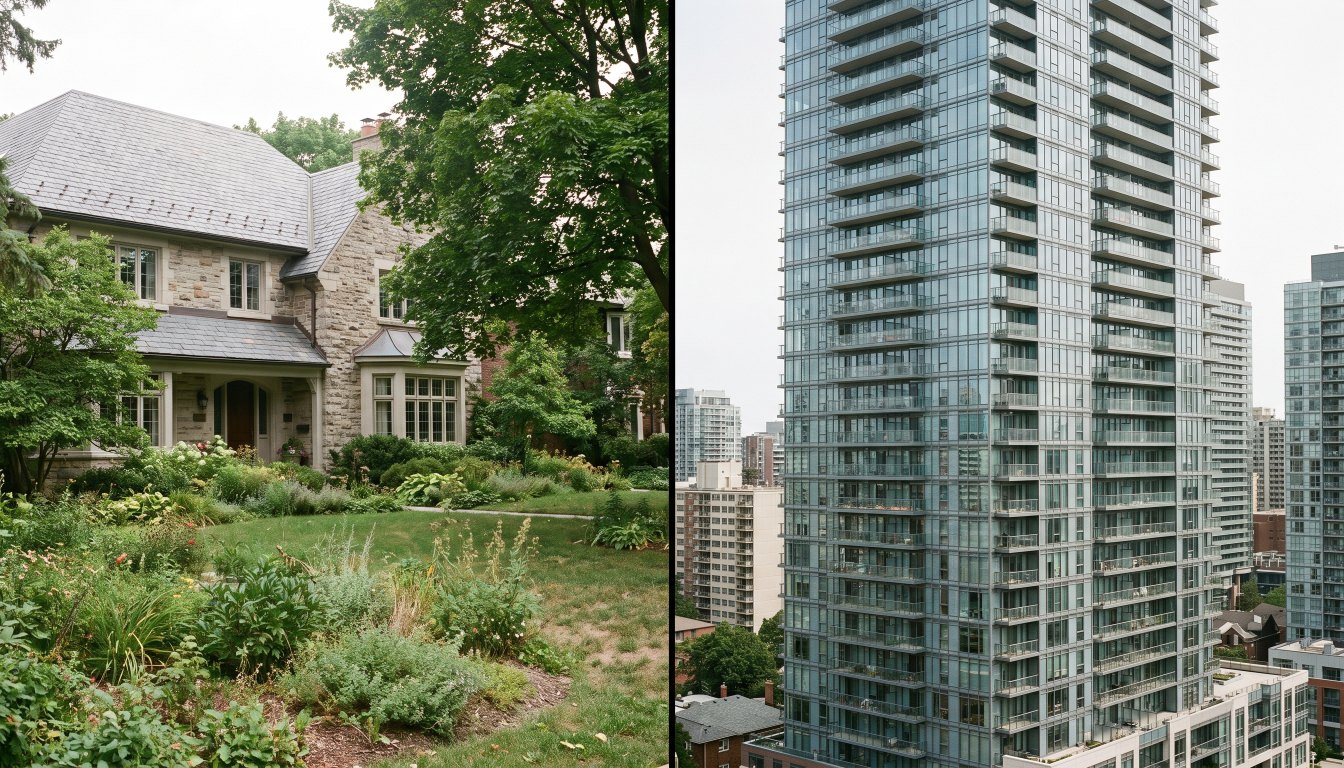
At the same price they are different assets, not different flavours of the same one. A house buys you land in fixed supply and full control, with all the maintenance and all the risk. A condominium buys you a share of a corporation and none of the land, with predictable costs, professional management, and exposure to how well that corporation is run.
Land transfer tax is identical on both. What differs is everything after closing: the condominium’s fees are visible and levelled, the house’s costs are invisible and lumpy, and the condominium carries a risk the house does not — a special assessment decided by people other than you.
Side by side at $3 million
| Luxury house | Luxury condominium | |
|---|---|---|
| What you own | Land and the building on it | A unit plus a share of the common elements |
| Land transfer tax on closing | Identical: $61,475 Ontario + $61,475 Toronto = $122,950 | |
| Fixed supply of what you own | The lot — permanently fixed | The building — fixed only if the location and building are genuinely scarce |
| Monthly costs | Invisible and lumpy | Visible, levelled, and includes reserve saving |
| Who decides on major repairs | You | The board and the owners |
| Main downside risk | Deferred maintenance you did not budget for | A special assessment you did not vote for |
| Regulatory burden | Ravine, tree, heritage and zoning rules apply to you directly | Handled at the corporation level |
| Ability to change things | Whatever the bylaws permit | Whatever the declaration, rules and board permit |
| Outdoor space | Yours, and your responsibility | A terrace, often an exclusive-use common element |
| Liquidity | Thin above $3M | Very thin above $3M |
The land argument, stated fairly
The strongest case for a house is that you own land whose supply cannot increase. The Bridle Path was subdivided into roughly fifty two-acre-minimum lots in the 1950s; Rosedale’s ravine lots are protected by the City’s ravine bylaw and by TRCA regulation; heritage district plans control what can replace the houses around you. That is genuine, durable scarcity, and the building on top of it is the depreciating part.
The honest counter-argument: a condominium in a genuinely scarce building has its own version of that. Four units sold above $5 million in the Toronto core in four months of 2026, and the buildings that produce those sales are not being replicated. What is not scarce is the ordinary investor unit — and Q1 2026 proved it, with a record 4,295 completed unsold units.
The costs argument, stated fairly
Condominium fees look alarming next to a house’s apparent zero. That comparison is false. The fee includes heating and cooling, water, building insurance, staffing, management and the reserve fund contribution. A house owner pays every one of those categories — the difference is that nobody sends them a monthly statement, and almost nobody saves for the roof.
The genuine cost difference is at the extremes: a full-service building with 24-hour concierge, valet and staffed amenities, divided among a small number of units, is expensive in a way that no house maintenance budget matches. That is a service purchase, and it is fair to call it one.
Where each one clearly wins
The house wins when you want control, outdoor space, a long horizon, room for a family that is still growing, and a specific piece of land you cannot get any other way.
The condominium wins when you travel, when you want the building to handle the building, when lock-and-leave security matters, when a single floor plate suits how you actually live, and when the location is one where no house exists at any price.
The practical takeaway
Do not choose between them on price per square foot or on monthly cost. Choose on two questions: how much of what you are buying is genuinely scarce, and how much maintenance and regulatory work you actually want to do. Everything else follows from those two answers.
Frequently asked questions
Is land transfer tax different for a condo?
No. Ontario and Toronto land transfer tax apply the same way to a condominium as to a house. At $3,000,000 that is $61,475 provincially and $61,475 municipally, for a combined $122,950 payable on closing.
Which holds value better in Toronto?
Land is the part of a property whose supply is fixed, and a house owner owns it directly. That is the structural argument for houses over long periods. The counter-argument is that a well-located condominium in a scarce building has its own fixed supply, and requires none of the maintenance.
Are condo fees really more expensive than house maintenance?
Not necessarily — they are more visible. A condominium fee includes heating, cooling, water, insurance on the common elements, staffing and, importantly, the reserve fund contribution for future major repairs. A house owner pays the same categories of cost, just unpredictably and often without saving for them.
Which is more liquid?
Both are illiquid at the top end. There were roughly 300 GTA sales above $3 million in four months of 2026, and only four condominium sales above $5 million in the Toronto core in that window. Neither should be treated as a short-horizon asset.
What risk does a condo carry that a house does not?
A special assessment. Decisions about major repairs are made by the corporation, not by you, and if the reserve fund is inadequate the cost is levied on owners. That risk is manageable and knowable — it is why the reserve fund study in the status certificate matters so much — but it exists.
What risk does a house carry that a condo does not?
Everything is yours. Roof, envelope, mechanical plant, drainage, trees, grading and the regulatory obligations that come with them — ravine permits, tree permits, heritage permits. Nobody budgets it for you and nobody schedules it for you.
Thinking about buying or selling at the top end?
Send me the address, or the shortlist you are considering. I will tell you what the property is actually worth today, what the land is worth without the house, what the transfer tax and carrying costs will be, and whether the deal makes sense. Confidential, always.
[email protected] · 833-330-1925 · Book a free consultation
Confidential. Read personally and answered within 24 hours. I never share, sell or distribute your information.
Related reading
- Buying a luxury condo in Toronto: the 2026 buyer’s guide
- Buying a luxury house in Toronto: the complete 2026 guide
- Downsizing from a Toronto luxury home: the math most people get wrong
- Why luxury condo maintenance fees are so high
Sources
Everything above that is a rule, a rate or a published number comes from these. Verify anything that matters to your own deal.
- Toronto Regional Real Estate Board — Market Watch, August 2026
- RE/MAX Canada — 2026 Spotlight on Luxury Real Estate, Greater Toronto
- Real Estate Magazine — Q1 2026 condominium market (Urbanation data)
- City of Toronto — Municipal Land Transfer Tax rates and fees
About the author — Jatin Dua, Broker of Record
I’m the Broker of Record at RE/MAX Quantum Realty, 799 The Queensway in Etobicoke, and I work with buyers, sellers and investors across Toronto and the west GTA. A large part of my work sits in the upper end of the market, where the comparables are thin, the rules are heavier and the cost of a wrong number is measured in hundreds of thousands of dollars.
The free estimators on this site are mine. I built them because the first question every owner asks is “what is it worth?” and the honest answer starts with a number you can check yourself. [email protected] or 833-330-1925.