
Published 2 November 2026 · By Jatin Dua, Broker of Record, RE/MAX Quantum Realty
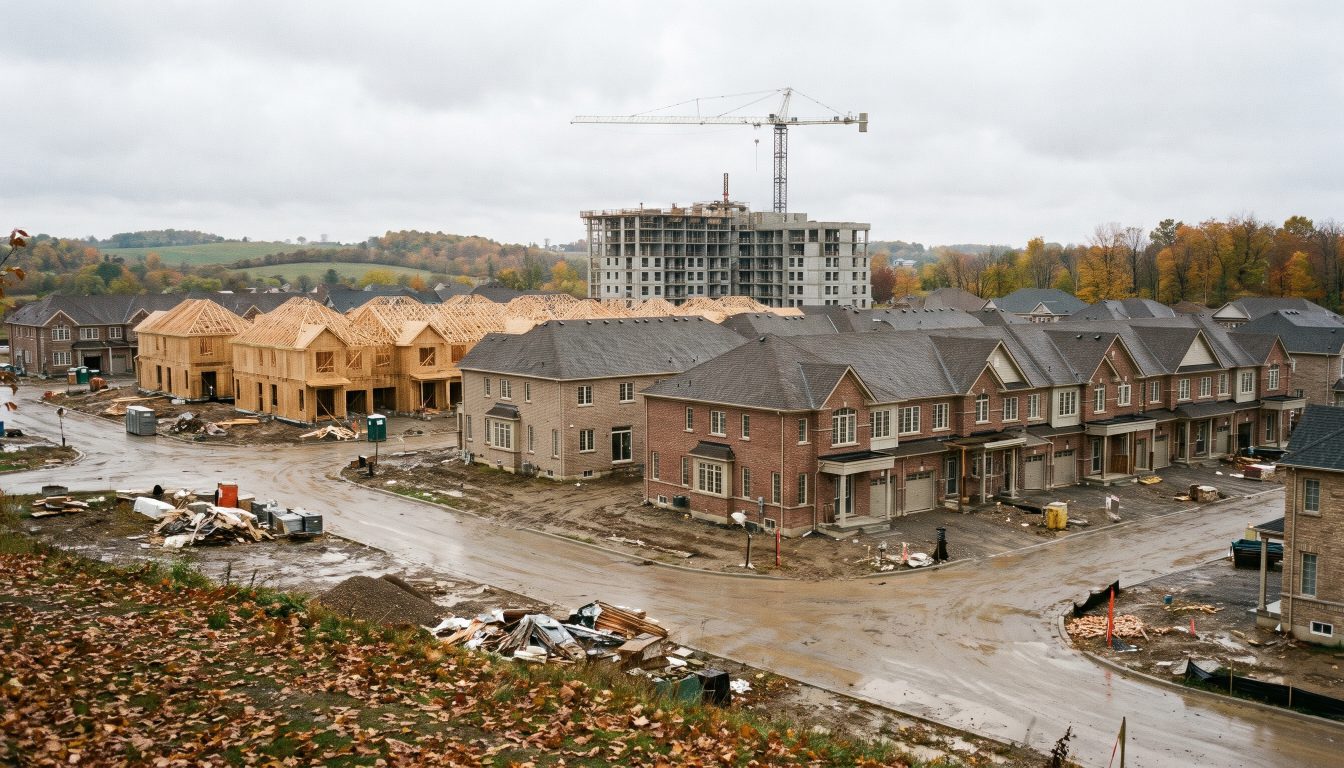
Toronto started the most new homes in 2025, with 10,517 housing starts, followed by Milton (2,323), Mississauga (2,111), Markham (2,005) and Oakville (1,559), based on CMHC data in the April 2026 RESCON report card. Milton built the most for its size, and these homes will be finishing through 2026 and 2027.
This guide is for buyers weighing a new home against a resale, and for owners who want to know how much new supply is coming to their city. You get the five GTA cities that started the most new homes in 2025, which are the homes that will be finishing through 2026 and 2027, what kind of homes they are, and what that means for prices and choice.
Where are the most new homes being built in the GTA?
Toronto started the most new homes by far in 2025, with 10,517 housing starts. Milton was a clear second with 2,323, ahead of much larger Mississauga (2,111), Markham (2,005) and Oakville (1,559). These figures come from CMHC’s Starts and Completions Survey, as published in the Missing Middle Initiative and RESCON 2025 GTA housing report card in April 2026.
| City | 2025 starts | 2021–24 yearly average | Change | Starts per 1,000 residents |
|---|---|---|---|---|
| 1. Toronto | 10,517 | 21,939 | -52% | 3.2 |
| 2. Milton | 2,323 | 1,227 | +89% | 14.8 |
| 3. Mississauga | 2,111 | 3,477 | -39% | 2.8 |
| 4. Markham | 2,005 | 1,932 | +4% | 5.4 |
| 5. Oakville | 1,559 | 2,496 | -38% | 6.4 |
| Richmond Hill | 1,470 | 1,117 | +32% | 6.6 |
| Brampton | 1,368 | 2,300 | -41% | 1.8 |
| Pickering | 1,135 | 1,297 | -12% | 9.6 |
| Vaughan | 966 | 3,458 | -72% | 2.7 |
Source: CMHC Starts and Completions Survey via Missing Middle Initiative and RESCON, 2025 GTA and GGH Final Housing Report Card (April 2026); 2021–24 average is the sum of the report’s averages by home type. Per-1,000 figures use Statistics Canada population estimates for 1 July 2025.
The big story is the slowdown. The report found starts across the 34 Ontario municipalities it tracks were down 34% in 2025, and pre-construction condo sales were down 89% from their 2021–24 average. Only a few GTA cities built more than their recent average, including Milton, Newmarket, Halton Hills, Richmond Hill, Markham and Burlington.
How did I measure which cities are building the most?
A housing start is counted when construction begins on a new home. I used 2025 starts because they are the latest full year of data and they become the homes that finish and come to market over the next one to three years. Houses and townhouses usually finish sooner; apartment buildings take longer.
I ranked by the total number of starts, then added starts per 1,000 residents so smaller cities are not hidden. Ontario also tracks each city against its housing target, but its count adds basement and garden suites, long-term care beds, student beds and retirement suites, and its latest published year is 2024. I use it below as a second check.
1. Toronto: 10,517 starts, mostly rentals
Toronto still builds more homes than the next four cities combined, but its 2025 starts were less than half of its 2021–24 average. The mix changed too. Purpose-built rental apartments made up 6,738 starts, condo apartments 2,974 and ground-oriented homes (houses, semis and townhouses) 805.
Condo starts fell 81% from the recent average. CMHC said in February 2026 that condo starts would be especially weak in Toronto, where pre-construction sales fell to multi-decade lows in 2025.
What it means: renters will see more new purpose-built buildings. Condo buyers will see fewer new launches, but many towers started in earlier years are still finishing. For the current state of new projects, see my fall 2026 GTA pre-construction report.
2. Milton: building the most for its size
Milton started 2,323 homes in 2025, 89% more than its 2021–24 average and about 15 for every 1,000 residents, the highest rate in the table. It was the only GTA municipality in the report card to start more homes than its target, and it also exceeded Ontario’s target for 2024.
The growth is going vertical. Condo apartment starts tripled to 1,470, from an average of 473, while 853 ground-oriented homes were started. Milton’s population grew from about 138,900 in 2021 to 157,300 in 2025, according to Statistics Canada estimates.
What it means: Milton buyers will have more new condos to choose from. Resale detached homes sold at a median of $1,130,000 from January to October 2026, down 6.6% (TRREB MLS data via REALM).
3. Mississauga: fewer condos, more rentals
Mississauga started 2,111 homes in 2025, down 39% from its average. Condo apartment starts fell to 1,218 from an average of 2,906, while purpose-built rental starts rose to 720 from 238. Only 173 ground-oriented homes were started.
Mississauga has Ontario’s third-largest ten-year target, 120,000 homes, after Toronto and Ottawa. In 2024 it reached 35% of that year’s provincial target, according to Ontario’s housing supply data. For resale prices and trends, see my Mississauga housing market outlook.
Instant Home Valuation
What’s your home
worth today?
Answer six quick questions and get an instant value range built from current Toronto & GTA sale data — property type, size, condition, lot and location all weighted the way a real pricing conversation weighs them. Takes about ninety seconds.
Reading recent GTA sale data…
Building your estimate
Estimated market value
—
$0–$0
Most likely value $0 · roughly $0 per square foot
What moved the number
Starting from the area baseline for your property type, here’s what each answer added or subtracted.
Market context
Recent local averages for comparison.
—
A range is a starting point.
A strategy is what sells.
This model doesn’t know that your neighbour’s identical semi went $80,000 over asking last month, or which two upgrades actually pay back in your area. That conversation is free and takes twenty minutes.
4. Markham: steady, with a half-and-half mix
Markham was one of the few large cities to hold its pace. It started 2,005 homes in 2025, 4% above its 2021–24 average, split almost evenly between 1,001 ground-oriented homes and 1,004 condo apartments.
Markham’s 1,001 ground-oriented starts were second only to Richmond Hill’s 1,015 in the GTA, and more than Toronto’s 805. Resale freehold townhouses in Markham sold at a median of $999,990 from January to October 2026, down 10.9%, so new and resale townhouses are competing for the same buyers.
5. Oakville: rentals rising
Oakville started 1,559 homes in 2025, down 38% from its average. The mix shifted: 600 purpose-built rental starts, against an average of 90, plus 591 ground-oriented homes and 368 condo apartments.
Oakville did better on Ontario’s 2024 count, reaching 134% of its target with 3,679 homes. The gap between the two measures shows how much can change in one year, and how the provincial count includes more than new-build starts.
On the resale side, Oakville’s detached prices held up better than most of the GTA, with a median of $1,625,000 from January to October 2026, down 3.0% (TRREB MLS data via REALM). New rentals add choice for tenants but do not compete directly with that market.
Just missing the list: Richmond Hill started 1,470 homes, 32% above its average, and led the GTA in new houses and townhouses. Pickering started 1,135, about 10 per 1,000 residents, the second-highest rate after Milton.
Which GTA cities are falling furthest behind?
Several fast-growing suburbs started far fewer homes in 2025 than their recent average:
- East Gwillimbury: 92 starts, down 74%.
- Vaughan: 966 starts, down 72%, with condo starts falling to 850 from an average of 2,448.
- Whitby: 324 starts, down 70%.
- Oshawa: 371 starts, down 68%.
- Brampton: 1,368 starts, down 41%, about 12% of its share of the target.
Brampton looks different on Ontario’s 2024 count, with 5,791 homes, because that count includes additional residential units such as basement apartments. Several of these cities were also among the fastest growing; see my list of the fastest-growing GTA cities.
Will the GTA build more homes in 2027?
Only a little more, if CMHC is right. Its July 2026 outlook for the Toronto census metropolitan area, which covers Toronto and most of the surrounding GTA but not the Oshawa area, shows:
- 37,718 starts in 2024 and 26,087 in 2025.
- A baseline forecast of 26,400 in 2026 and 28,600 in 2027.
- Ground-oriented starts rising to about 8,600 in 2027, from 7,101 in 2025.
CMHC’s February 2026 outlook said Ontario starts would fall to near two-decade lows in 2026 because of very low pre-construction condo sales. These are forecasts, not guarantees.
What does all this building mean for buyers and sellers?
For buyers, two things help in 2027. First, new homes started in 2023 to 2025 keep finishing, which adds choice, especially for condos and rentals. Second, Ontario’s enhanced new housing rebate covers the 8% provincial part of HST, up to $80,000, on new homes bought from a builder with agreements signed between 1 April 2026 and 31 March 2027, and Ontario’s New Home Affordability Payment can cover up to $50,000 of the federal part. Read my guide to the $130,000 new home HST rebate, and confirm your eligibility with your lawyer.
For resale sellers, new supply is competition. Where builders are offering rebates on new townhouses, a resale townhouse has to be priced to compete.
A high number of starts does not mean every project will finish on time. Pre-construction sales fell sharply in 2025, and builders can delay or cancel projects that do not sell. Before you sign for a new home, read the agreement’s cancellation and delay terms with a lawyer, and check the builder’s record with Tarion.
Milton and Markham are where I expect the most new ground-level and condo choice to show up in 2027, and Toronto is where new rentals will show up. If you are buying, compare a new home after the HST rebate with a resale home in the same area, because the gap may be smaller than you think. If you are selling a resale home near a big new subdivision, price for that competition from day one.
What to do next
- Check how many homes your city started in 2025 and what type they were, using the table above.
- If you are buying new, ask your lawyer whether you qualify for the Ontario rebate before the 31 March 2027 deadline.
- Compare one new-build price with three recent resale sales nearby.
- Get your current home’s value with the tool above if you plan to sell first.
- Book a call to compare a new-build and a resale option side by side.
Need help with this? Talk to me.
I’m Jatin Dua, Broker of Record at RE/MAX Quantum Realty, and I’m the best agent to do this kind of work for you in Toronto and across the GTA. Over $100 million in GTA sales and 100+ families helped sell. Feel free to contact me any time: call or text 833-330-1925 or email [email protected].
Frequently asked questions
Which GTA city is building the most new homes?
Toronto started the most, with 10,517 housing starts in 2025, according to CMHC data in the Missing Middle Initiative and RESCON report card. Milton was second with 2,323, followed by Mississauga (2,111), Markham (2,005) and Oakville (1,559). For its size, Milton built the most: about 15 starts per 1,000 residents.
How many housing starts were there in the GTA in 2025?
In the Toronto census metropolitan area, CMHC counted 26,087 housing starts in 2025, down from 37,718 in 2024. That area covers Toronto and most of Peel, York and Halton but not Durham’s Oshawa area. CMHC’s July 2026 baseline forecast is 26,400 starts in 2026 and 28,600 in 2027.
Why are housing starts down in Toronto?
Mainly because pre-construction condo sales collapsed. Toronto’s condo apartment starts fell to 2,974 in 2025 from a 2021–24 average of 15,540, according to the Missing Middle Initiative and RESCON report card. CMHC said pre-construction sales fell to multi-decade lows in 2025. Purpose-built rental starts rose to 6,738 and kept total starts above 10,000.
Is Milton growing fast?
Yes. Milton started 2,323 new homes in 2025, 89% above its 2021–24 average and about 15 per 1,000 residents, the highest rate among large GTA cities, based on CMHC data in the RESCON report card. Its population rose from about 138,900 in 2021 to 157,300 in 2025, according to Statistics Canada.
Which GTA cities met their housing targets?
In Ontario’s 2024 data, Oakville (134%), Milton (129%) and Pickering (174%) exceeded their annual targets, and Toronto was on track at 88%. Mississauga reached 35% and Brampton 62%. Ontario’s count includes starts, basement and garden suites, long-term care beds and other homes. Data for 2025 was not posted as of November 2026.
Where are new houses being built in the GTA, not condos?
Markham and Richmond Hill led for ground-oriented homes among large cities in 2025, with 1,001 and 1,015 starts of houses, semis and townhouses, according to the Missing Middle Initiative and RESCON report card. Milton started 853, Toronto 805, Brampton 705 and Oakville 591. Vaughan started only 116.
Will there be more new homes for sale in the GTA in 2027?
Somewhat. CMHC’s July 2026 baseline forecast has Toronto-area starts rising to 28,600 in 2027 from 26,087 in 2025, with ground-oriented starts climbing to about 8,600. Homes started in 2023 to 2025 will also keep finishing. Forecasts can change with interest rates and pre-construction sales.
Can I get the HST rebate on a new home in Ontario in 2027?
Yes, if you sign with a builder by 31 March 2027 and meet the conditions. Ontario’s enhanced new housing rebate covers the 8% provincial part of HST up to $80,000 for agreements from 1 April 2026 to 31 March 2027, with a partial rebate up to $1.85 million. Confirm eligibility with your lawyer.
Does new home construction lower house prices in the GTA?
It can add competition, but it is one factor among many. In 2026, resale prices fell across the GTA while starts were low, mainly because of weak demand, economic uncertainty and borrowing costs, according to TRREB and CMHC. More completions add choice for buyers, especially in condos and rentals, which can limit price gains locally.
Sources
- Missing Middle Initiative and RESCON: 2025 GTA and GGH Final Housing Report Card (April 2026)
- Ontario: Tracking housing supply progress
- Ontario Data Catalogue: Ontario’s housing supply progress
- CMHC: Summer Update, 2026 Housing Market Outlook
- CMHC: Housing Market Outlook 2026
- CRA Notice 346: Ontario enhanced new housing rebate
- Statistics Canada Table 17-10-0155-01: Population estimates, census subdivisions
- TRREB Market Watch, October 2026
Related reading
- Top 5 Best Neighbourhoods to Live in Mississauga in 2027
- Top 5 Best Neighbourhoods to Live in Brampton in 2027
- Top 5 Best Neighbourhoods to Live in Markham in 2027
- Top 5 Best Neighbourhoods to Live in Oakville in 2027
About the author — Jatin Dua, Toronto and GTA real estate broker
I am Jatin Dua, Broker of Record and co-founder of RE/MAX Quantum Realty Inc., Brokerage, Unit 101, 799 The Queensway, Toronto. I work with buyers and sellers across Toronto and the GTA and have helped more than 100 families sell. Four-plus years of active GTA transactions and over $100 million in sales volume.
Reach me at [email protected] or 833-330-1925, or book a call.