
Published 18 October 2026 · By Jatin Dua, Broker of Record, RE/MAX Quantum Realty
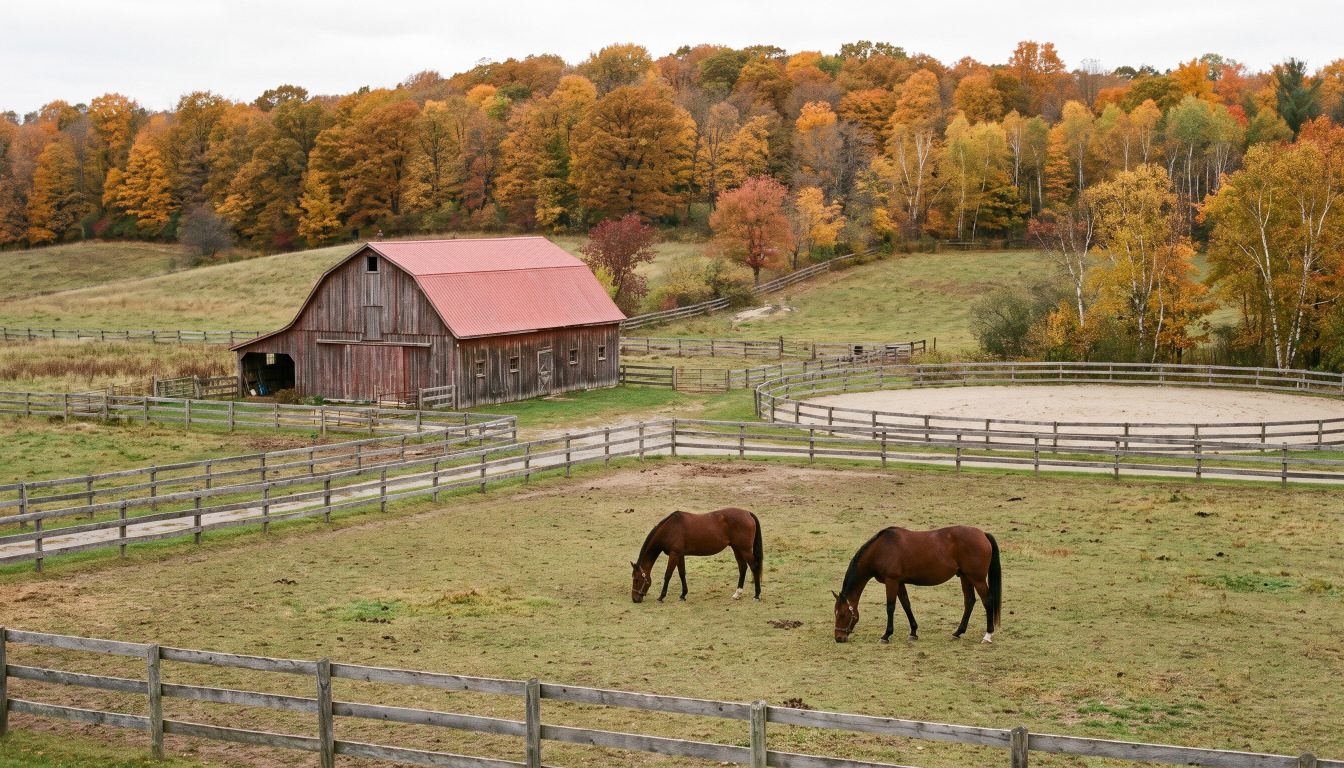
The main areas for horse farms near Toronto are Caledon (especially around Palgrave and Caledon Equestrian Park), King Township, Whitchurch-Stouffville and Uxbridge, with Mono and Halton Hills just outside. Caledon and nearby Erin suit show riders, Stouffville and Uxbridge suit trail riders through the York and Durham regional forests, and King is the shortest commute. Most of it sits under the Greenbelt, Moraine or Escarpment plans, so buy permitted barns that already exist. Farm tax requires an Agricorp application and at least $7,000 in gross farm income, and more than 5 nutrient units (6 riding horses) triggers a Nutrient Management Strategy before any new barn permit.
Tell me how many horses, how many acres and how you ride, and I will send you horse properties near Toronto that fit.
Where do horse people actually buy around Toronto?
When buyers ask me for a horse property within reach of the city, the conversation almost always lands on the same northern arc: Caledon on the west, King Township in the middle, Whitchurch-Stouffville and Uxbridge on the east, with Mono and Halton Hills as the edges. What ties them together: land still zoned and taxed for agriculture, trails you can legally ride, and a show or lesson barn within trailering distance.
Most of this arc sits under the Oak Ridges Moraine, Niagara Escarpment or Greenbelt plans, which decide whether you can sever a lot, add an arena or build a second dwelling. I work across Toronto and the whole GTA, including rural and estate property, and this is the list I walk buyers through before we look at a single farm.
Which GTA areas suit a horse property? (comparison table)
| Area | Why horse people buy here | Verified venues and trails nearby | Main provincial plan to check | Best for |
|---|---|---|---|---|
| Caledon (Palgrave, Caledon East, Terra Cotta) | Rolling moraine and escarpment land, a long riding culture, and a major show park in the town itself | Caledon Equestrian Park, Palgrave (2015 Pan Am Games venue); Caledon Trailway (horseback riding permitted); Palgrave Forest off Hwy 50 | Oak Ridges Moraine, Niagara Escarpment, Greenbelt | Show jumpers and hunter riders who want to compete close to home |
| King Township (King City, Schomberg, Nobleton, Snowball) | Closest true farm country to Toronto, with established boarding and lesson barns | Toronto Equestrian North on Dufferin Street, Snowball (moved here October 2025); York Regional Forest tracts at Happy Valley and Nobleton | Oak Ridges Moraine, Greenbelt | Commuters to Toronto, families with riding kids |
| Whitchurch-Stouffville (Ballantrae, Vandorf, Bloomington) | The largest concentration of York Regional Forest tracts, all open to horses | York Regional Forest: 13 tracts in the town, including Eldred King Woodlands, Hall, Porritt and North tracts | Oak Ridges Moraine, Greenbelt | Trail and pleasure riders |
| Uxbridge | Calls itself the Trail Capital of Canada, with over 300 km of trails; larger lots for the money than York Region | Durham Regional Forest (16+ km of marked loops, horseback riding listed); Brookdale Trail; The Pickering Horse Centre, 3800 Paddock Rd, Claremont, to the south | Oak Ridges Moraine, Greenbelt | Trail riders, breeders, retirement herds |
| Mono / Hockley Valley (Dufferin, just outside the GTA) | Escarpment scenery, larger acreages, a historic eventing community | Will O’ Wind Farm, Mono (Pan Am 2015 cross-country venue; stopped hosting competitions in 2023); Toronto and North York Hunt kennels in nearby Mulmur | Niagara Escarpment | Eventers, hunt followers, buyers wanting 50+ acres |
| Halton Hills / Milton | West-side access via the 401 and 407, escarpment land, established show heritage | Halton Place, 9328 15th Sideroad, Halton Hills (show jumping venue on a 200-acre property; confirm its current season); Angelstone, 8720 Wellington Rd 50, Erin, just to the north | Niagara Escarpment, Greenbelt | Buyers working toward Mississauga, Oakville or the airport |
Venue details are as at 2026; check each venue directly before relying on it.
Caledon: why is Palgrave the centre of GTA horse country?
Caledon Equestrian Park is in the village of Palgrave. It hosted the equestrian events of the 2015 Pan American Games, with only the eventing cross-country phase held off site, and it has hosted selection trials for Canada’s show jumping and dressage teams. In spring 2021 the Angelstone group, whose home venue is in Erin, bought the park and planned to run the two venues as a circuit. Equestrian Canada’s 2026 medal hosting list shows a full season there, including the CSIO3* Nations Cup of Caledon.
A farm near Palgrave has a real resale audience: riders who compete there all summer. Riders who hack out have the Caledon Trailway, where the Town lists horseback riding, and Palgrave Forest on Highway 50 just north of the village.
Caledon East and Palgrave sit on the Oak Ridges Moraine; the moraine plan names the “Palgrave Estates Community” as a specific exception to its lot creation rules. West Caledon around Terra Cotta sits under the Niagara Escarpment Plan.
King Township and Whitchurch-Stouffville: commute and trails
King is where most of my Toronto clients start: the shortest drive to proper acreage. It is largely Oak Ridges Moraine and Greenbelt, which keeps it open but limits what you can add later.
Toronto Equestrian moved its North riding school from Claremont to King Township on 1 October 2025, to a farm on Dufferin Street near Snowball with a 30-stall barn, a large indoor arena, an outdoor sand ring and hacking trails. And York Region confirms that horses are allowed on all trails in the York Regional Forest, including the Happy Valley Forest and Nobleton tracts in King. Stay on designated trails; the Region lists no designated trailer parking.
Stouffville’s draw is simple. York Region lists 13 York Regional Forest tracts in the town, among them Clarke, Dainty, Eldred King Woodlands, Hall, Hollidge, Porritt and the North Tract, and says bikes and horses are allowed on all forest trails. A farm north of Stouffville Road can put you within a short haul of several tracts.
The trade-off: outside its settlement areas the town is moraine and Greenbelt, so buy for what the property already has, not what you hope to build.
Uxbridge: the trail capital, and more land for the money
The Township of Uxbridge describes itself as the Trail Capital of Canada, with over 300 kilometres of trails. It lists the 3.7 km Brookdale Trail for horseback riding. The Durham Regional Forest, on the moraine in Uxbridge and managed by the Lake Simcoe Region Conservation Authority, has more than 16 kilometres of marked loops and lists horseback riding as an activity, with pedestrians yielding to riders.
For lessons and shows, The Pickering Horse Centre at 3800 Paddock Road, Claremont, runs lessons, camps and horse shows, south of Uxbridge. Uxbridge buyers usually trade a longer commute for more acreage.
Mono, Halton Hills and Milton: the edges of the arc
Mono, in Dufferin County, is not GTA, but it is on almost every horse buyer’s list. Will O’ Wind Farm in Mono, opened by Ann and Geoff Morgan in 1979, hosted the cross-country phase of eventing at the 2015 Pan Am Games. In October 2023 the owners announced it would stop organizing competitions as they retire, so do not count on it as a local show venue. The Toronto and North York Hunt, founded in 1843, keeps its kennels and stables in the hills of Mulmur, a short drive north.
Much of Mono and the Hockley Valley is escarpment land (the NEC lists Mono Centre as a Minor Urban Centre), so expect an NEC permit conversation for new buildings.
Halton Hills has the longest show history of the west-side areas. Halton Place, at 9328 15th Sideroad, is a show jumping facility on a 200-acre property with hunter and jumper rings and grass and sand Grand Prix arenas. In March 2011 Halton Place cancelled its three-week Canadian Country Classic for 2012 citing “an ongoing dispute with the Niagara Escarpment Commission.” If an escarpment rule can stop a major show, it can stop a private arena.
Angelstone, a 100-acre show jumping venue with five rings at 8720 Wellington Road 50 in Erin, is just north of Halton Hills. In Milton, horse buyers look at the escarpment lands around Campbellville, which the NEC lists as a Minor Urban Centre.
What do the Greenbelt, Oak Ridges Moraine and Niagara Escarpment rules mean for a horse farm?
Greenbelt Plan. In the Protected Countryside, the plan says lot creation “is discouraged” and lists narrow exceptions. New agricultural lots must be at least 40 hectares (100 acres) in prime agricultural areas and 16 hectares (40 acres) in specialty crop areas (policy 4.6.1.2). Non-agricultural uses are not permitted in prime agricultural areas except as the plan allows (policy 4.1.1.1). Do not buy a 50-acre farm planning to sever a lot.
Oak Ridges Moraine Conservation Plan. The plan divides the moraine into Natural Core, Natural Linkage, Countryside and Settlement areas. In Natural Core areas only existing uses, agricultural uses and very restricted new resource management are allowed, and lot creation is very restrictive across the three rural designations.
Niagara Escarpment Plan. Inside the Area of Development Control you need a Niagara Escarpment Commission development permit for many types of development. You check your property on the NEC’s interactive map. Agricultural use, including on-farm buildings and livestock facilities, is permitted in the Escarpment Protection and Rural areas, subject to development criteria. I read what you can build on Greenbelt and moraine land with every buyer in these areas.
Conservation authorities add one more layer. Most of these farms have a creek, wetland or valley somewhere, and regulated land needs its own permit. See conservation authority regulated land in the west GTA.
Will my horse farm be taxed as a farm?
Not automatically. MPAC says farm properties are classified in the residential tax class by default. To move your farmland and outbuildings into the farm class, you apply to Agricorp under the Farm Property Class Tax Rate Program. If you qualify, farmland is taxed at no more than 25% of the municipality’s residential rate. The house and the land used for it stay at the residential rate. MPAC says that where a farmer lives in the house, typically one acre around it is classified residential.
Agricorp’s eligibility rules, as at 2026, are that MPAC has assessed the property as farmland, it is actively farmed by you, a tenant farmer or both, it generates at least $7,000 in annual gross farm income reported to the Canada Revenue Agency, the farm business has a valid Farm Business Registration number, and the owners are Canadian citizens or permanent residents. A few personal horses do not make a farm, so get the seller’s tax bills and program status before you firm up.
MPAC values farmland on its productivity and farm buildings on replacement cost less depreciation, so a large arena can add assessment.
Do I need a building permit for a barn or riding arena?
Usually yes. Ontario’s farm building guidance says a building permit is normally required before construction or renovation, and that in most cases a farm building must be designed by a licensed architect or professional engineer to the National Farm Building Code. Smaller low-occupancy farm buildings under 600 m² and no more than three storeys are deemed to comply if built to Supplementary Standard SB-11.
Two provincial steps come before that permit for any barn that houses horses:
- Minimum Distance Separation (MDS). The province says an MDS calculation is required before a building permit can be approved for a livestock facility. Failing it means a slow, uncertain minor variance.
- Nutrient Management Strategy (NMS). Covered in the next section.
In the Escarpment area you may also need an NEC permit, and on regulated land a conservation authority permit. Ask for permits and final inspections on every existing barn and arena.
How does the Nutrient Management Act apply to horses?
Under the Nutrient Management Act, 2002 and O. Reg. 267/03, livestock are counted in nutrient units (NU). Ontario’s horse barn guidance sets these values:
- Small framed, such as a Shetland pony: 2 ponies = 1 NU
- Medium framed, such as a riding or pleasure horse: 1 horse = 1 NU
- Large framed, such as a Clydesdale or Belgian: 0.7 horses = 1 NU
Farms with more than 5 NU need an approved Nutrient Management Strategy before applying for a building permit for horse housing or manure storage. That is 6 riding horses, 11 small ponies or 4 draft horses. The municipality will ask for the ministry’s Record of Approval. A full Nutrient Management Plan is required at 300 NU or more, or where an NMS is needed and the farm is within 100 metres of a municipal well. The NMS covers manure volumes, siting relative to wells and surface water, and runoff. A manure pile beside the well is the first thing I flag on a showing.
Wells, septic and insurance: what else should I check?
A horse drinks a lot of water, and every one of these farms is on a private well. Ontario says owners are responsible for protecting their well, should test well water at least three times a year (with free bacteria testing kits from Public Health Ontario), and must use a licensed well contractor for construction, repair or abandonment under the Wells Regulation (Regulation 903). Old unused wells, common on farms, must be plugged and sealed properly. Ask for the well record.
My full checklist is in septic systems and wells explained for rural buyers, and the clause wording is in well and septic conditions in Ontario.
A standard home policy is written for a house, not a working farm. During your conditional period, get a written quote from an insurance broker for how you will use it: number of horses, whether you board others’ horses or teach lessons, and the barn’s age and wiring. Boarding and lessons usually mean commercial liability cover, and expect questions on wiring, heaters and hay storage.
My take
Buy the barn, the arena and the water that already exist with permits, not the ones you plan to build. On the moraine and the escarpment, a farm with a permitted indoor arena, a compliant manure set-up and a strong well is worth a real premium over a pretty field, because the rules can make the second one very hard to turn into the first. Pick the area by the riding you do: Palgrave and Erin for shows, Stouffville and Uxbridge for trails, King for the commute.
Watch out
Do not assume a listing’s “farm taxes” carry over to you. The reduced rate depends on the owner’s own farm business, FBR number and $7,000 of gross farm income. If you will not farm the land, your tax bill can rise sharply after closing. Also confirm that existing barns and arenas have building permits and, in the escarpment area, NEC permits. An unpermitted structure becomes your problem on closing day.
Due-diligence checklist for a horse property
| Check | What to ask for | Who confirms it |
|---|---|---|
| Provincial plan area | Is the land in the Greenbelt, Oak Ridges Moraine or Niagara Escarpment Area of Development Control, and which designation? | Municipal planning; NEC interactive map |
| Zoning | Zoning by-law category; whether boarding, lessons or events are permitted uses | Municipal zoning department |
| Building permits | Permits and final inspections for house, barn, arena and run-in sheds | Municipal building department |
| NEC permit | Development permits for any structures in the Escarpment area | Niagara Escarpment Commission |
| Conservation authority | Is any part regulated (creek, wetland, valley)? Any permits issued? | TRCA, CVC, LSRCA, NVCA or Conservation Halton |
| Nutrient management | Current NMS approval if more than 5 NU; manure storage location and runoff | Seller; ministry approval record |
| MDS | Can a new or expanded barn meet Minimum Distance Separation from neighbours? | Municipal planning |
| Farm tax class | Current tax bill, MPAC classification, whether in the farm program | MPAC; Agricorp; seller |
| Well | Well record, flow rate test, bacteria and chemical test results | Licensed well contractor; lab |
| Septic | Permit, age, location relative to paddocks and barn | Municipal or health unit records; inspector |
| Barn condition | Electrical, fire separation, roof, footing, water lines | Barn-experienced inspector; electrician |
| Insurance | Written quote for your intended use (private, boarding, lessons) | Insurance broker |
| Severance and lot rules | Can the lot be split or a second dwelling added? Usually no in the Greenbelt | Municipal planning; lawyer |
If you are buying bare land to build your own farm, start with what to check before buying land in Ontario.
Instant Home Valuation
What’s your home
worth today?
Answer six quick questions and get an instant value range built from current Toronto & GTA sale data — property type, size, condition, lot and location all weighted the way a real pricing conversation weighs them. Takes about ninety seconds.
Reading recent GTA sale data…
Building your estimate
Estimated market value
—
$0–$0
Most likely value $0 · roughly $0 per square foot
What moved the number
Starting from the area baseline for your property type, here’s what each answer added or subtracted.
Market context
Recent local averages for comparison.
—
A range is a starting point.
A strategy is what sells.
This model doesn’t know that your neighbour’s identical semi went $80,000 over asking last month, or which two upgrades actually pay back in your area. That conversation is free and takes twenty minutes.
Send me horse properties near Toronto
Tell me what you need and I will send matching farms and acreages across Caledon, King, Stouffville, Uxbridge and beyond.
I will come back to you personally, usually the same day. If it is urgent, call 833-330-1925.
Frequently asked questions
Where is the best place to buy a horse farm near Toronto?
It depends on how you ride. Caledon around Palgrave suits show riders because Caledon Equestrian Park is there, Whitchurch-Stouffville and Uxbridge suit trail riders because of the York and Durham regional forests, and King Township is the shortest commute to the city.
Do horses qualify a property for farm property tax in Ontario?
Only if the property is run as a farm business. Agricorp requires MPAC farmland assessment, active farming, at least $7,000 in annual gross farm income reported to CRA, a valid Farm Business Registration number and Canadian or permanent resident owners. Eligible farmland is taxed at no more than 25% of the residential rate, while the house stays residential.
How many horses trigger a Nutrient Management Strategy in Ontario?
More than 5 nutrient units triggers an approved NMS before a building permit for horse housing or manure storage. That is 6 medium-framed riding horses, 11 small ponies or 4 large draft horses. A full Nutrient Management Plan is needed at 300 nutrient units or more.
Do I need a building permit for a horse barn or riding arena?
Usually yes. Ontario says a building permit is normally needed, most farm buildings must be designed by an architect or engineer to the National Farm Building Code, and a Minimum Distance Separation calculation is needed before a livestock building permit is approved. In the Niagara Escarpment area you may also need an NEC development permit.
Can I sever a lot off a horse farm in the Greenbelt?
Rarely. The Greenbelt Plan says lot creation is discouraged in the Protected Countryside and requires new agricultural lots to be at least 40 hectares (100 acres) in prime agricultural areas. The Oak Ridges Moraine plan is also very restrictive, so value the farm as one parcel.
Can I ride on the trails in the York Regional Forest?
Yes. York Region says bikes and horses are allowed on all trails in the forest, provided riders stay on designated trails and park trailers considerately. Tracts are spread across Whitchurch-Stouffville, East Gwillimbury and King.
What should I test on a horse farm well?
Ask for the well record and a flow test, and test for bacteria and chemistry. Ontario recommends testing at least three times a year, offers free bacteria kits through Public Health Ontario, and requires a licensed contractor for well work. My rural well and septic guide has the full list.
Sources
- Government of Ontario — Farm property class tax rate program — 25% of residential rate; residence taxed residential; eligibility basics
- Agricorp — Farm Property Class Tax Rate Program: Are you eligible? — $7,000 gross farm income, FBR, ownership rules
- MPAC — Farms Fact Sheet — How farmland, the farm residence and one acre, and farm buildings are assessed
- Government of Ontario — Nutrient management strategies and horse barns — Horse nutrient units, 5 NU NMS trigger, 300 NU NMP threshold
- Government of Ontario — Building permit requirements to construct, expand or renovate farm buildings — NFBC, SB-11, MDS and NMS before permit
- Government of Ontario — Greenbelt Plan (2017): General policies for the Protected Countryside — Lot creation policies 4.6.1 and minimum lot sizes
- Government of Ontario — Oak Ridges Moraine Conservation Plan (2017) — Land use designations, lot creation, Palgrave Estates Community
- Niagara Escarpment Commission — Development permits — When an NEC development permit is needed
- Government of Ontario — Wells on your property — Well owner duties, testing, Regulation 903
- York Region — York Regional Forest — Horses allowed on all trails; tracts by municipality
Related reading
- Buying a rural lot: septic systems and wells explained
- Greenbelt and Oak Ridges Moraine land: what you can build
- Well and septic conditions in Ontario offers
- Conservation authority regulated land in the west GTA
- Severing a lot in Ontario: what consent costs and takes
About the author — Jatin Dua, Toronto and GTA real estate broker
I am Jatin Dua, Broker of Record and co-founder of RE/MAX Quantum Realty Inc., Brokerage, Unit 101, 799 The Queensway, Toronto. I work with buyers, sellers, investors and business owners across Toronto and the GTA. Four-plus years of active GTA transactions, over $100 million in sales volume and 100+ families helped sell. Every rule and fact here is linked to a source below, so you can check it without asking me.
Reach me at [email protected] or 833-330-1925, or book a call.