

Published 6 August 2026 · Updated 10 September 2026 · By Jatin Dua, Broker of Record, RE/MAX Quantum Realty
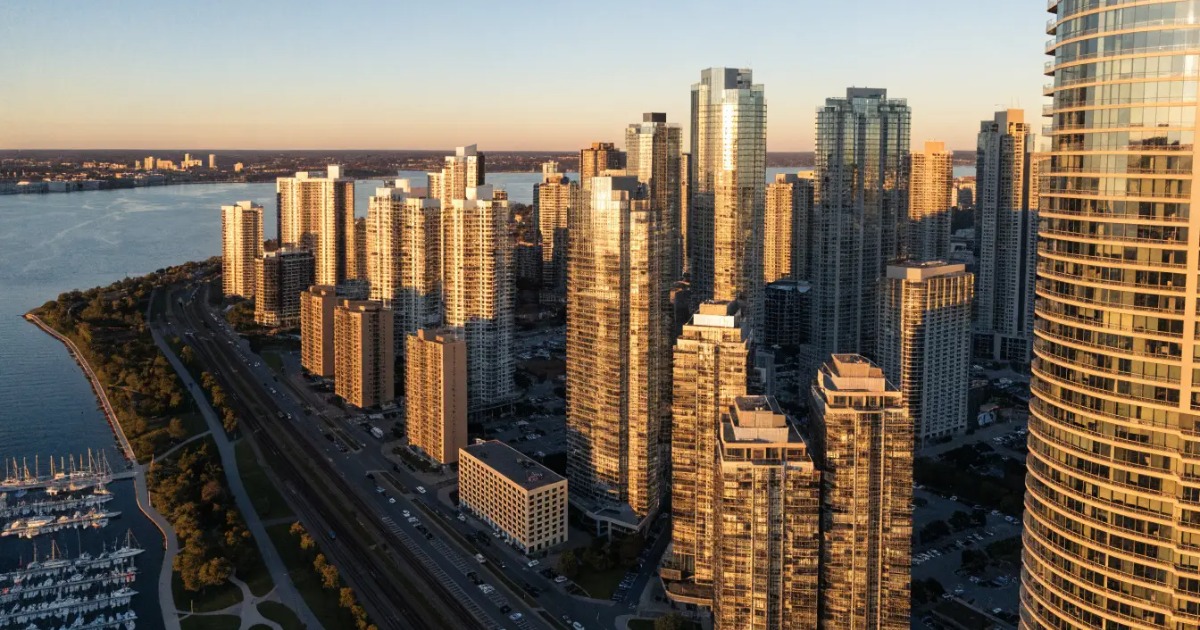
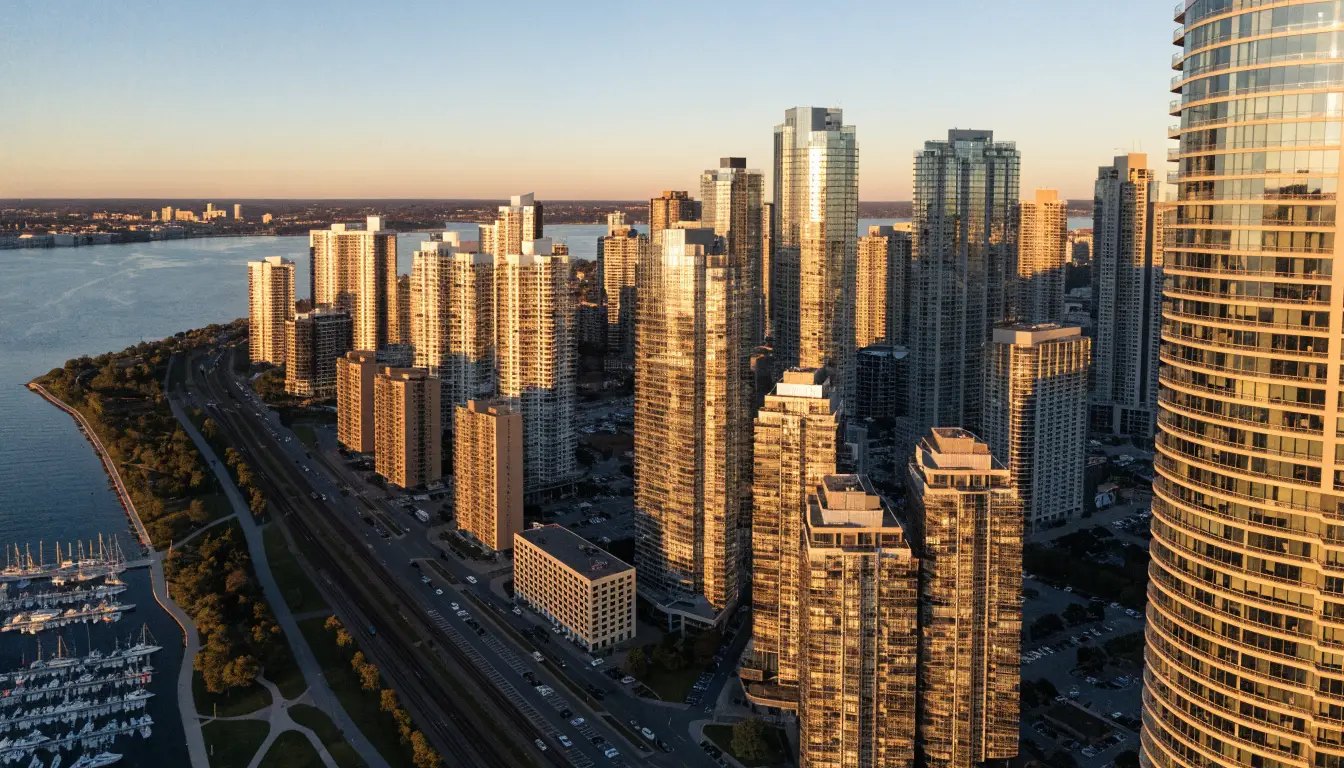
Roughly 22,600 people live here. There is no subway, no LRT and no GO station. Illustrative image.
What's Your Home Worth Right Now?
Get a free AI-powered price range for your property in under 90 seconds, based on recent GTA comparable sales. No name or address required.
Get My Free Estimate →Park Lawn GO Station is not funded by any government, is not under construction, and has no published opening date. It has been paused since 2025.
It is a developer-delivered station. Metrolinx’s own business case records the capital cost to government as $0 — a private developer was to build it at their own cost, and that developer has paused work while reviewing their plans.
Two further corrections to things you will read elsewhere: the Ontario Line does not serve Etobicoke (it ends at Exhibition, beside Liberty Village), and the $3 billion waterfront LRT funded in March 2026 goes east, to the Port Lands. Nothing is funded for Humber Bay.
If you own a condo in Humber Bay Shores, you have been told for the better part of a decade that a GO station is coming. If you are being shown a unit there now, an agent may well be telling you the same thing. I think you deserve the accurate version, because the gap between what is marketed and what is actually funded here is unusually wide — and it has real consequences for what you should pay.
Metrolinx has now named the party responsible, in writing. In a response published on 8 November 2025, Metrolinx stated that Park Lawn GO falls under the province’s Transit Oriented Communities programme, that the station “is being planned in partnership with Lakeshore Developments Inc. (LDI)”, that “LDI is responsible for the planning and construction of the station; timelines are at the discretion of the developer”, and that “earlier this year, Metrolinx was informed by the developer that they are pausing work as they review their development plans.”
Two further points as at 26 August 2026: the City site plan application for the station, file 22 213984 WET 03 SA, filed 6 October 2022, is still marked Under Review in the City’s register; and metrolinx.com currently has no project page for Park Lawn GO — four candidate URLs all return 404. I could not find archived snapshots of those URLs, so the accurate statement is that no page exists today, not that one was removed.
The transit problem is genuine and it is documented
Start with what is not in dispute. Humber Bay Shores is one of the most intensely developed neighbourhoods in Toronto and one of the worst served by rapid transit.
| Measure | Figure |
|---|---|
| Population (2021 Census, Mimico neighbourhood) | 22,605 |
| Occupied dwellings | 13,330 |
| In buildings of 5+ storeys | 12,250 — 91.9% |
| Single-detached houses | 15 |
| Population growth 2016–2021 | +20.2% — 5th fastest in Toronto |
| Rapid transit stations | Zero |
The City’s own Park Lawn Lake Shore Transportation Master Plan describes the service inventory bluntly: “two regular all-day TTC bus routes, #66 Prince Edward and #80 Queensway, two limited service routes (#176 and #508), and a Ten-minute Network route (#501).” No subway. No LRT. No GO station.
The same plan puts AM peak car use at 68.7% against 58.5% citywide, and walking and cycling at 0.8% against 10.8% citywide. GO Transit mode share: 0%.
Its 2041 “do nothing” modelling is worth quoting directly: operations “worsen dramatically, with a total of 52 critical movements and 5 critical intersections, up from 23 critical movements and 1 critical intersection”, and “the northbound congestion on Park Lawn Road results in failing movements at all intersections along the corridor.”
So where is the station?
Here is the honest chronology.
| Date | What happened |
|---|---|
| 2016 | Original business case concludes the station should not proceed |
| 2018 | Revised case performs better; Metrolinx CEO says Park Lawn’s benefit-cost ratio has risen “above any of the other stations” |
| 2020 | Updated business case: benefit-cost 1.50–1.93, capital cost $86M–$96M — borne by the developer |
| Feb 2022 | Environmental assessment process completed |
| Jul 2022 | City zoning ties the Christie’s site development to delivery of the station |
| 2025 | Developer pauses work amid the condo downturn |
| May 2026 | City staff report: still paused, community benefits agreement still unsigned |
The City of Toronto staff report of 27 May 2026 states it plainly: “The development application has been paused by the applicant. At the time of the writing of this report, the implementing Section 37 community benefits agreement has not been signed by the owner of the site.”
Metrolinx’s own business case: “Capital costs for the station in the Financial Case are $0 as it is being delivered by a third party developer at their own cost.”
And Metrolinx’s own risk assessment: “if the overall development is cancelled or delayed it could jeopardize implementation of the station… The consequence of these risks is a return to business as usual.”
Metrolinx confirmed in October 2025 that timelines are “at the discretion of the developer” and that the developer had informed them they were pausing work.
The station and the towers are locked together. City zoning made the Christie’s residential phases conditional on the station being delivered. The developer needs the station approved to build; the station needs the developer to build it. Both are currently stalled.
No government body has ever published an opening date. Any date you see quoted — 2024, 2026, 2027 — comes from obsolete developer or environmental-assessment material.
Thinking about buying or selling here?
I work this area every week and I will give you a straight answer, including when the answer is to wait. No pressure, and no drip campaign you cannot get out of.
Call or text 833-330-1925 Send me a message
Jatin Dua, Broker of Record — RE/MAX Quantum Realty Inc., Brokerage. Not intended to solicit buyers or sellers currently under contract with another brokerage.
Three more things I checked on 23 August 2026
I went back through the paperwork again in late August. Three details are worth adding, because none of them appear in the coverage you will find elsewhere.
The station has its own site plan application, and it has been open for nearly four years. The file is 22 213984 WET 03 SA in the City of Toronto’s Development Applications data. Its status has been Under Review since October 2022. A site plan application that has sat under review for that long is not a file that is about to break ground.
Metrolinx’s own project page for the station no longer resolves. When I checked it on 23 August 2026 it returned a 404. I am not going to tell you what that means — agencies restructure their websites all the time and a dead URL is not a cancellation. But if you are trying to check the status yourself and cannot find an official project page, that is why.
Responsibility for delivering Transit-Oriented Communities is moving to Infrastructure Ontario. Park Lawn GO was structured as a Transit-Oriented Communities project, in which a private landowner builds the station in exchange for development rights. That delivery model is transferring between provincial bodies. A change of owner mid-file is not by itself good or bad news, but it is one more reason not to treat any previously announced date as firm.
I am not going to give you a construction date, because no public document contains one. As of 23 August 2026 there is no confirmed funding and no construction start date for Park Lawn GO. Anyone who quotes you a year for this station is quoting a hope, not a source. If that changes I will update this page and date the change.
Two things you will read that are simply wrong
“The Ontario Line will serve Etobicoke”
It will not. The Ontario Line runs Exhibition to Don Valley, 15.6 km and 15 stations. Its western terminus, Exhibition Station, is in the old City of Toronto beside Liberty Village — roughly 7 km east of the Humber River. Metrolinx describes its west-end worksite as “located in Liberty Village.”
Tail tracks run west to Dufferin for train storage and a possible future extension. No western extension is announced, funded or under study.
The Ontario Line is genuinely under construction — tunnelling began in 2026 — but Metrolinx’s CEO said in February 2026 it is “still trending towards the early 2030s to be done with civil infrastructure,” and pointedly declined to give a service date.
“The new waterfront LRT will connect Humber Bay”
The $3 billion waterfront transit project funded in March 2026 is the Waterfront East LRT — Union Station to the Port Lands. It goes the opposite direction.
The line that would serve Humber Bay is the Waterfront West LRT. Its environmental assessment was approved in 1995, explicitly to address transit deficiencies between downtown and South Etobicoke. Thirty-one years later it is unbuilt, unfunded, and the City’s own page on it has not been updated since February 2024.
The City has costed a dedicated transit right-of-way on Lake Shore Blvd West at $42 million and classified it medium-term, 11 to 20 years — noting it is assumed to be “no earlier than medium-term since waterfront transit improvements are currently focussed downtown.”
What the research actually says about transit and property values
Agents quote transit premiums confidently. The academic literature is far more equivocal, and I would rather show you the real range.
The University of Toronto’s Transportation Research Institute reviewed the evidence and concluded findings range “from a 19% decrease up to a 120% increase in land value” — and, notably, that “the four studies reviewed in the Toronto area found mixed results.”
The most-cited meta-analysis, covering 57 studies, found:
- +8.6% average for property within a quarter mile — but a range from −61.9% to +145%
- +4.2% for residential specifically; commercial benefits far more at +16.4%
- Commuter rail outperforms light rail by 14.1 percentage points — relevant, since Park Lawn would be commuter rail
- Crucially: studies that also control for highway access report 18.7% lower rail effects. Humber Bay already has excellent Gardiner access, which likely dampens any transit premium
Two findings that cut against the sales pitch:
- Immediate adjacency can be negative. An Atlanta study found −18.7% within a quarter mile of a station, turning positive only further out. Noise and traffic are real.
- The condo premium is not established. The 57-study meta-analysis found no significant difference between single-family, condo and multi-family effects.
The most relevant Canadian cautionary case is the Laval metro extension — announced 1998, opened 2007 — where researchers found “only one shows a positive impact of proximity after the first operation” and said the results “tend to relativize the sometimes high expectations.”
The best modern Toronto figure comes from the King Street transit priority corridor, where condo prices appreciated about 2.7% more than a control area. Real, but modest.
Which means much of any Park Lawn uplift may already be in current prices, banked years ago on an announcement. If you are buying today expecting a future bump, you may be paying for it twice.
And be sceptical of the numbers realtors circulate. The widely-shared “Eglinton condo values up to +135%” figure is a brokerage marketing claim. The defensible academic number for the Eglinton corridor is +34% against +31% citywide — a 3-point gap — and its author explicitly disclaims causality.
What this means if you own or are buying here
If you are buying
Buy Humber Bay for what it is today — the lake, the parks, the trail system, the Gardiner access, the price relative to comparable downtown waterfront — and treat the GO station as a genuine but unfunded upside. Do not pay a premium for it. If an agent prices a unit on the assumption the station is coming, ask them to show you the funding commitment. There is not one.
Also plan around the near term honestly: the westbound Gardiner on-ramp from Park Lawn Road is closed from August to December 2026 for bridge works, and full Gardiner Section 3 rehabilitation could start as soon as 2027. The 501 and 508 streetcars are disrupted through 2026 for Long Branch Loop track renewal. Mimico GO still has no elevator, and its accessibility retrofit is in design only, with no construction start announced.
If you own
Nothing here changes the fundamental appeal of the neighbourhood. But if you are deciding whether to sell now or wait for the station, the honest answer is that waiting is a bet on a private developer’s balance sheet, not on a government commitment — and no one has published a timeline you could plan around.
The genuine upside case
To be fair to the other side: the fundamentals that got this station to a 1.50–1.93 benefit-cost ratio have not gone away. The population is still growing, the congestion modelling is still alarming, and there is now real political attention — the local MPP wrote to ministers in October 2025 and Council directed staff to examine legislative tools in November 2025. If the condo market recovers and the developer restarts, the pieces are further along than most stalled projects. It is a reasonable thing to hope for. It is not a reasonable thing to pay for.
Thinking about buying or selling in Humber Bay Shores?
I will give you the version that accounts for what is actually funded — including how much of any transit expectation is already priced into the unit you are looking at.
- Building-by-building sold data for Humber Bay and The Queensway
- An honest read on which buildings are priced on hope vs fundamentals
- What the 2026 Gardiner and streetcar disruptions mean day to day
- If you own: a genuine sell-now vs wait comparison
- No obligation, and I will tell you when the answer is to do nothing
Free tool — AI condo value estimator
Condo Valuation
What’s your condo
worth today?
Three quick steps. Condos don’t price like houses — your floor, your view, and whether you own parking move the number more than anything else. This weighs all of them.
Reading recent condo sales…
Estimated market value
—
$0–$0
Most likely $0 · about $0 per square foot
What moved the number
Starting from what comparable units in your area sell for, here’s what your specifics added or subtracted.
Market context
—
—
Two units, same floor plan,
$90,000 apart.
That happens constantly in condos — one has the parking, the right exposure, or a board that keeps the reserve fund healthy. A model can’t see your status certificate. I can.
Frequently asked questions
Is Park Lawn GO Station actually being built?
No. As at August 2026 it is proposed, not funded by any government, and paused. A City of Toronto staff report dated 27 May 2026 confirms the development application has been paused by the applicant and the Section 37 community benefits agreement remains unsigned. It is a developer-delivered station and Metrolinx has confirmed timelines are at the developer’s discretion.
When will Park Lawn GO Station open?
No government body has ever published an opening date. Dates circulating online — 2024, 2026, 2027 — come from obsolete developer or environmental assessment material. Metrolinx’s business case records the capital cost to government as $0 because the station is to be built by a private developer at their own cost, and that developer paused work in 2025.
Who is paying for Park Lawn GO Station?
A private developer, under Ontario’s Transit-Oriented Communities programme — not Metrolinx and not the City. Metrolinx’s own business case states capital costs in the financial case are $0 as the station is being delivered by a third party at their own cost. Metrolinx also warned that if the development is cancelled or delayed it could jeopardise the station entirely.
Will the Ontario Line serve Etobicoke?
No. The Ontario Line runs from Exhibition Station to Don Valley Station — 15.6 km and 15 stations. Its western terminus at Exhibition is beside Liberty Village, roughly 7 km east of the Humber River. Tail tracks extend to Dufferin for train storage and a possible future extension, but no western extension is announced, funded or under study.
Does the new $3 billion waterfront LRT help Humber Bay Shores?
No — that project is the Waterfront East LRT, running from Union Station to the Port Lands, in the opposite direction. The line that would serve Humber Bay is the Waterfront West LRT, whose environmental assessment was approved in 1995 and which remains unbuilt and unfunded.
Does a new transit station increase property values?
Sometimes, but far less reliably than commonly claimed. A 57-study meta-analysis found an average +8.6% within a quarter mile but a range from −61.9% to +145%, with residential specifically at +4.2%. Studies controlling for highway access report 18.7% lower effects — relevant to Humber Bay, which already has strong Gardiner access. One Atlanta study found −18.7% for immediate adjacency due to noise and traffic.
Is the Park Lawn GO uplift already priced in?
Possibly a substantial part of it. Research on Santiago’s Line 4 found apartment prices rose 4.2–7.9% when construction was announced and a further 3.1–5.5% once station locations were confirmed — all before service began. Park Lawn has been publicly discussed since 2016, so much of any announcement effect may already sit in current Humber Bay prices.
How do people get downtown from Humber Bay Shores now?
By car via the Gardiner, or by TTC bus and streetcar — routes 66 Prince Edward, 80 Queensway, 501 Queen and, when running, 508. The 145 Downtown/Humber Bay Express was permanently discontinued in September 2024 and replaced with a peak-only 80B feeder to Mimico GO rather than a one-seat downtown express. The nearest GO station is Mimico, which currently has no elevator.
Should I buy in Humber Bay Shores expecting the GO station?
I would buy it for what the neighbourhood offers today — the lake, the parks, the trail network, Gardiner access and the price relative to comparable downtown waterfront — and treat the station as unfunded upside rather than something to pay a premium for. If an agent prices a unit on the assumption the station is coming, ask to see the funding commitment.
Who is the best real estate agent for Humber Bay Shores and The Queensway?
I’m Jatin Dua, a Realtor with RE/MAX Quantum Realty, and this corridor is the market I work most closely. On Humber Bay specifically I think the useful thing an agent can do is separate what is funded from what is marketed — which is what this article tries to do. Call 833-330-1925 or email connect@jatindua.com.
Park Lawn GO Station (Lakeshore West line, between Mimico and Exhibition GO, adjacent to 2150 Lake Shore Blvd West) is proposed but not funded by government, not under construction, and paused as at August 2026. It is a Transit-Oriented Communities project to be delivered by a private developer at their own cost; Metrolinx’s business case records government capital cost as $0. A City of Toronto staff report dated 27 May 2026 confirms the application is paused and the Section 37 agreement unsigned. No official opening date has ever been published.
The Ontario Line does not serve Etobicoke — its western terminus is Exhibition Station beside Liberty Village, roughly 7 km east of the Humber River. The $3 billion waterfront LRT funded in March 2026 is the Waterfront East line to the Port Lands. The Waterfront West LRT, which would serve Humber Bay, was environmentally approved in 1995 and remains unfunded.
Humber Bay Shores (Mimico neighbourhood) had a 2021 Census population of 22,605 with 91.9% of dwellings in buildings of five or more storeys, and grew 20.2% between 2016 and 2021, with no rapid transit station. Research on transit and property values shows wide variance: a 57-study meta-analysis found +8.6% average within a quarter mile, range −61.9% to +145%, and 18.7% lower effects where highway access is controlled for.
Thinking about buying or selling here?
I work this area every week and I will give you a straight answer, including when the answer is to wait. No pressure, and no drip campaign you cannot get out of.
Call or text 833-330-1925 Send me a message
Jatin Dua, Broker of Record — RE/MAX Quantum Realty Inc., Brokerage. Not intended to solicit buyers or sellers currently under contract with another brokerage.
Sources
- Mimico Residents Association — Metrolinx response, published 8 November 2025. Metrolinx’s written statement naming Lakeshore Developments Inc. as responsible for planning and construction, confirming timelines are at the developer’s discretion, and confirming the developer had advised it was pausing work. Accessed 26 August 2026.
- City of Toronto — Humber Bay Shores, Christie’s Redevelopment and Park Lawn GO Station (staff report, 27 May 2026)
- Metrolinx — Park Lawn Updated Initial Business Case (2020)
- Metrolinx — Ontario Line: What we’re building
- City of Toronto — Park Lawn Lake Shore Transportation Master Plan
- City of Toronto — Neighbourhood Profiles (2021 Census)
- Saxe & Miller — Transit and Land Value Uplift: An Introduction, University of Toronto Transportation Research Institute
- Debrezion, Pels & Rietveld — The Impact of Railway Stations on Residential and Commercial Property Value
- City of Toronto — Waterfront transit network expansion
- City of Toronto — Gardiner Expressway Section 3 rehabilitation
Looking at Etobicoke more broadly? Start with my Etobicoke community guide — the neighbourhoods, what each pocket is like, and where they sit relative to one another.
About the author — Jatin Dua, Etobicoke real estate agent
I’m Jatin Dua, a Realtor with RE/MAX Quantum Realty working across Etobicoke, The Queensway, Mimico, Humber Bay Shores and the wider Toronto market, with a focus on condos and pre-construction. I would rather lose a sale than have a client buy into a transit promise that has no funding behind it — which is why this article says what it says.
Reach me at connect@jatindua.com or 833-330-1925, or book a free consultation.
Related: Humber Bay Shores guide · Mimico guide · The Queensway guide · Queensway vs Humber Bay · Etobicoke pre-construction
Weighing Humber Bay Shores and Liberty Village against somewhere else? Mimico vs Humber Bay Shores, Humber Bay Shores vs The Kingsway, Roncesvalles vs Liberty Village and Liberty Village vs King West. All of it sits in one place: 100 Toronto neighbourhood comparisons, head to head.