
Published 2 November 2026 · By Jatin Dua, Broker of Record, RE/MAX Quantum Realty
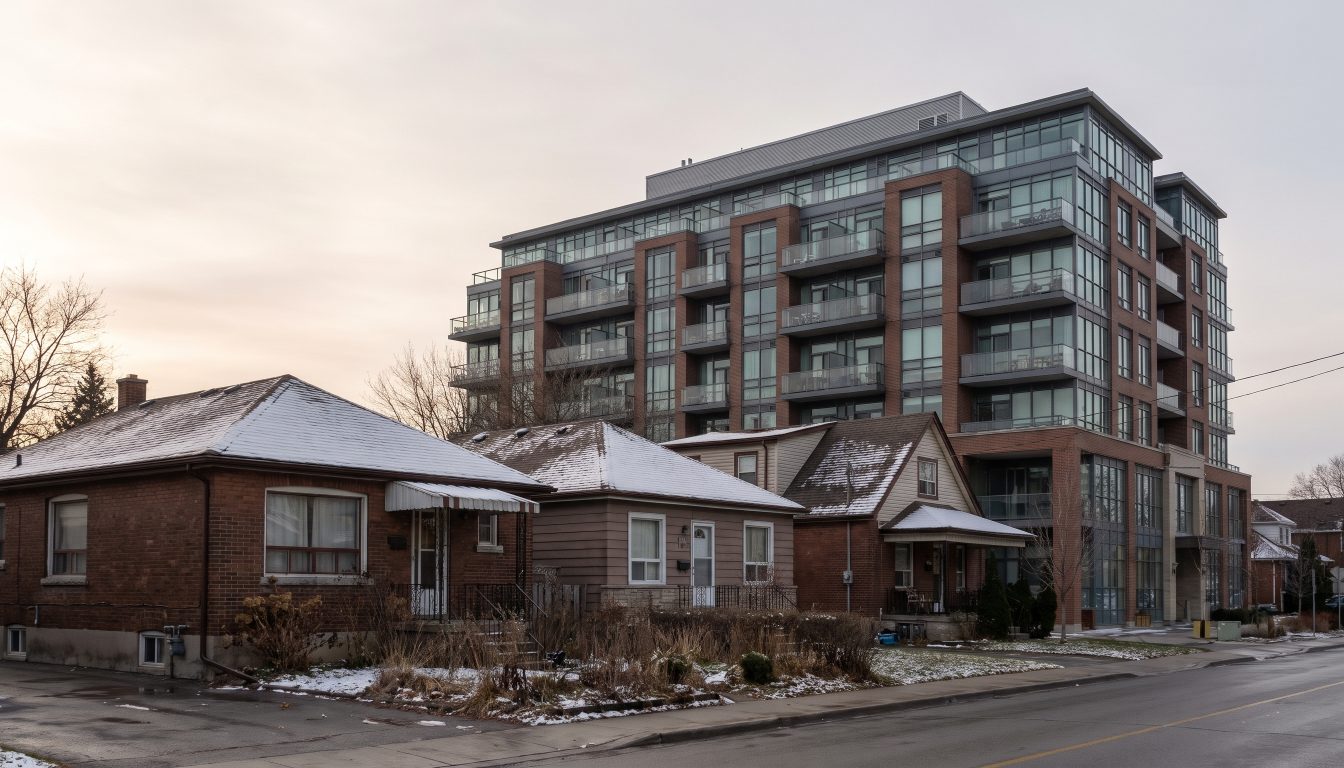
In the GTA, a condo usually costs half or less of a detached house: in Mississauga the 2026 median was $485,000 for a condo apartment and $1,225,000 for a detached home. Houses held value better: Mississauga detached medians fell about 11% since 2024, condos about 17%. Buy a condo for price and location, a house for space and long-term value.
This is for first-time buyers, upsizers and downsizers in Toronto and the GTA who are deciding between a condo and a house for 2027. You will get side-by-side prices by city, how each type has held its value since 2024, the cash you need to close on each, and a clear way to decide which fits you.
Should I buy a condo or a house in 2027?
Buy a condo if your budget, commute or lifestyle points to one and you plan to stay at least five years. Buy a house if you need space, want land that tends to hold value better, and can carry the higher payment if rates rise again. In the 2026 data, houses held their value better than condos almost everywhere in the GTA, but condos cost far less to get into.
2027 adds two twists. Interest rates went up in October 2026, which hits bigger mortgages hardest. And condo prices have already fallen further than house prices, so some of the condo risk may already be priced in. Neither type is the “right” answer for everyone. The right answer is the one you can afford to hold through a bad year.
How much cheaper is a condo than a house in the GTA right now?
Roughly half the price, or less. The table shows 2026 median sold prices by home type, from January to October.
| Area | Condo apartment | Freehold townhouse | Detached house | Avg days on market (condo / detached) |
|---|---|---|---|---|
| Toronto W08 (central Etobicoke) | $525,000 | $1,140,000 | $1,540,000 | 38 / 24 |
| Toronto E04 (Scarborough) | $415,786 | $840,000 | $870,000 | 39 / 24 |
| Mississauga | $485,000 | $880,000 | $1,225,000 | 42 / 31 |
| Brampton | $415,000 | $755,000 | $950,000 | 53 / 30 |
| Vaughan | $530,000 | $1,014,500 | $1,415,000 | 42 / 30 |
| Markham | $558,000 | $999,990 | $1,420,000 | 39 / 29 |
| Oakville | $528,000 | $1,005,000 | $1,625,000 | 45 / 33 |
| Pickering | $470,000 | $789,000 | $1,039,999 | 33 / 26 |
| Oshawa | $340,500 | $657,500 | $730,000 | 51 / 25 |
Source: TRREB MLS data via REALM, January to October 2026, median sold prices and average days on market. Toronto rows are TRREB districts, not neighbourhoods.
Two things stand out. First, the gap is huge in the core and the west: in Oakville a detached house costs about three times a condo. Second, in places such as Scarborough’s E04 district and Oshawa, a freehold townhouse or a detached house is within reach of buyers who might otherwise settle for a Toronto condo, if they can live with the commute.
Have condos or houses held their value better since 2024?
Houses, clearly. Condo apartment medians have fallen more than detached medians in every city below over the past two years.
| Area | Condo apartment, 2024 to 2026 | Detached, 2024 to 2026 |
|---|---|---|
| Mississauga | -16.8% | -10.7% |
| Brampton | -23.1% | -15.7% |
| Vaughan | -16.5% | -11.0% |
| Markham | -20.3% | -13.9% |
| Oakville | -14.8% | -7.8% |
| Toronto W08 | -13.0% | -3.1% |
Source: TRREB MLS data via REALM, change in median sold price, January to October 2024 vs January to October 2026.
TRREB’s October 2026 benchmark prices show the same pattern: across all TRREB areas, apartments were down 7.33% from a year earlier and detached homes 4.44%. The main reason is supply. Urbanation reports that a record 29,077 new condos were completed in the GTHA in 2025, many bought by investors who now want to sell or rent them out. That wave is shrinking: scheduled completions fall to 15,825 in 2027. My post on whether Toronto condo prices are still falling goes district by district.
How much cash do I need to buy a condo vs a house in 2027?
A lot less for a condo. The minimum down payment in Canada is 5% of the first $500,000 and 10% of the part between $500,000 and $1.5 million. At $1.5 million and above you need 20% down, and mortgage insurance is not available. With less than 20% down, CMHC’s premium is 4.00% of the loan at 90.01% to 95% loan-to-value, added to your mortgage. Ontario charges provincial sales tax on that premium, and it must be paid in cash at closing.
| Example (2026 median) | Minimum down payment | Insurance premium (added to loan) | Ontario land transfer tax | Toronto land transfer tax |
|---|---|---|---|---|
| Toronto C01 condo, $600,000 | $35,000 | $22,600 | $8,475 | $8,475 |
| Mississauga condo, $485,000 | $24,250 | $18,430 | $6,175 | None |
| Mississauga freehold town, $880,000 | $63,000 | $32,680 | $14,075 | None |
| Mississauga detached, $1,225,000 | $97,500 | $45,100 | $20,975 | None |
| Toronto W08 detached, $1,540,000 | $308,000 (20%) | Not available | $27,275 | $27,275 |
My calculations using CMHC premium rates, Ontario’s land transfer tax brackets and Toronto’s MLTT rates, before first-time buyer refunds. Add legal fees, title insurance and adjustments.
First-time buyers can get back up to $4,000 of the Ontario tax and up to $4,475 of the Toronto tax. That wipes out the land transfer tax on the $600,000 downtown condo above, but covers only a small part on a house. My guide on how much home you can afford in the GTA shows how the stress test sets your ceiling.
Condo Valuation
What’s your condo
worth today?
Three quick steps. Condos don’t price like houses — your floor, your view, and whether you own parking move the number more than anything else. This weighs all of them.
Reading recent condo sales…
Estimated market value
—
$0–$0
Most likely $0 · about $0 per square foot
What moved the number
Starting from what comparable units in your area sell for, here’s what your specifics added or subtracted.
Market context
—
—
Two units, same floor plan,
$90,000 apart.
That happens constantly in condos — one has the parking, the right exposure, or a board that keeps the reserve fund healthy. A model can’t see your status certificate. I can.
Is a condo cheaper to own each month than a house?
Usually, but not always by as much as the price gap suggests. Here is how the monthly costs compare.
The mortgage
This is the biggest difference. As an illustration only, every $100,000 borrowed over 25 years costs about $553 a month at a 4.5% rate and about $610 at 5.5%. On the Mississauga examples above, that is roughly $2,650 a month for the condo loan and $6,490 for the detached loan at 4.5%. A one-point rise in rates adds about $270 a month to the condo payment and about $670 to the house.
Condo fees
Condo owners pay a monthly fee that covers building insurance, shared utilities, staff, amenities and the reserve fund. Fees vary widely by building, so get the actual figure and the last few years of increases before you offer.
Repairs, utilities and tax
A house has no condo fee, but you pay for the roof, furnace, windows, driveway and every repair yourself, plus all utilities and a higher insurance bill. Property tax is based on your MPAC assessment, so a house usually pays more than a condo in the same city. Put money aside every month for repairs, even when nothing is broken.
Which is easier to sell later, a condo or a house?
Right now, a house. In 2026, condos took longer to sell than detached houses in every area in the first table, often by 10 to 20 days. In October 2026, the City of Toronto had 5,251 active condo apartment listings against 949 sales that month, while detached homes had 2,708 active listings against 741 sales.
That could change by the end of the decade. Urbanation reports condo construction starts in the first nine months of 2026 were 82% below the 10-year average, so far fewer new condos will compete with yours if you sell in 2029 or 2030. But nobody can promise when the market turns.
Is a townhouse a good middle option in 2027?
Often, yes. A freehold townhouse gives you land and no condo fee at a lower price than a detached house. In Mississauga, the 2026 freehold town median was $880,000 against $1,225,000 for detached. A condo townhouse costs less again but comes with fees and shared rules. If you are torn between a condo and a house, look at both before deciding. My comparison of condos, townhouses and semis in Toronto covers the trade-offs.
Who should buy a condo in 2027, and who should buy a house?
A condo tends to suit you if
- You want to live close to work, transit or downtown and value time over space.
- You are buying your first home and need a lower down payment.
- You want low maintenance, or you are downsizing.
- You plan to stay at least five years, so you are not forced to sell into a soft market.
A house tends to suit you if
- You need bedrooms, a yard or space for a home office or family.
- You want to add a basement or garden suite for rental income or family.
- You can handle repairs and a larger payment if rates rise.
- You are thinking 10 years or more and want land, which has held value better.
In my experience, for many first-time buyers the choice is less “condo or house” and more “which commute can I live with”. A condo in the core and a townhouse or older detached house further out often cost a similar total each month once you count fees and transit. I run both scenarios with real numbers before we tour anything. If you choose a condo, choose the building as carefully as the unit: a well-run building with a healthy reserve fund will matter more to your resale than a slightly better view.
A cheap condo in a building with a weak reserve fund can turn into a special assessment or a big fee increase within a year of buying. Always make your offer conditional on your lawyer reviewing the status certificate. On the house side, do not stretch to the top of your pre-approval when rates are rising: a one-point increase at renewal on a $1 million mortgage can add hundreds of dollars a month.
My guide to reading a status certificate lists the red flags.
What to do next
- Get a pre-approval with a rate hold so you know your real ceiling.
- Pick two areas, one for a condo and one for a house or townhouse, and compare total monthly cost, not just price.
- For any condo, ask for the monthly fee, the reserve fund study date and recent fee increases before you offer.
- For any house, budget for an inspection and a repair reserve from day one.
- Check whether you qualify for the first-time buyer land transfer tax refunds and the 30-year insured amortization.
Need help with this? Talk to me.
I’m Jatin Dua, Broker of Record at RE/MAX Quantum Realty, and I’m the best agent to do this kind of work for you in Toronto and across the GTA. Over $100 million in GTA sales and 100+ families helped sell. Feel free to contact me any time: call or text 833-330-1925 or email [email protected].
Frequently asked questions
Is it better to buy a condo or a house in 2027?
It depends on your budget and how long you will stay. In the GTA, houses held their value better than condos from 2024 to 2026, but a condo costs about half as much or less and needs a smaller down payment. If you can comfortably afford a house and plan to stay 10 years, a house has the stronger track record.
Should I buy a condo or house in Toronto in 2027?
In Toronto, a condo makes sense if you want to live near downtown or transit and plan to stay at least five years. The 2026 condo median in downtown’s C01 district was $600,000, while the City of Toronto’s detached median was $1,260,000 in October 2026. A house suits buyers who need space and can carry a larger mortgage if rates rise.
Are condos a bad investment in Toronto in 2027?
Condos have been the weakest GTA home type since 2024, but that does not make every condo a bad buy. TRREB’s October 2026 index showed apartments down 7.33% over the year across its area. Condo construction starts in 2026 were 82% below the 10-year average, according to Urbanation, which could reduce new supply later in the decade.
How much down payment do I need for a condo vs a house in Ontario?
For a $485,000 condo, the minimum down payment is 5%, or $24,250. For a $1,225,000 house it is $97,500, because you pay 5% on the first $500,000 and 10% on the rest. Homes priced at $1.5 million or more need 20% down, and mortgage insurance is not available at that price.
Do condos sell slower than houses in the GTA?
Yes. In 2026, condo apartments took longer to sell than detached houses across the GTA, according to TRREB MLS data via REALM. In Brampton, condos averaged 53 days on market against 30 for detached homes, and in Mississauga 42 days against 31. More competing listings is the main reason.
Is a townhouse better than a condo in 2027?
A freehold townhouse can be a good middle ground in 2027. You own the land and pay no condo fee, at a lower price than a detached house. In Mississauga, the 2026 median freehold townhouse sold for $880,000 against $485,000 for a condo apartment and $1,225,000 for a detached house.
Do condo fees make a condo more expensive than a house?
Condo fees can narrow the gap but rarely close it on their own. A house has no fee, but you pay for every repair, all utilities and higher insurance and property tax yourself. Compare the full monthly cost, including the mortgage, fee or repair reserve, tax and utilities, for the specific homes you are considering.
Can first-time buyers get a 30-year mortgage on a condo in Ontario?
Yes. First-time buyers can get a 30-year amortization on an insured mortgage for a condo or a house, as long as the price is under $1.5 million. Buyers of newly built homes also qualify. A longer amortization lowers the monthly payment but means paying more interest over the life of the loan.
Sources
- TRREB Market Watch, October 2026
- CMHC: Mortgage loan insurance premiums
- Ontario: Calculating land transfer tax
- Ontario: Land transfer tax refunds for first-time homebuyers
- City of Toronto: MLTT rates and fees
- City of Toronto: MLTT rebate opportunities
- Urbanation: GTHA new condo sales double from a year ago in Q3 (19 Oct 2026)
- Bank of Canada raises the policy rate to 2.5% (28 October 2026)
Related reading
- Biggest Condo Developers in Toronto: Track Records Buyers Should Check
- Is It a Good Idea to Buy a Condo in Toronto in 2027?
- Buying a House in Ontario on a Work Permit (2027): What the Foreign Buyer Ban Allows
- Can You Buy a House With No Down Payment in Ontario?
About the author — Jatin Dua, Toronto and GTA real estate broker
I am Jatin Dua, Broker of Record and co-founder of RE/MAX Quantum Realty Inc., Brokerage, Unit 101, 799 The Queensway, Toronto. I work with buyers and sellers across Toronto and the GTA and have helped more than 100 families sell. Four-plus years of active GTA transactions and over $100 million in sales volume.
Reach me at [email protected] or 833-330-1925, or book a call.