

Published 10 September 2026 · By Jatin Dua, Broker of Record, RE/MAX Quantum Realty
What's Your Home Worth Right Now?
Get a free AI-powered price range for your property in under 90 seconds, based on recent GTA comparable sales. No name or address required.
Get My Free Estimate →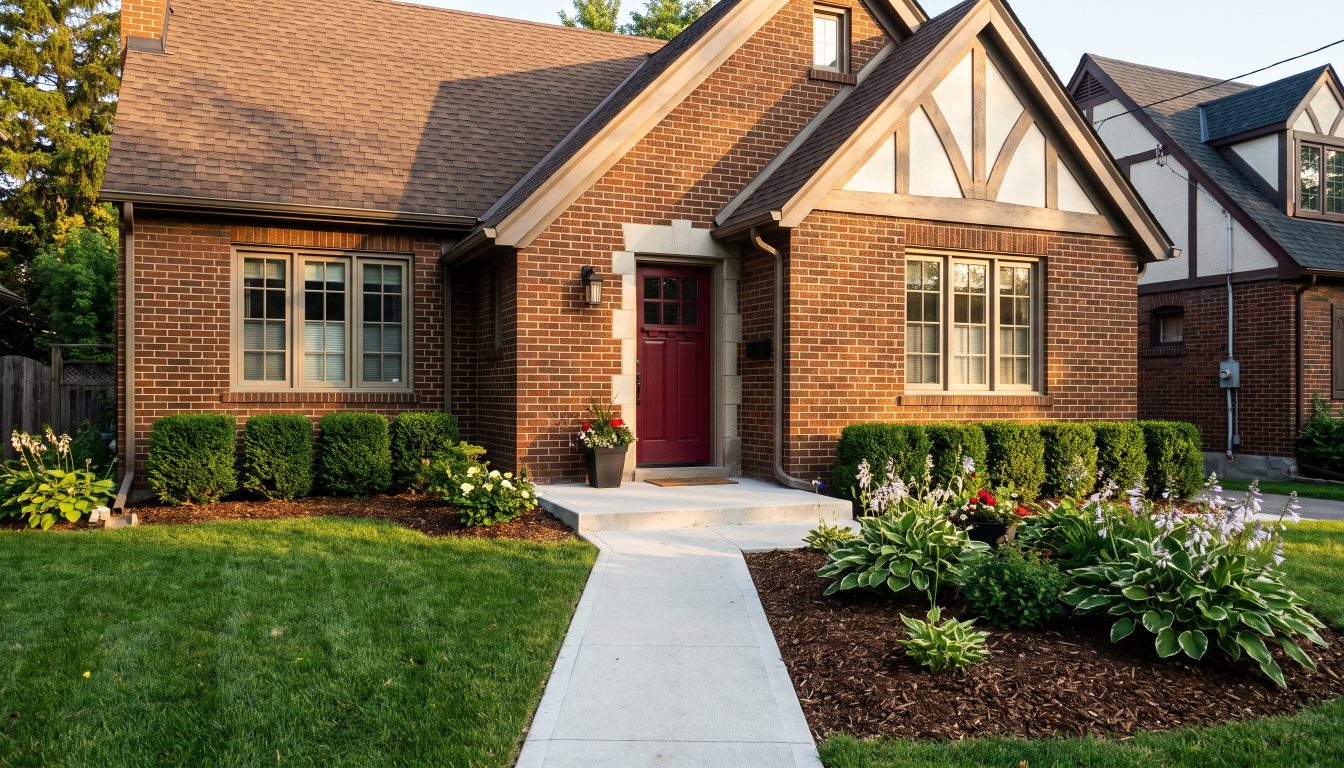
Curb appeal earns its money in two places: the photograph that decides whether a buyer books a showing, and the eight seconds between the car door and the front door. In Etobicoke the highest-return work is almost always cleaning, cutting, painting and lighting rather than replacing — and two Toronto rules constrain what you may do at all. A private tree with a stem 30 centimetres or more in diameter, measured 1.4 metres up, cannot be removed without a permit. And Zoning By-law 569-2013 requires most of your front yard to stay landscaped, with at least 75% of that landscaping soft. Paving the front for parking is not the upgrade people think it is.
Why the front of the house is worth disproportionate attention
Buyers do not evaluate a house in the order you would like. They see one photograph on a phone. If that photograph does not earn a second look, nothing inside the house ever gets considered. Then, if they do come, they form an impression on the walk from the car that colours everything they see for the next twenty minutes. The kitchen is being judged against a frame that was set at the curb.
That is the honest case for curb appeal, and it is a case about traffic and framing, not about a renovation that returns 140 cents on the dollar. Nothing does. No exterior project is guaranteed to return its cost, and an appraiser will only credit the contributory value of an improvement in that market at that time — not what you paid for it. What good exterior work reliably buys you is more showings, faster, and a buyer who arrives predisposed rather than sceptical.
For context: TRREB reported an average Etobicoke sale price of $1,049,793 across 243 sales in August 2026. On a house at that level, a week of extra days on market and one round of “we’ll wait and see” costs more than the entire budget discussed in this article.
Two Toronto rules that decide what you are allowed to do
Etobicoke is inside the City of Toronto, so Toronto’s bylaws apply to your front yard whether or not your street feels like the suburbs. Two of them matter constantly and are routinely discovered too late.
1. The private tree bylaw
Under Toronto Municipal Code Chapter 813, a permit is required to injure or destroy a private tree “including a multi-stem tree having at least one stem that has a diameter measurement of 30 centimetres or more measured at 1.4 metres above ground level.” Where a permit to destroy is issued, replacement trees must be planted and maintained in good condition for two years; where planting on site is not feasible, the City may require planting elsewhere or accept cash in lieu equal to 120% of the cost of replanting and two years of maintenance.
Thirty centimetres in diameter is not a large tree. It is roughly 94 centimetres around — a trunk you can get your arms around. A great many mature Etobicoke front-yard maples, Norway spruces and silver maples clear that threshold comfortably.
The practical rule: measure before you call anybody. If a tree is at or near the threshold, a permit process is involved, and it is not a weekend. Pruning for shape and clearance is generally a different matter from removal, but “injure” is in the bylaw for a reason — aggressive topping of a protected tree is not a loophole.
2. The front yard landscaping requirement
Zoning By-law 569-2013, at section 10.5.50.10, sets how much of a residential front yard must remain landscaped. On lots with a frontage of 6.0 to less than 15.0 metres, a minimum of 50% of the front yard must be landscaping; on lots 15.0 metres or wider, a minimum of 60%. On the narrowest lots — under 6.0 metres — the front yard excluding a permitted driveway must be landscaping. And in every case, at least 75% of that front yard landscaping must be soft landscaping: growing things and permeable ground, not stone, not pavers, not concrete.
Two consequences follow. First, the fantasy of paving the front yard to add parking is, in most of Etobicoke, simply not permitted — front yard parking is tightly restricted and widening a driveway is not a homeowner’s discretionary decision. Second, a hardscape-heavy front yard design that looks great in a magazine may put your property offside, and a buyer’s lawyer or an inspector can find that.
What actually pays back, ranked
The ranking below is by return on effort and cash, based on what buyers respond to in this market rather than on national renovation surveys. Cost ranges are broad Etobicoke-typical ranges for an ordinary detached or semi-detached house and will vary with size, access and season.
| Work | Typical cost | Why it works |
|---|---|---|
| Cleaning: siding, brick, walkway, driveway, eaves, windows | $300–$900 | Removes the “deferred maintenance” read. The single highest-leverage spend, every time. |
| Lawn repair and edging, fresh mulch in beds | $250–$800 | Defined edges photograph as care. Mulch reads as maintained even where planting is thin. |
| Pruning back overgrowth from windows and the front door | $200–$700 | Overgrown foundation planting darkens the interior and hides the house. Light is the product. |
| Front door painted or refinished, new hardware | $150–$600 | The one object every buyer touches. A sticking lock or a scuffed door sets the tone for the tour. |
| House numbers, mailbox, porch light replaced as a set | $150–$450 | Three small dated objects clustered together age a house more than any single big one. |
| Exterior lighting: path lights, a warm porch bulb, a soffit fixture | $200–$1,200 | Makes evening showings possible in October through March, which is half the selling year here. |
| Garage door painted, or replaced if failing | $300 painted / $1,800–$4,500 replaced | On many Etobicoke bungalows the garage door is 25–30% of the front elevation. It dominates the photo. |
| Eavestrough and downspout repair, fascia paint | $400–$1,500 | Sagging eaves are read by buyers as a water problem, which is read as a basement problem. |
| Porch and step repair, railing paint | $400–$2,500 | A wobbly step is felt, not seen. Physical discomfort at the threshold is disproportionately memorable. |
| Fence repair and stain along the frontage | $400–$2,000 | Only the visible run matters for the photograph. Repair the frontage, not the whole yard. |
| Window and door trim paint | $600–$2,500 | Crisp trim reads as a maintained house at a fraction of the cost of new windows. |
| Driveway sealing or crack repair | $300–$900 | Cheap. Replacement rarely returns its cost; presentable repair usually does. |
Thinking about buying or selling here?
I work this area every week and I will give you a straight answer, including when the answer is to wait. No pressure, and no drip campaign you cannot get out of.
Call or text 833-330-1925 Send me a message
Jatin Dua, Broker of Record — RE/MAX Quantum Realty Inc., Brokerage. Not intended to solicit buyers or sellers currently under contract with another brokerage.
What rarely pays back before a sale
- Full driveway replacement. A new driveway is invisible in a photograph and buyers do not price it. Repair the cracks, seal it, and put the money into the front door and the lighting.
- New windows purely for looks. Windows are expensive, disruptive, and their contributory value at resale is usually well under their cost. Replace them because they are failing, not because you are listing.
- A new roof on a roof with life left. Buyers ask the age. A documented ten-year-old roof in good condition is a fine answer. A brand-new roof mostly removes an objection you could have removed with a receipt and an inspection.
- Elaborate hardscaping and retaining walls. High cost, slow build, and in Toronto it runs straight into the soft-landscaping requirement described above.
- Mature specimen plantings. Expensive, hard to establish out of season, and a buyer cannot tell a four-year-old shrub from a one-year-old shrub in a photograph.
- Extending the front porch or adding a portico. Permits, drawings, zoning review, weeks of work, and a return that depends entirely on whether that particular buyer wanted a portico.
The pattern is consistent: buyers pay for the absence of problems, not for the presence of upgrades. Curb appeal money is best spent removing reasons to hesitate.
Etobicoke housing stock: what each type needs
Post-war bungalows — Alderwood, Long Branch, Rexdale, parts of Islington
The garage door and the front picture window carry the elevation. Aluminum storm doors, 1970s wrought-iron railings and an oversized dated house number are the three things that date these houses instantly and cost almost nothing to fix. Foundation planting is usually forty years old and twice the height it should be; cutting it back to below the window sill transforms both the exterior photograph and the interior light.
Kingsway and Humber Valley Tudors and centre-hall homes
Here the front door, the light fixtures and the landscaping frame are doing the work, and buyers at this price point read authenticity. Vinyl-look replacements on a stucco-and-timber house are noticed and marked down. Restoring original woodwork, repointing where needed and getting the lighting warm and symmetrical outperforms modernising.
Mimico, New Toronto and Queensway semis and narrow-lot houses
Narrow frontage means the front yard is small, and the soft-landscaping percentage bites hardest. The whole frontage is visible in a single photograph, so a single failed element — a cracked walkway, a leaning fence post, a mismatched door — occupies a large fraction of the image. Symmetry and a limited palette do more here than volume of planting.
Condominium and townhouse owners
Most of the exterior is the corporation’s, and altering it is not yours to do. Your leverage is what a buyer sees between the elevator and your unit door, plus the balcony or terrace in the photographs: clean glass, a cleared and styled outdoor space, a working light, and no storage visible. Check the declaration and the rules before changing anything visible from outside.
Season matters more than most sellers think
Half the Etobicoke selling year has bare trees and early darkness. Plan for it rather than fighting it.
- Photograph early. If you are listing in November, get exterior photographs taken in the last good week of October. Nobody is harmed by an accurate photograph taken three weeks earlier.
- Keep a summer set. If you have good photographs from a previous summer showing your own garden in leaf, they can be used alongside current images, clearly identified as such.
- Buy the lighting. In December a 4:30 p.m. showing is a night showing. A warm porch light, path lights and a lit interior visible through the front window is the difference between arriving at a home and arriving at a dark house.
- Clear snow and ice properly, every time. Not just a path — the full walkway, the steps and the driveway apron. Salted, dry, and safe. It is a maintenance signal and a liability question at once.
- Evergreen structure carries winter. Two well-placed containers with cut greens at the door outperform an empty bed in January and cost under a hundred dollars.
The two-weekend plan
If you have limited time and about $1,500, this is the order I would spend it in.
- Weekend one, morning: pressure wash the walkway, driveway, porch and lower siding. Clean every front-facing window inside and out.
- Weekend one, afternoon: cut back all foundation planting to below the window sills. Edge the lawn. Remove anything dead.
- Between weekends: order house numbers, a porch light and door hardware as a matched set. Book a lawn repair if the front lawn is thin.
- Weekend two, morning: paint the front door and the trim around it. Paint the garage door if it is dated rather than damaged.
- Weekend two, afternoon: install the new fixtures and numbers. Fresh mulch in every bed. Two containers at the door.
- Before photography: remove every car from the driveway and the frontage, take down the recycling bins, coil the hose out of sight, and take the photographs in the last two hours of daylight.
The things people forget to remove
The last five minutes before the photographer arrives are worth more than the last five hundred dollars. Off the frontage: vehicles, garbage and recycling bins, hoses, ladders, seasonal decorations more than a week old, contractor signs, security-company lawn signs, for-sale-by-neighbour signs where you can politely ask, children’s toys, and the mat that says something clever. Nothing on the porch except the furniture you intended to be there.
And check the view from the street, standing where a buyer parks — not from your own front door looking out. It is a different picture, and it is the one they will remember.
Frequently asked questions
Does curb appeal really increase what my house sells for?
Indirectly, and that is the honest answer. No exterior project is guaranteed to return its cost, and an appraiser credits contributory value in that market at that time, not what you spent. What curb appeal reliably does is increase the number of buyers who book a showing after seeing one photograph, and improve the frame of mind of the ones who arrive. More competition and better first impressions are what move price, not the mulch itself.
Do I need a permit to remove a tree in my front yard in Etobicoke?
If any stem is 30 centimetres or more in diameter measured 1.4 metres above ground, yes — Toronto Municipal Code Chapter 813 applies to private trees anywhere in the City, Etobicoke included. Where a permit to destroy is granted, replacement trees must be planted and maintained for two years, or cash in lieu of 120% of the replanting and maintenance cost may be accepted. Measure before you book anyone.
Can I pave my front yard for extra parking before selling?
Generally no. Zoning By-law 569-2013 s. 10.5.50.10 requires a minimum of 50% of the front yard to be landscaping on lots 6.0 to under 15.0 metres wide and 60% on lots 15.0 metres or wider, with at least 75% of that landscaping being soft landscaping. Front yard parking is separately restricted. Paving without approval creates a compliance problem that surfaces during the sale.
What is the highest-return curb appeal project?
Cleaning, consistently. Pressure washing the walkway, driveway, porch and lower siding, plus washing every front-facing window, costs a few hundred dollars and removes the impression of deferred maintenance that buyers price into their offers. After that: cutting back overgrown foundation planting, a repainted front door with new hardware, and exterior lighting.
Should I replace my garage door before listing?
Paint it first and see. On many Etobicoke bungalows and side-splits the garage door occupies a quarter or more of the front elevation, so it dominates the listing photograph. If the door is dated but sound, paint solves it for a few hundred dollars. Replace it only if it is failing, noisy, or visibly damaged, where the replacement removes an objection rather than adding an upgrade.
Is it worth replacing the driveway before selling?
Usually not. A new driveway barely registers in a photograph and buyers rarely pay for it. Crack repair and sealing for a few hundred dollars achieves most of the visual benefit. Put the difference into the front door, the lighting and the planting, where buyers actually respond.
What if I am selling in winter?
Photograph early — take exterior images in the last good week before the leaves go, even if you list weeks later. Buy proper exterior lighting, because December showings are night showings. Clear and salt the full walkway, steps and driveway apron every time. Two containers of cut evergreens at the door do more for a January frontage than anything else at that price.
How much should I budget for curb appeal on an Etobicoke house?
For most detached and semi-detached houses, $1,000 to $2,500 covers cleaning, pruning, lawn repair, mulch, a painted front door with new hardware, matched exterior fixtures and numbers, and lighting — the work that actually changes buyer behaviour. Spending beyond that generally buys diminishing returns unless something specific is failing and would otherwise become a negotiating point.
Sources
- Toronto Municipal Code Chapter 813, Trees — the 30 cm diameter threshold measured at 1.4 m, replacement planting for two years, and cash in lieu at 120% of replanting and maintenance cost. Accessed 10 September 2026.
- City of Toronto Zoning By-law 569-2013, Chapter 10 — s. 10.5.50.10 front yard landscaping minimums by frontage and the 75% soft landscaping requirement. Accessed 10 September 2026.
- TRREB Market Watch, August 2026 — the Etobicoke average sale price of $1,049,793 across 243 sales. Accessed 10 September 2026.
- City of Toronto — Zoning By-law 569-2013 — the consolidated by-law and how to confirm the provisions applying to a specific address. Accessed 10 September 2026.
Related reading
- Preparing an Etobicoke home for sale: what pays back
- Why your Etobicoke house is not selling
- Do open houses still work in Toronto?
- The 1950s and 1960s Etobicoke bungalow inspection checklist
- Lot severance in Ontario: consent, cost and process
About the author — Jatin Dua, Etobicoke real estate agent
I am Jatin Dua, Broker of Record at RE/MAX Quantum Realty Inc., Brokerage, Unit 101, 799 The Queensway in Etobicoke, with more than four years of active GTA transactions and over $100M in sales volume. I have walked up a great many Etobicoke front paths with buyers, and I can tell you what they say before they reach the door.
Reach me at connect@jatindua.com or 833-330-1925.