
Published 2 November 2026 · By Jatin Dua, Broker of Record, RE/MAX Quantum Realty
What's Your Home Worth Right Now?
Get a free AI-powered price range for your property in under 90 seconds, based on recent GTA comparable sales. No name or address required.
Get My Free Estimate →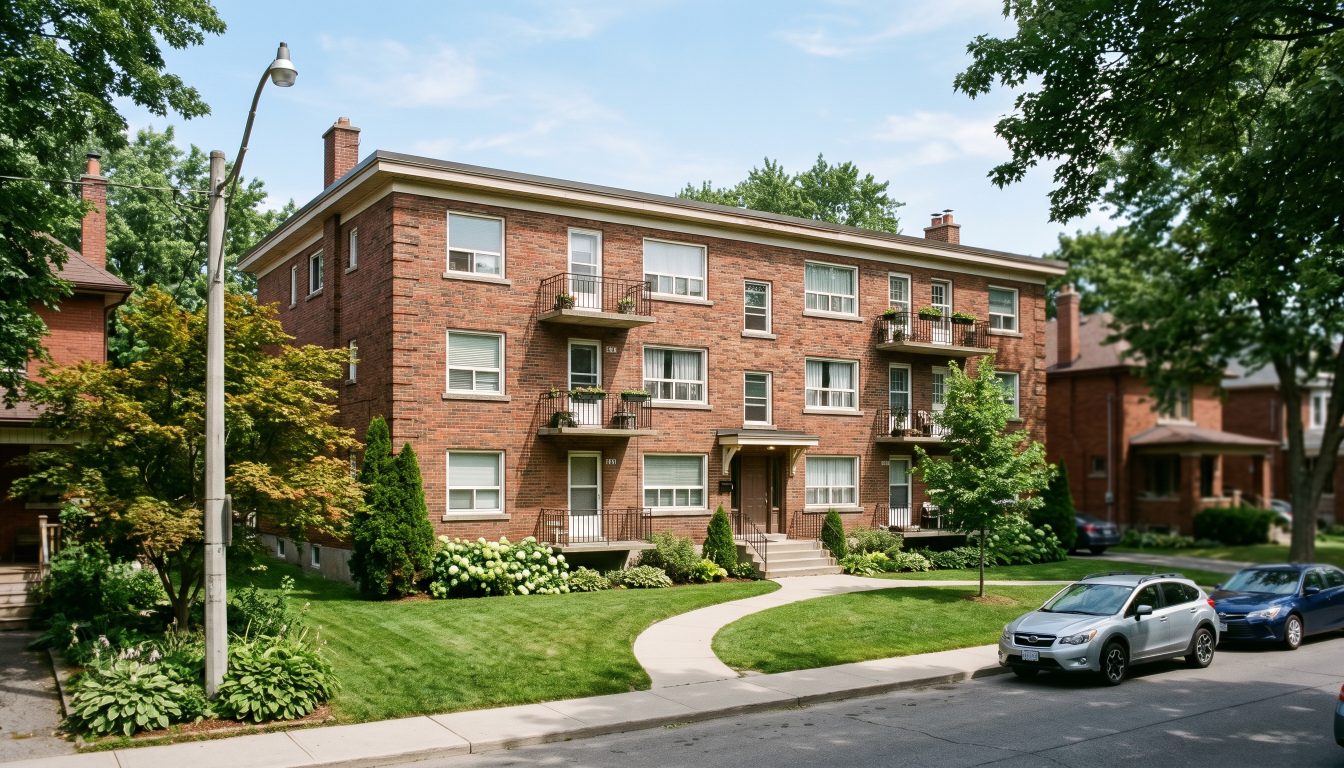
Small 6 to 20 unit buildings put many rents under one roof, but rules change with size: 5+ units means commercial or CMHC financing, 7+ units moves into Toronto’s multi-residential tax class at 1.208792% versus 0.767311% residential in 2026, and 10+ units over three storeys falls under RentSafeTO. Underwrite on actual rents.
This guide is for investors who own a few condos or a duplex and want to step up to a small apartment building, or who have $1 million to $5 million and want one roof instead of many units. You will get the rules that change at 5, 6, 7 and 10 units, the 2026 Toronto tax rates that make the seventh unit matter, an illustrative 8-unit example with the arithmetic shown, and the financing routes open in 2027.
What counts as a small apartment building in the GTA?
In this guide, a small apartment building has 6 to 20 self-contained units. Each unit has its own kitchen, bathroom and entrance. In the GTA these are usually one of three types:
- older walk-up buildings of two to four storeys, often built in the 1950s and 1960s;
- large houses converted into many units, which MPAC calls “bachelorettes” when they have seven or more units; and
- low-rise buildings under five storeys, typically without an elevator.
Most sit on main streets or in older neighbourhoods, and many are owned by the same family for decades. That is one reason they rarely come up for sale, and why I approach owners off-market as well as watching MLS.
Why do investors buy 6- to 20-unit buildings?
A small building puts many rents under one roof, one tax bill and one insurance policy. Compared with owning eight condos, you have no condo fees, no condo board and full control over repairs and upgrades. Compared with a large tower, the price fits a budget of a few million dollars and the building is simple enough to understand.
Several condos or one small building?
Many of my clients arrive owning three or four investment condos. Moving that equity into one small building changes the job:
- you trade several condo fees and boards for one set of repairs that you control;
- you trade separate mortgages for one commercial loan, sized on the building’s income;
- you trade units that are easy to sell one at a time for one asset that takes longer to sell; and
- you may trade newer condos that are exempt from the rent increase guideline for older units with long-term tenants.
Neither is better for everyone. The building suits owners who want control and can handle capital repairs; condos suit owners who want simpler exits.
The trade-off is concentration. One boiler, one roof and one set of tenants carry the whole investment. A vacancy in a 6-unit building is a sixth of your income.
Which rules change as a building gets bigger?
Several rules switch on at a set number of units. Knowing them helps you understand why a 6-unit and a 7-unit building can perform very differently.
| Threshold | What changes |
|---|---|
| More than 2 units | Land transfer tax uses the flat 2% top rate, with no luxury bands (Ontario and Toronto) |
| 5 or more units | Financed as a commercial loan; eligible for CMHC multi-unit insurance and, from 1 Feb 2027, new private insurance |
| 6 or more units (Toronto) | Demolishing any rental unit needs a Rental Housing Demolition Application; tenants of 6+ demolished units get a right to return |
| 7 or more units | Taxed in the multi-residential property class (except the new multi-residential class) |
| 3+ storeys and 10+ units (Toronto) | Must register with RentSafeTO and meet its standards |
| Any unit first occupied after 15 Nov 2018 | Exempt from the rent increase guideline |
Source: MPAC; City of Toronto rental housing demolition and RentSafeTO pages; Ontario rent increase guideline; CMHC; Finance Canada rules reported November 2026.
How much more property tax does a 7-unit building pay?
In Toronto, quite a lot. MPAC classes properties with seven or more self-contained units as multi-residential, and values them on their income. The City of Toronto’s 2026 total tax rates are:
- Residential: 0.767311% of assessed value.
- Multi-residential: 1.208792% of assessed value.
- New multi-residential: 0.767311%, the same as residential.
On each $1 million of assessment, that is about $7,673 a year at the residential rate and $12,088 at the multi-residential rate. A 7-unit building can therefore carry a noticeably higher tax bill than a 6-unit building of similar value. Always check the class on the current tax bill and the MPAC notice before you underwrite.
To see what your own cash buys and how the cash flow compares across building types, use the calculator below. It is set to $5 million, but you can change every number.
Loading the investment calculator…
What do the numbers look like on an 8-unit building?
Here is an illustrative 8-unit Toronto building. It is not a real property, and every assumption is stated.
- Rents: 8 units at an average of $1,800 a month, or $172,800 a year. Rents like these, below what a newer unit would fetch, are common in older rent-controlled buildings.
- Other income: $4,800 a year from laundry and parking.
- Vacancy: 3% of rent, or $5,184.
- Effective gross income: $172,416.
- Property tax: $19,341, using the multi-residential rate on an assumed $1.6 million assessment.
- Insurance $10,000, utilities $16,000, repairs $11,000, management at 4% ($6,897), a reserve of $400 per unit ($3,200) and admin $2,500.
- Total expenses: $68,938, or 40% of income.
- Net operating income (NOI): $103,478.
NOI is income minus vacancy and operating costs, before mortgage payments. At a 4.5% cap rate this NOI supports a price of about $2,299,500, or $287,400 per unit. At 5.0% it is about $2,069,600, or $258,700 per unit. If the same building were taxed at the residential rate, its tax bill would be $12,277, and NOI would be $7,064 higher.
Closing costs matter too. On a $2,300,000 purchase of a building with more than two units, the Ontario land transfer tax is $42,475, and inside Toronto the city charges the same again, for $84,950 in total. My guide to apartment building price per door and cap rates shows how these numbers compare with published averages.
How do you finance a small apartment building in 2027?
Once a building has five or more units, you leave the world of home mortgages. Lenders size the loan by the lower of loan-to-value (LTV) and the debt service coverage ratio (DSCR), which is NOI divided by yearly mortgage payments. The main routes are:
- Conventional loans. No insurance premium, but lower leverage and higher rates than insured loans. My guide to commercial mortgage rates in Canada tracks current pricing.
- CMHC standard multi-unit insurance. Up to 85% LTV on existing buildings with at least five units. The borrower needs a net worth of at least 25% of the loan and multi-unit management experience, or a manager who has it.
- CMHC MLI Select. You earn points for committing to affordable rents, energy savings or accessibility for at least 10 years. At 50, 70 or 100 points you can get higher leverage and amortizations of 40, 45 or 50 years. The minimum debt coverage ratio for standard rental housing is 1.10.
- New private insurance. For lender applications submitted on or after 1 February 2027, private insurers may cover loans on 5 to 50 unit buildings, up to 85% LTV and 40-year amortization for existing buildings, with no owner-occupancy rule. These rules were announced in November 2026, and products may vary by insurer and lender.
My post on CMHC MLI Select for small Toronto investors walks through the points system with a 5-unit example.
What are the biggest risks with older small buildings?
Many 6- to 20-unit buildings have long-term tenants paying far below market, plus original wiring, plumbing and boilers. You cannot simply renovate and re-rent. In Toronto, ending a tenancy for renovations with an N13 notice now also requires a city rental renovation licence, and demolishing rental units in a building with six or more units triggers the city’s rental replacement rules. Price the building on the rents you will actually collect, with the repairs you will actually need.
Before you firm up, get a building condition assessment from an engineer, confirm every rent against its lease and bank deposits, and check for work orders and unpermitted units. My guide to N13 renovictions and Toronto’s renovation licence explains the tenant rules in detail.
Where in the GTA do small apartment buildings make sense?
Inside Toronto, small buildings cluster in older neighbourhoods and along main streets, where rents and land values are high but supply is thin. Outside Toronto you avoid the municipal land transfer tax, which on the illustrative $2.3 million building saves $42,475. Many investors also compare apartment buildings in Hamilton and Kitchener-Waterloo, where prices per unit are often lower.
If you would rather build than buy, Toronto now allows up to six units on many residential lots in some parts of the city. My sixplex guide covers where and whether the numbers work.
For a first building, I like 6 to 12 units with separate hydro meters, a recent roof and boiler, and a mix of rents where some units are already near market. That gives you room to learn without one problem sinking the year. I would also check the tax class before anything else, because the jump from residential to multi-residential rates changes the value of a building more than most buyers expect.
What to do next
- Set your cash budget, including land transfer tax, a reserve and the cost of reports.
- Ask a commercial lender or mortgage broker which route fits you, including the new private insurance from 1 February 2027.
- For each building, check the tax class, unit count, rent roll and first-occupancy dates before you make an offer.
- Line up an engineer and lawyer so your conditional period is used well.
- Run your numbers in the $5 million calculator above, then book a call with me to walk through a specific building and its rent roll.
Need help with this? Talk to me.
I’m Jatin Dua, Broker of Record at RE/MAX Quantum Realty, and I’m the best agent to do this kind of work for you in Toronto and across the GTA. Over $100 million in GTA sales and 100+ families helped sell. Feel free to contact me any time: call or text 833-330-1925 or email [email protected].
Frequently asked questions
How much does a 6 unit apartment building cost in Toronto?
It depends on the rents, not just the unit count, and small older Toronto buildings vary widely. In my illustrative 2027 example, an 8-unit building earning $103,478 of NOI was worth about $2.07 million to $2.3 million at 4.5% to 5% cap rates. Price each building on its own income.
Is a small apartment building a good investment in Ontario in 2027?
It can be, if you buy on actual rents and today’s loan rates. Small Ontario apartment buildings offer many rents under one roof and no condo fees, but they concentrate risk in one building and often have old systems and below-market tenants. Cash flow with conventional loans was thin in late 2026, so insured financing and careful underwriting matter.
How many units before a building is commercial in Ontario?
For financing, buildings with five or more units are usually treated as commercial and get commercial or CMHC multi-unit loans. For property tax, Ontario’s multi-residential class starts at seven or more self-contained units. For land transfer tax, buildings with more than two units are taxed at the non-residential rates, with a flat 2% top rate.
What is the property tax rate for a multi-residential building in Toronto?
Toronto’s 2026 total tax rate for the multi-residential class is 1.208792% of assessed value, compared with 0.767311% for residential and new multi-residential properties. On $1 million of assessment that is about $12,088 a year versus $7,673. The multi-residential class covers properties with seven or more self-contained units.
Can I get CMHC insurance on an 8 unit apartment building?
Yes. CMHC insures loans on existing rental buildings with five or more units, including 8-unit buildings, up to 85% loan-to-value under its standard product. The borrower needs net worth of at least 25% of the loan and multi-unit experience or an experienced manager. MLI Select offers higher leverage in exchange for affordability, energy or accessibility commitments.
What is the new mortgage insurance for 5 to 50 unit buildings?
It is a federal change announced in November 2026 that lets private insurers cover loans on buildings with 5 to 50 units for lender applications submitted on or after 1 February 2027. Existing buildings can be insured up to 85% loan-to-value with up to 40-year amortization. Borrowers need net worth of at least 25% of the loan, with a $100,000 minimum.
Does RentSafeTO apply to small apartment buildings?
Only to larger ones. Toronto’s RentSafeTO program applies to apartment buildings with three or more storeys and ten or more units. A 6-unit walk-up or an 8-unit converted house is outside it, though all rental buildings in Toronto must still meet the city’s property standards and Ontario’s maintenance rules.
Are small apartment buildings in Ontario rent controlled?
Most older ones are. Units first occupied for residential purposes on or before 15 November 2018 are subject to Ontario’s rent increase guideline, which is 1.9% for 2027. Units first occupied after that date are exempt. Many 6- to 20-unit buildings in the GTA were built decades ago, so assume rent control unless records prove otherwise.
What cap rate should I expect on a small apartment building in the GTA?
There is no reliable published average for small GTA buildings in 2027. The published Toronto multifamily averages mostly reflect larger buildings. Small buildings vary with rents, condition and tax class, so rebuild the NOI from the rent roll and statements and test the price at more than one cap rate.
Sources
- MPAC: Multi-residential property assessments
- City of Toronto: Property tax rates and fees (2026)
- City of Toronto: Rental housing demolition
- City of Toronto: Apartment building standards (RentSafeTO)
- CMHC: MLI Select
- CMHC: Standard rental housing mortgage loan insurance
- Department of Finance Canada: Mortgage insurance rule changes to support missing middle housing (5 Nov 2026)
- Government of Ontario: Rent increase guideline
Related reading
- How to Invest $5 Million in GTA Real Estate (2027): Your Real Options
- What $5 Million Buys in GTA Real Estate in 2027: Houses, Buildings, Plazas and Land
- A $5 Million House or a $5 Million Apartment Building in Toronto? The 2027 Math
- Commercial vs Residential Real Estate Investment in the GTA (2027)
About the author — Jatin Dua, Toronto and GTA real estate broker
I am Jatin Dua, Broker of Record and co-founder of RE/MAX Quantum Realty Inc., Brokerage, Unit 101, 799 The Queensway, Toronto. I work with buyers and sellers across Toronto and the GTA and have helped more than 100 families sell. Four-plus years of active GTA transactions and over $100 million in sales volume.
Reach me at [email protected] or 833-330-1925, or book a call.
More from the library
- Drive-Thru Restaurant Sites in Toronto and the GTA: Zoning (2027)
- Best Real Estate Investments in the GTA for 2027, by Property Type
- Financing a Restaurant Purchase in Ontario: Loans, Limits and What Lenders Ask For
- Buying a Home in the GTA as a Newcomer to Canada: The Real Rules
- Selling Land to a Developer in Ontario: What to Know Before You Sign
- New Town of York, 135 George St S: 51 Large Suites in Old York
