
Published 7 September 2026 · Updated 30 September 2026 · By Jatin Dua, Broker of Record, RE/MAX Quantum Realty
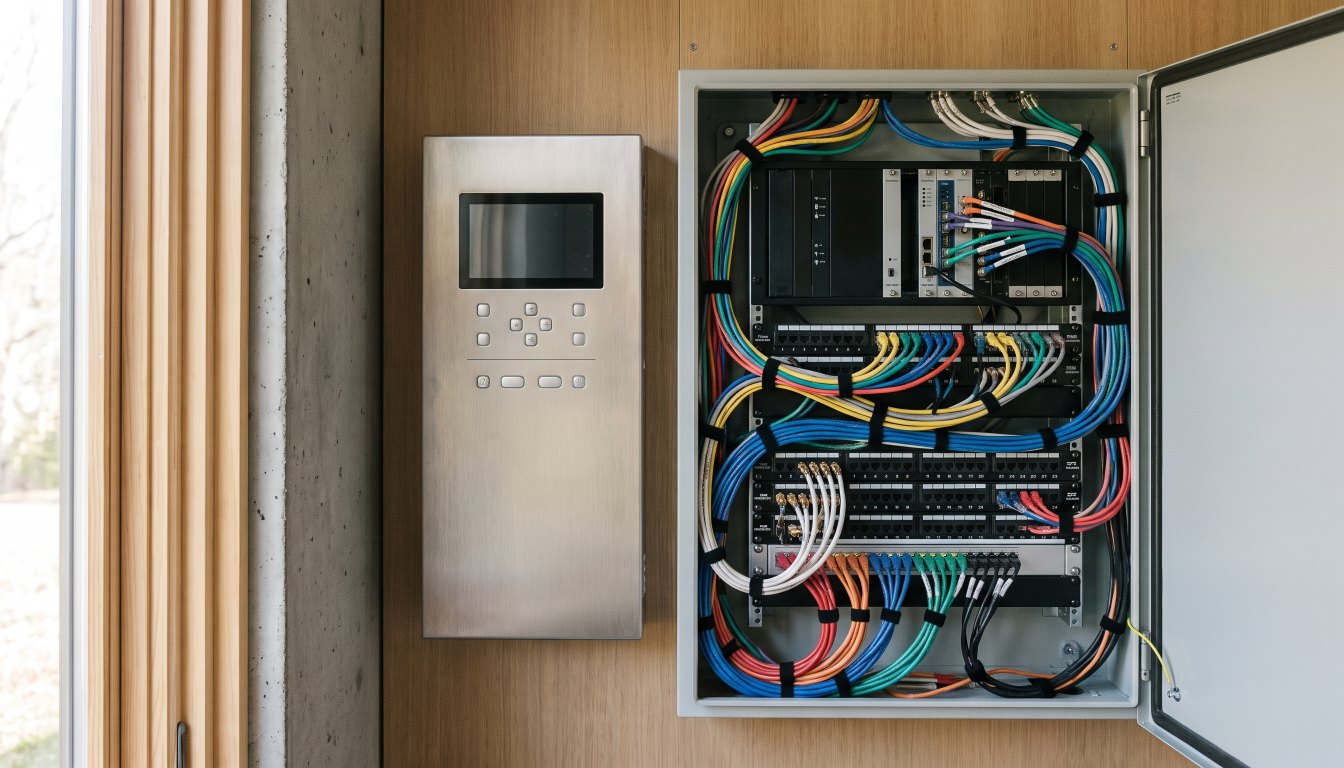
Infrastructure holds value. Gadgets do not. Conduit, structured wiring, a properly labelled low-voltage panel, adequate electrical service, hard-wired network drops, and provision for future EV charging are all things a buyer would otherwise have to open walls to add, so they are worth real money.
Proprietary, closed, integrator-locked systems are the opposite. When a system requires a specific dealer to change a light scene, and that dealer has moved on, the next owner is buying a problem. The test is simple: can one component be replaced without replacing the whole system?
The only distinction that matters
Technology in a luxury home falls into two categories, and they behave in opposite directions at resale.
| Infrastructure — holds value | Products — depreciates |
|---|---|
| Conduit to key locations | Wall-mounted touch panels |
| Structured cabling and network drops | The control processor itself |
| A labelled, organised low-voltage panel | In-wall speakers of a specific vintage |
| Electrical service with capacity to spare | Proprietary lighting keypads |
| EV charging provision at the garage | A dedicated theatre projector and screen |
| Neutral wires at every switch box | Any app-dependent device with a subscription |
The left column is worth money because a buyer cannot add it without opening finished walls. The right column is worth roughly what a buyer would pay for it used, which at ten years old is close to nothing.
The replaceability test
Ask one question about any system in the house: can one part be replaced without replacing all of it?
If a failed keypad means calling one specific integrator who alone holds the programming file, the system is a closed loop and the next owner is inheriting a dependency. If a failed switch can be swapped for anything on the market because the wiring is standard and the neutral is present, the house is future-proof.
What buyers above $3 million actually notice
They notice the electrical service
An older large house with an undersized service and a full panel is a genuine constraint on everything from EV charging to a serious kitchen. Buyers at this level check.
They notice network coverage
Large stone and plaster houses defeat consumer wireless equipment. Hard-wired access points in the right places are invisible when present and glaringly obvious when absent.
They notice EV provision
Not necessarily a charger — but a dedicated circuit, or at minimum conduit to the garage with panel capacity behind it.
They notice mechanical zoning
This is the least glamorous item on the list and the one that affects daily life most. A 6,000 square foot house on one or two zones is uncomfortable in every season, and correcting it means opening ceilings.
They do not notice, and will not pay for
- Voice control of anything
- Smart appliances with proprietary apps
- Motorised everything, particularly where a manual alternative was removed
- Any single-purpose room built around a device
Contracts that follow the house
Three categories require attention before listing, because they are legal obligations rather than equipment:
- Solar and battery systems under lease or power purchase agreements
- Alarm monitoring contracts with remaining terms
- Rented equipment — water heaters, water treatment, HVAC on a rental programme
Each of these has to be identified, disclosed and dealt with in the agreement of purchase and sale. Discovering one on the day before closing is how deals get delayed.
The practical takeaway
If you are building or renovating, spend on the wire and be conservative about the boxes. Conduit, structured cabling, panel capacity and zoning are cheap now, expensive later, and universally valued. Everything that plugs in will be replaced by the next owner regardless of what it cost you.
Frequently asked questions
Does home automation increase resale value?
The wiring does. The automation platform usually does not. Buyers value being able to add whatever system they prefer without cutting into finished walls, which is what conduit and structured cabling deliver. A five-year-old proprietary control system is usually treated as something to be replaced.
What technology should I install if I am building?
Infrastructure that outlives any product: generous conduit, hard-wired network drops to every room, a properly sized and labelled low-voltage panel, an electrical service with headroom, provision for EV charging, and neutral wires at every switch box. All of it is inexpensive during construction and expensive afterwards.
Do buyers care about solar and battery storage?
Some do, strongly. What matters commercially is whether the equipment is owned outright or subject to a lease or contract that transfers on closing. A leased system with an ongoing obligation is a negotiation item; an owned, well-documented system is a feature.
What about security and camera systems?
Cameras and alarms are expected at this level and rarely add a premium, but their absence is noticed. What buyers actually ask about is whether monitoring contracts transfer, whether recordings are stored locally or in a subscription cloud, and whether there are cameras covering interior spaces that they will want removed.
Should I remove my automation system before selling?
No, but make it usable. Leave documentation, credentials, panel labelling and a working handover. A system nobody can log into reads as a defect; the same system with a folder explaining it reads as an asset.
Does a home theatre still add value?
A dedicated, windowless, single-purpose theatre room is one of the least flexible spaces in a large house, and many buyers price it as a room to be repurposed. A well-integrated media room that also works as a family room does considerably better.
Thinking about buying or selling at the top end?
Send me the address, or the shortlist you are considering. I will tell you what the property is actually worth today, what the land is worth without the house, what the transfer tax and carrying costs will be, and whether the deal makes sense. Confidential, always.
[email protected] · 833-330-1925 · Book a free consultation
Confidential. Read personally and answered within 24 hours. I never share, sell or distribute your information.
Related reading
- 7 things luxury buyers in Toronto pay extra for (and 5 they do not)
- Luxury renovation ROI in Toronto: where the money comes back
- Does an architect-designed house hold its value in Toronto?
- What a real inspection on a luxury home should include
Sources
Everything above that is a rule, a rate or a published number comes from these. Verify anything that matters to your own deal.
- RE/MAX Canada — 2026 Spotlight on Luxury Real Estate, Greater Toronto
- Toronto Regional Real Estate Board — Market Watch, August 2026
About the author — Jatin Dua, Broker of Record
I’m the Broker of Record at RE/MAX Quantum Realty, 799 The Queensway in Etobicoke, and I work with buyers, sellers and investors across Toronto and the west GTA. A large part of my work sits in the upper end of the market, where the comparables are thin, the rules are heavier and the cost of a wrong number is measured in hundreds of thousands of dollars.
The free estimators on this site are mine. I built them because the first question every owner asks is “what is it worth?” and the honest answer starts with a number you can check yourself. [email protected] or 833-330-1925.