
Published 2 November 2026 · By Jatin Dua, Broker of Record, RE/MAX Quantum Realty
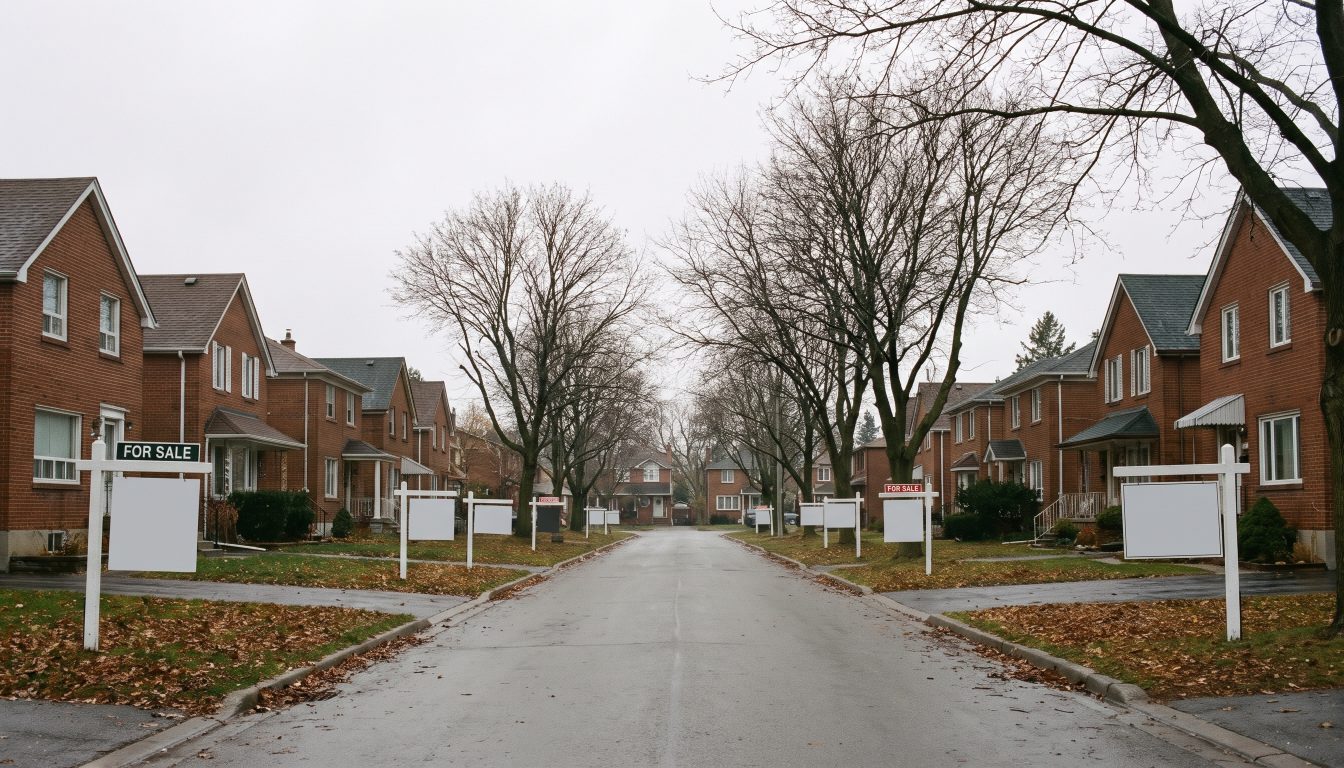
Toronto has the most homes for sale in the GTA, followed by Mississauga, Brampton, Vaughan and Markham. In TRREB’s September 2026 report they had 9,865, 2,408, 1,785, 1,267 and 1,122 active listings. All five had sales-to-new-listings ratios below 45%, so the market leans toward buyers, especially for condos.
This guide is for buyers who want the most choice and bargaining power in 2027, and for sellers who need to know how much competition they face. You will see the five GTA cities with the most homes for sale, which home types are piling up, and whether the numbers point to a buyer’s market.
Which GTA cities have the most homes for sale going into 2027?
Toronto has by far the most homes for sale, followed by Mississauga, Brampton, Vaughan and Markham. In TRREB’s September 2026 report, these five cities held 16,447 of the 26,131 active listings across the whole TRREB area. That is about 63% of everything for sale.
| Rank | City | Active listings | Sales | Average price | Months of inventory | Sales-to-new-listings ratio |
|---|---|---|---|---|---|---|
| 1 | Toronto | 9,865 | 1,937 | $1,034,320 | 4.6 | 38.5% |
| 2 | Mississauga | 2,408 | 468 | $929,600 | 4.8 | 36.5% |
| 3 | Brampton | 1,785 | 404 | $854,322 | 4.7 | 35.3% |
| 4 | Vaughan | 1,267 | 213 | $1,163,441 | 4.9 | 37.2% |
| 5 | Markham | 1,122 | 245 | $1,125,353 | 4.1 | 40.5% |
| All TRREB areas | 26,131 | 5,040 | $1,006,409 | 4.6 | 37.8% |
Source: TRREB Market Watch, September 2026, all home types. Months of inventory and sales-to-new-listings ratio are TRREB’s trend figures.
Oakville (1,073 active listings) and Richmond Hill (974) were just outside the top five. Richmond Hill had the highest months of inventory of any large GTA city, at 5.6.
The REALM data tells the same story at the end of October. Toronto’s 35 districts had 9,512 active listings, Mississauga 2,342, Brampton 1,621, Vaughan 1,211 and Markham 1,048.
Is the GTA a buyer’s market going into 2027?
The GTA is leaning toward buyers, but it is not a fire sale. Two numbers help you judge this.
- Sales-to-new-listings ratio (SNLR): the share of new listings that sell. The Canadian Real Estate Association (CREA) says a national ratio roughly between 45% and 65% is generally a balanced market. Below that leans toward buyers. All five cities above were under 45% in September 2026.
- Months of inventory: how long it would take to sell every listing at the current pace, if no new homes came on the market. CREA reported about five months of inventory nationally in February 2026 and called that in line with the long-term average. The GTA was at 4.6 months in September.
So buyers have choice and time, but well-priced homes still sell close to asking. In September, homes across the TRREB area sold for 98% of their list price on average. In Toronto it was 99%.
Here is something many people miss: there are fewer homes for sale than a year ago. In the REALM data for Toronto and the surrounding TRREB municipalities, active listings at the end of October fell from 26,680 in 2025 to 24,050 in 2026. Sales also fell, from 51,581 to 50,427 for January to October. Prices are soft because buyers are cautious, not because the market is flooded. TRREB said buyers were in a holding pattern in September, with sales down 9% and new listings down 14.4% from a year earlier.
1. Toronto: the most listings by far, mostly condos
What the numbers say: 9,865 active listings in September, with 4.6 months of inventory and an SNLR of 38.5%. But the supply is lopsided. At the end of October, condo apartments made up 5,289 of Toronto’s 9,512 active listings in the REALM data, more than half.
Who it suits: condo buyers. With about 5.8 months of condo apartment supply and median condo prices down in most districts, condo buyers have the most leverage in the GTA right now.
What to check: freehold houses are a different story. Toronto semis had only about 2.7 months of supply, and in September semis sold for 104% of list price on average. If you want a Toronto semi or townhouse, expect competition. My guide to the Toronto areas with the most condos for sale breaks the condo supply down by district.
2. Mississauga: the most choice outside Toronto
What the numbers say: 2,408 active listings in September, 4.8 months of inventory and an SNLR of 36.5%. Homes sold for 97% of list price on average. At the end of October, there were 901 detached homes and 813 condo apartments for sale.
Who it suits: buyers who want lots of choice across every home type. Mississauga’s condo apartments had about 6.7 months of supply, and the median condo price was $485,000, down 9.3% from 2025. Detached homes had about 5.0 months of supply, with a median of $1,225,000, down 5.8%.
What to check: in a city this large, the averages hide big gaps between neighbourhoods. Compare recent sales on your exact street or in your exact building. My Mississauga housing market outlook has more detail.
Instant Home Valuation
What’s your home
worth today?
Answer six quick questions and get an instant value range built from current Toronto & GTA sale data — property type, size, condition, lot and location all weighted the way a real pricing conversation weighs them. Takes about ninety seconds.
Reading recent GTA sale data…
Building your estimate
Estimated market value
—
$0–$0
Most likely value $0 · roughly $0 per square foot
What moved the number
Starting from the area baseline for your property type, here’s what each answer added or subtracted.
Market context
Recent local averages for comparison.
—
A range is a starting point.
A strategy is what sells.
This model doesn’t know that your neighbour’s identical semi went $80,000 over asking last month, or which two upgrades actually pay back in your area. That conversation is free and takes twenty minutes.
3. Brampton: fewer listings than last year, but buyers still have room
What the numbers say: 1,785 active listings in September, 4.7 months of inventory and the lowest SNLR of the five, at 35.3%. Homes sold for 97% of list price.
The twist: Brampton’s listings dropped sharply. At the end of October there were 1,621 active listings in the REALM data, down from 2,201 a year earlier, a fall of about 26%. Detached sales rose 9% to 2,280, even as the median detached price fell 8.9% to $950,000. Lower prices brought buyers back.
Who it suits: buyers looking for a detached home under $1 million, and condo buyers. Brampton condo apartments had about 7.3 months of supply and took 53 days to sell on average.
What to check: semis and freehold towns are tight, with only about 2.5 and 3.1 months of supply. Do not assume every home type in Brampton is a buyer’s market. See my Brampton housing market outlook for the full picture.
4. Vaughan: homes take the longest to sell
What the numbers say: 1,267 active listings in September, 4.9 months of inventory and an SNLR of 37.2%. Vaughan homes sat on the market the longest of the five cities in September, at 42 days on average.
Who it suits: patient buyers. Condo townhouses had about 8.5 months of supply in the REALM data, and condo apartments about 6.4 months. The median detached price was $1,415,000, down 5.0%.
What to check: a long time on market often means the first price was too high. Ask for the listing history, including any price drops and earlier listings that were taken down and relisted. My Vaughan housing market outlook has more on prices by home type.
5. Markham: a big market that is still fairly tight
What the numbers say: 1,122 active listings in September, but only 4.1 months of inventory, the lowest of the five. Its SNLR of 40.5% was also the highest, so Markham was the closest of these cities to a balanced market.
Who it suits: condo buyers, who saw the median condo apartment price fall 13.2% to $558,000. Detached buyers have less room. The median detached price was $1,420,000, down 6.5%, with about 4.1 months of supply.
What to check: in a tighter market, a lowball offer on a well-priced home can lose you the house. Base your offer on the last few sales, not on the headline that prices are down.
Which home types have the most supply in these five cities?
Condos have the most supply everywhere. Semis and freehold townhouses are the tightest in all five cities.
| City | Detached | Semi | Freehold town | Condo town | Condo apartment |
|---|---|---|---|---|---|
| Toronto | 4.3 | 2.7 | 3.3 | 5.8 | 5.8 |
| Mississauga | 5.0 | 3.1 | 4.1 | 4.6 | 6.7 |
| Brampton | 4.2 | 2.5 | 3.1 | 6.5 | 7.3 |
| Vaughan | 4.6 | 3.0 | 3.3 | 8.5 | 6.4 |
| Markham | 4.1 | 2.8 | 3.5 | 4.1 | 5.6 |
Source: my calculation from TRREB MLS data via REALM: active listings at the end of October 2026 divided by average monthly sales from January to October 2026. Rough months of supply, not a forecast.
For a seller, this table matters more than the city headline. A detached owner in Markham faces about four months of competing supply. A condo townhouse owner in Vaughan faces more than eight.
How should buyers and sellers use high inventory in 2027?
If you are buying
- Get pre-approved first. The Bank of Canada raised its policy rate to 2.50% on 28 October 2026 and said it may need to raise rates again. Prime is now 4.70%.
- Look at homes that have been listed for three weeks or more. That is where sellers are most open to offers.
- Ask for conditions you might have skipped in a hot market, such as a home inspection and financing.
- Remember the down payment rules: at least 5% of the first $500,000 and 10% of the part up to $1.5 million, and 20% at $1.5 million or more.
If you are selling
- Price off the most recent sales, not last spring’s prices. In my experience, overpriced homes sit, and homes that sit too long often end up selling for less.
- Know your months of supply. If your home type has six months or more, plan for a longer sale and better presentation.
- Timing matters less than price. My post on whether 2027 is a good time to sell covers the trade-offs.
More listings do not always mean lower prices on the home you want. Semis had about three months of supply or less in all five cities, and Toronto semis sold above asking on average in September. If you go in assuming every seller is desperate, you can lose good homes to buyers who did their homework.
My view, and it is only a view: going into 2027, the best leverage for buyers is in condo apartments and condo townhouses in Toronto, Mississauga, Brampton and Vaughan, where supply is six months or more in several cases. Freehold buyers have some room, but less than the headlines suggest. Sellers who price right from day one are still selling at about 97% to 99% of asking. I would not expect a big rebound or a crash. Rates are the wild card, and nobody can promise where they go next.
What to do next
- Pick the home type and city you want, then check its months of supply in the table above.
- Get a mortgage pre-approval before you start touring, so you can move when a good listing has sat.
- Use the estimator on this page to check what your current home is worth before you list or buy.
- Ask for a list of homes in your target area that have been on the market for more than 21 days.
- Book a call with me to plan your buying or selling strategy for early 2027.
Need help with this? Talk to me.
I’m Jatin Dua, Broker of Record at RE/MAX Quantum Realty, and I’m the best agent to do this kind of work for you in Toronto and across the GTA. Over $100 million in GTA sales and 100+ families helped sell. Feel free to contact me any time: call or text 833-330-1925 or email [email protected].
Frequently asked questions
Is 2027 going to be a buyer’s market in the GTA?
The GTA was leaning toward buyers going into 2027. In September 2026, TRREB reported a sales-to-new-listings ratio of 37.8% and 4.6 months of inventory. CREA treats a ratio between about 45% and 65% as balanced nationally, so the GTA was below that range. Rates and the economy could still change this in 2027.
Which GTA city has the most listings?
Toronto has the most listings in the GTA by far, with 9,865 active listings in TRREB’s September 2026 report. Mississauga was second with 2,408, then Brampton with 1,785, Vaughan with 1,267 and Markham with 1,122. Together, these five cities held about 63% of all active listings in the TRREB area.
Are there more homes for sale in the GTA than last year?
No, there are slightly fewer. In the REALM data for Toronto and the surrounding TRREB municipalities, active listings at the end of October 2026 were 24,050, down from 26,680 a year earlier. Sales also fell. Prices are soft mainly because buyers are cautious, not because the GTA is flooded with listings.
What does months of inventory mean in real estate?
Months of inventory is how long it would take to sell every home for sale at the current pace of sales, if no new listings came on. Fewer months favours sellers and more months favours buyers. In September 2026, TRREB reported 4.6 months for the GTA, 4.1 in Markham and 5.6 in Richmond Hill.
Where do GTA homes take the longest to sell?
Among the five GTA cities with the most listings, Vaughan homes took the longest to sell, at 42 days on average in September 2026, according to TRREB. Condo apartments are slow across the region. In Brampton, condo apartments took 53 days on average from January to October 2026, based on TRREB MLS data via REALM.
Are Toronto houses still selling over asking in 2026?
Some are. In September 2026, Toronto semi-detached homes sold for 104% of list price on average and Toronto freehold townhouses for 102%, according to TRREB. Detached houses sold for 98% and condo apartments for 97%. Across all home types, Toronto homes sold for 99% of list price on average.
Is it a good time to buy a condo in Mississauga in 2027?
For buyers with stable income, Mississauga offers lots of condo choice going into 2027. There were 813 condo apartments for sale at the end of October 2026, about 6.7 months of supply, and the median price was $485,000, down 9.3% from 2025, based on TRREB MLS data via REALM. Higher rates are the main risk.
Which home types are hardest to find in the GTA right now?
Semi-detached homes and freehold townhouses are the hardest to find in the five biggest GTA markets. At the end of October 2026, semis had only about 2.5 to 3.1 months of supply in Toronto, Mississauga, Brampton, Vaughan and Markham, based on TRREB MLS data via REALM. Condo apartments had about 5.6 to 7.3 months.
Should I wait for more listings before buying in the GTA?
Waiting for more listings may not help much. Active listings in the GTA were lower at the end of October 2026 than a year earlier, not higher. Buying while other buyers are cautious can give you more room to negotiate. Rates could also rise again after the Bank of Canada’s October 2026 hike.
Sources
- TRREB Market Watch, September 2026
- TRREB: Economic uncertainty kept GTA homebuyers on the sidelines in September
- CREA: Canadian housing activity stays quiet in February 2026
- Bank of Canada: Policy rate announcement, 28 October 2026
- Government of Canada: Saving for a down payment
Related reading
- Top 5 Best Neighbourhoods to Live in Mississauga in 2027
- Top 5 Best Neighbourhoods to Live in Brampton in 2027
- Top 5 Best Neighbourhoods to Live in Markham in 2027
- Top 5 Best Neighbourhoods to Live in Oakville in 2027
About the author — Jatin Dua, Toronto and GTA real estate broker
I am Jatin Dua, Broker of Record and co-founder of RE/MAX Quantum Realty Inc., Brokerage, Unit 101, 799 The Queensway, Toronto. I work with buyers and sellers across Toronto and the GTA and have helped more than 100 families sell. Four-plus years of active GTA transactions and over $100 million in sales volume.
Reach me at [email protected] or 833-330-1925, or book a call.