
Published 2 November 2026 · By Jatin Dua, Broker of Record, RE/MAX Quantum Realty
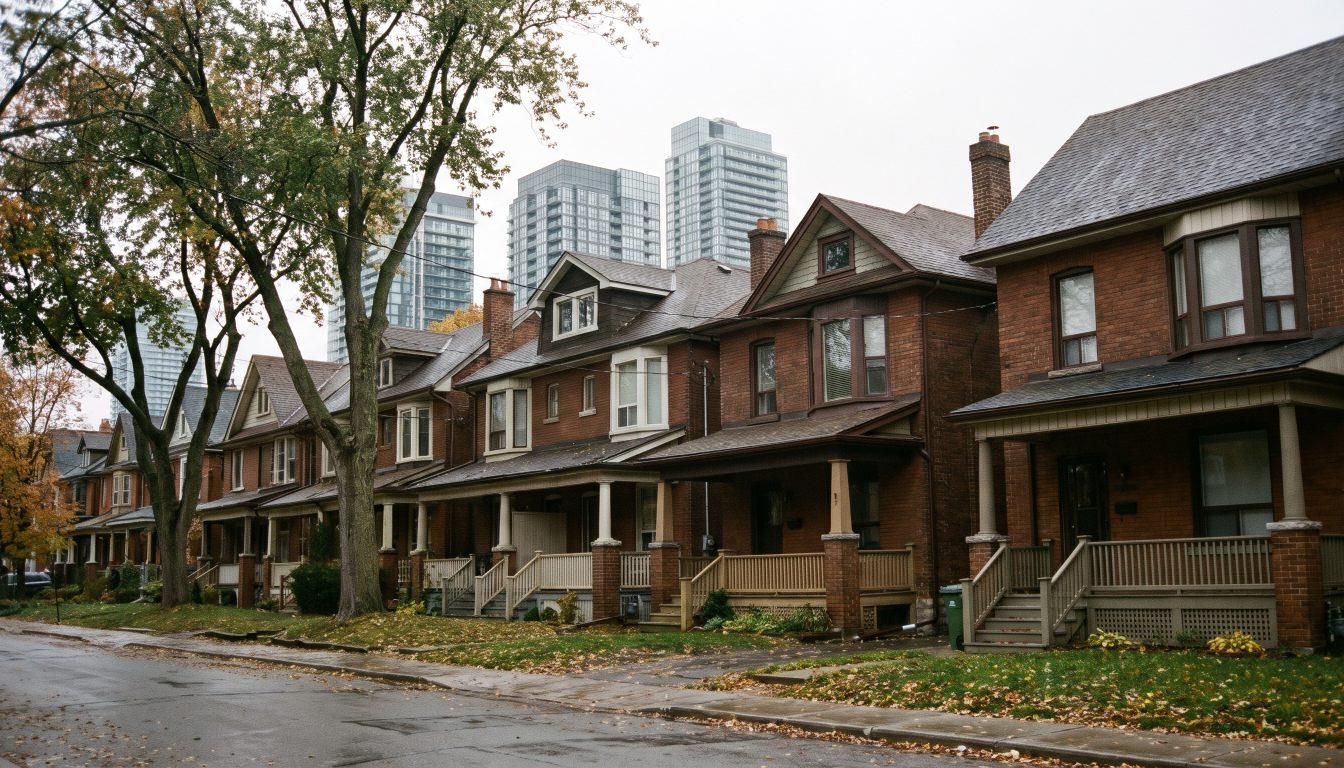
When rates rise, buyers can borrow less, so sales slow first and prices usually soften after. After the Bank of Canada began hiking in 2022, the GTA average price fell from $1,334,544 in February 2022 to $1,024,108 in October 2026. A small hike like October 2026’s mainly adds pressure to a market that was already soft.
This guide is for GTA buyers, sellers and owners who want to know what the Bank of Canada’s October 2026 rate hike could do to house prices in 2027. You will get the mechanics in plain English, what the last rate cycle did to Toronto-area prices, and the latest city-by-city numbers to plan with.
Do house prices go down when interest rates rise?
Usually, yes, but with a lag and not one-for-one. Higher rates raise the monthly payment on any given loan. Buyers who budget by payment, which is most buyers, can borrow less. Fewer buyers can pay last year’s prices, so sales drop first. If sellers do not need to sell, listings drop too, and prices slip slowly instead of falling fast.
Rates are not the only force. Jobs, population growth, new supply and confidence all matter. In its October 2026 release, TRREB said uncertainty about inflation, borrowing costs and the economy kept many GTA buyers on the sidelines, and its CEO pointed to continued population growth over the longer term. Rates set the pressure; the other forces decide how much it shows up in prices.
What happened to GTA prices the last time rates rose?
The last big cycle is the best guide we have. The Bank of Canada’s policy rate was 0.25% in February 2022. It began raising rates on 2 March 2022 and reached 5% on 12 July 2023. Cuts began on 5 June 2024 and took the rate down to 2.25% by 29 October 2025. On 28 October 2026 the Bank raised it again, to 2.50%.
| Measure (GTA, TRREB) | February 2022 | October 2026 | Change |
|---|---|---|---|
| Bank of Canada policy rate | 0.25% | 2.50% | +2.25 points |
| 5-year mortgage rate listed by TRREB | 4.79% | 6.19% | +1.40 points |
| Average price, all home types | $1,334,544 | $1,024,108 | −23.3% |
| Average price, detached | $1,797,203 | $1,310,627 | −27.1% |
| Average price, condo apartment | $799,966 | $621,400 | −22.3% |
Source: TRREB Market Watch, February 2022 and October 2026; Bank of Canada rate announcements. Percentage changes are my arithmetic. The months differ, so some of the gap is seasonal.
Two lessons. First, the fall was large and it outlasted the hikes: prices stayed well below the peak even after the Bank cut its rate from 5% to 2.25%. Second, cuts did not bring a quick rebound. My reading is that prices had run far ahead of what incomes could carry once rates were no longer near zero.
How does a rate hike shrink what buyers can borrow?
The mortgage stress test makes every rate move count twice. Under OSFI’s rule for uninsured loans, and CMHC’s rule for insured ones, buyers must qualify at the higher of their contract rate plus two points or 5.25%. When contract rates rise, the qualifying rate rises with them.
Here is what that does to a buyer who can afford $4,000 a month in principal and interest at the qualifying rate, over 25 years.
| Contract rate | Qualifying rate | Largest mortgage |
|---|---|---|
| 3.75% | 5.75% | $639,977 |
| 4.25% | 6.25% | $610,928 |
| 4.75% | 6.75% | $583,899 |
| 5.25% | 7.25% | $558,723 |
Source: OSFI minimum qualifying rate; my arithmetic, 25-year amortization, interest compounded twice a year. Example rates, not quotes.
Each half-point rise in rates cuts this buyer’s maximum mortgage by about 4% to 5%. Multiply that across thousands of buyers and you get the slower sales and softer prices we see in GTA data. The October 2026 hike was a quarter point, so its direct effect on budgets is smaller, but TRREB’s own figures show five-year rates already sat well above 2022 levels.
Where are GTA prices going into 2027?
TRREB reported 5,603 GTA sales in October 2026, down 7.9% from October 2025. The average price was $1,024,108, down 2.7%, and the MLS Home Price Index composite benchmark was down 4.3% year over year. New listings fell 11.9%. On a seasonally adjusted basis, both sales and prices edged up from September.
The year-to-date picture by city shows how broad the softness has been since 2024:
| Area | Detached 2024 | Detached 2026 | Change | Condo apt 2024 | Condo apt 2026 | Change |
|---|---|---|---|---|---|---|
| Mississauga | $1,371,085 | $1,225,000 | −10.7% | $583,000 | $485,000 | −16.8% |
| Brampton | $1,127,250 | $950,000 | −15.7% | $540,000 | $415,000 | −23.1% |
| Markham | $1,650,000 | $1,420,000 | −13.9% | $700,000 | $558,000 | −20.3% |
| Vaughan | $1,590,000 | $1,415,000 | −11.0% | $635,000 | $530,000 | −16.5% |
| Oakville | $1,763,000 | $1,625,000 | −7.8% | $620,000 | $528,000 | −14.8% |
| Pickering | $1,190,000 | $1,039,999 | −12.6% | $569,450 | $470,000 | −17.5% |
| Toronto C01 (downtown) | $1,890,000 | $1,500,000 | −20.6% | $680,000 | $600,000 | −11.8% |
Source: TRREB MLS data via REALM, median sold prices, January–October 2024 vs January–October 2026. C01 detached sales are few (57 in 2026), so treat that figure with care.
Homes also take longer to sell. In Mississauga, the average days on market for a detached house went from 22 to 31 over the same two periods, and for a condo apartment from 31 to 42. That is what a market with fewer qualified buyers looks like.
Instant Home Valuation
What’s your home
worth today?
Answer six quick questions and get an instant value range built from current Toronto & GTA sale data — property type, size, condition, lot and location all weighted the way a real pricing conversation weighs them. Takes about ninety seconds.
Reading recent GTA sale data…
Building your estimate
Estimated market value
—
$0–$0
Most likely value $0 · roughly $0 per square foot
What moved the number
Starting from the area baseline for your property type, here’s what each answer added or subtracted.
Market context
Recent local averages for comparison.
—
A range is a starting point.
A strategy is what sells.
This model doesn’t know that your neighbour’s identical semi went $80,000 over asking last month, or which two upgrades actually pay back in your area. That conversation is free and takes twenty minutes.
Why do condos feel rate hikes more than houses?
Condo apartments fell more than detached homes in almost every city above. Part of the reason, in my experience, is who buys them. Many condo buyers are investors, and an investor’s maths depends on rent versus mortgage cost. When rates rise, the gap widens and investors step back.
Urbanation’s third-quarter 2026 report shows the strain. Average resale condo prices across the Greater Toronto and Hamilton Area were down 5.7% from a year earlier to $724 per square foot, and bulk buyers of unsold new units paid on average 40% less than the original prices in the same buildings. There is a counterweight: Urbanation’s rental report says GTHA condo rents rose 2.4% from the second quarter and listings for rent fell 25% from a year earlier, and it expects rents to keep recovering as completions fall.
What do the Bank of Canada and TRREB expect for 2027?
The Bank of Canada expects inflation to average about 3% in 2027 and return to 2% by the middle of 2028. It expects growth to pick up in 2027, but said housing should remain relatively weak. It also said there could be a need to raise rates further, and that it will proceed carefully. As of 28 October 2026, markets priced roughly a 43% chance of another hike in December, and some economists, including at RBC, expected more hikes. Those are forecasts, not facts.
The next decision is on 9 December 2026. The 2027 decision dates are 27 January, 3 March, 28 April, 2 June, 21 July, 8 September, 27 October and 8 December.
TRREB’s president said a Canada-US trade deal and an end to the Middle East conflict could ease inflation worries and renew interest in buying in 2027. Its chief information officer noted that lower prices have softened the effect of higher rates on monthly payments.
Will a rate hike lower house prices in 2027?
My view, and it is only a view: one quarter-point hike on its own is unlikely to cause a fresh slide like 2022. Prices have already reset a long way, and many sellers are holding back. What a hike does is keep the lid on. If the Bank raises again in December or early 2027, I would expect sales to stay slow and prices to drift rather than recover, with condos weakest. If rates hold and trade tension eases, a flat 2027 is more likely than a drop. Nobody can promise either, so plan around your own timeline, not a forecast.
For a deeper look at the forecasts, see will mortgage rates go down in 2027 and the wider GTA housing market forecast for 2027.
What rising rates mean if you are selling or buying in 2027
If you are selling
Price to what has sold in the last 90 days, not to 2024 or to a neighbour’s asking price. Buyers’ budgets were cut by the stress test, and they know it. The common errors are in the top mistakes sellers make when rates are rising.
If you are buying
Rising rates give you room to negotiate, but they also shrink what you can borrow. Get a pre-approval with a rate hold before you shop, and check what the hike did to your payment in what the October 2026 hike means for the GTA.
If you own and are renewing
Owners matter as much as buyers. Many GTA households who took five-year fixed mortgages in 2021 and 2022, when rates were low, have already renewed at higher rates or will soon. In my experience most absorb the jump, but some cannot, and they list. Rising rates add a small number of motivated sellers, which tends to hold prices down in the segments where those owners sit, often condos and newer townhomes bought at the peak. If that is you, start with your 2027 renewal options after the rate hike, well before your renewal date.
Do not buy now on the assumption that rates will fall before your renewal. The Bank of Canada itself says another increase could be needed. Make sure you could carry the payment at least one or two points higher, which is what the stress test is meant to check.
What to do next
- Get a current value for your home with the estimator on this page, based on recent sales, not peak prices.
- Look up your city or district’s 2026 median and days on market in the table above, and compare with your plans.
- If you have a mortgage renewing in 2027, ask your lender now what your payment would be at today’s rates.
- Mark 9 December 2026 and 27 January 2027 in your calendar; both are rate decision dates.
- If you are deciding whether to sell or buy anywhere in the GTA in 2027, ask me for a written plan built on local sales.
Need help with this? Talk to me.
I’m Jatin Dua, Broker of Record at RE/MAX Quantum Realty, and I’m the best agent to do this kind of work for you in Toronto and across the GTA. Over $100 million in GTA sales and 100+ families helped sell. Feel free to contact me any time: call or text 833-330-1925 or email [email protected].
Frequently asked questions
Do house prices drop when interest rates go up?
House prices usually soften when interest rates go up, but slowly and not by a fixed amount. Higher rates cut what buyers can borrow, so sales fall first. In the GTA, the average price fell from $1,334,544 in February 2022 to $1,024,108 in October 2026, a period that began with the Bank of Canada’s 2022 rate hikes.
Will the October 2026 rate hike lower GTA house prices?
The October 2026 hike to 2.50% is small on its own, so it is more likely to keep GTA prices flat than cause a sharp drop. TRREB reported October 2026 average prices down 2.7% from a year earlier. A larger effect would come if the Bank of Canada raises rates again in December 2026 or in 2027.
How do interest rates affect the housing market in 2027?
In 2027, interest rates affect the GTA housing market mainly through borrowing power. Buyers must pass the stress test at the higher of their rate plus two points or 5.25%, so each half-point rise cuts the largest mortgage they can get by about 4% to 5%. Fewer qualified buyers means slower sales and softer prices.
How much does a 1% rate increase reduce what I can borrow?
A 1% rate increase reduces what you can borrow by roughly 8% to 9% at today’s rates. For example, a buyer who can carry $4,000 a month over 25 years could borrow about $610,928 at a 4.25% contract rate but about $558,723 at 5.25%, because the stress test rate rises with it.
Are condo prices more sensitive to interest rates than houses?
Yes, condo prices in the GTA have been more sensitive to rates than detached houses. From January to October 2024 vs the same months of 2026, condo apartment medians fell 16.8% in Mississauga and 20.3% in Markham, compared with 10.7% and 13.9% for detached homes, according to TRREB MLS data via REALM.
When is the next Bank of Canada rate decision?
The next Bank of Canada rate decision is on 9 December 2026. The 2027 decision dates are 27 January, 3 March, 28 April, 2 June, 21 July, 8 September, 27 October and 8 December. Announcements are at 9:45 a.m. Eastern, with a Monetary Policy Report in January, April, July and October.
Did house prices go up when the Bank of Canada cut rates in 2024 and 2025?
No, GTA house prices did not rise much when the Bank of Canada cut rates from June 2024 to October 2025. Year-to-date TRREB data via REALM show detached and condo medians lower in 2026 than in 2024 in every major GTA city in this guide, even though the policy rate was cut from 5% to 2.25%.
Should I wait for rates to drop before buying a house in the GTA?
Waiting for rates to drop is a gamble in 2027. The Bank of Canada raised rates in October 2026 and said more increases could be needed, so lower rates are not assured. Buy when the payment works for your budget at a rate one or two points higher, and when you plan to stay several years.
Sources
- Bank of Canada raises the policy rate by 25 basis points to 2½% (28 October 2026)
- Bank of Canada: Policy interest rate (recent decisions)
- Bank of Canada increases policy interest rate (2 March 2022)
- Bank of Canada raises policy rate to 5% (12 July 2023)
- TRREB Market Watch, October 2026
- TRREB Market Watch, February 2022
- OSFI: Minimum qualifying rate for uninsured mortgages
- Urbanation: GTHA new condo sales double from a year ago in Q3 (19 October 2026)
Related reading
- The Bank of Canada Raised Rates: What It Means for GTA Buyers, Sellers and Owners
- Variable-Rate Mortgage After the Hike: How Much Your Payment Changes
- Should I Lock In My Variable Mortgage Before 2027?
- Mortgage Renewal in 2027 After the Rate Hike: Your Options in Ontario
About the author — Jatin Dua, Toronto and GTA real estate broker
I am Jatin Dua, Broker of Record and co-founder of RE/MAX Quantum Realty Inc., Brokerage, Unit 101, 799 The Queensway, Toronto. I work with buyers and sellers across Toronto and the GTA and have helped more than 100 families sell. Four-plus years of active GTA transactions and over $100 million in sales volume.
Reach me at [email protected] or 833-330-1925, or book a call.
More from the library
- Tarion Warranty for Pre-Construction Condos: What Is Covered, What Is Not, and Every Deadline
- Luxury Renovation ROI in Toronto: Where the Money Comes Back
- Mortgage Broker vs Bank in Ontario: Which Should You Use?
- Top 10 things no one will tell you about Parkdale, Toronto — except your local real estate expert
- Top 5 Condo Buildings to Rent in Forest Hill, Toronto (2026)
- Alter, 89 McGill St: Tridel’s Shifting-Box Tower at Church and McGill
How this estimate is produced
The estimate blends recent selling prices for comparable units in the area with the details you entered: size, bedrooms, floor, exposure, parking, locker and condition. It is a statistical estimate, not an appraisal and not a formal opinion of value.
What it cannot see
- Interior condition and upgrades beyond what you told it
- Unit-specific issues: noise, an obstructed view, a pending special assessment
- Your reserve fund and where the maintenance fee is heading
- What is competing with you in your own building right now
What moves the number most
- Floor and exposure, which can separate otherwise identical units
- Parking and locker, each priced separately by buyers
- Kitchen and bathroom condition
- Maintenance fee per square foot against the rest of the building
Treat it as a range, not a price
A single figure to the dollar would be false precision. Use the estimate to decide whether a move is worth exploring. Before you price anything for the market, the number needs checking against what is actually selling and sitting in your building this month, and that takes a person. I will do that for you at no cost and with no obligation.
Market data is sourced from the Toronto Regional Real Estate Board. Information is deemed reliable but is not guaranteed. This tool does not provide an appraisal or a formal opinion of value, and it is not a substitute for advice on your specific property. Jatin Dua, Broker of Record, RE/MAX Quantum Realty.
