
Published 7 September 2026 · Updated 29 September 2026 · By Jatin Dua, Broker of Record, RE/MAX Quantum Realty
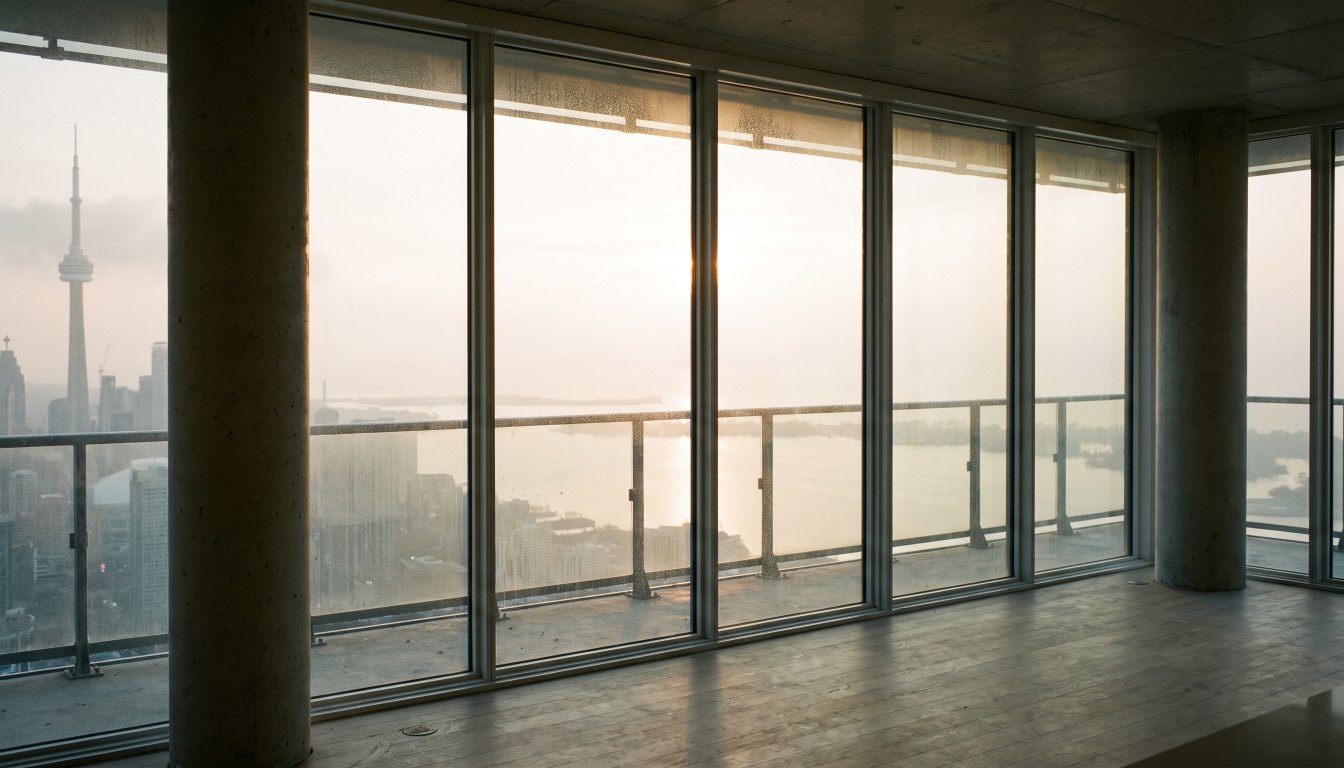
A view is worth a premium only to the extent that it is protected. An unprotected view over a low-rise commercial site is a temporary amenity being sold as a permanent one. A view over Lake Ontario, over a ravine, over a park, or over a Heritage Conservation District is structurally different, because something other than luck is preventing a building from appearing in it.
The test is mechanical. Identify every site in your sightline, check what the zoning permits there, check for active development applications, and ask whether the buildings in front are already built to their permitted height. Ten minutes of that work is worth more than any adjective in the listing.
Two kinds of view
| Protected view | Unprotected view |
|---|---|
| Over Lake Ontario, with nothing developable in between | Over a surface parking lot |
| Over a ravine or valley subject to ravine protection and TRCA regulation | Over a two-storey commercial strip on a site zoned for far more |
| Over a public park | Over an aging low-rise building on a large site |
| Over a Heritage Conservation District where a district plan controls scale and massing | Over any site with an active development application |
| Over sites already built to their permitted height | Over sites well below their permitted height |
The difference is not the quality of what you are looking at today. It is whether anything other than luck is keeping it there.
The ten-minute test
- Stand at the window and identify each site in the sightline. Not vaguely — specifically, address by address.
- Check what the zoning permits on each. A site zoned for a 30-storey building with a four-storey building on it is a future wall.
- Check for active development applications. The City publishes them. A proposal in the system is the clearest possible warning.
- Note which sites are already built out. A tower already at its permitted height is not going to grow.
- Identify anything permanently protected. Water, ravine, park, heritage district, school land, cemetery.
Why heritage districts protect views
A Part V Heritage Conservation District applies an area-wide plan that governs demolition, additions and new construction, requiring compatibility in scale, massing, materials and fenestration. A unit overlooking South Rosedale, North Rosedale, Wychwood Park, Yorkville–Hazelton, the East Annex or Teiaiagon–Baby Point is looking at a streetscape that a planning instrument is actively maintaining.
The same logic applies to ravine and valley lands, where Municipal Code Chapter 658 and TRCA regulation under O. Reg. 41/24 make development on the protected land itself extremely difficult.
What the view premium should reflect
In practice buyers pay for four separate things that get bundled into the word “view”:
- Outlook — what you actually see
- Light — a function of orientation, not of the view itself
- Openness — the absence of a building close in front, which affects privacy as much as scenery
- Permanence — whether all of the above survives
A unit with modest outlook but excellent light, privacy and permanence is very often a better buy than a spectacular unprotected panorama at a premium.
The practical takeaway
Never pay a view premium you have not verified. Ten minutes with the zoning map and the development application list will tell you whether you are buying a permanent asset or renting a temporary one at a purchase price. If the view is protected, pay for it — it is one of the few things in a condominium that cannot be renovated in or out.
Frequently asked questions
Which Toronto condo views are actually protected?
Views over water, over ravines and valley lands subject to the City’s ravine protection and TRCA regulation, over public parks, and over Heritage Conservation Districts where a district plan controls scale and massing. Views over surface parking, low-rise commercial buildings and underdeveloped sites are the ones most likely to disappear.
How do I check if something can be built in front of my unit?
Identify the sites in your sightline, check the zoning that applies to each, look for active development applications on the City’s planning portal, and note whether existing buildings are already at their permitted height. A site already built to its limit is far safer than one well below it.
Is a lake view always safe in Toronto?
The water itself cannot be built on, but the land between you and it can be. Many waterfront views have been lost to later towers on intervening sites. What matters is not that you can see the lake, but what stands between you and it.
Does a view premium hold at resale?
A protected view generally does, because the next buyer can verify the same protections you did. An unprotected view holds until a crane appears, at which point the premium disappears faster than the building goes up.
What about north versus south exposure?
South and west exposures usually command more, for light and for the lake. North light is steadier and easier to live with for anyone working from home, and north-facing units often sit at a discount that does not reflect how good they are to occupy.
Should I pay more for a higher floor?
Up to a point. Height buys view, light and quiet, but the increments flatten once you are clear of surrounding buildings. The step that matters most is the floor at which the view opens up — check where that is in the building rather than assuming higher is proportionally better.
Thinking about buying or selling at the top end?
Send me the address, or the shortlist you are considering. I will tell you what the property is actually worth today, what the land is worth without the house, what the transfer tax and carrying costs will be, and whether the deal makes sense. Confidential, always.
[email protected] · 833-330-1925 · Book a free consultation
Confidential. Read personally and answered within 24 hours. I never share, sell or distribute your information.
Related reading
- Penthouse, sub-penthouse or full floor: what the labels actually mean
- Buying a luxury condo in Toronto: the 2026 buyer’s guide
- What is my condo worth? Floor, view and parking, priced
- Free AI condo value estimator for Toronto
Sources
Everything above that is a rule, a rate or a published number comes from these. Verify anything that matters to your own deal.
- City of Toronto — Heritage Conservation Districts
- City of Toronto — Municipal Code Chapter 658, Ravine and Natural Feature Protection
- Real Estate Magazine — Q1 2026 condominium market (Urbanation data)
About the author — Jatin Dua, Broker of Record
I’m the Broker of Record at RE/MAX Quantum Realty, 799 The Queensway in Etobicoke, and I work with buyers, sellers and investors across Toronto and the west GTA. A large part of my work sits in the upper end of the market, where the comparables are thin, the rules are heavier and the cost of a wrong number is measured in hundreds of thousands of dollars.
The free estimators on this site are mine. I built them because the first question every owner asks is “what is it worth?” and the honest answer starts with a number you can check yourself. [email protected] or 833-330-1925.