
Published 7 September 2026 · Updated 29 September 2026 · By Jatin Dua, Broker of Record, RE/MAX Quantum Realty
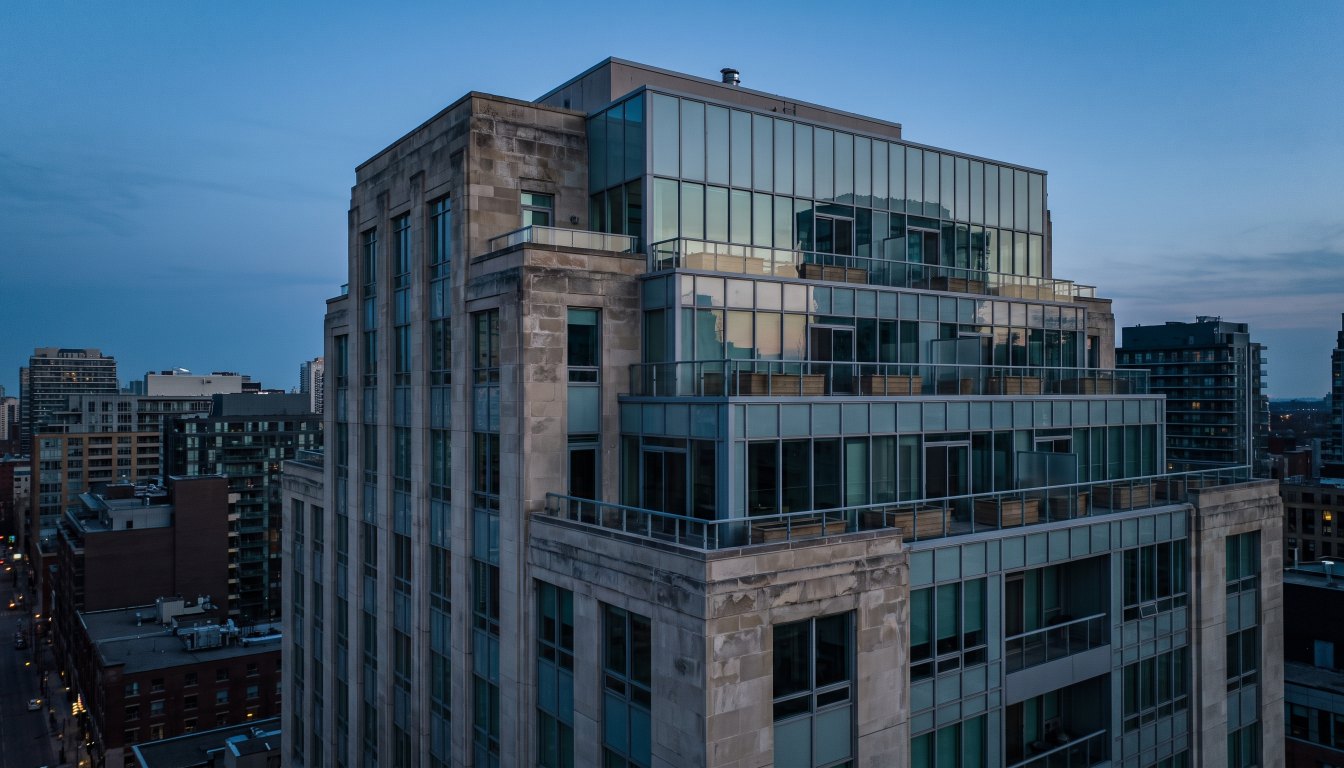
None of these terms is regulated. “Penthouse” is a marketing description, and a building can label an entire top floor of eight units “PH1” through “PH8.” What is legally definite is the unit and level number in the declaration, which is what appears on title and in the status certificate.
What actually creates value at the top of a tower is measurable: ceiling height, which is often greater on upper floors; exposure count, since a full floor has four; outdoor space, since setbacks create terraces; private elevator access; and a view that nothing can be built in front of. Judge those, not the label.
The labels, and what they are worth
| Label | What it means legally | What it usually means in practice |
|---|---|---|
| Penthouse | Nothing | A unit on or near the top floor, sometimes one of many so labelled |
| Sub-penthouse | Nothing | The floor below the penthouse-labelled units, often with the same ceiling height and view |
| Full floor | Nothing, but verifiable | One unit occupying an entire floor plate: four exposures, no corridor wall, usually direct elevator arrival |
| Half floor | Nothing, but verifiable | Two or three exposures, one shared wall |
| Unit and level in the declaration | Everything | What is actually on title and in the status certificate |
What actually creates the premium
Ceiling height
Upper floors in many buildings are constructed with greater slab-to-slab height. This is the most durable of the top-floor advantages, because it cannot be altered and it changes how every room in the unit feels.
Number of exposures
A full floor gives you four. Light through the whole day, cross-ventilation where operable glazing exists, and views in every direction. It is also the reason full-floor units are so scarce: each one consumes a whole level of a building.
Outdoor space
Towers step back at the top, which creates terraces. But read the declaration carefully: a terrace is frequently an exclusive-use common element rather than part of the unit. That distinction determines who repairs it, who insures it, what you may build on it, and whether you may plant.
Access
Private or keyed elevator arrival into the unit rather than into a shared corridor. Genuinely different to live with, and difficult to replicate.
A view that cannot be taken
The only one that can vanish. Check zoning and active development applications on every site in your sightline before you pay for it.
What to verify before you pay the premium
- The declaration. Unit number, level, boundaries, and what is unit versus exclusive-use common element.
- Actual ceiling height, measured, not described.
- Terrace responsibility for repair, waterproofing and insurance.
- Elevator arrangements and whether service access is separate.
- Mechanical location. Top floors sometimes sit directly below rooftop plant.
- Window and envelope maintenance obligations, and how access is arranged at height.
- The status certificate, with particular attention to the reserve fund and any envelope or terrace-related litigation.
The practical takeaway
Ignore the label and price the attributes. Two units in the same building, one called a penthouse and one not, can be nearly identical in height, view and exposure, with a meaningful difference in price. The sub-penthouse is frequently the better purchase for exactly that reason.
Frequently asked questions
Is penthouse a legal term in Ontario?
No. It is a marketing label with no statutory definition. What is legally definite is the unit and level identified in the condominium declaration, which is what appears on title. A building can and often does call many units on its upper floors penthouses.
What is a sub-penthouse?
Typically the floor immediately below the units labelled penthouse. Again there is no definition, and in practice a sub-penthouse unit is often the better value, because it frequently shares the ceiling height and view while carrying a smaller label premium.
Is a full-floor unit worth more?
Usually, because it gives four exposures, light through the day, no shared corridor wall, and typically direct elevator arrival. It is also genuinely scarce: only a handful exist in any building, and only a handful of buildings offer them.
How many top-end condos actually sell in Toronto?
Very few. In the January to April 2026 window, four condominium units sold above $5 million in the Toronto core, one of them above $10 million. That is the entire ultra-luxury condominium market for a third of a year.
What should I check before paying a penthouse premium?
The declaration and unit description, the actual ceiling height, whether the terrace is an exclusive-use common element rather than part of your unit, who is responsible for terrace and window maintenance, elevator arrangements, and what can be built in your sightline.
Are terraces included in the square footage?
Usually not in interior area, and they are frequently exclusive-use common elements rather than part of the unit itself. That distinction affects who repairs them, who insures them, and what you may do with them. Check the declaration, not the brochure.
Thinking about buying or selling at the top end?
Send me the address, or the shortlist you are considering. I will tell you what the property is actually worth today, what the land is worth without the house, what the transfer tax and carrying costs will be, and whether the deal makes sense. Confidential, always.
[email protected] · 833-330-1925 · Book a free consultation
Confidential. Read personally and answered within 24 hours. I never share, sell or distribute your information.
Related reading
- What a view is actually worth in a Toronto condo
- Buying a luxury condo in Toronto: the 2026 buyer’s guide
- Branded residences in Toronto: what you pay for and what you get
- The Toronto luxury condo market in 2026: two markets in one city
Sources
Everything above that is a rule, a rate or a published number comes from these. Verify anything that matters to your own deal.
- RE/MAX Canada — 2026 Spotlight on Luxury Real Estate, Greater Toronto
- Condominium Authority of Ontario — Status certificates
About the author — Jatin Dua, Broker of Record
I’m the Broker of Record at RE/MAX Quantum Realty, 799 The Queensway in Etobicoke, and I work with buyers, sellers and investors across Toronto and the west GTA. A large part of my work sits in the upper end of the market, where the comparables are thin, the rules are heavier and the cost of a wrong number is measured in hundreds of thousands of dollars.
The free estimators on this site are mine. I built them because the first question every owner asks is “what is it worth?” and the honest answer starts with a number you can check yourself. [email protected] or 833-330-1925.