
Published 7 September 2026 · Updated 29 September 2026 · By Jatin Dua, Broker of Record, RE/MAX Quantum Realty
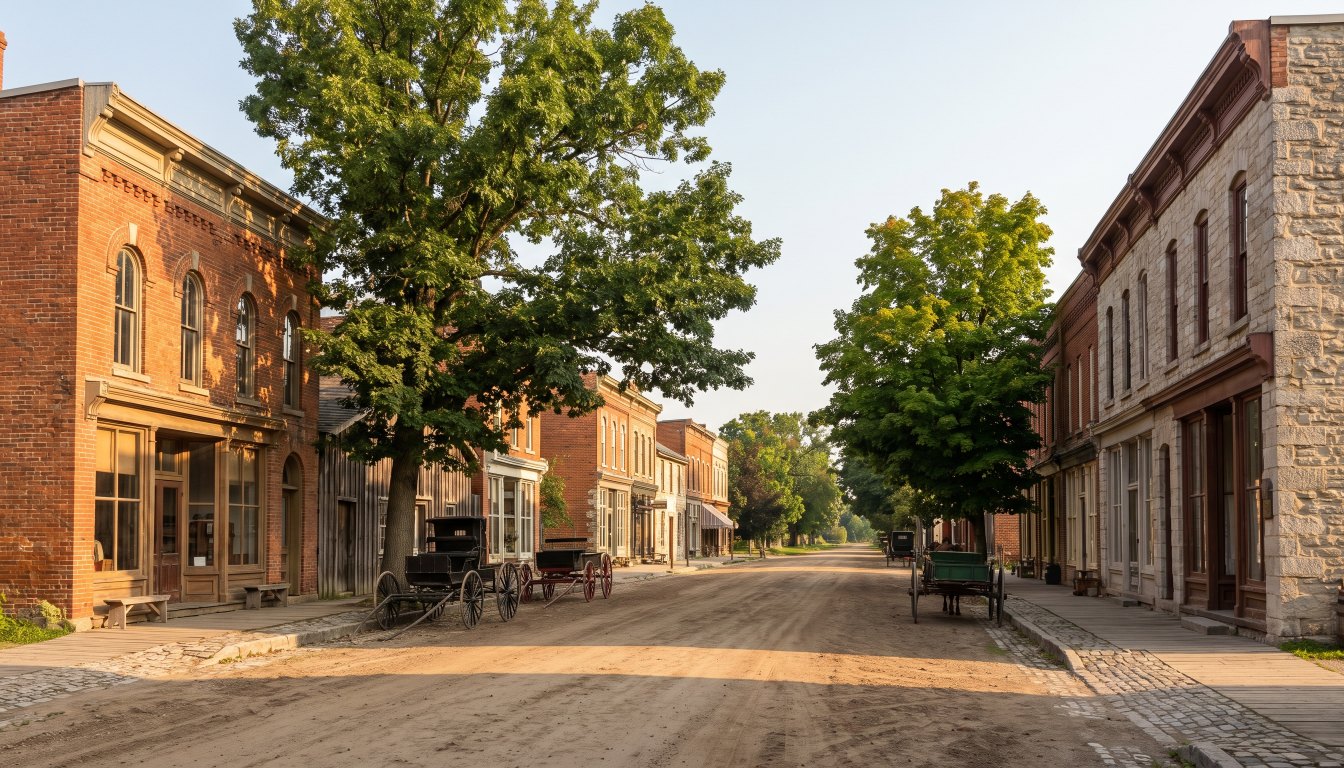
The Old Oakville Heritage Conservation District was designated by By-law 1981-144 on 20 October 1981, making it one of Ontario’s earliest Part V districts. It runs from Robinson Street north to Lake Ontario south, Sixteen Mile Creek west to Allan Street east, and covers 162 primarily single-family, one and two storey nineteenth-century residences in Neoclassical, Gothic, Georgian and Italianate styles, plus institutional buildings.
The district plan means alterations require approval through the Municipal Heritage Committee against the district’s design guidelines. The study material reviewed noted that most applications were approved within about two months — a restrictive process rather than a prohibition. And because Oakville is in Halton Region, there is no municipal land transfer tax: only the provincial tax applies.
One of the first, in 1981
| Designated | By-law 1981-144, 20 October 1981 |
| Boundaries | Robinson Street (north), Lake Ontario (south), Sixteen Mile Creek (west), Allan Street (east) |
| Properties | 162 primarily single-family residences, one and two storeys |
| Styles | Neoclassical, Gothic, Georgian, Italianate |
| Also included | Institutional buildings — churches, schools, the Murray House Hotel |
| Founded by | William Chisholm, who purchased 960 acres and developed the harbour |
| First survey | 1833, from Sixteen Mile Creek to Allan Street |
For context, Toronto’s comparable districts came much later: East Annex in 1994, South Rosedale in 2002, Yorkville–Hazelton in 2002, North Rosedale in 2004. Old Oakville was designated in 1981, and Wychwood Park received heritage status in 1985.
What the designation actually does
Alterations within the district require approval through the Municipal Heritage Committee — Heritage Oakville — assessed against the district’s design guidelines. The study material reviewed noted that most applications were approved within about two months, which is worth stating plainly: this is a process, not a prohibition.
The Town has been carrying out an update to the district plan, including work to align it with zoning. Confirm the current plan and process with the Town before planning anything.
Why buyers accept the process
The same reason they accept it in Rosedale or Baby Point. A district plan is what guarantees that the nineteenth-century streetscape you are paying for is still there in thirty years. The constraint on you is the protection for you.
The tax difference from Toronto
Oakville is in Halton Region, and only the City of Toronto charges a municipal land transfer tax.
| Purchase price | In Toronto | In Oakville | Difference |
|---|---|---|---|
| $3,000,000 | $122,950 | $61,475 | $61,475 |
| $5,000,000 | $271,450 | $111,475 | $159,975 |
| $10,000,000 | $721,450 | $236,475 | $484,975 |
On a $5 million purchase, $159,975 stays in your account on closing day. That is a genuine and frequently overlooked part of the Toronto-versus-905 comparison at this level.
What to verify before buying here
- Whether the property is inside the district, and whether it is a contributing building under the plan.
- The current district plan and the design guidelines that apply to your intended work.
- Whether past exterior alterations were approved. Unapproved work becomes your problem on closing.
- Conservation authority status — Conservation Halton, not TRCA, regulates here, and Sixteen Mile Creek and the lake shoreline are relevant.
- Town of Oakville tree protection requirements, which are the Town’s own and differ from Toronto’s Chapter 813.
- The survey, since nineteenth-century lots frequently carry boundary irregularities and encroachments.
Where Halton sits in the luxury market
The RE/MAX January to April 2026 count reported by region gave York Region 35 sales above $3 million and Peel Region 24, alongside 31 across the west end of Toronto. Halton figures were not broken out in the same way in the material reviewed, so I am not going to invent one — but the market’s character in Old Oakville is the same as elsewhere at this level: few transactions, well-advised buyers, and a premium for what cannot be replicated.
Frequently asked questions
When was Old Oakville designated a heritage conservation district?
By By-law 1981-144 on 20 October 1981, making it one of Ontario’s earliest Part V heritage conservation districts. The Town has since carried out an update process for the district plan.
What are the district boundaries?
Robinson Street to the north, Lake Ontario to the south, Sixteen Mile Creek to the west and Allan Street to the east.
How many properties are in the district?
162 primarily single-family residences of one and two storeys, mostly nineteenth century, in Neoclassical, Gothic, Georgian and Italianate styles, together with institutional buildings including churches, schools and the Murray House Hotel.
What does the designation restrict?
Alterations require approval through the Municipal Heritage Committee, Heritage Oakville, against the district’s design guidelines. The study material reviewed noted most applications were approved within about two months. Confirm the current process and the applicable district plan with the Town of Oakville.
Does Oakville charge a municipal land transfer tax?
No. Only the City of Toronto does. On a $5,000,000 purchase, Ontario land transfer tax of $111,475 applies in Oakville, against $271,450 in Toronto — a difference of $159,975.
Who founded Oakville?
William Chisholm, who purchased 960 acres and developed the harbour in the early nineteenth century. The first survey was completed in 1833, covering the area from Sixteen Mile Creek to Allan Street.
Thinking about buying or selling at the top end?
Send me the address, or the shortlist you are considering. I will tell you what the property is actually worth today, what the land is worth without the house, what the transfer tax and carrying costs will be, and whether the deal makes sense. Confidential, always.
[email protected] · 833-330-1925 · Book a free consultation
Confidential. Read personally and answered within 24 hours. I never share, sell or distribute your information.
Related reading
- Old Oakville Lakefront Homes: What the Shoreline Actually Costs
- Bronte Harbour, Oakville: Living on the Lake West of Toronto
- Buying a heritage home in Toronto: Part IV vs Part V
- Land transfer tax on a luxury home in Toronto: the full 2026 numbers
- Toronto’s luxury neighbourhoods compared
- Lorne Park: how a collapsed wharf created Mississauga’s best lots
Sources
Everything above that is a rule, a rate or a published number comes from these. Verify anything that matters to your own deal.
- University of Waterloo Heritage Resources Centre — Old Oakville HCD study
- Town of Oakville — Old Oakville Heritage Conservation District study
- Government of Ontario — Calculating land transfer tax
- RE/MAX Canada — 2026 Spotlight on Luxury Real Estate, Greater Toronto
About the author — Jatin Dua, Broker of Record
I’m the Broker of Record at RE/MAX Quantum Realty, 799 The Queensway in Etobicoke, and I work with buyers, sellers and investors across Toronto and the west GTA. A large part of my work sits in the upper end of the market, where the comparables are thin, the rules are heavier and the cost of a wrong number is measured in hundreds of thousands of dollars.
The free estimators on this site are mine. I built them because the first question every owner asks is “what is it worth?” and the honest answer starts with a number you can check yourself. [email protected] or 833-330-1925.