
Published 7 September 2026 · Updated 29 September 2026 · By Jatin Dua, Broker of Record, RE/MAX Quantum Realty
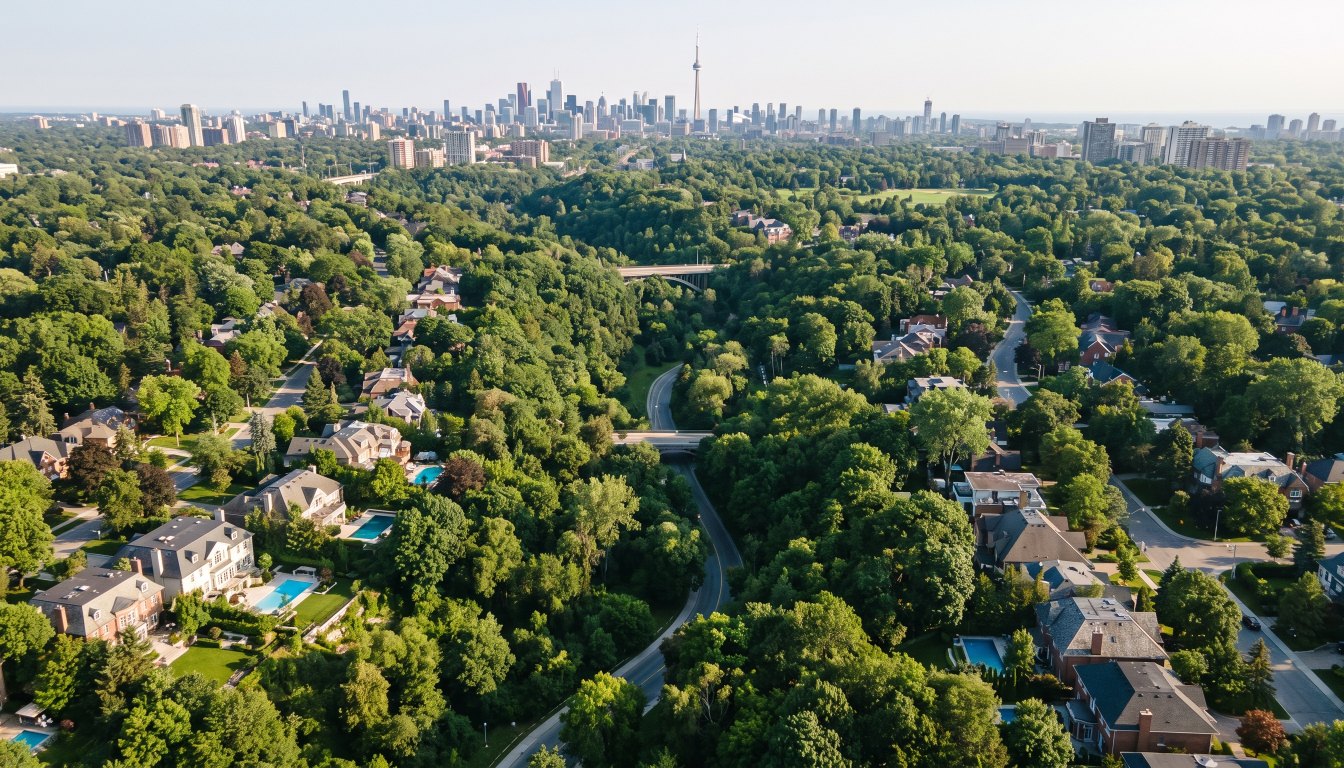
The neighbourhoods differ on four things that matter: what protects the streetscape (a heritage district plan, an original developer’s controls, or nothing), what constrains your own property (ravine and conservation authority rules, heritage permits, trees), the lot character, and how many homes actually trade.
On the last point, the January to April 2026 counts of sales above $3 million were: Rosedale 20, Lawrence Park 20, Bridle Path–Sunnybrook–York Mills 14, Forest Hill South 11, Kingsway South 9, with the west end of Toronto totalling 31 against York Region 35 and Peel Region 24.
The comparison
| Neighbourhood | Origin | What protects the streetscape | $3M+ sales, Jan–Apr 2026 |
|---|---|---|---|
| Bridle Path–Sunnybrook–York Mills | Subdivided into ~50 lots in the 1950s; two-acre minimum | Lot size only — no heritage district | 14 |
| Rosedale | 1850–1910 south; 1908 plan north | Two HCDs: South (2002), North (2004) | 20 |
| Lawrence Park | Garden suburb assembled from 1907 | Lot pattern; no HCD | 20 |
| Forest Hill | Village 1923–1967; architect-designed rule | Study completed, not designated | 11 (Forest Hill South) |
| Hoggs Hollow / York Mills | Mill settlement 1824; golf course 1927–1950s | Valley topography and ravine regulation | Within area total |
| Yorkville / Annex | Village 1830, annexed 1883; Annex subdivided 1886 | Yorkville–Hazelton (2002), East Annex (1994), West Annex Ph.1 (2015); 1975 45-ft cap | 4 condo sales above $5M in the core |
| Wychwood Park | Artists’ colony, late 19th c. | Heritage status 1985; private roads; ~60 houses | Very few |
| Lytton Park | 1890–1930, annexed 1912 | Nothing district-wide | Within area total |
| The Kingsway | Home Smith, from 1912, Garden City | Original design approval; no HCD | 9 (Kingsway South) |
| Baby Point | Home Smith, from 1912, on Teiaiagon | Teiaiagon–Baby Point HCD | Within west-end total |
| Humber Valley Village | Home Smith, 1930s–1960s | Nothing district-wide | Within west-end total |
| Swansea / High Park | Village 1926; subdivided 1882–80s | Park, river and lake boundaries | Within west-end total |
| Lorne Park, Mississauga | Resort 1877; cottage lots assembled | 1922 survey preserved forest character | Peel Region total 24 |
| Old Oakville, Halton | Chisholm, 1833 survey | HCD by By-law 1981-144, Oct 1981 | Not broken out |
The trade-off that actually matters
Protection versus freedom
A heritage conservation district guarantees what the street will look like in thirty years and adds a permit process to your own exterior work. A neighbourhood without one gives you freedom to build and no guarantee about your neighbours. Rosedale, Baby Point, Wychwood Park, the Annex, Yorkville and Old Oakville are the first. The Bridle Path, Lawrence Park, Lytton Park, The Kingsway and Humber Valley Village are the second — though The Kingsway’s original design controls have produced much of the same effect without the permit process.
Which constraints apply where
| Constraint | Where it bites hardest |
|---|---|
| Heritage permit for exterior work | Rosedale, Baby Point, the Annex, Yorkville, Wychwood Park, Old Oakville |
| Ravine bylaw, Chapter 658 | Rosedale, Hoggs Hollow, Baby Point, Humber Valley Village, the Old Mill, Lawrence Park’s ravine edge |
| TRCA clearance before a building permit | Any property in a regulated area — valley, stream corridor, wetland, shoreline |
| Private tree bylaw, 30 cm threshold | Everywhere in Toronto, and hardest in mature neighbourhoods: Lytton Park, Lawrence Park, The Kingsway, Forest Hill |
| Private road and resident council obligations | Wychwood Park |
| Municipal land transfer tax | City of Toronto only — not Mississauga, Oakville, Vaughan or Markham |
The tax line is worth restating
Only the City of Toronto charges a municipal land transfer tax. On a $5,000,000 purchase, the total is $271,450 in Toronto against $111,475 in Lorne Park or Old Oakville — a difference of $159,975 on closing day.
How to use this comparison
- Decide first whether you want a guaranteed streetscape or freedom to build. That single choice halves the list.
- Decide whether you want valley setting and can live with the ravine and conservation authority process.
- Compare on lot character — frontage, table land, shape — rather than on neighbourhood reputation.
- Check the transaction count in your band, because it tells you how long the search will realistically take.
- Price the land transfer tax difference if a 905 address is genuinely acceptable to you.
Frequently asked questions
Which Toronto neighbourhood has the most $3 million-plus sales?
Rosedale and Lawrence Park tied at 20 each between January and April 2026, followed by Bridle Path–Sunnybrook–York Mills at 14, Forest Hill South at 11 and Kingsway South at 9.
Which luxury neighbourhoods are heritage conservation districts?
South Rosedale (2002), North Rosedale (2004), Wychwood Park (1985), Yorkville–Hazelton (2002), East Annex (1994), West Annex Phase 1: Madison Avenue (2015) and Teiaiagon–Baby Point. Old Oakville in Halton was designated by By-law 1981-144 in October 1981.
Which have the largest lots?
Bridle Path–Sunnybrook–York Mills, with a two-acre minimum and typical parcels of two to four acres. Lorne Park in Mississauga also has unusually large parcels, assembled from two to four original cottage lots into properties of up to about 0.4 hectares.
Which are most affected by ravine rules?
Rosedale, Hoggs Hollow and York Mills, Baby Point, Humber Valley Village and the Old Mill area all sit on or beside valley land. Inside a mapped ravine protected area, Chapter 658 requires permits for tree work, fill and grade alteration, and where TRCA jurisdiction applies under O. Reg. 41/24 clearance is required before a building permit issues.
Is the west end now comparable to the traditional core?
On volume, partly. The west end of Toronto as a whole recorded 31 sales above $3 million between January and April 2026 — roughly comparable to York Region at 35, though the individual core neighbourhoods of Rosedale and Lawrence Park each recorded 20 on their own.
Which neighbourhood is best?
That depends entirely on what you want protected and what you want to be free to do. A heritage district guarantees the streetscape and adds a permit process to your own exterior work. A neighbourhood without one gives you freedom and no guarantee. Both are legitimate trade-offs.
Thinking about buying or selling at the top end?
Send me the address, or the shortlist you are considering. I will tell you what the property is actually worth today, what the land is worth without the house, what the transfer tax and carrying costs will be, and whether the deal makes sense. Confidential, always.
[email protected] · 833-330-1925 · Book a free consultation
Confidential. Read personally and answered within 24 hours. I never share, sell or distribute your information.
Related reading
- The Bridle Path: what you are actually buying
- Rosedale real estate: north vs south and the heritage districts
- West Toronto vs North Toronto luxury: two different kinds of money
- Buying a heritage home in Toronto: Part IV vs Part V
- How many $3 million homes actually sell in Toronto each year?
Sources
Everything above that is a rule, a rate or a published number comes from these. Verify anything that matters to your own deal.
- RE/MAX Canada — 2026 Spotlight on Luxury Real Estate, Greater Toronto
- City of Toronto — Heritage Conservation Districts
- City of Toronto — Municipal Code Chapter 658, Ravine and Natural Feature Protection
- City of Toronto — Municipal Code Chapter 813, Trees
About the author — Jatin Dua, Broker of Record
I’m the Broker of Record at RE/MAX Quantum Realty, 799 The Queensway in Etobicoke, and I work with buyers, sellers and investors across Toronto and the west GTA. A large part of my work sits in the upper end of the market, where the comparables are thin, the rules are heavier and the cost of a wrong number is measured in hundreds of thousands of dollars.
The free estimators on this site are mine. I built them because the first question every owner asks is “what is it worth?” and the honest answer starts with a number you can check yourself. [email protected] or 833-330-1925.