
Published 1 September 2026 · Updated 29 September 2026 · By Jatin Dua, Broker of Record, RE/MAX Quantum Realty
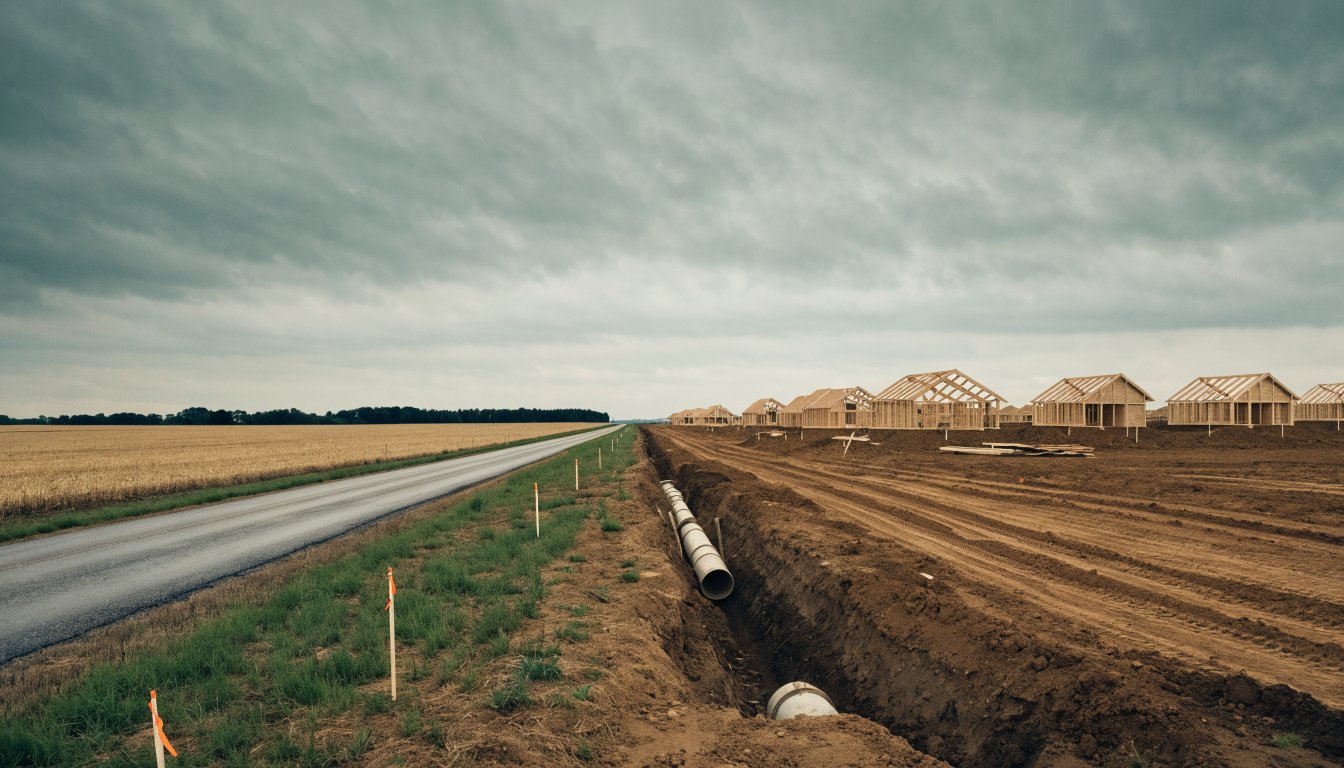
As at 1 August 2026, total development charges on a single or semi-detached home are $148,006.77 in Caledon and $155,650.32 in Brampton — a gap of $7,643.55, with Brampton the more expensive side. A Brampton row townhouse is $124,237.76. Caledon has no townhouse line at all: conventional towns are charged as “other residential” at $125,660.74, but stacked towns are charged as apartments, dropping to $61,537.06 under 70 square metres. The charge is imposed on the builder, not on you — your exposure is whatever the development charge adjustment clause in your agreement passes through. Rates index on 1 February and 1 August each year, education charges on 1 July; the last Caledon step added $1,466.63.
Every new-home sales office on the Mayfield Road corridor will tell you the price. None of them will walk you through the $148,006.77 of development charges sitting inside a single-detached lot in Caledon, or the $155,650.32 sitting inside the same house across the road in Brampton.
These are not estimates. They are the published, in-force schedules as at 1 August 2026, from the Town of Caledon, the City of Brampton and the Region of Peel. Every figure on this page comes from one of those documents or from the school boards’ own schedule. Nothing here is taken from a listing aggregator.
First, the thing most articles get wrong. A development charge is imposed on the builder, not on you. You do not write this cheque at closing. It is a cost of production and it is already inside the price on the sign. What can reach you is a development charge adjustment clause in the agreement of purchase and sale, under which some or all of an increase between signing and closing is passed through. Whether your agreement has one, and whether it is capped, varies from builder to builder and I cannot generalise about it — that clause is the single most important page in your agreement and it is the one to put in front of your lawyer during the cooling-off period.
The two schedules, side by side
Mayfield Road is the boundary. North is Caledon, south is Brampton. The same builder, building the same model on the same day, pays a different total depending on which side of the road the lot sits on.
| Dwelling type | Municipal | Region of Peel | Education | Total |
|---|---|---|---|---|
| Caledon — single / semi / duplex | $63,348.11 | $78,982.66 | $5,676.00 | $148,006.77 |
| Brampton — single family & semi-detached | $69,993.78 | $79,980.54 | $5,676.00 | $155,650.32 |
| Brampton — row townhouse | $55,216.77 | $63,344.99 | $5,676.00 | $124,237.76 |
| Caledon — other residential (includes freehold towns) | $57,430.09 | $62,554.65 | $5,676.00 | $125,660.74 |
| Brampton — apartment over 750 sq ft | $39,584.71 | $58,015.43 | $5,676.00 | $103,276.14 |
| Caledon — apartment over 70 m² | $43,553.87 | $57,291.62 | $5,676.00 | $106,521.49 |
| Brampton — apartment 750 sq ft or under | $24,360.40 | $30,682.75 | $5,676.00 | $60,719.15 |
| Caledon — apartment 70 m² or under | $25,561.11 | $30,299.95 | $5,676.00 | $61,537.06 |
All figures effective 1 August 2026. Caledon: Town by-laws 2024-042 and 2024-043. Brampton: by-laws approved by Council 10 July 2024, effective 2 August 2024. Region: By-law 77-2020, passed 10 December 2020, in effect 22 January 2021. Education: the 2024 board by-laws effective 1 July 2024.
The single-detached gap is $7,643.55, and Brampton is the expensive side. That is the opposite of what most people assume when they hear “Caledon” and picture the more expensive address. On the development-charge line alone, the Caledon side of Mayfield Road is cheaper to build on.
Why Caledon is cheaper, exactly
Two things, and one of them is genuinely surprising.
The municipal portion. Caledon charges $63,348.11 where Brampton charges $69,993.78 on a single or semi. That is $6,645.67 of the gap, and it is simply two different councils funding two different capital programmes.
The police line. The rest is policing. Peel publishes different regional rates for Caledon than for Brampton and Mississauga, because Caledon is policed by the Ontario Provincial Police rather than Peel Regional Police. On a single or semi:
| Regional line item | Brampton / Mississauga | Town of Caledon |
|---|---|---|
| Hard services (water, wastewater, transportation) | $75,969.68 | $75,969.68 |
| Peel Regional Police Services | $1,157.06 | — |
| Ontario Provincial Police Services | — | $159.18 |
| All other soft services | $2,853.80 | $2,853.80 |
| Regional total | $79,980.54 | $78,982.66 |
The hard services are identical to the cent — the same water, the same wastewater, the same transportation programme. The entire regional difference is $997.88, and it is almost all the police levy.
The classification trap: stacked towns in Caledon
This one is worth real money and almost nobody explains it.
Brampton’s schedule has four residential categories, including a distinct row (townhouse) line at $124,237.76. Caledon’s schedule has no townhouse line at all. Caledon townhouses fall into “Other Residential Dwellings” at $125,660.74 — unless they are stacked.
Note 1 on the Caledon schedule says it plainly: the apartment threshold is 70 square metres, roughly 750 square feet, and it “includes stacked townhomes.”
| Product in Caledon | Category applied | Total DC |
|---|---|---|
| Conventional freehold townhouse | Other Residential Dwellings | $125,660.74 |
| Stacked townhome over 70 m² | Apartment over 70 m² | $106,521.49 |
| Stacked townhome 70 m² or under | Apartment 70 m² or under | $61,537.06 |
A stacked town under 750 square feet in Caledon carries $64,123.68 less in development charges than a conventional freehold town on the same street. That is not a rounding difference. It is roughly half the cost of a serviced lot, and it is the reason you will see more stacked and small-unit product proposed on the Caledon side than the streetscape renderings suggest.
When it gets paid — and a conflict between two municipal documents
Caledon’s schedule carries this note, verbatim:
“Effective November 3, 2025, the Development Charges Act, 1997 has been amended to provide that the DCs for non-rental residential developments shall be paid in full on the earlier of a.) the day a permit is issued authorizing occupation of the building and b.) the day the building is first occupied. The deferral of payment to occupancy is now legislated and affects the Town of Caledon and Region of Peel non-rental residential DCs.”
Brampton’s current schedule, dated the same 1 August 2026, says something different:
“Payment of the Current, indexed rate will be required prior to issuance of Building Permit.”
These two published documents do not say the same thing, and I am not going to pretend they do. Caledon states that a statutory deferral to occupancy now applies to non-rental residential; Brampton’s sheet states payment is required before permit issuance and does not mention the amendment. The most likely reading is that Brampton’s general statement has not been updated to carve out non-rental residential, but I cannot verify that from a primary source and I am not going to guess on your behalf. If the timing matters to your file — and it matters a great deal to a builder’s carrying cost, and therefore to price — get it in writing from the municipality. Education development charges remain payable at building permit issuance in both.
Peel adds a further wrinkle for subdivisions: where a residential development requires approval of a plan of subdivision under section 51 of the Planning Act or a consent under section 53, the hard-service portion — water, wastewater and transportation — is payable “immediately upon the owner entering into a subdivision agreement or a consent agreement.” Peel also publishes a part-lot collection figure of $37,984.84 for a single or semi.
The indexing calendar, and why the date on the sheet matters
These numbers move on a schedule, and the schedule is published.
| Charge | Indexed on | Index used | Next move |
|---|---|---|---|
| Town of Caledon | 1 February and 1 August | Statistics Canada Quarterly, Non-Residential Building Construction Price Index | 1 February 2027 |
| City of Brampton | 1 February and 1 August | Same index | 1 February 2027 |
| Region of Peel | 1 February and 1 August | Same index | 1 February 2027 |
| Education (both boards) | 1 July | Set by the 2024 by-laws, not indexed to a price index | 1 July 2027 |
Six months of movement on the Caledon single/semi, for scale: the 1 February 2026 schedule showed a total of $146,540.14. The 1 August 2026 schedule shows $148,006.77. That is $1,466.63 in one indexing cycle, of which $300 is the education step.
If you are reading a Caledon development charge figure online, check the date on the sheet. The 1 February 2026 schedule is still the first result many searches surface, and it is superseded. The number in force today is on the 1 August 2026 schedule.
Education charges are the one number published years ahead
Unusually, the school boards publish their whole schedule in advance. This is genuinely useful for anyone modelling a later phase of a corridor community.
| Period | Dufferin-Peel Catholic DSB | Peel DSB | Total per dwelling |
|---|---|---|---|
| 1 Jul 2024 – 30 Jun 2025 | $1,300 | $3,776 | $5,076 |
| 1 Jul 2025 – 30 Jun 2026 | $1,300 | $4,076 | $5,376 |
| 1 Jul 2026 – 30 Jun 2027 (in force now) | $1,300 | $4,376 | $5,676 |
| 1 Jul 2027 – 30 Jun 2028 | $1,300 | $4,676 | $5,976 |
| 1 Jul 2028 – 30 Jun 2029 | $1,300 | $4,976 | $6,276 |
The Catholic board’s figure is flat at $1,300 throughout. The entire increase is the Peel District School Board’s, rising $300 a year. Note that the same rate applies to a small apartment as to a single-detached — education development charges are flat per dwelling unit, not scaled by size.
A verification note worth knowing: as at 1 September 2026 the Peel District School Board’s own education development charge page still published only 2019 documents and did not carry the 2024 by-law or the current rates. The figures above are confirmed instead from three independent schedules — Brampton’s, Caledon’s and Dufferin-Peel’s — which reconcile to the cent. That is stronger corroboration than a single source, but it is worth knowing that one of the two boards charging the fee does not publish it.
What the servicing discount tells you about timing
Note 2 on the Caledon schedule prices something most buyers never think about. The full regional charge of $78,982.66 on a single or semi:
| Servicing available | Regional DC, single / semi |
|---|---|
| Water and wastewater | $78,982.66 |
| Water but no wastewater | $46,206.33 |
| Neither | $16,025.37 |
Read that as a price list for infrastructure. Roughly $63,000 per home of the regional charge is water and wastewater capacity. Which means servicing capacity is not a technicality on this corridor — it is the majority of the regional charge, and it is the thing that actually gates when a subdivision can be occupied.
And here is the gap I could not close. Peel is running a Water and Wastewater Master Plan for the lake-based systems, an approximately two-and-a-half year study supporting growth to 2051, with the first public information centre held 2 to 4 December 2025 and completion anticipated in 2026. But no published Peel document states a numeric servicing allocation — units or capacity — assigned to Mayfield West or Northwest Brampton, or a date on which allocation is expected. Brampton’s own development allocation programme page records that the programme was “temporarily suspended” and carries an update dated December 2016. Anyone who tells you a firm servicing date for this corridor is not reading it off a public document, because there is not one to read.
What this actually means if you are buying
- Do not treat the DC as your cost. It is the builder’s, and it is in the price. Your exposure is limited to whatever the adjustment clause in your agreement passes through.
- Find the adjustment clause and find the cap. Ask directly: is the development charge adjustment capped, and at what dollar figure? Get the answer in the agreement, not in conversation. Then have your lawyer read it during the cooling-off period.
- Know your indexing exposure. Charges move 1 February and 1 August. A closing that slides past one of those dates crosses an indexing step. The last one added $1,466.63 to a Caledon single/semi.
- Ask which category your unit is in. On the Caledon side, whether your town is classified as “other residential” or as an apartment under the 70-square-metre stacked-townhome rule changes the charge by up to $64,123.68.
- Treat closing dates as estimates until servicing is confirmed. Not because builders are careless, but because the public record contains no allocation figure for this corridor. Read the delayed closing provisions in your agreement as though they will be used.
None of this is a reason not to buy on the Mayfield corridor. It is a reason to know which of these numbers is yours, which is the builder’s, and which one moves on a date somebody already published.
Comparing lots on both sides of Mayfield Road?
The two sides of that road are two municipalities, two development charge schedules, two police services and two sets of secondary plan timelines. If you send me the projects you are cross-shopping and the models you are looking at, I will put the verifiable numbers side by side for you — charges, categories, indexing exposure and what the public record actually says about approvals. I am a cooperating agent, not a builder’s sales office, so I have no reason to steer you to one sign over another. No cost, no obligation.
[email protected] · 833-330-1925 · Book a free consultation
Confidential. Read personally and answered within 24 hours. I never share, sell or distribute your information.
Free tool — AI home value estimator
Instant Home Valuation
What’s your home
worth today?
Answer six quick questions and get an instant value range built from current Toronto & GTA sale data — property type, size, condition, lot and location all weighted the way a real pricing conversation weighs them. Takes about ninety seconds.
Reading recent GTA sale data…
Building your estimate
Estimated market value
—
$0–$0
Most likely value $0 · roughly $0 per square foot
What moved the number
Starting from the area baseline for your property type, here’s what each answer added or subtracted.
Market context
Recent local averages for comparison.
—
A range is a starting point.
A strategy is what sells.
This model doesn’t know that your neighbour’s identical semi went $80,000 over asking last month, or which two upgrades actually pay back in your area. That conversation is free and takes twenty minutes.
Frequently asked questions
How much are development charges in Caledon in 2026?
On the schedule effective 1 August 2026, a single, semi-detached or duplex dwelling in the Town of Caledon carries total development charges of $148,006.77, made up of $63,348.11 to the Town, $78,982.66 to the Region of Peel and $5,676.00 in education development charges. Other residential dwellings, which is where conventional townhouses fall, total $125,660.74. An apartment over 70 square metres is $106,521.49 and an apartment of 70 square metres or less is $61,537.06. Town and Regional rates index on 1 February 2027; education rates on 1 July 2027.
How much are development charges in Brampton in 2026?
On the schedule as of 1 August 2026, effective until 31 January 2027, a single family or semi-detached dwelling carries $155,650.32 in total: $69,993.78 to the City, $79,980.54 to the Region of Peel, $4,376.00 to the Peel District School Board and $1,300.00 to the Dufferin-Peel Catholic District School Board. A row townhouse totals $124,237.76, a large apartment over 750 square feet $103,276.14, and a small apartment of 750 square feet or less $60,719.15.
Why are development charges lower in Caledon than in Brampton?
Two reasons. The municipal portion is lower: $63,348.11 in Caledon against $69,993.78 in Brampton, a difference of $6,645.67. And the Region of Peel charges a different rate in Caledon because Caledon is policed by the Ontario Provincial Police rather than Peel Regional Police. The Peel police line is $1,157.06 in Brampton and Mississauga; the OPP line in Caledon is $159.18. The hard services portion, water, wastewater and transportation, is identical at $75,969.68 in both.
Do I pay the development charge as the buyer?
No. A development charge is imposed on the builder under the Development Charges Act, 1997, and is a cost of production already reflected in the price. What can reach you is a development charge adjustment clause in the agreement of purchase and sale, under which some or all of an increase between signing and closing is passed through to the buyer. Whether your agreement contains one, and whether it is capped, varies between builders. Find that clause and have your lawyer read it during the cooling-off period.
How are stacked townhomes charged in Caledon?
As apartments, not as townhouses. Note 1 on the Caledon schedule states that the apartment size threshold is 70 square metres, approximately 750 square feet, and expressly includes stacked townhomes. So a conventional freehold town falls in Other Residential Dwellings at $125,660.74, a stacked town over 70 square metres is charged $106,521.49, and a stacked town of 70 square metres or less is charged $61,537.06. The gap between a conventional town and a small stacked town is $64,123.68 per unit.
When do development charges go up?
City of Brampton, Town of Caledon and Region of Peel rates are indexed on 1 February and 1 August each year to the Statistics Canada Quarterly, Non-Residential Building Construction Price Index, so the next step is 1 February 2027. Education development charges move on 1 July under the boards’ 2024 by-laws, so the next step there is 1 July 2027. For scale, the Caledon single and semi total went from $146,540.14 on 1 February 2026 to $148,006.77 on 1 August 2026, an increase of $1,466.63 in one cycle.
What are education development charges in Peel?
For the period 1 July 2026 to 30 June 2027 the combined figure is $5,676.00 per dwelling unit: $4,376.00 to the Peel District School Board and $1,300.00 to the Dufferin-Peel Catholic District School Board. The boards publish the schedule years ahead: $5,976 for 1 July 2027 to 30 June 2028 and $6,276 for 1 July 2028 to 30 June 2029. The Catholic board’s share stays flat at $1,300 throughout; the entire increase is the public board’s. The same amount applies to every dwelling unit regardless of size.
When are development charges payable, at permit or at occupancy?
The two municipal schedules published on 1 August 2026 do not agree, and you should confirm rather than assume. Caledon’s schedule states that effective 3 November 2025 the Development Charges Act, 1997 was amended so that charges for non-rental residential developments are payable on the earlier of the day an occupancy permit is issued and the day the building is first occupied, and that this legislated deferral affects Town of Caledon and Region of Peel non-rental residential charges. Brampton’s schedule of the same date states that payment of the current indexed rate is required prior to issuance of a building permit and does not mention the amendment. Education development charges remain payable at building permit issuance. For subdivisions, Peel requires the hard services portion immediately on entering into a subdivision or consent agreement.
Is there a published servicing allocation for Mayfield West or Northwest Brampton?
Not that I could find in any public document as at 1 September 2026. The Region of Peel is running a 2025 Water and Wastewater Master Plan for the lake-based systems, an approximately two-and-a-half year study supporting growth to 2051, with its first public information centre held 2 to 4 December 2025 and completion anticipated in 2026. But no Peel document publishes a numeric allocation of units or capacity to Mayfield West or Northwest Brampton, or a date by which allocation is expected. Brampton’s own development allocation programme page records the programme as temporarily suspended, with an update dated December 2016. Servicing matters here: Caledon’s schedule shows the regional charge falling from $78,982.66 to $46,206.33 with water but no wastewater, and to $16,025.37 with neither.
Related reading
- The $80,000 rebate on a new Caledon or Brampton home, and the 31 March 2027 deadline
- Six pre-construction projects, six municipal files: what the record says
- Tarion, the 45-day notice and deposit coverage
- Cannot close your assignment sale? The HST sentence and the flipping rule
Sources
Every figure on this page traces to one of these, and each was read on 1 September 2026. Primary sources only — statute, regulation, and the government or agency that administers the rule. Where I could not verify something from a primary source, the page says so instead of guessing.
- Town of Caledon Development Charges, effective 1 August 2026 (PDF). Town of Caledon. The schedule in force. Single, semi-detached and duplex: Town $63,348.11, Region of Peel $78,982.66, Education $5,676.00, total $148,006.77. Town by-laws 2024-042 and 2024-043; Region by-law 77-2020. Town and Region rates subject to indexing 1 February 2027; education rates 1 July 2027. Note 1 states the apartment threshold is 70 square metres and includes stacked townhomes. Accessed 1 September 2026.
- Development charges — Town of Caledon. Town of Caledon. Page metadata gives an issued date of 1 August 2026. The landing page for the current schedule. Accessed 1 September 2026.
- Town of Caledon Development Charges, effective 1 February 2026 (PDF). Town of Caledon. The superseded schedule, cited here only to show the movement between indexing dates. Single, semi-detached and duplex totalled $146,540.14 — Town $62,828.87, Region $78,335.27, Education $5,376.00. Accessed 1 September 2026.
- Development Charges as of August 1, 2026, effective until January 31, 2027 (PDF) — City of Brampton. City of Brampton. Single family and semi-detached: City $69,993.78, Region of Peel $79,980.54, Peel District School Board $4,376.00, Dufferin-Peel Catholic District School Board $1,300.00, grand total $155,650.32. Row townhouse grand total $124,237.76. States that City and Region amounts are adjusted to the Statistics Canada Quarterly Non-Residential Building Construction Price Index on 1 February and 1 August each year, and that payment of the current indexed rate is required prior to issuance of a building permit. Accessed 1 September 2026.
- Development charges, amended rates — City of Brampton. City of Brampton, read 1 September 2026. States that Council approved the current development charge by-laws on 10 July 2024, effective 2 August 2024. Accessed 1 September 2026.
- Region of Peel development charge rates, effective 1 August 2026 to 31 January 2027 (PDF). Region of Peel, Appendix I to By-law 77-2020, Schedule A. Publishes separate residential rate tables for Brampton and Mississauga and for the Town of Caledon. Single and semi-detached hard services are $75,969.68 in both, but Caledon pays Ontario Provincial Police Services of $159.18 in place of Peel Regional Police Services of $1,157.06, giving totals of $78,982.66 in Caledon and $79,980.54 in Brampton. States that all rates are subject to bi-annual indexing on 1 February and 1 August each year. Accessed 1 September 2026.
- Development charges — Region of Peel. Region of Peel, read 1 September 2026. States that By-law 77-2020 was passed by Regional Council on 10 December 2020 and took effect 22 January 2021, that indexing follows the Statistics Canada Quarterly Non-Residential Building Construction Price Index as prescribed by the Development Charges Act, that housing services was removed as a development charge service effective 29 November 2022, and that the Ontario Land Tribunal on 22 August 2023 issued an order allowing an appeal in part and amending the by-law. Accessed 1 September 2026.
- Education development charges — Dufferin-Peel Catholic District School Board. Dufferin-Peel Catholic District School Board, read 1 September 2026. Publishes the combined Peel District School Board and Dufferin-Peel schedule under the 2024 education development charge by-laws effective 1 July 2024, running from $5,076 per dwelling unit for 1 July 2024 to 30 June 2025, through $5,676 for 1 July 2026 to 30 June 2027, to $6,276 for 1 July 2028 to 30 June 2029. Accessed 1 September 2026.
- Education development charges — Peel District School Board. Peel District School Board, read 1 September 2026. As at that date the board’s own education development charge page still published only 2019 documents and did not publish the 2024 by-law or the current rates. The current Peel District School Board figure is confirmed instead from the Brampton and Caledon schedules and from the Dufferin-Peel schedule, which agree exactly. Accessed 1 September 2026.
- Development Charges Act, 1997, S.O. 1997, c. 27. Government of Ontario e-Laws. The statute under which municipal and education development charges are imposed, indexed and collected. Accessed 1 September 2026.
- 2025 water and wastewater master plan, lake-based systems — Region of Peel. Region of Peel, read 1 September 2026. An approximately two-and-a-half year study supporting existing servicing needs and growth to 2051. Public Information Centre 1 was held 2 to 4 December 2025 and master plan completion is anticipated in 2026. No numeric servicing allocation for Mayfield West or Northwest Brampton is published. Accessed 1 September 2026.
- Mayfield West Secondary Plan — Town of Caledon. Town of Caledon, page dated 11 November 2021. Records the Minister’s Zoning Order of 13 July 2020 for Mayfield West Phase 2 Stage 2, and Council’s adoption of Official Plan Amendment 255 on 26 October 2021 expanding the settlement area by approximately 105 hectares. Accessed 1 September 2026.
- Current applications — Town of Caledon. Town of Caledon, page metadata issued 27 August 2026. Lists active planning applications including the Mayfield Tullamore Secondary Plan, the Mayfield West Phase 2 Stage 3 Secondary Plan and the Mayfield West Phase 3 Secondary Plan. Accessed 1 September 2026.
About the author — Jatin Dua, Broker of Record
I’m the Broker of Record at RE/MAX Quantum Realty, 799 The Queensway in Etobicoke, and I work with buyers across the west GTA including the Caledon and Brampton new-construction corridor along Mayfield Road. I am a cooperating agent, not a builder’s sales representative and not a builder’s sales office. I do not set prices, release lots or control inventory, and nothing on this page is an offer of priority access to any project.
I write these pages the same way I work a file: read the primary source, quote it, date it, and say plainly where the source is silent or where two sources disagree. Every dollar figure below comes from a municipal, regional, provincial or federal document, not from a listing aggregator. If a figure on this page has no citation beside it, that is a mistake and I want to hear about it. [email protected] or 833-330-1925.