
Published 7 September 2026 · Updated 29 September 2026 · By Jatin Dua, Broker of Record, RE/MAX Quantum Realty
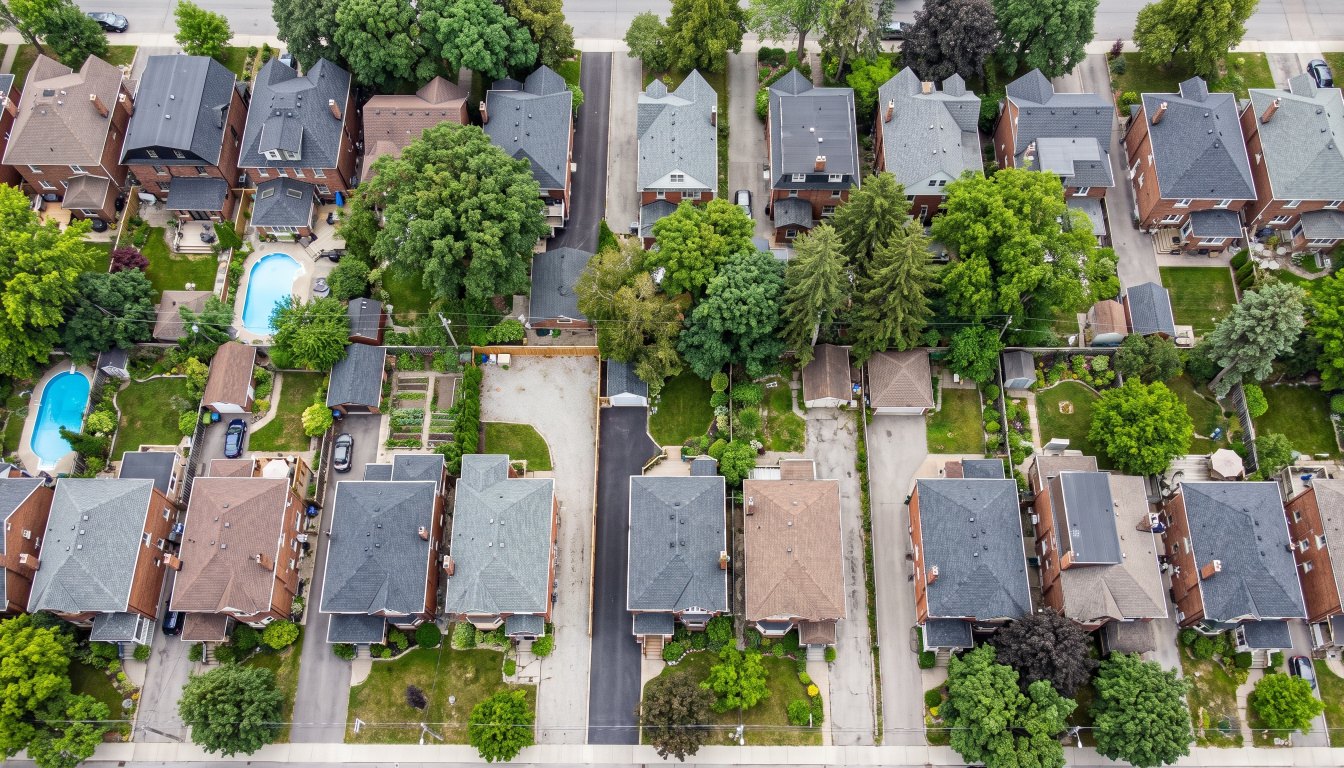
Because the lot is the part of the property that cannot be reproduced. A house can be renovated, extended or replaced. Frontage cannot be widened, depth cannot be added, and a slope cannot be turned into table land. At the top of the Toronto market, most of the money is in the land, which is why frontage is usually a better predictor of value than interior square footage.
Four attributes do most of the work: frontage, which sets what can be built and how the house sits; usable depth or table land, as distinct from total depth; shape, because irregular and pie lots behave very differently under zoning; and constraints — ravine mapping, TRCA regulation, heritage district status and protected trees — which determine what you are actually permitted to do.
The variable that hides in plain sight
Listings lead with interior square footage because it is easy to state and easy to compare. It is also the wrong headline at the top of the market. Interior area describes the building, and the building is the depreciating half of the asset. The land is the half that holds value across decades, and it is described by four numbers most buyers never look at properly.
1. Frontage
Frontage sets the shape of everything. It determines how wide a house can be after side-yard setbacks, whether a two-car garage works, whether a principal room can face the garden, and how the house presents from the street. It is also the number that cannot be changed at any price.
In practical terms, moving from a 40-foot frontage to a 60-foot frontage in the same neighbourhood is not a 50% improvement, it is a change of category — because side yards consume a fixed amount and everything beyond that goes into the house.
2. Usable depth, not registered depth
This is where listings mislead most often. Two properties both described as 200 feet deep can be completely different:
| Lot A | Lot B | |
|---|---|---|
| Registered depth | 200 ft | 200 ft |
| Table land | 200 ft, flat | 85 ft, then slope into a ravine |
| Room for a pool and terrace | Yes | Tight, and regulated |
| Room for a rear addition | Yes | Limited |
| Regulated work in the rear | No | Ravine bylaw, possibly TRCA |
| Privacy and outlook | Neighbour’s house | Permanent forest view |
Neither is better in the abstract. Lot B is worth more in Rosedale or Hoggs Hollow, where the view is the point. Lot A is worth more to a buyer who wants a pool, a tennis court and a rear addition. What matters is that they are different products, and per-square-foot pricing treats them as identical.
3. Shape
Zoning setbacks are measured from lot lines, so shape has outsized consequences. A pie lot that widens to the rear can produce an unusually generous building envelope. A reverse pie that narrows can sterilise the back half. An angled rear lot line on a curved street — common in Lawrence Park, which was laid out from 1907 as a planned garden suburb with curving roads, and in North Rosedale, whose 1908 subdivision plan used curvilinear City Beautiful streets — can be either.
The only reliable way to know is to have someone draw the envelope. Everything else is guesswork dressed up as experience.
4. What you are allowed to do with it
A lot is worth what you can lawfully do with it. Four constraints matter most in Toronto’s top neighbourhoods:
- Ravine protection. Inside a mapped protected area, Chapter 658 requires a permit to remove a tree, place fill or alter grade. Penalties run $500 to $100,000 per tree.
- TRCA regulation. Where O. Reg. 41/24 applies, TRCA clearance is required before a City building permit will issue.
- Heritage Conservation District. In a Part V district, an area-wide plan governs exterior alterations, additions and demolition. South Rosedale, North Rosedale, Wychwood Park, Yorkville–Hazelton, East Annex, West Annex Phase 1 and Teiaiagon–Baby Point are all designated.
- Private trees. Chapter 813 requires a permit for any privately owned tree of 30 centimetres trunk diameter or more, with the same penalty range and a two-year replacement maintenance obligation, or cash in lieu at 120% of replanting plus two years of maintenance.
How to compare two lots properly
- Get both surveys. Not the listing dimensions. The survey.
- Measure table land, separately from registered depth.
- Draw the envelope under the actual zone, including any exceptions that apply to the property.
- Pull the ravine and TRCA mapping for both addresses.
- Check heritage status — Part IV individual designation and Part V district.
- Count the trees over 30 centimetres anywhere you might want to build.
- Look at what is across the street and behind, and what could replace it.
The practical takeaway
When you are choosing between two properties above $3 million, and one has a better house while the other has a better lot, the lot almost always wins over any holding period longer than a few years. You can fix a kitchen. You cannot widen a frontage, and no amount of money will move a ravine.
Frequently asked questions
Is frontage more important than lot depth?
Usually, yes. Frontage determines how wide a house can be, how it sits on the street, whether a garage works, and how the property reads from the road. Extra depth beyond a certain point adds garden but rarely adds buildable house, especially where the rear of the lot is slope or regulated land.
What is table land and why does it matter?
Table land is the flat, usable portion of a lot. A 200-foot deep property that begins to fall away into a ravine at 90 feet has 90 feet of table land. Pools, additions, terraces and most landscaping happen on table land. When comparing two lots, compare table land, not registered depth.
Do pie-shaped and irregular lots sell for less?
Not necessarily less, but differently. Zoning setbacks are measured from lot lines, so an irregular shape can either create an unusually generous building envelope or sterilise a large part of the lot. The only way to know is to have the envelope drawn.
How much frontage does a large Toronto house need?
It depends entirely on the zone, because Zoning By-law 569-2013 sets lot coverage and floor space limits by zone and many older neighbourhoods carry exceptions. There is no universal number, and anyone quoting one without naming your zone is guessing.
Why do Bridle Path lots dominate the record sales list?
Because the neighbourhood was platted with a two-acre minimum lot size and typical parcels of two to four acres, subdivided into roughly fifty lots in the 1950s. That supply is fixed. The 2025 top GTA sale at $27,325,000 was in fact two adjoining Park Lane Circle properties bought together — a land assembly.
Does a corner lot add or subtract value?
Both, depending on the street. A corner adds light, a second exposure and often a wider apparent frontage, but it also adds a second front-yard setback under zoning, more exposure to traffic and noise, and more sidewalk. On a quiet interior street it usually helps; on an arterial it usually does not.
Thinking about buying or selling at the top end?
Send me the address, or the shortlist you are considering. I will tell you what the property is actually worth today, what the land is worth without the house, what the transfer tax and carrying costs will be, and whether the deal makes sense. Confidential, always.
[email protected] · 833-330-1925 · Book a free consultation
Confidential. Read personally and answered within 24 hours. I never share, sell or distribute your information.
Related reading
- Price per square foot: why it breaks down above $3 million
- Buying a ravine lot in Toronto: what the bylaw does to your plans
- How luxury homes are actually valued in Toronto
- What actually moves house value in Toronto and the GTA
Sources
Everything above that is a rule, a rate or a published number comes from these. Verify anything that matters to your own deal.
- City of Toronto — Zoning By-law 569-2013, residential provisions
- City of Toronto — Municipal Code Chapter 658, Ravine and Natural Feature Protection
- City of Toronto — Municipal Code Chapter 813, Trees
- Canadian Mortgage Professional — 2025 most expensive GTA home sales, ranked
About the author — Jatin Dua, Broker of Record
I’m the Broker of Record at RE/MAX Quantum Realty, 799 The Queensway in Etobicoke, and I work with buyers, sellers and investors across Toronto and the west GTA. A large part of my work sits in the upper end of the market, where the comparables are thin, the rules are heavier and the cost of a wrong number is measured in hundreds of thousands of dollars.
The free estimators on this site are mine. I built them because the first question every owner asks is “what is it worth?” and the honest answer starts with a number you can check yourself. [email protected] or 833-330-1925.
A wide frontage raises an obvious question: what severing a lot in Ontario really costs and takes.