
Published 7 September 2026 · Updated 29 September 2026 · By Jatin Dua, Broker of Record, RE/MAX Quantum Realty
What's Your Home Worth Right Now?
Get a free AI-powered price range for your property in under 90 seconds, based on recent GTA comparable sales. No name or address required.
Get My Free Estimate →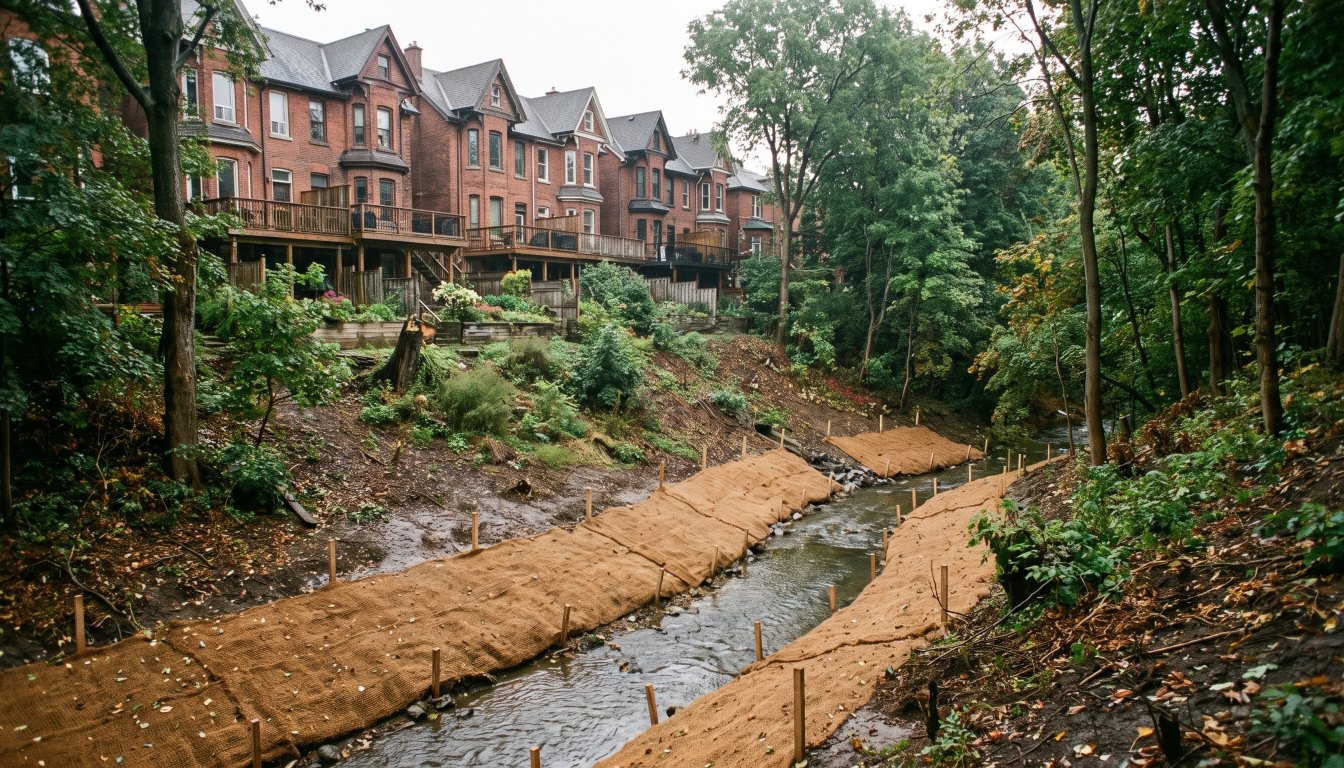
Where a property falls inside a TRCA regulated area under O. Reg. 41/24 — valley and stream corridors, wetlands, and shoreline — a TRCA permit is required, and the City of Toronto will not issue a building permit until TRCA clearance is obtained. The sequence is not negotiable and it is the single most common source of delay on ravine projects.
A property can also, separately, sit inside a mapped ravine protected area under Municipal Code Chapter 658, which requires a City permit to injure, destroy or remove a tree, place or dump fill, or alter the grade of land. Many ravine-edge properties in Toronto are subject to both regimes at once.
Two regimes, one property
| City of Toronto ravine bylaw | TRCA regulation | |
|---|---|---|
| Instrument | Municipal Code Chapter 658 | O. Reg. 41/24 |
| Administered by | City of Toronto | Toronto and Region Conservation Authority |
| Applies to | Mapped ravine protected areas | Regulated areas: valley and stream corridors, wetlands, shoreline |
| Controls | Injuring, destroying or removing trees; placing or dumping fill; altering grade | Development, interference with wetlands, alterations to watercourses |
| Relationship to building permit | Separate permit | Clearance required before the building permit issues |
A property can be inside one, both, or neither, and the boundaries do not always match what the land looks like from the back garden. This is a mapping question, not a judgement call.
Why sequence is the whole issue
The most expensive mistake on a ravine project is commissioning full architectural drawings before the conservation authority has expressed a view. TRCA’s considerations — siting, footprint, distance from the slope, drainage — shape the design. Drawings produced before that conversation frequently get redrawn.
Replacing an existing home
TRCA publishes guidance specifically on replacing an existing home in a regulated area. Replacement is often achievable — the questions are about where the new house sits, how large its footprint is, how far it stands from the slope, and how drainage is handled. What is not achievable is assuming that because a house exists there, any house can replace it.
Timeline and budget
Approvals of this kind take time measured in months, not weeks, and they sit ahead of a building permit process that has its own duration. On a property purchased with a rebuild in mind, that timeline has three consequences worth planning for:
- Carrying costs across a longer approval period — property tax, insurance and financing
- Toronto’s Vacant Home Tax, at 3% of Current Value Assessment, where the property sits unoccupied. The annual declaration is mandatory for every residential property; failing to declare defaults the property to vacant
- Design fees, which should be staged against approvals rather than committed up front
For buyers
Confirm the mapping during your conditional period, or before you write a firm offer — Ontario provides no cooling-off period on a resale purchase. Ask specifically:
- Is the property in a City ravine protected area?
- Is it in a TRCA regulated area?
- How much of the lot is table land rather than slope?
- Was any past work — retaining walls, fill, patios, tree removal — permitted?
The practical takeaway
On a ravine property, the approvals are part of what you are buying. Confirm the mapping before you commit, talk to TRCA before you draw, and build the timeline into your budget rather than your optimism. The same regulation that slows your project is what guarantees the setting you paid for.
Frequently asked questions
What is a TRCA regulated area?
Land regulated by the Toronto and Region Conservation Authority under O. Reg. 41/24, generally covering valley and stream corridors, wetlands and shoreline areas together with associated allowances. Whether a specific property is inside one is a mapping question to confirm for the address.
Does TRCA approval come before or after the building permit?
Before. Where TRCA jurisdiction applies, the City will not issue a building permit until TRCA clearance has been obtained. Plan your design, budget and closing timeline around that sequence.
What activities require a TRCA permit?
Broadly, development, interference with wetlands, and alterations to watercourses within a regulated area. That includes new construction, additions, some grading and site alteration, and works affecting a watercourse. Confirm the specifics with TRCA for your property and your proposal.
Can I replace an existing house on a ravine lot?
TRCA publishes guidance specifically on replacing an existing home in a regulated area. It is often possible and it is governed by considerations including siting, footprint and setback from the slope. Speak to TRCA early — their view shapes the design.
Is the ravine bylaw the same as TRCA regulation?
No. They are separate regimes administered by different bodies. Municipal Code Chapter 658 is a City bylaw covering trees, fill and grade alteration in mapped protected areas. TRCA regulation under O. Reg. 41/24 covers development and alterations in regulated areas. A property can be subject to one, both or neither.
How do I find out if my property is affected?
The City publishes ravine protected area mapping, and TRCA can confirm whether an address falls within a regulated area. Confirm both before buying a ravine or valley-adjacent property, and have your lawyer verify as part of your diligence.
Thinking about buying or selling at the top end?
Send me the address, or the shortlist you are considering. I will tell you what the property is actually worth today, what the land is worth without the house, what the transfer tax and carrying costs will be, and whether the deal makes sense. Confidential, always.
[email protected] · 833-330-1925 · Book a free consultation
Confidential. Read personally and answered within 24 hours. I never share, sell or distribute your information.
Related reading
- Buying a ravine lot in Toronto: what the bylaw does to your plans
- The Toronto tree bylaw can cost you $100,000. Here is how it works
- Building a custom home in Toronto: the real timeline and the real costs
- Conservation authority regulated land: TRCA and CVC explained
Sources
Everything above that is a rule, a rate or a published number comes from these. Verify anything that matters to your own deal.
- Toronto and Region Conservation Authority — Replacing an existing home
- City of Toronto — Municipal Code Chapter 658, Ravine and Natural Feature Protection
- City of Toronto — When to apply for a tree or ravine permit
About the author — Jatin Dua, Broker of Record
I’m the Broker of Record at RE/MAX Quantum Realty, 799 The Queensway in Etobicoke, and I work with buyers, sellers and investors across Toronto and the west GTA. A large part of my work sits in the upper end of the market, where the comparables are thin, the rules are heavier and the cost of a wrong number is measured in hundreds of thousands of dollars.
The free estimators on this site are mine. I built them because the first question every owner asks is “what is it worth?” and the honest answer starts with a number you can check yourself. [email protected] or 833-330-1925.