
Published 2 November 2026 · By Jatin Dua, Broker of Record, RE/MAX Quantum Realty
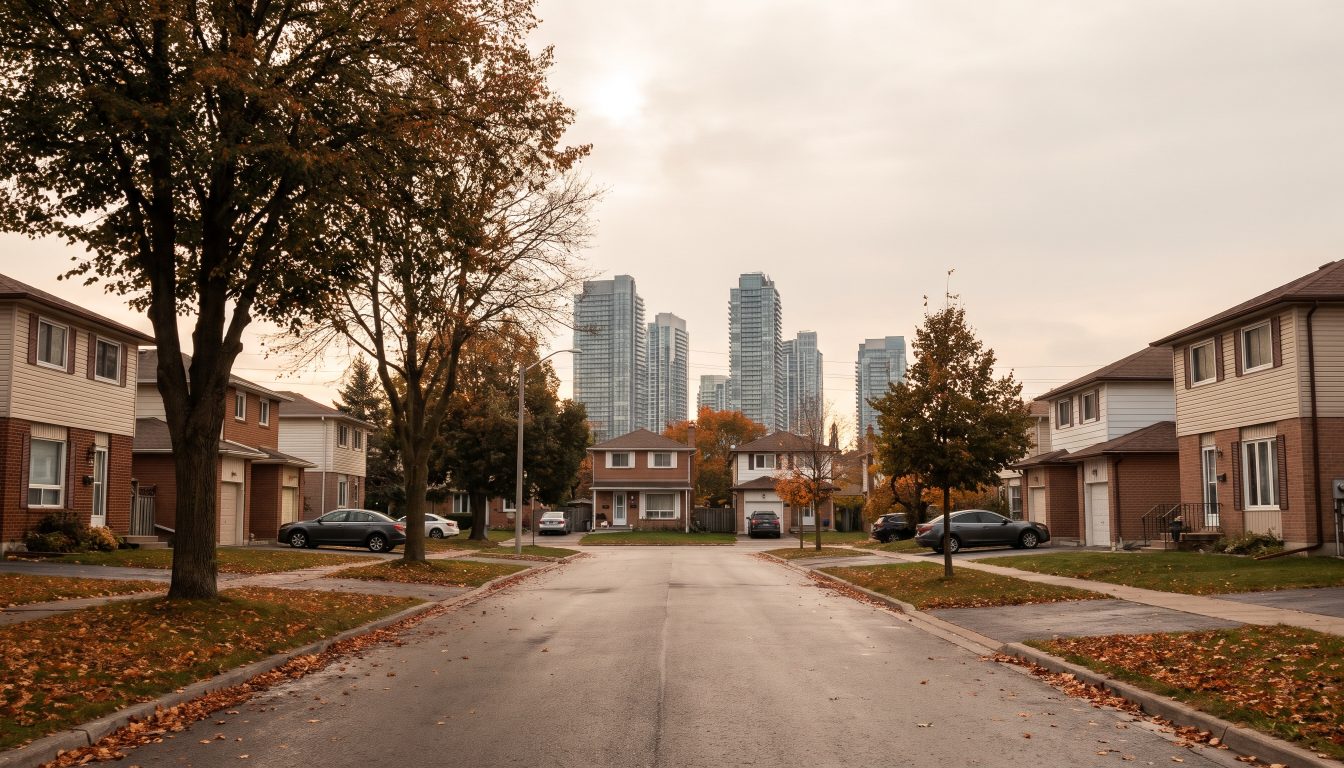
Mississauga prices fell again in 2026: the detached median was $1,225,000 for January to October, down 5.8% from 2025, and condo apartments fell 9.3% to $485,000. For 2027, CREA and TD expect more sales and near-flat prices, but those forecasts came before the October 2026 rate hike.
This is for anyone buying, selling or owning in Mississauga who wants real numbers before planning a 2027 move. You will see three years of TRREB MLS data by home type, what the October 2026 rate hike changes, what forecasters expect, and my own cautious view, clearly labelled.
What are home prices in Mississauga in 2026?
Every major home type in Mississauga sold for less in January to October 2026 than in the same months of 2025, and less again than in 2024. The typical detached house sold for $1,225,000, about $146,000 below the 2024 median. Condo apartments fell the most over two years, close to 17%.
| Home type | Median 2024 | Median 2025 | Median 2026 | 2026 vs 2025 | 2026 vs 2024 |
|---|---|---|---|---|---|
| Detached | $1,371,085 | $1,300,000 | $1,225,000 | -5.8% | -10.7% |
| Semi-detached | $999,999 | $955,000 | $885,000 | -7.3% | -11.5% |
| Freehold townhouse | $990,000 | $950,000 | $880,000 | -7.4% | -11.1% |
| Condo townhouse | $797,500 | $750,000 | $689,300 | -8.1% | -13.6% |
| Condo apartment | $583,000 | $535,000 | $485,000 | -9.3% | -16.8% |
Source: TRREB MLS data via REALM, January–October of each year (median sold price, year to date). 2026 = January–October 2026 vs the same period of 2025 and 2024.
These are medians, meaning half of homes sold for more and half for less. A median for a whole city hides big differences. A detached house in Lorne Park and one in Malton are in very different markets. Use the city number as a starting point, then look at recent sales on your own street.
How many homes are selling in Mississauga, and how fast?
Sales across the five main home types were 4,602 in January to October 2026, almost the same as 4,646 in 2025 but about 11% below 2024. Detached sales rose 3.3% from 2025, the only big segment with more sales. Homes are taking longer to sell across the board.
| Home type | Sales 2024 | Sales 2025 | Sales 2026 | Avg days on market 2024 / 2025 / 2026 | Active listings end of Oct 2024 / 2025 / 2026 |
|---|---|---|---|---|---|
| Detached | 1,892 | 1,741 | 1,798 | 22 / 28 / 31 | 767 / 996 / 901 |
| Semi-detached | 696 | 661 | 662 | 18 / 22 / 26 | 159 / 217 / 204 |
| Freehold townhouse | 168 | 171 | 152 | 20 / 23 / 29 | 54 / 54 / 63 |
| Condo townhouse | 912 | 798 | 777 | 24 / 30 / 37 | 334 / 410 / 361 |
| Condo apartment | 1,493 | 1,275 | 1,213 | 31 / 37 / 42 | 771 / 848 / 813 |
Source: TRREB MLS data via REALM, January–October 2024, 2025 and 2026 (sales and average days on market year to date; active listings at period end).
Here is the simple way to read this table. In 2026, Mississauga sold about 121 condo apartments a month on average, and 813 were for sale at the end of October. At that pace it would take more than six months to sell them all. That is a buyer’s market by most rules of thumb. Detached homes sold about 180 a month with 901 listed, so roughly five months of supply: still tilted toward buyers, but less so.
The latest monthly TRREB report agrees. In September 2026, Mississauga had 468 sales across all home types at an average price of $929,600, with 2,408 active listings. Homes sold for 97% of the asking price on average.
How will the October 2026 rate hike affect the Mississauga housing market?
On 28 October 2026, the Bank of Canada raised its policy rate by 0.25 points to 2.50%, its first increase in more than three years. The Bank said it acted to keep high energy prices, linked to the war in the Middle East, from spreading into other prices. It expects inflation of about 3.5% by the end of 2026 and an average of about 3% in 2027, and it said a further increase could be needed. It also said it expects housing activity to stay relatively weak.
The big banks raised prime from 4.45% to 4.70%, effective 29 October 2026, so variable-rate mortgages and home equity lines of credit tied to prime went up 0.25 points right away. Fixed rates follow Government of Canada bond yields instead, and those had already risen through September and October. In plain terms: the cost of carrying a Mississauga mortgage went up just as prices were coming down.
For a sense of scale: by my own arithmetic, a 0.25-point rise adds roughly $65 to $70 a month to a $500,000 mortgage on a 25-year amortization. On the typical Mississauga detached purchase with a larger loan, the increase is bigger.
What economists expect for rates in 2027
TD Economics expects one more 0.25-point hike in the first quarter of 2027, to 2.75%. CIBC expects a hold on 9 December 2026, a hike in January and then no change for the rest of 2027. These are forecasts, not promises. The Bank’s next decisions are on 9 December 2026 and 27 January 2027.
Instant Home Valuation
What’s your home
worth today?
Answer six quick questions and get an instant value range built from current Toronto & GTA sale data — property type, size, condition, lot and location all weighted the way a real pricing conversation weighs them. Takes about ninety seconds.
Reading recent GTA sale data…
Building your estimate
Estimated market value
—
$0–$0
Most likely value $0 · roughly $0 per square foot
What moved the number
Starting from the area baseline for your property type, here’s what each answer added or subtracted.
Market context
Recent local averages for comparison.
—
A range is a starting point.
A strategy is what sells.
This model doesn’t know that your neighbour’s identical semi went $80,000 over asking last month, or which two upgrades actually pay back in your area. That conversation is free and takes twenty minutes.
What do forecasters expect for Mississauga in 2027?
No major forecaster publishes a Mississauga-only price forecast that I could verify, so here is what the regional and provincial outlooks say. Use them as a direction, not a number for your home.
- CREA (16 October 2026): national sales up 4.4% in 2027 to 464,235, and a national average price up 1.2% to $689,909. CREA assumed limited Bank of Canada action over the next year.
- TD Economics (29 September 2026): Ontario sales up 7.4% in 2027 and Ontario average prices up only 0.6%, with pent-up demand doing much of the work. TD assumed bond yields would start easing in late 2026.
- CMHC (July 2026 baseline): about 71,500 MLS sales in the Toronto census metropolitan area in 2027 with an average price near $1,050,000.
- Bank of Canada (28 October 2026): housing activity expected to remain relatively weak.
For Mississauga specifically, TRREB’s September 2026 report shows Peel Region sales at 936 for the month, with homes selling for 97% of asking on average. Peel is moving with the rest of the GTA: slower sales, lower prices, and buyers taking their time.
The key point is timing. The CREA, TD and CMHC numbers were all published before the October hike. If rates rise again in December or January, the 2027 rebound in sales they describe could arrive later or be smaller.
What else could affect Mississauga real estate in 2027?
- The Hazel McCallion Line. This 18-kilometre light rail line will run along Hurontario Street from Port Credit GO to the Brampton Gateway Terminal at Steeles Avenue, with 19 stops. As of the latest public updates I could find, no opening date has been confirmed. Do not pay a premium for LRT access based on an opening year someone tells you.
- HST relief on new homes. Ontario and Ottawa now offer enhanced HST relief of up to $130,000 on new homes for eligible buyers, not only first-time buyers, when the agreement is signed after 31 March 2026 and before 1 April 2027. This can make new Mississauga condos and towns more competitive with resale until that deadline.
- Insured mortgage limit. The typical Mississauga detached home, at $1,225,000, is under the $1.5 million cap for insured mortgages. The minimum down payment at that price is $97,500 (5% of the first $500,000 plus 10% of the rest).
Is 2027 a good time to buy in Mississauga?
For buyers with a stable income, Mississauga in late 2026 offers more choice and more room to negotiate than at any time in the last three years. Detached homes take a month on average to sell, condos about six weeks. That gives you time to compare homes and room to ask for conditions on financing and inspection.
The catch is borrowing costs. Prices are lower, but rates are rising. Before you shop, get a pre-approval with a rate hold, and check your budget at a rate one point higher. If you are buying your first home, my first-time buyer guide to Mississauga walks through cash to close.
This is my cautious view, not a forecast: I do not expect Mississauga prices to jump in 2027, and I would not bet on a sharp drop either. The detached market is close to balanced; the condo market is not. If you are a condo buyer, you have time and leverage. If you are a detached buyer, the best homes on good streets still sell, so be ready when the right one appears.
Is 2027 a good time to sell in Mississauga?
It can be, if you price for the market you are in. A Mississauga detached seller faces about five months of supply, and a condo seller more than six. Buyers have options, and they compare. Homes priced at 2024 levels tend to sit, and a stale listing often sells for less in the end than one priced right on day one.
If you are moving within Mississauga, remember the drop works both ways. A move-up buyer selling a condo and buying a detached home may lose about $50,000 on the condo median since 2025 but save about $75,000 on the detached median. For a current number for your home, see how much your Mississauga house is worth or, for condos, how much your Mississauga condo is worth.
Mississauga condo apartments have the longest selling times and the most supply relative to sales of any home type in the city. If you are a condo investor counting on a quick resale in 2027, plan for a longer sale and possibly a lower price than you paid. If you must sell by a set date, list earlier than you think you need to.
If you are deciding whether to hold a Mississauga property as an investment, my Mississauga real estate investment guide covers rents, carrying costs and cash flow.
What to do next
- Find the median for your exact home type in the tables above, and compare it with recent sales within a few blocks of you.
- Get a mortgage pre-approval with a rate hold before the Bank of Canada decisions on 9 December 2026 and 27 January 2027.
- If you are looking at new construction, check whether you can sign before 1 April 2027 to qualify for the enhanced HST relief.
- If you are selling, ask for a pricing plan based on 2026 sales and current competing listings, not last year’s numbers.
- Re-check these numbers in spring 2027, once early-year sales show whether the forecast rebound is happening.
Need help with this? Talk to me.
I’m Jatin Dua, Broker of Record at RE/MAX Quantum Realty, and I’m the best agent to do this kind of work for you in Toronto and across the GTA. Over $100 million in GTA sales and 100+ families helped sell. Feel free to contact me any time: call or text 833-330-1925 or email [email protected].
Frequently asked questions
Will Mississauga house prices go down in 2027?
No verified forecast covers Mississauga alone, and the regional outlooks point to roughly flat prices in 2027. TD expects Ontario average prices to rise about 0.6% and CREA expects national prices up 1.2%. Both were made before the October 2026 rate hike, so Mississauga prices could stay flat or soften further if rates keep rising.
What is the average house price in Mississauga in 2026?
The median detached house price in Mississauga was $1,225,000 for January to October 2026, based on TRREB MLS data via REALM. That is down 5.8% from 2025. Across all home types, TRREB reported a September 2026 average price of $929,600 in Mississauga, with condos pulling the average down.
How much is a condo in Mississauga in 2026?
The median Mississauga condo apartment sold for $485,000 in January to October 2026, down 9.3% from $535,000 in 2025, based on TRREB MLS data via REALM. Condo apartments took about 42 days to sell on average, and there were 813 active listings at the end of October 2026.
Is Mississauga a buyer’s market right now?
For condos, yes. In late 2026, Mississauga had more than six months of condo apartment supply at the 2026 sales pace, and prices fell 9.3% from 2025. The detached market is closer to balanced, with about five months of supply and sales up 3.3% from 2025, but buyers still have room to negotiate.
How long does it take to sell a house in Mississauga?
A detached house in Mississauga took 31 days on average to sell in January to October 2026, up from 22 days in 2024, based on TRREB MLS data via REALM. Semi-detached homes averaged 26 days and condo apartments 42 days. Well-priced homes often sell faster than the average.
When will the Hazel McCallion LRT open in Mississauga?
As of November 2026, I could not find a confirmed public opening date for the Hazel McCallion Line. The 18-kilometre light rail line will run along Hurontario Street from Port Credit GO to the Brampton Gateway Terminal with 19 stops. Do not pay extra for a home based on a promised opening year.
Will the rate hike lower Mississauga home prices?
It may slow the market, but its exact effect on Mississauga prices cannot be known in advance. The Bank of Canada raised its rate to 2.50% on 28 October 2026 and said housing activity would stay relatively weak. Higher payments reduce what buyers can afford, which tends to keep pressure on prices.
How much down payment do I need for a house in Mississauga?
For the 2026 median Mississauga detached price of $1,225,000, the minimum down payment is $97,500: 5% of the first $500,000 plus 10% of the remaining $725,000. Homes priced at $1.5 million or more need at least 20% down because they cannot be insured. A Mississauga condo at the $485,000 median needs $24,250.
Should I sell my Mississauga condo now or wait for 2027?
It depends on your timeline, but waiting is not a sure win. Mississauga condo prices fell 9.3% in 2026 and the major 2027 forecasts call for only small price gains at best. If you need to sell in 2027, plan for a longer sale. If you can hold comfortably, you have more choice.
Sources
- TRREB Market Watch, September 2026
- Bank of Canada raises the policy rate by 25 basis points to 2½% (28 October 2026)
- CREA quarterly resale housing market forecast (16 October 2026)
- TD Economics, Provincial Resale Market Outlook (September 2026)
- CMHC, Summer Update: 2026 Housing Market Outlook
- Mortgage Professional Canada: economists and brokers react to the October 2026 rate hike
- PwC Tax Insights: Enhanced HST relief on the sale of new homes in Ontario
- ReNew Canada: Hazel McCallion LRT project profile
Related reading
- GTA Housing Market Forecast 2027: City-by-City Numbers
- Brampton Housing Market 2027: Prices, Sales and What to Expect
- Markham and Richmond Hill Housing Market 2027
- Vaughan Housing Market 2027: Prices, Sales and What to Expect
About the author — Jatin Dua, Toronto and GTA real estate broker
I am Jatin Dua, Broker of Record and co-founder of RE/MAX Quantum Realty Inc., Brokerage, Unit 101, 799 The Queensway, Toronto. I work with buyers and sellers across Toronto and the GTA and have helped more than 100 families sell. Four-plus years of active GTA transactions and over $100 million in sales volume.
Reach me at [email protected] or 833-330-1925, or book a call.