
Published 2 November 2026 · By Jatin Dua, Broker of Record, RE/MAX Quantum Realty
A Brampton basement apartment is legal only once it is registered with the City and its work is permitted and inspected. Registration costs $200 per unit and the permit fee is $1,186.24. Up to three units are allowed per lot, and rented units also need the free citywide rental licence from 1 January 2026.
This guide is for Brampton homeowners who want to add or legalize a basement apartment in 2027, and for buyers looking at a house that already has one. You will get the City’s actual rules, the fees it charges, the steps from drawings to registration, and the rental licence you now need almost everywhere in the city.
Is a basement apartment legal in Brampton?
Yes, but only once it is registered with the City. Brampton calls these units additional residential units, or ARUs. A basement apartment is the most common type. The City’s own guide is blunt: a second unit is not legal unless it has been registered and any work has been approved and inspected.
Registration is required whether you rent the unit or use it for family. It also applies to older units that were once allowed under earlier rules. The City’s ARU page says previously legal non-conforming second units must still be registered.
Registration confirms the unit meets the Ontario Building Code and the zoning by-law. Under By-law 157-2022, the City can refuse or revoke registration if the unit fails the Building Code, the Fire Code, the Electrical Safety Code, the zoning by-law or the property standards by-law.
How many units can you have on one Brampton property?
Since By-law 69-2023 took effect in May 2023, Brampton allows up to three units on one lot, counting the main house. Ontario’s Planning Act changes in 2022 required cities to permit this. You can choose one of two layouts:
- The main house, one attached second unit (such as a basement apartment) and one garden suite in the backyard.
- The main house, one attached second unit and one attached third unit, for example a basement unit plus a unit on another floor.
ARUs are allowed in detached houses, semi-detached houses and townhouses. They are not allowed in lodging houses, supportive housing residences, floodplain areas or open space zones. Each ARU is registered separately and gets its own address: Unit 2 for the second unit, Unit 3 for a third unit and Unit 4 for a garden suite.
If you want more than three units, Brampton’s ARU rules do not cover it. That is a different, larger project. My post on moving a parent in under Ontario’s three-unit rule explains how families often use the same rules.
What are Brampton’s zoning rules for a basement apartment?
Before you spend money on drawings, check that your house can meet the zoning rules. Brampton’s two-unit guide lists them:
- Size: the second unit must be smaller in floor area than the main unit.
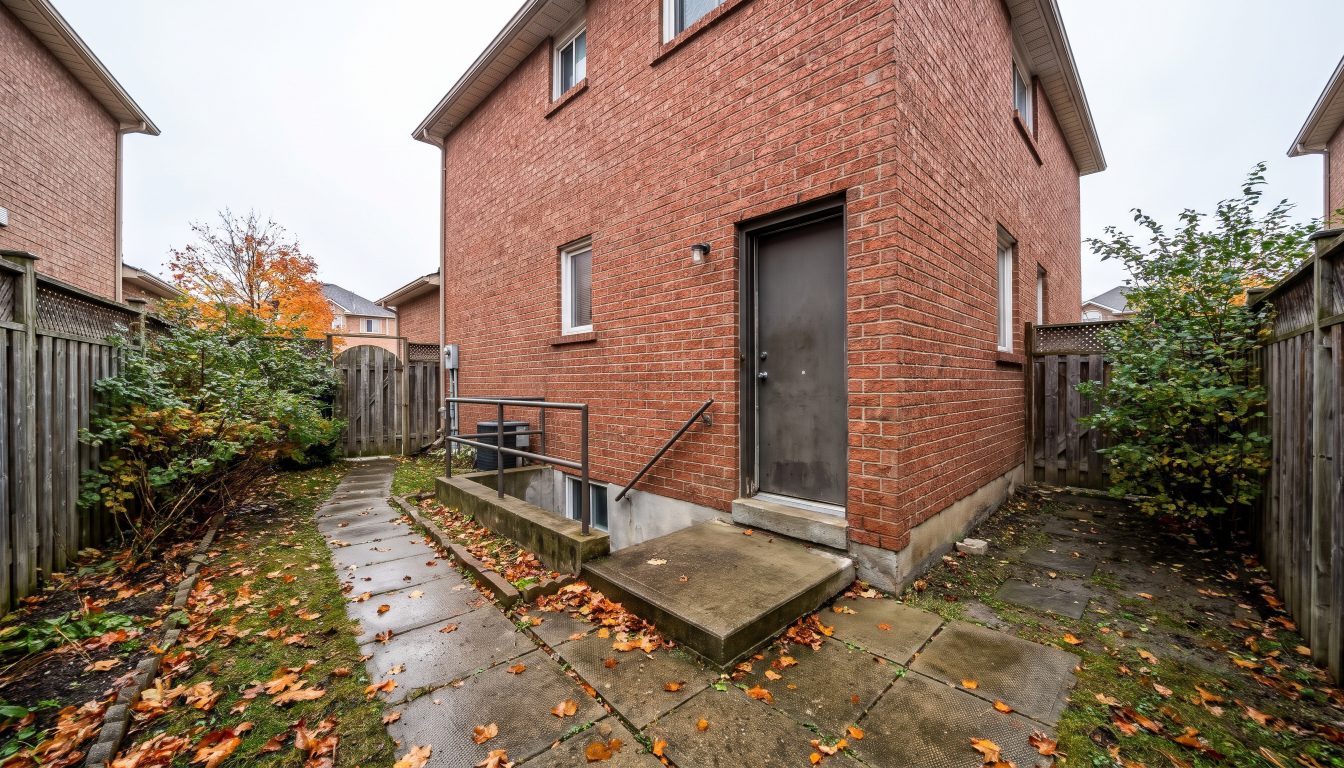
- Entrance: the entrance can be in the side or rear yard, as long as there is a 1.2-metre unobstructed path to it, entirely on your property. Access through the garage or a shared inside vestibule is also allowed.
- Side door landing: if a side door above grade is the main entrance, the landing must be less than 0.6 metres above the ground and no more than 0.9 by 0.9 metres, with steps at both the front and back.
- Parking: one ARU needs no extra parking space, but the lot must keep the minimum parking the zoning by-law already requires. Two ARUs need one additional space, and tandem parking is allowed. Spaces must be on your driveway or in a garage, not on the street or boulevard.
- Location: no ARUs on land zoned Open Space or Floodplain, or inside the Downtown Floodplain Regulation Area.
Some lots also need approval from a conservation authority, such as Credit Valley Conservation or the Toronto and Region Conservation Authority. The City says the permit cannot go ahead without it. If your house cannot meet a rule, a minor variance from the Committee of Adjustment may give relief.
What Building Code and fire rules does a Brampton basement unit need?
The Building Code is usually where basement projects succeed or fail. The table below uses the Province’s guide to adding a second unit to an existing house. The Code was updated in 2024, so have your designer confirm each item against the current edition.
| Requirement | What the provincial guide says |
|---|---|
| Ceiling height in a basement unit | At least 1.95 m (about 6 ft 4.75 in) over the required floor area, including the route to the exit |
| Fire separation between units | 30 minutes, or 15 minutes if the whole house has interconnected smoke alarms |
| Basement escape window | Unobstructed opening of at least 0.38 m², no side under 460 mm, sill no more than 900 mm above the floor |
| Smoke alarms | On every level, outside sleeping areas, in each bedroom of the second unit and in shared areas |
| Carbon monoxide alarms | Required with a fuel-burning furnace or an attached garage, near sleeping areas |
| Shared furnace | Allowed with a duct smoke detector that shuts the furnace down |
| Plumbing | Separate water shut-off valves for each unit |
Source: Government of Ontario, “Add a second unit in your house” (last updated January 2023). Brampton’s permit drawings must show these items.
Ceiling height is the most common deal-breaker. If your basement is too low, the fix is lowering the floor, which is expensive. Measure first, before anything else. Electrical work also has to meet the Electrical Safety Code. Since 3 March 2025, Brampton notifies the Electrical Safety Authority about new ARUs itself, so you no longer email an ESA certificate to finish registration.
Instant Home Valuation
What’s your home
worth today?
Answer six quick questions and get an instant value range built from current Toronto & GTA sale data — property type, size, condition, lot and location all weighted the way a real pricing conversation weighs them. Takes about ninety seconds.
Reading recent GTA sale data…
Building your estimate
Estimated market value
—
$0–$0
Most likely value $0 · roughly $0 per square foot
What moved the number
Starting from the area baseline for your property type, here’s what each answer added or subtracted.
Market context
Recent local averages for comparison.
—
A range is a starting point.
A strategy is what sells.
This model doesn’t know that your neighbour’s identical semi went $80,000 over asking last month, or which two upgrades actually pay back in your area. That conversation is free and takes twenty minutes.
How do you register a basement apartment in Brampton?
Brampton combines registration and the building permit into one application. Here is the order it follows:
- Check zoning and constraints. Confirm your lot is not in a floodplain or open space zone and whether a conservation authority approval is needed.
- Get drawings. The design must be by an architect, an engineer, a designer with a Building Code Identification Number (BCIN), or the homeowner taking legal responsibility. A below-grade entrance with stairs needs an engineer or BCIN designer. The City strongly recommends a qualified designer.
- Include a legal survey. The package needs a survey, site plan, existing and proposed floor plans with ceiling heights, egress details, fire separations, smoke alarm locations and a plumbing schematic.
- Apply online and pay. At submission, you pay the $200 registration fee and the $1,186.24 permit fee.
- Build with licensed trades. Building renovators, plumbing contractors and HVAC contractors must hold a City of Brampton licence before working on an ARU.
- Pass inspections. Typical inspections include plumbing, framing, insulation, HVAC and final. Once everything passes, the City issues occupancy and the final registration certificate together.
The City may treat an application as abandoned if it is not completed within 18 months. If work was done earlier without a permit, an inspector can require walls or ceilings to be opened so the work can be checked.
How much does a legal basement apartment cost in Brampton?
The City’s fees are small. Construction is where the real money goes, and no official source publishes an average construction cost for Brampton basements. Get at least two written quotes based on your actual drawings.
| Cost item | Amount |
|---|---|
| ARU registration fee | $200 per unit, non-refundable |
| Building permit fee due at application (two-unit dwelling) | $1,186.24 |
| Development charges for a second unit in an existing house | Not collected (provincial rule) |
| Residential rental licence | Free |
| Liability insurance for the rental licence | At least $2 million in coverage (premium varies by insurer) |
| Inspection recall fee | Charged if an inspection fails twice (amount not listed on the City page) |
| Design, survey, construction, trades | Varies with your house; no official average |
Sources: City of Brampton Two-Unit Dwelling Registration and Permit Application Guide (revised February 2026), By-law 157-2022, Residential Rental Licensing FAQ; Government of Ontario second unit guide.
Budget for a few items people forget. If the water service is too small for two units, you need a connection approval from the Region of Peel. Your property assessment may also rise. Brampton sends permit information to MPAC, which can change the assessment for the current year and part of the previous two years. My post on Brampton property tax for 2027 shows how the tax rate turns an assessment into a bill.
Do you need a rental licence for a basement apartment in Brampton?
Yes, if you rent it out. Brampton’s Residential Rental Licensing program began as a pilot in part of the city. The City’s FAQ now says the program is citywide, all wards require licensing from 1 January 2026, and the program runs until 31 December 2028.
It covers rental properties with one to four units. That includes an owner-occupied house with a rented basement unit. The application is free, but you must:
- register the ARU first, so it has passed Building Code permits and inspections;
- carry at least $2 million in liability insurance and submit proof;
- complete a one-time online landlord education module;
- renew every year and post the licence inside the rental unit.
If the basement unit is not rented, the City asks for a non-rental declaration instead. My guide to landlord insurance in Ontario explains what a rental policy should cover.
What happens if your basement apartment is not registered?
Brampton lists the penalties on its ARU page. Administrative penalties of $1,000 to $1,500 apply for failing to register an ARU, for breaking bedroom occupancy standards, and for converting a room into a bedroom without a permit. Working as an unlicensed renovator, plumber or HVAC contractor carries a $250 penalty. Court fines under the Planning Act, Building Code Act and Municipal Act range from $25,000 to $1.5 million, with daily fines for continuing offences.
Under the rental licensing program, fines start at $750 and can rise to $1,500. Fire safety inspection fees start at $3,000 for a first non-compliance.
Many Brampton houses are sold with a “basement apartment” that was never registered. The City warns that unregistered units can bring enforcement, fines, legal action and insurance problems. If you are buying, ask for the registration and occupancy records, or check the City’s ARU search map. If there are none, price in the cost of legalizing, including the risk that ceiling height makes it impossible.
My post on buying a house with a basement apartment covers the lender and insurance side in more detail.
Is a legal basement apartment worth it in Brampton?
It depends on your build cost and the rent the unit can earn. Here is what the published numbers show:
- Basement rents: no official source publishes them for Brampton. TRREB and CMHC do not track basement units separately.
- Condo rents as an upper check: TRREB’s Q2 2026 report put Brampton’s one-bedroom condo lease average at $2,052 and two-bedrooms at $2,408.
- Older apartments as a lower check: CMHC’s October 2025 survey put Brampton’s purpose-built one-bedrooms at $1,778 and two-bedrooms at $2,032.
- Vacancy: CMHC’s Brampton purpose-built vacancy rate rose to 4.4% in October 2025 from 2.9% a year earlier, so tenants have more choice than they did.
On the value side, Brampton’s median detached house sold for $950,000 from January to October 2026, down 8.9% from 2025 (TRREB MLS data via REALM). In my experience, a registered unit also helps at resale, because buyers and lenders can rely on the income being legal. Keep in mind that a unit first occupied after 15 November 2018 is exempt from the rent increase guideline, which gives you flexibility on future increases.
In Brampton the paperwork is not the hard part. The City’s fees are about $1,400 and the licence is free. The hard parts are ceiling height, a code-compliant exit and finding licensed trades. Measure your basement, get a BCIN designer’s opinion before you buy materials, and price your rent against Brampton’s condo and purpose-built numbers, not against the highest listing you can find.
What to do next
- Measure your basement ceiling height and check your lot against the zoning rules above.
- Look up your address on the City’s ARU search map to see if a unit is already registered.
- Hire a BCIN-qualified designer or engineer to prepare drawings and confirm the Building Code items.
- Apply online, pay the $200 registration and $1,186.24 permit fees, and book inspections as you build.
- Before renting, complete the landlord module, arrange $2 million liability insurance and apply for the free rental licence.
Need help with this? Talk to me.
I’m Jatin Dua, Broker of Record at RE/MAX Quantum Realty, and I’m the best agent to do this kind of work for you in Toronto and across the GTA. Over $100 million in GTA sales and 100+ families helped sell. Feel free to contact me any time: call or text 833-330-1925 or email [email protected].
Frequently asked questions
Do I need to register my basement apartment in Brampton?
Yes. Every additional residential unit in Brampton, including a basement apartment, must be registered with the City under By-law 157-2022. Registration is required whether the unit is rented or used by family, and it also applies to older units that were legal under earlier rules. A unit is not legal until it is registered and its work has been permitted and inspected.
How much does it cost to register a basement apartment in Brampton?
Brampton charges a non-refundable $200 registration fee for each additional residential unit. When you apply, you also pay a $1,186.24 building permit fee for a two-unit dwelling, according to the City’s guide revised in February 2026. Development charges are not collected for a second unit in an existing house. Design, survey and construction costs are extra.
How many basement apartments are allowed in Brampton?
Brampton allows one attached second unit, such as a basement apartment, plus either one more attached unit or one garden suite. That makes a maximum of three units on the lot, including the main house, under By-law 69-2023 in effect since May 2023. Units are not allowed in floodplains, open space zones or lodging houses.
What is the minimum ceiling height for a basement apartment in Ontario?
Ontario’s guide to adding a second unit sets a minimum ceiling height of 1.95 metres, about 6 feet 4.75 inches, over the required floor area of a basement unit, including the path to the exit. The Building Code was updated in 2024, so have a qualified designer confirm the current rule for your Brampton house before you build.
Do I need a separate entrance for a basement apartment in Brampton?
Brampton allows access through the garage or a shared inside vestibule, so a separate outside door is not the only option. An outside entrance can be in the side or rear yard if there is a 1.2-metre clear path to it on your own property. A below-grade entrance with stairs needs an engineer or BCIN-qualified designer.
Do I need a rental licence for my basement in Brampton?
Yes, if you rent it. Brampton’s Residential Rental Licensing program is citywide from 1 January 2026 and covers rental properties with one to four units, including an owner-occupied home with a rented basement. The licence is free but requires a registered unit, $2 million liability insurance and a one-time landlord education module, renewed every year.
Do I need extra parking for a basement apartment in Brampton?
No extra parking space is needed for one additional unit in Brampton, but the lot must keep the parking the zoning by-law already requires. If you add two units, you need one more space, and tandem parking is allowed. All spaces must be on your driveway or in a garage, not on the street or boulevard.
What is the fine for an illegal basement apartment in Brampton?
Brampton’s administrative penalty for failing to register an additional residential unit is $1,000 to $1,500. Converting a room into a bedroom without a permit carries the same range. Court fines under the Planning Act, Building Code Act and Municipal Act range from $25,000 to $1.5 million, with daily penalties for continuing offences.
How long does it take to legalize a basement apartment in Brampton?
Brampton does not publish a standard timeline for registering a basement unit. The work runs through drawings, permit review, construction, inspections and occupancy, and the City can treat an application as abandoned if it is not finished within 18 months. Ontario’s guide says municipalities respond to complete house permit applications within 10 business days.
Sources
- City of Brampton: Additional Residential Units (ARUs)
- City of Brampton: Two-Unit Dwelling Registration and Permit Application Guide (revised February 2026, PDF)
- City of Brampton: Additional Residential Units Registration By-law 157-2022 (office consolidation, PDF)
- City of Brampton: Building permits for second and third units
- City of Brampton: Residential Rental Licensing FAQs
- Government of Ontario: Add a second unit in your house
- TRREB Rental Market Report, Q2 2026 (PDF)
- CMHC Rental Market Report data tables, Toronto CMA 2025 (Brampton zones)
Related reading
- How Much Does a Fourplex Cost to Build or Buy in Toronto?
- Converting a House to a Triplex in Toronto: Cost, Permits and Payback
- Multiplex Benefits for Toronto Homeowners: Rent, Value and Family Living
- Legal Basement Apartment in Mississauga (2027): Rules, Permits and Costs
About the author — Jatin Dua, Toronto and GTA real estate broker
I am Jatin Dua, Broker of Record and co-founder of RE/MAX Quantum Realty Inc., Brokerage, Unit 101, 799 The Queensway, Toronto. I work with buyers and sellers across Toronto and the GTA and have helped more than 100 families sell. Four-plus years of active GTA transactions and over $100 million in sales volume.
Reach me at [email protected] or 833-330-1925, or book a call.