
Published 2 November 2026 · By Jatin Dua, Broker of Record, RE/MAX Quantum Realty
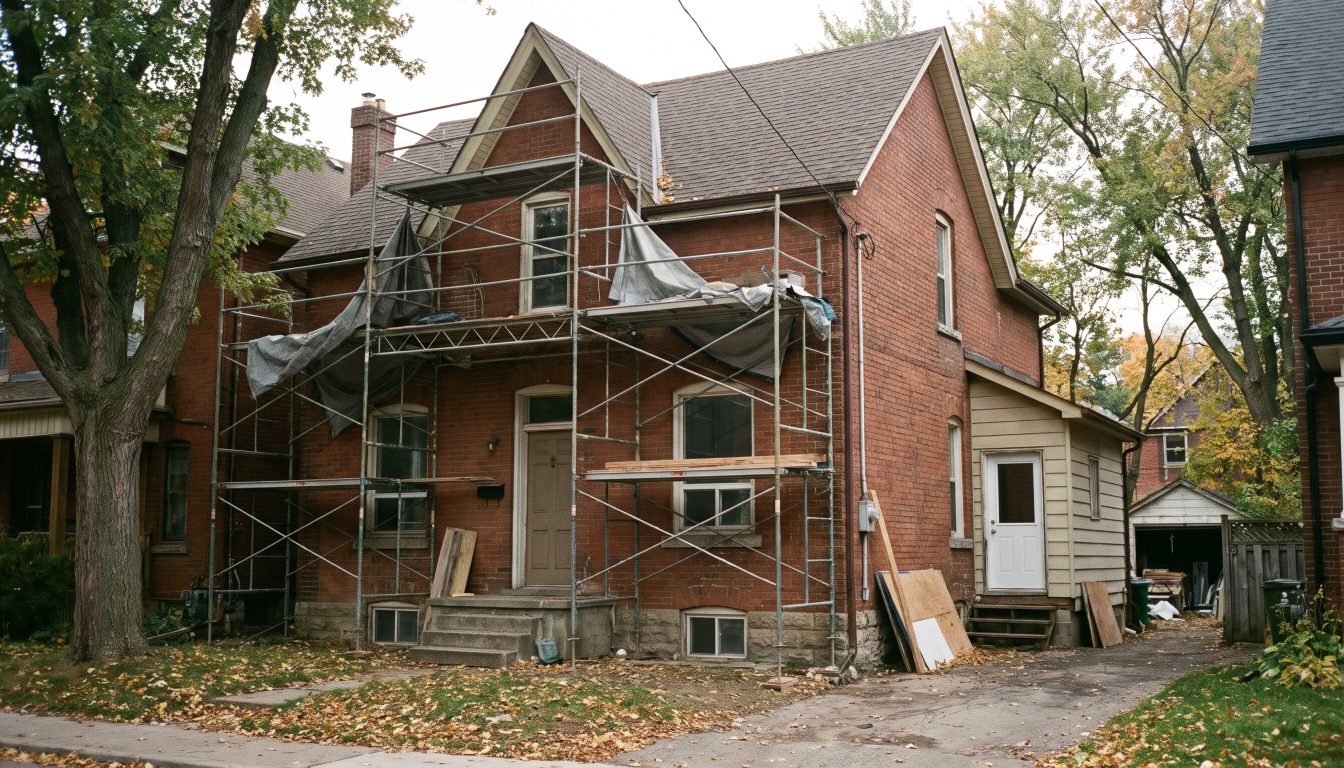
Converting a house to a triplex in Toronto is allowed as of right, but you need a building permit. A City-commissioned ULI panel used $300 to $450 per square foot in hard costs (2022), plus 15% contingency and 20% soft costs. Development charges are generally waived up to four units, and payback depends mostly on construction cost and market rent.
This guide is for Toronto homeowners and buyers who want to turn a house into three units. You will get the rules, the permits, the real cost inputs from named and dated sources, and a simple way to test the payback before you spend a dollar on drawings.
Can you legally turn a house into a triplex in Toronto?
Yes. Toronto City Council changed the Official Plan and the zoning bylaw in May 2023 so that buildings with up to four units are allowed in residential zones across the whole city. A triplex is simply a multiplex with three units. You do not need a rezoning. You need a building permit, and your plans must meet the zoning rules for your lot.
A few rules from the City of Toronto shape every project:
- At least one unit must sit above another. Units side by side fall under townhouse or semi-detached rules instead.
- Zones: multiplexes are allowed in the R, RD, RS, RM and RT residential zones, and existing houses in those zones can be converted.
- Height: limits are set in metres. Where the height overlay shows less than 10 metres, a multiplex can still go to 10 metres.
- Parking: since 3 February 2022, duplexes, triplexes and fourplexes do not have to provide parking.
- Trees: you need a permit to injure or remove a private tree 30 cm or more in diameter.
Sixplexes are a separate case. As of November 2026 they are only permitted in the Toronto and East York District and Ward 23. If you want more than four units, read my guide on buying land to build a multiplex in Toronto.
How much does a triplex conversion cost in Toronto?
There is no official “average” conversion cost, because every house is different. What you can use are planning-level numbers from named sources. The best Toronto-specific set comes from an Urban Land Institute (ULI) Toronto technical panel that the City asked to test multiplex conversions in April 2022. The panel used hard construction costs of $300 to $450 per square foot, plus a 15% contingency and 20% soft costs. Those are 2022 figures, so treat them as a floor rather than today’s price.
| Cost item | Figure or range | Source and date |
|---|---|---|
| Hard cost of a conversion | $300 to $450 per sq ft | ULI Toronto panel, April 2022 |
| Contingency reserve | 15% | ULI Toronto panel, April 2022 |
| Soft costs (design, engineering, fees, financing) | 20% | ULI Toronto panel, April 2022 |
| New wood-frame single family house, GTA (for comparison) | $150 to $275 per sq ft, above grade | Altus Group 2026 Canadian Cost Guide (as at 31 Jan 2026) |
| Custom-built single family house, GTA | $500 to $1,130 per sq ft | Altus Group 2026 Canadian Cost Guide |
| Toronto permit fee, interior alterations | $11.53 per square metre | City of Toronto, rates from 1 Jan 2026 |
| Toronto permit fee, each new residential unit | $56.33 per unit | City of Toronto, rates from 1 Jan 2026 |
| Development charges and parkland cash-in-lieu | Generally exempt up to 4 units on the lot | City of Toronto (Municipal Code 415) |
Source: ULI Toronto Technical Assistance Panel, Multiplex Housing Financial Feasibility Exercise (April 2022); Altus Group 2026 Canadian Cost Guide; City of Toronto multiplex conversion permit guide and multiplex considerations page.
Two things stand out. City fees are small next to construction. And the Altus new-build numbers cover above-grade work only, so they are a comparison point, not a renovation quote. Your real number comes from a designer and two or three contractor bids on your actual house.
What permits do you need to convert a house into a triplex?
The City of Toronto has a specific “multiplex conversion” building permit for turning an existing house into a duplex, triplex, fourplex, fiveplex or sixplex. Here is what the City asks for:
- A zoning review. This confirms your plans meet the zoning bylaw. If they do not, you can ask the Committee of Adjustment for a minor variance, which adds time and cost.
- Drawings by a qualified person. Plans must be to scale and show the designer’s name, registration and qualification number, or be sealed by an engineer or architect. The package includes a site plan from a survey, floor plans for each level (with smoke and carbon monoxide alarm locations), sections and construction details.
- Mechanical and plumbing. HVAC follows the City’s residential mechanical guide, and a plumbing data sheet is required. Projects with more than two units need fixture layouts for each floor.
- Extra forms where they apply. A road damage deposit for exterior work, a tree declaration if trees could be harmed, and a rental renovation licence screening form for renovation permits.
The City does not publish a fixed review time for these permits. Its own monitoring of the first 222 multiplex permits listed the Ontario Building Code, the Toronto Hydro connection process and permit inconsistencies among the problems owners were raising.
What makes a triplex conversion expensive?
The finishes are not usually the budget killer. The hidden items are:
- Fire separations and exits. The ULI panel found that, for one newer house type, the need for two separate exits and new fire-rated barriers between units made a conversion unworkable.
- Electrical service. In its bungalow scenario the panel assumed an upgrade to 200-amp service. Three kitchens and three sets of laundry use a lot of power.
- Basement height and light. The panel used window wells and sunken patios so basement units had outdoor space, but warned these can trigger zoning variances.
- Going to four storeys. The City’s 2023 multiplex report noted that the Building Code requires an elevator in residential buildings of four storeys or more, which usually makes a four-unit design too expensive.
A conversion can trigger GST/HST. The CRA’s guide RC4231 includes an example of an owner who lives in one unit of a triplex and rents the other two, and treats her as a builder who must self-assess tax on the whole property when it is first occupied. The enhanced 100% rental rebate does not apply to duplexes or triplexes. Speak with an accountant before construction starts, not after.
Instant Home Valuation
What’s your home
worth today?
Answer six quick questions and get an instant value range built from current Toronto & GTA sale data — property type, size, condition, lot and location all weighted the way a real pricing conversation weighs them. Takes about ninety seconds.
Reading recent GTA sale data…
Building your estimate
Estimated market value
—
$0–$0
Most likely value $0 · roughly $0 per square foot
What moved the number
Starting from the area baseline for your property type, here’s what each answer added or subtracted.
Market context
Recent local averages for comparison.
—
A range is a starting point.
A strategy is what sells.
This model doesn’t know that your neighbour’s identical semi went $80,000 over asking last month, or which two upgrades actually pay back in your area. That conversation is free and takes twenty minutes.
How long does the payback take on a Toronto triplex conversion?
Here is a simple test. It is my illustration, not a quote. Suppose you rebuild 1,500 square feet of space to create two new rental units and live in the third.
| Line | Low case | High case |
|---|---|---|
| Hard cost (1,500 sq ft at $300 / $450) | $450,000 | $675,000 |
| Contingency (15%) | $67,500 | $101,250 |
| Soft costs (20%) | $90,000 | $135,000 |
| Total project cost | $607,500 | $911,250 |
| Gross rent, one 1-bed + one 2-bed unit | $63,432 a year | $63,432 a year |
| Years of gross rent to repay cost | about 9.6 | about 14.4 |
Source: cost inputs from the ULI Toronto panel (April 2022); rents are TRREB’s Q2 2026 GTA average condo apartment rents ($2,273 one-bedroom, $3,013 two-bedroom). Gross rent is before vacancy, interest, tax, insurance and repairs.
Real payback is longer once you subtract interest, insurance, maintenance and income tax. Rents also matter a lot. The ULI panel found conversions only work where tenants pay market rent, and work better in higher-rent areas. In one of its scenarios, the modelled return ranged from below zero to about 18% depending on construction cost and rent.
One rule helps the numbers. Under Ontario rules, units first occupied as homes after 15 November 2018 are exempt from the annual rent increase guideline. A brand-new unit created by your conversion would generally fall in that group. Confirm the details for your situation before you set rents.
Which Toronto houses make the best triplex conversions?
The City’s own monitoring gives a clue. Of the 222 multiplex permits it reviewed (May 2023 to November 2024), 83 were triplexes, and 158 of the 222 were renovations or additions rather than new houses. Those 222 permits created 663 units in total, or 393 net new units.
The ULI panel was blunt about which houses do not work. A house built since 2000 worth $2 million to $3 million was not worth converting, because the owner would do better to sell. A typical 1970s bungalow was also not financially feasible to renovate into a multiplex for an average owner; adding a storey or rebuilding was the better path.
In my experience, the strongest candidates are older two-storey or two-and-a-half-storey houses with a tall basement, a side entrance or room for one, and good transit nearby. Purchase price matters too. Detached medians across Toronto’s TRREB districts ranged from $866,500 to $3,627,500 between January and October 2026 (TRREB MLS data via REALM, January–October 2026 vs the same period of 2025). A lower entry price leaves more room in the budget for construction.
What are the benefits of a triplex?
- Two rents help carry one mortgage. The City’s 2023 report named “help pay the mortgage” as a main reason owners add units.
- Room for family. A unit for a parent or an adult child, each with their own door and kitchen. See my guide on moving a parent in.
- No development charges for units two to four on the lot.
- Flexibility. You can live in one unit now and rent all three later, or the reverse.
The trade-off: you become a landlord with Ontario’s rules, and a converted house can appeal to a smaller pool of buyers than a single-family house. My guide on buying a duplex or triplex in Toronto covers how these properties are financed and valued.
Will converting to a triplex change your income tax?
It can. The CRA’s principal residence folio (S1-F3-C2) says that turning part of a house into a self-contained rental unit, such as a duplex or triplex, is a structural change. That normally counts as a change in use of that part of the home, which can create a deemed sale for tax purposes. An election under subsection 45(2) may let you defer this. Rental income and expenses go on your return each year. My posts on the change-of-use election and Form T776 explain both.
How do people pay for a triplex conversion?
Most owners use home equity: a refinance or a home equity line of credit, with construction draws released as work is done. Rates matter here. Prime rose to 4.70% on 29 October 2026 after the Bank of Canada raised its policy rate to 2.50%, so variable borrowing just got more expensive. Compare options in my HELOC vs refinance guide. The City notes that CMHC’s multi-unit financing tool generally starts at five units, which is one reason small owners find triplexes harder to fund than larger buildings.
Do not start with a contractor. Start with a one-page budget: what the house is worth today, what the finished triplex would rent for, and what it would cost at both $300 and $450 a square foot plus 35% for contingency and soft costs. If the numbers only work at the low end, the project probably does not work. If they still work at the high end, get a designer to check zoning and fire separations before you buy or commit.
What to do next
- Get a current estimate of your home’s value so you know your starting equity and the opportunity cost of converting rather than selling.
- Book a zoning review or a designer’s feasibility check on height, entrances and basement ceiling height.
- Price the project at $300 and $450 per square foot plus 35%, then compare with today’s rents in your area.
- Ask an accountant about GST/HST self-supply and the change-of-use election before you sign a contract.
- Line up financing and get at least three written contractor bids.
Need help with this? Talk to me.
I’m Jatin Dua, Broker of Record at RE/MAX Quantum Realty, and I’m the best agent to do this kind of work for you in Toronto and across the GTA. Over $100 million in GTA sales and 100+ families helped sell. Feel free to contact me any time: call or text 833-330-1925 or email [email protected].
Frequently asked questions
How much does it cost to convert a house into a triplex in Toronto?
There is no official average, but a City of Toronto-commissioned Urban Land Institute panel used $300 to $450 per square foot in hard costs in April 2022, plus a 15% contingency and 20% soft costs. On 1,500 square feet that works out to roughly $607,500 to $911,250. Costs have generally risen since 2022, so get contractor bids on your own house.
Is a triplex allowed in my Toronto neighbourhood?
Yes, in most cases. Since May 2023, Toronto has allowed buildings with up to four units as of right in its residential zones (R, RD, RS, RM and RT) across the city. You still need a building permit, and your plans must meet zoning rules such as height in metres, setbacks and lot coverage, or you need a minor variance.
Do I pay development charges on a triplex conversion in Toronto?
Generally no. The City of Toronto says multiplexes are exempt from development charges and cash-in-lieu of parkland when the residential lot has no more than four units. The City has flagged that development charges do apply at five units or more, which is one reason triplexes and fourplexes are more common than larger plexes.
Do I need parking for a triplex in Toronto?
No. Since 3 February 2022, Toronto has not required parking for duplexes, triplexes or fourplexes. If you choose to provide parking, it must meet the zoning standards. The City’s monitoring of the first 222 multiplex permits found triplexes provided about 0.42 parking spaces per unit on average.
How long does a triplex take to pay for itself in Toronto?
Gross rent alone typically repays the cost in about 10 to 15 years in a simple example. Using 2022 ULI cost ranges and TRREB’s Q2 2026 GTA average rents for a one-bed and a two-bed, a 1,500-square-foot conversion repays in about 9.6 to 14.4 years before interest, tax, insurance and repairs, so the real payback is longer.
What permits do I need to convert a house into a triplex in Toronto?
You need a City of Toronto building permit for a multiplex conversion, which includes a zoning review. Drawings must be prepared by a qualified designer, engineer or architect, with site plans, floor plans, sections, and plumbing and HVAC information. Removing a private tree 30 cm or more in diameter also needs a separate tree permit.
Does converting my house to a triplex affect my principal residence exemption?
It can. The CRA’s principal residence folio treats creating a self-contained rental unit, such as a duplex or triplex, as a structural change that is normally a change in use of that part of the home. That can create a deemed sale for tax purposes. An election under subsection 45(2) may defer it, so ask an accountant first.
Do I have to pay HST when I convert my house to a triplex?
Possibly. The CRA’s guide RC4231 gives an example of an owner who lives in one unit of a triplex and rents the other two, and treats her as a builder who must self-assess GST/HST on the whole property. The 100% purpose-built rental rebate does not apply to duplexes or triplexes. Get tax advice before construction starts.
What are the benefits of a triplex in Toronto?
A triplex gives you two units of rental income to help carry one mortgage, separate homes for family members, and flexibility to live in one unit now and rent all three later. In Toronto, units two to four are generally exempt from development charges, and new units first occupied after 15 November 2018 are exempt from the rent increase guideline.
Sources
- City of Toronto: Multiplex housing
- City of Toronto: Considerations when building multiplexes
- City of Toronto: Multiplex conversion building permit guide
- ULI Toronto: Multiplex Housing Financial Feasibility Exercise (April 2022)
- City of Toronto: Sixplexes study and Multiplex Monitoring Program presentation (April 2025)
- Altus Group: 2026 Canadian Cost Guide
- CRA RC4231: GST/HST New Residential Rental Property Rebate
- TRREB Rental Market Report, Q2 2026
Related reading
- How Much Does a Fourplex Cost to Build or Buy in Toronto?
- Multiplex Benefits for Toronto Homeowners: Rent, Value and Family Living
About the author — Jatin Dua, Toronto and GTA real estate broker
I am Jatin Dua, Broker of Record and co-founder of RE/MAX Quantum Realty Inc., Brokerage, Unit 101, 799 The Queensway, Toronto. I work with buyers and sellers across Toronto and the GTA and have helped more than 100 families sell. Four-plus years of active GTA transactions and over $100 million in sales volume.
Reach me at [email protected] or 833-330-1925, or book a call.