
Published 2 November 2026 · By Jatin Dua, Broker of Record, RE/MAX Quantum Realty
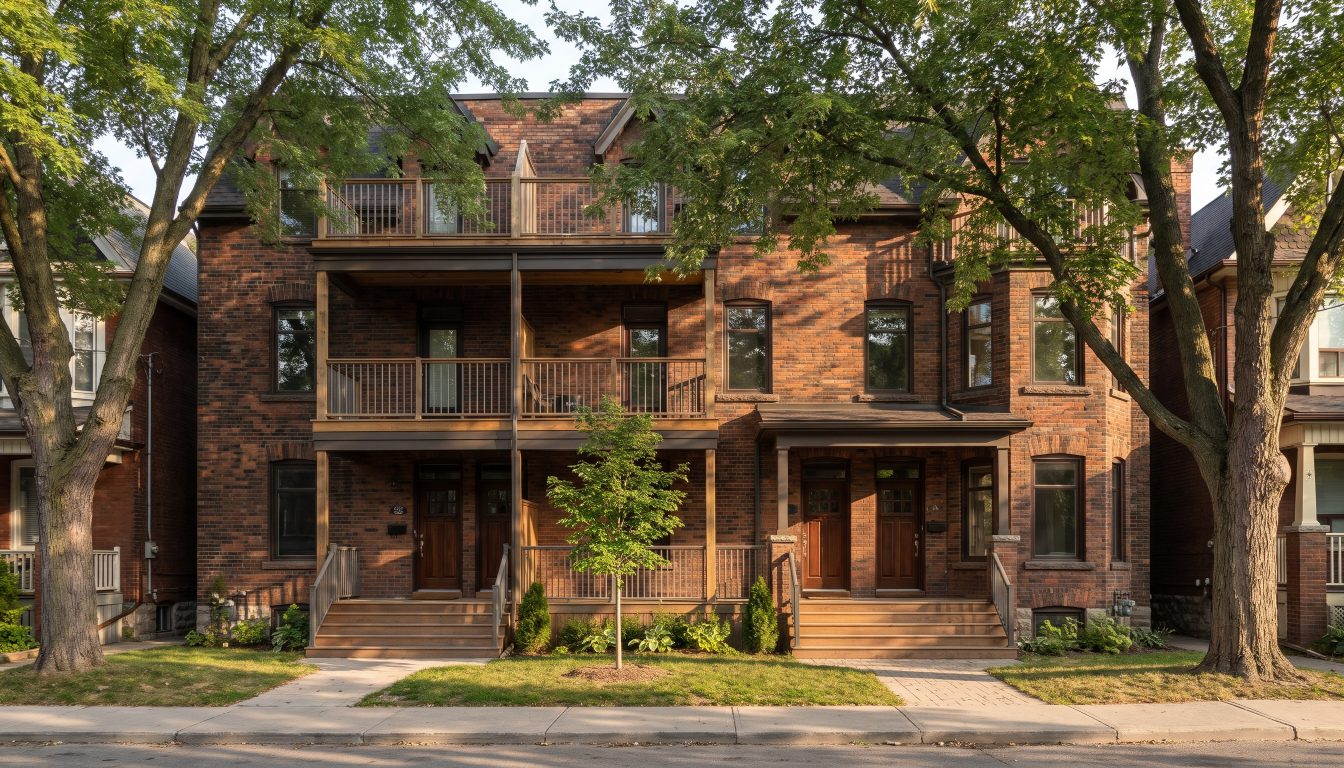
A Toronto multiplex lets you earn rent from up to three extra units, house family members in separate suites, and adapt your home as life changes. Up to four units are allowed city-wide since May 2023, with no parking required and development charges generally waived up to four units. The trade-offs are construction cost, financing and landlord duties.
This guide is for Toronto homeowners who are wondering whether adding units to their house, or buying a multiplex, is worth it. You will learn what the rules now allow, the real benefits for rent, value and family living, where multiplexes are actually being built, and the costs and risks to weigh first.
What is a multiplex in Toronto?
In Toronto, a multiplex is one building that holds several separate homes, with at least one unit sitting above another. The City counts duplexes, triplexes and fourplexes as multiplexes, and in some parts of the city fiveplexes and sixplexes. It can be an existing house that is converted, or a new building on the lot.
Here is what is allowed as of November 2026:
- Up to four units city-wide. Council approved this in May 2023, so you do not need a rezoning, only a building permit that meets the zoning rules.
- Up to six units in some areas. In June 2025, Council allowed sixplexes in the Toronto and East York District and in Ward 23.
- Extra suites on top. A garden suite or laneway suite can also go on a multiplex lot if it meets those rules.
Ontario’s own rules also changed. Ontario Regulation 462/24 on additional residential units came into force on 20 November 2024, and the City said it would align some of its standards with it.
What are the main benefits of a multiplex for homeowners?
When the City of Toronto made multiplexes legal across the city, its 2023 planning report listed why owners might want one. In plain terms:
- Rent that helps pay the mortgage. A second, third or fourth unit can bring in monthly income.
- A home for family. A separate unit for an aging parent, an adult child or a caregiver, with its own door and kitchen.
- Aging in place. You can stay in your neighbourhood and move into a smaller unit while renting the rest.
- Flexibility over time. The report described owners changing their homes as their households change, for example when children move out.
- Lower city charges. Development charges and parkland cash-in-lieu are generally waived when the lot has no more than four units.
- No parking required. Since 3 February 2022, duplexes, triplexes and fourplexes do not need to provide parking.
The same report pointed out that more than 400,000 Toronto households live in homes with more bedrooms than they need, while about 135,000 households have fewer bedrooms than they need. A multiplex is one way to turn unused space into a separate home.
How much rent can a multiplex unit earn in Toronto?
There is no official rent figure for multiplex units alone. The closest public benchmark is TRREB’s quarterly report on condo apartments rented through its MLS system. Multiplex units often compete with these, so they are a fair starting point.
| Unit type (GTA condo apartments) | Average rent, Q2 2026 | Change vs Q2 2025 |
|---|---|---|
| Bachelor | $1,849 | -1.3% |
| One-bedroom | $2,273 | -2.3% |
| Two-bedroom | $3,013 | -1.7% |
| Three-bedroom | $3,779 | -3.7% |
Source: TRREB Rental Market Report, Q2 2026 (GTA condominium apartments leased through TRREB MLS).
Two points matter. First, rents were lower than a year earlier in every bedroom type, and TRREB said conditions should keep favouring renters in the near term. Second, a basement unit with low ceilings or a unit with no laundry will usually rent for less than a new condo. Price your units from comparable rentals near you, not from averages.
There is one helpful rule. Units first occupied as a home after 15 November 2018 are exempt from Ontario’s rent increase guideline, which is 1.9% for 2027. A newly created multiplex unit would generally fall into that exempt group. Read my guide on the November 2018 rent control rule for how it works.
Where are multiplexes being built in Toronto?
The City’s multiplex monitoring team reviewed the first 222 multiplex permits issued between May 2023 and November 2024. Here is what they found.
| Measure | Result |
|---|---|
| Duplex permits | 71 |
| Triplex permits | 83 |
| Fourplex permits | 68 |
| Total units in those buildings | 663 (393 net new) |
| Renovations and additions vs new houses | 158 vs 64 |
| Ward with the most permits | Ward 9 Davenport (35) |
| Next highest wards | Ward 5 York South-Weston (22), Ward 11 University-Rosedale (19), Ward 4 Parkdale-High Park (17) |
| Parking spaces per unit, triplexes and fourplexes | 0.42 |
Source: City of Toronto, Sixplexes City-Wide Study and Multiplex Monitoring Program presentation, April 2025. The City said the data could change.
The City also estimated roughly 250 more permits that looked like multiplexes, for about 1,200 to 1,400 multiplex units in all. Activity spread across nearly every ward, but it clustered in older west-end and central neighbourhoods. Most projects were renovations of existing houses rather than knock-downs.
Instant Home Valuation
What’s your home
worth today?
Answer six quick questions and get an instant value range built from current Toronto & GTA sale data — property type, size, condition, lot and location all weighted the way a real pricing conversation weighs them. Takes about ninety seconds.
Reading recent GTA sale data…
Building your estimate
Estimated market value
—
$0–$0
Most likely value $0 · roughly $0 per square foot
What moved the number
Starting from the area baseline for your property type, here’s what each answer added or subtracted.
Market context
Recent local averages for comparison.
—
A range is a starting point.
A strategy is what sells.
This model doesn’t know that your neighbour’s identical semi went $80,000 over asking last month, or which two upgrades actually pay back in your area. That conversation is free and takes twenty minutes.
Does a multiplex add value to a Toronto home?
It can, but there is no public Toronto data that shows a set percentage gain. The value depends on the rent the units can earn, the quality of the work, and whether the units are legal with permits closed.
A City-commissioned Urban Land Institute (ULI) Toronto panel tested conversions in April 2022. In one scenario, a house worth $2,000,000 was converted at a total cost of about $2.62 million, and the panel estimated the finished building at about $6.43 million in year five. In its smaller scenario, a $1,500,000 house plus about $1.53 million of work was estimated at about $3.72 million. Those are model outputs under 2022 assumptions about rent and cost, not a promise.
The same panel found the projects only worked when units rented at market rates, and that construction cost, which it modelled at $300 to $450 per square foot, played a big role in whether a conversion paid off. For a full cost and payback example, see my guide to buying a duplex or triplex in Toronto.
For context, detached medians across Toronto’s TRREB districts ranged from $866,500 to $3,627,500 from January to October 2026, and most districts were down on 2025 (TRREB MLS data via REALM, January–October 2026 vs the same period of 2025). In my view, when prices are soft, the rent a property can prove on paper carries more weight with buyers.
Is a multiplex good for multigenerational family living?
Often, yes. A multiplex gives each household its own kitchen, bathroom and front door, which is very different from sharing one house. Parents can live a floor away, and the family can pool income to carry the property. When needs change, a family unit can become a rental, or the reverse.
Plan the layout early. A ground-floor or basement unit is easier for an older parent who wants to avoid stairs. If you are weighing a separate building instead, compare with a garden or laneway suite. My guides on moving a parent in and laneway suite costs go through those options.
What are the downsides of owning a multiplex?
- Cost and complexity. The ULI panel found that, for one newer house type, the need for two exits and fire-rated barriers between units made conversion unworkable.
- Financing gaps. The City noted that CMHC’s multi-unit financing tool generally starts at five units, so smaller plexes often rely on home equity.
- Fees at five units. Development charges apply at five units or more.
- Being a landlord. Ontario’s Residential Tenancies Act sets the rules for leases, rent increases and ending tenancies.
- Tax. The CRA treats creating a self-contained rental unit, such as a duplex or triplex, as a change in use of that part of the home, which can affect your principal residence exemption. Speak with an accountant before construction starts.
- Utilities. The City listed the Toronto Hydro connection process among the challenges owners raised.
An unpermitted unit is not the same as a legal one. If the City has not closed the permit, the unit may not meet the fire and building codes, your insurer may not know it exists, and a buyer’s lender may give it no value. Before you buy a “multiplex”, ask for the permit history and the final inspection records.
How do you finance a multiplex in Toronto?
Most owners use a refinance or a home equity line of credit, with money released in stages as work is done. Borrowing just got dearer. The Bank of Canada raised its policy rate to 2.50% on 28 October 2026, and the big banks moved prime to 4.70% the next day. See my HELOC vs refinance guide for the trade-offs. If you are aiming for five units or more, CMHC’s MLI Select program becomes relevant, which I cover in financing a 5-unit multiplex.
The best multiplex projects I see start with a clear reason: income, family, or both. If your main goal is family living, the numbers matter less and the layout matters more. If your main goal is income, be strict: price the work at the high end, use today’s lower rents, and only go ahead if it still makes sense. A plex is a long-term hold, not a quick flip.
What to do next
- Get a current value estimate for your home so you know your equity and what you would give up by converting rather than selling.
- Check your zoning and height on the City’s zoning map, then book a designer’s feasibility review.
- Pull rental comparables for units like yours within a short walk of your house.
- Ask an accountant about the change-of-use election and GST/HST before you sign a contract.
- Decide whether the extra unit is for family or for tenants, and design for that use first.
Need help with this? Talk to me.
I’m Jatin Dua, Broker of Record at RE/MAX Quantum Realty, and I’m the best agent to do this kind of work for you in Toronto and across the GTA. Over $100 million in GTA sales and 100+ families helped sell. Feel free to contact me any time: call or text 833-330-1925 or email [email protected].
Frequently asked questions
What are the benefits of a multiplex in Toronto?
The main benefits are rental income to help pay the mortgage, separate homes for family members, and the flexibility to change how you use the house over time. In Toronto, up to four units are allowed city-wide since May 2023, parking is not required for duplexes to fourplexes, and development charges are generally waived when the lot has no more than four units.
How many units can I build on my lot in Toronto?
As of November 2026, you can have up to four units in one building on residential lots across Toronto, and up to six units in the Toronto and East York District and Ward 23. A garden suite or laneway suite may also be added if it meets those rules. You still need a building permit and must meet zoning standards.
Which Toronto wards have the most multiplexes?
Ward 9 Davenport led with 35 of the first 222 multiplex permits the City reviewed (May 2023 to November 2024). Next were Ward 5 York South-Weston with 22, Ward 11 University-Rosedale with 19 and Ward 4 Parkdale-High Park with 17. Permits appeared in almost every ward, and most were renovations of existing houses.
How much rent can I get for a basement or multiplex unit in Toronto?
There is no official multiplex rent figure, but TRREB’s Q2 2026 report put average GTA condo apartment rents at $2,273 for a one-bedroom and $3,013 for a two-bedroom, both down from 2025. Basement units with low ceilings or no laundry usually rent for less, so price from nearby comparable rentals.
Are new multiplex units rent controlled in Ontario?
Generally no. Ontario units first occupied as a home after 15 November 2018 are exempt from the annual rent increase guideline, which is 1.9% for 2027. A unit newly created in a Toronto multiplex would usually fall into that group. Other tenant protections, including 90 days’ written notice and 12 months between increases, still apply.
Does adding units increase my home’s value in Toronto?
It can, but there is no public Toronto figure for how much. Value depends on the rent the units can earn, the quality of the work and whether permits are closed. A City-commissioned ULI panel in 2022 modelled large value gains in some scenarios, but only when units rented at market rates and costs stayed under control.
Do I need parking for a multiplex in Toronto?
No. Since 3 February 2022, the City of Toronto has not required parking for duplexes, triplexes or fourplexes. If you provide parking, it must meet zoning standards. In the City’s review of the first 222 multiplex permits, triplexes and fourplexes provided about 0.42 parking spaces per unit on average.
Is a multiplex good for multigenerational living?
Yes, for many Toronto families. Each household gets its own kitchen, bathroom and entrance, so parents, adult children and caregivers can live close without sharing one space. The City of Toronto’s 2023 multiplex report named housing family members and aging in place as reasons owners add units. Plan accessible units on the lower floor early.
Can I get CMHC financing for a Toronto fourplex?
Usually not through CMHC’s multi-unit program. The City of Toronto noted in April 2025 that CMHC’s financing tool generally applies at five units or more, so most duplex, triplex and fourplex owners in Toronto use a refinance or a home equity line of credit. Prime rose to 4.70% on 29 October 2026, raising variable borrowing costs.
Sources
- City of Toronto: Multiplex housing
- City of Toronto: Considerations when building multiplexes
- City of Toronto: Expanding housing options in neighbourhoods
- City of Toronto: Multiplex Study Final Report (April 2023)
- City of Toronto: Sixplexes study and Multiplex Monitoring Program presentation (April 2025)
- ULI Toronto: Multiplex Housing Financial Feasibility Exercise (April 2022)
- TRREB Rental Market Report, Q2 2026
- CRA Income Tax Folio S1-F3-C2: Principal Residence
Related reading
- How Much Does a Fourplex Cost to Build or Buy in Toronto?
- Converting a House to a Triplex in Toronto: Cost, Permits and Payback
About the author — Jatin Dua, Toronto and GTA real estate broker
I am Jatin Dua, Broker of Record and co-founder of RE/MAX Quantum Realty Inc., Brokerage, Unit 101, 799 The Queensway, Toronto. I work with buyers and sellers across Toronto and the GTA and have helped more than 100 families sell. Four-plus years of active GTA transactions and over $100 million in sales volume.
Reach me at [email protected] or 833-330-1925, or book a call.