

Published 7 August 2026 · Updated 11 September 2026 · By Jatin Dua, Broker of Record, RE/MAX Quantum Realty
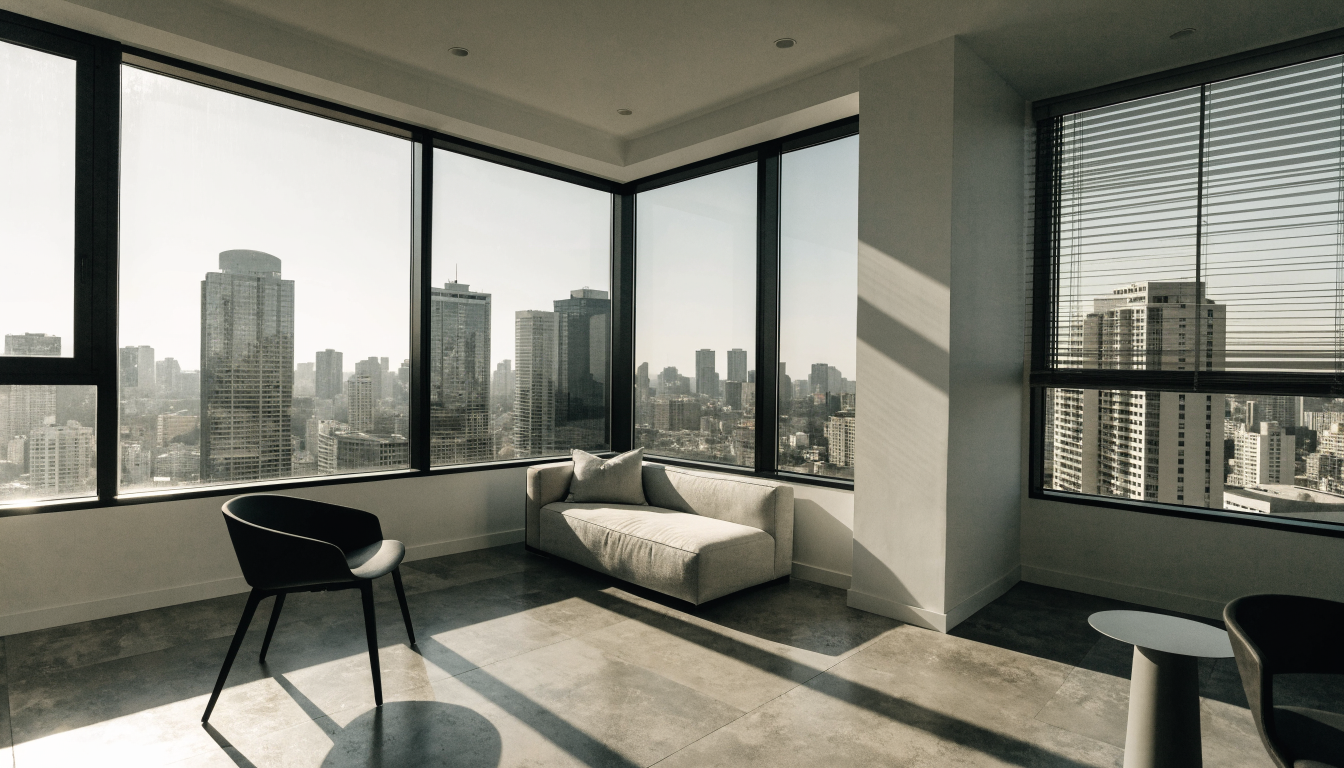
A corner unit gives you two exposures instead of one — dramatically more natural light, cross-ventilation, and usually a larger or wraparound balcony. It commands a premium and it generally resells faster and better, because corner units are a fixed and scarce share of any building. The costs are real though: more glass means higher heating and cooling bills, more wind on a waterfront tower, and corner floor plans are often less space-efficient — you pay for square footage that ends up as circulation. In Humber Bay Shores the decisive factor is not corner versus interior at all. It is which way the corner faces: a south or southeast corner over Humber Bay Park and the lake has a view protected permanently by public parkland. A north corner over the Gardiner has a view with an expiry date.
The market figures in this article reflect data available when it was written. TRREB’s July 2026 report is now the most current: the GTA average selling price was $1,003,956, down 4.5% year over year, new listings fell 17.8% to 14,484, and condo apartments averaged $672,807 in the 416 and $560,923 in the 905. TRREB describes the market as tightening and setting the stage for price stability. For the current picture and what it means for a decision to sell or hold, see Should I sell my Toronto condo now or wait?
This is one of the most common questions I get in Humber Bay Shores, and the answer people expect — “corner units are always better” — is only about two-thirds right.
Corner units are genuinely better on light, air and outdoor space, and they hold value better because supply is structurally limited. But they are not automatically the right buy, and I have talked people out of corner units more than once.
The thing that actually decides it in this neighbourhood is orientation. A corner unit facing the wrong way is worse than a well-oriented interior unit — and it costs more.
Here is the honest breakdown.
What a corner unit actually gives you
Light
This is the real benefit and it is not marginal. Two walls of glass on perpendicular exposures means light through most of the day rather than a few hours. In a Toronto winter, when daylight is short and you are indoors, this affects how a home feels more than almost any other variable.
Interior units get one exposure. When the sun moves off it, the unit is dim for the rest of the day.
Cross-ventilation
Windows on two perpendicular walls let air move through. Single-exposure units cannot cross-ventilate at all — air comes in one side and has nowhere to go. On a mild spring or autumn day this is the difference between opening the windows and running the HVAC.
Outdoor space
Corner units frequently get a larger balcony or a wraparound. Given how small new condo interiors have become, usable outdoor space is one of the few remaining ways to add real living area.
One shared wall
An interior unit has neighbours on both sides. A corner unit has one. Less noise transfer, and fewer opportunities for the classic condo problems — a neighbour’s renovation, a barking dog, a shared wall behind your bedroom.
View angles
Two exposures means two view corridors. In Humber Bay Shores that can mean the lake from one side and the skyline from the other, which is genuinely hard to replicate.
The verdict: Light and cross-ventilation are the substantive benefits — they change how the unit feels daily, and no amount of renovation can add them to an interior unit.
Thinking about buying or selling here?
I work this area every week and I will give you a straight answer, including when the answer is to wait. No pressure, and no drip campaign you cannot get out of.
Call or text 833-330-1925 Send me a message
Jatin Dua, Broker of Record — RE/MAX Quantum Realty Inc., Brokerage. Not intended to solicit buyers or sellers currently under contract with another brokerage.
The costs nobody mentions at the sales centre
Energy costs
Glass is a poor insulator relative to wall. Two glass walls means more heat loss in winter and more heat gain in summer. In a Humber Bay Shores tower where hydro is frequently excluded from maintenance fees, that lands directly on your monthly bill.
A west-facing corner in particular gets significant late-afternoon solar gain in summer. Budget for window coverings — good ones, not the builder’s blinds — as a real cost.
Wind
Waterfront and high floor means genuine wind. On a corner, exposed on two sides, it is more pronounced. It affects balcony usability on a lot more days than people expect, and it can make windows noisy.
View the unit with the balcony door open before you buy. On a windy day this tells you more than any floor plan.
Floor plan efficiency
This is the one people miss entirely. Corner units frequently have less usable space per square foot. Angled walls, awkward corners and long hallways to reach the second exposure mean you pay for area that functions as circulation rather than living space.
An efficiently laid out 700 sq ft interior unit can feel larger and work better than a poorly planned 800 sq ft corner. Compare the actual furniture layout, not the square footage. Walk both.
The premium
You pay more, both at purchase and — because you are buying more square footage — in maintenance fees, which are typically charged per square foot.
The verdict: Higher energy bills, more wind, and often a less efficient layout. Walk the actual unit and compare furniture placement before paying the premium.
In Humber Bay Shores, orientation beats corner status
This is the section that matters most, and it is the point most buyers get wrong.
The protected view
A south or southeast unit looking over Humber Bay Park and Lake Ontario has a view protected permanently by public parkland and open water. Toronto parkland does not get rezoned. That view is as close to guaranteed as anything in real estate.
When I price a Humber Bay Shores unit, sightline over that park is one of the first three variables — ahead of building age.
The expiring view
A north-facing unit looks over the Gardiner toward land that is actively developing. That view has an expiry date, and the price difference today is nothing like the price difference in ten years once a tower goes up in front of it.
A north-facing corner is two exposures onto a view that may not last. That is paying a premium for something temporary.
The fifteen minutes that matter
Before you offer on any unit in this neighbourhood, check what is under development application around the building. City of Toronto development application records are public. Walk the block and look at what is vacant or low-rise.
This is the highest-value fifteen minutes available to a Humber Bay Shores buyer and almost nobody does it.
The ranking
A south or southeast interior unit with a protected lake view is a better buy than a north-facing corner. Orientation first, corner status second.
The verdict: Buy the exposure that cannot be built out. A protected south or southeast sightline over the park beats corner status pointing the wrong way.
Resale — where corner units genuinely win
This is the strongest argument for paying the premium, and it is structural rather than aesthetic.
The scarcity mechanic
Every floor has a fixed number of corners — usually four. In a 300-unit building there might be 40 corner units and 260 interior ones. That ratio never changes.
When you sell an interior unit, you are competing against dozens of near-identical units, several in your own building, some on your own floor. Differentiation is nearly impossible and price becomes the only lever.
When you sell a corner unit, you may be one of a handful available. Buyers who want a corner cannot substitute an interior unit for it.
Why this matters more right now
GTA condo apartment values are down roughly 9.4% year over year to an average near $630,688, with around four months of inventory. In a soft market with buyer choice, anything that differentiates your unit protects you disproportionately.
In a rising market, undifferentiated units get carried along. In this one they do not.
The honest qualifier
The corner premium holds when the corner has something to offer — a good view, good light, a usable layout. A north-facing corner with an awkward floor plan and a view of a construction site does not command a premium just for being on a corner.
The scarcity argument only works if the unit is genuinely desirable.
The verdict: Corner supply is structurally fixed, so you compete against far fewer listings at resale — which matters most in exactly the soft market we are in.
Corner vs interior — the trade-offs
| Corner unit | Interior unit | |
|---|---|---|
| Exposures | Two | One |
| Natural light | Best — most of the day | Limited to one exposure |
| Cross-ventilation | Yes | No |
| Balcony | Often larger or wraparound | Standard |
| Shared walls | One | Two |
| Heating and cooling cost | Higher — more glass | Lower |
| Wind exposure | Higher | Lower |
| Layout efficiency | Often worse — angles and circulation | Often better per sq ft |
| Price and fees | Higher | Lower |
| Resale differentiation | Strong — scarce supply | Weak — many near-identical units |
Deciding between two units in the same building?
Send me both unit numbers. I will pull what each exposure has actually sold for in that building, check what is under development application nearby, and tell you honestly whether the corner premium is worth paying for that specific pair.
Talk to JatinFree home valuationNet proceeds calculatorConfidential. Reviewed personally and answered within 24 hours. I never share, sell or distribute your information.
Free tool — AI condo value estimator
Condo Valuation
What’s your condo
worth today?
Three quick steps. Condos don’t price like houses — your floor, your view, and whether you own parking move the number more than anything else. This weighs all of them.
Reading recent condo sales…
Estimated market value
—
$0–$0
Most likely $0 · about $0 per square foot
What moved the number
Starting from what comparable units in your area sell for, here’s what your specifics added or subtracted.
Market context
—
—
Two units, same floor plan,
$90,000 apart.
That happens constantly in condos — one has the parking, the right exposure, or a board that keeps the reserve fund healthy. A model can’t see your status certificate. I can.
Frequently asked questions
Are corner units worth the extra money in a condo?
Usually, but not automatically. Corner units give you two exposures rather than one, which means substantially more natural light through the day, cross-ventilation that single-exposure units cannot achieve, often a larger or wraparound balcony, and only one shared wall. They also resell better because corner supply per floor is structurally fixed and scarce. The costs are higher energy bills from more glass, more wind exposure on waterfront towers, and floor plans that are frequently less space-efficient because of angled walls and circulation. Walk both units and compare actual furniture layouts rather than square footage.
What is the best exposure for a Humber Bay Shores condo?
South or southeast, over Humber Bay Park and Lake Ontario. That view is protected permanently by public parkland and open water, and Toronto parkland does not get rezoned. North-facing units look over the Gardiner toward land that is actively developing, so that view has an expiry date. Orientation matters more than corner status here — a south or southeast interior unit with a protected lake view is a better buy than a north-facing corner. Before offering, check what is under development application around the specific building; City of Toronto records are public.
Do corner condos cost more to heat and cool?
Yes. Glass insulates poorly relative to solid wall, so two glass walls means more heat loss in winter and more heat gain in summer. This matters particularly in Humber Bay Shores towers where hydro is frequently excluded from maintenance fees and lands directly on your monthly bill. West-facing corners get significant late-afternoon solar gain in summer, so budget for quality window coverings as a real cost rather than an afterthought.
Are corner units always bigger than interior units?
Usually larger in square footage, but not necessarily more usable. Corner floor plans frequently include angled walls, awkward corners and long hallways to reach the second exposure, which means you pay for area that functions as circulation rather than living space — and you pay maintenance fees on it too, since fees are typically charged per square foot. An efficiently laid out 700 square foot interior unit can work better than a poorly planned 800 square foot corner. Compare furniture placement in both before deciding.
Do corner units resell better?
Generally yes, and the reason is structural. Every floor has a fixed number of corners, usually four, so in a 300-unit building there might be 40 corner units against 260 interior ones and that ratio never changes. When you sell an interior unit you compete against dozens of near-identical listings, several in your own building, and price becomes the only lever. Corner units face far fewer direct substitutes. This matters more in the current market, with GTA condo values down roughly 9.4% year over year and about four months of inventory — differentiation protects you when buyers have choice. The qualifier is that the premium only holds if the corner is genuinely desirable in view, light and layout.
Is wind a problem in Humber Bay Shores corner units?
It is a real consideration. Waterfront location plus height produces genuine wind, and a corner unit exposed on two sides feels it more. It affects balcony usability on more days than buyers expect and can make windows noisy. View the unit with the balcony door open, ideally on a windy day — that will tell you more about how the unit lives than any floor plan or rendering.
Corner condominium units provide two exposures instead of one, delivering substantially more natural light throughout the day, cross-ventilation that single-exposure units cannot achieve, frequently a larger or wraparound balcony, and only one shared wall with a neighbour. They typically resell better because the number of corner units per floor is structurally fixed and scarce, meaning fewer directly competing listings — an advantage that matters more in the current market where GTA condo apartment values are down roughly 9.4% year over year to an average near $630,688 with about four months of inventory. The disadvantages are higher heating and cooling costs because glass insulates poorly, greater wind exposure on waterfront towers, and floor plans that are often less space-efficient due to angled walls and circulation space. In Humber Bay Shores, orientation matters more than corner status: south and southeast units overlooking Humber Bay Park and Lake Ontario have views permanently protected by public parkland and open water, while north-facing units overlook the Gardiner Expressway toward actively developing land. Buyers should check City of Toronto development application records around a specific building before making an offer.
Thinking about buying or selling here?
I work this area every week and I will give you a straight answer, including when the answer is to wait. No pressure, and no drip campaign you cannot get out of.
Call or text 833-330-1925 Send me a message
Jatin Dua, Broker of Record — RE/MAX Quantum Realty Inc., Brokerage. Not intended to solicit buyers or sellers currently under contract with another brokerage.
Sources and further reading
Toronto Regional Real Estate Board condominium apartment market statistics · City of Toronto development application records and parkland designations · general building performance principles on glazing, thermal transfer and solar gain. Building-specific exposures, floor plans, maintenance fee structures and utility inclusions vary and must be confirmed for the individual unit.
Looking at Etobicoke more broadly? Start with my Etobicoke community guide — the neighbourhoods, what each pocket is like, and where they sit relative to one another.
General information prepared August 2026. Statements about pricing, premiums and resale are general observations from the Etobicoke and Humber Bay Shores market and are not a valuation of, or a guarantee of value for, any specific unit. Utility inclusions, maintenance fee structures, exposures, floor plans and view corridors vary by building and unit and must be independently verified. Development applications and future construction are matters of public record but their outcomes and timing are uncertain — verify current applications with the City of Toronto. Market statistics cited are GTA-wide averages. Jatin Dua is a Realtor with RE/MAX Quantum Realty.