Published 2 November 2026 · By Jatin Dua, Broker of Record, RE/MAX Quantum Realty
What's Your Home Worth Right Now?
Get a free AI-powered price range for your property in under 90 seconds, based on recent GTA comparable sales. No name or address required.
Get My Free Estimate →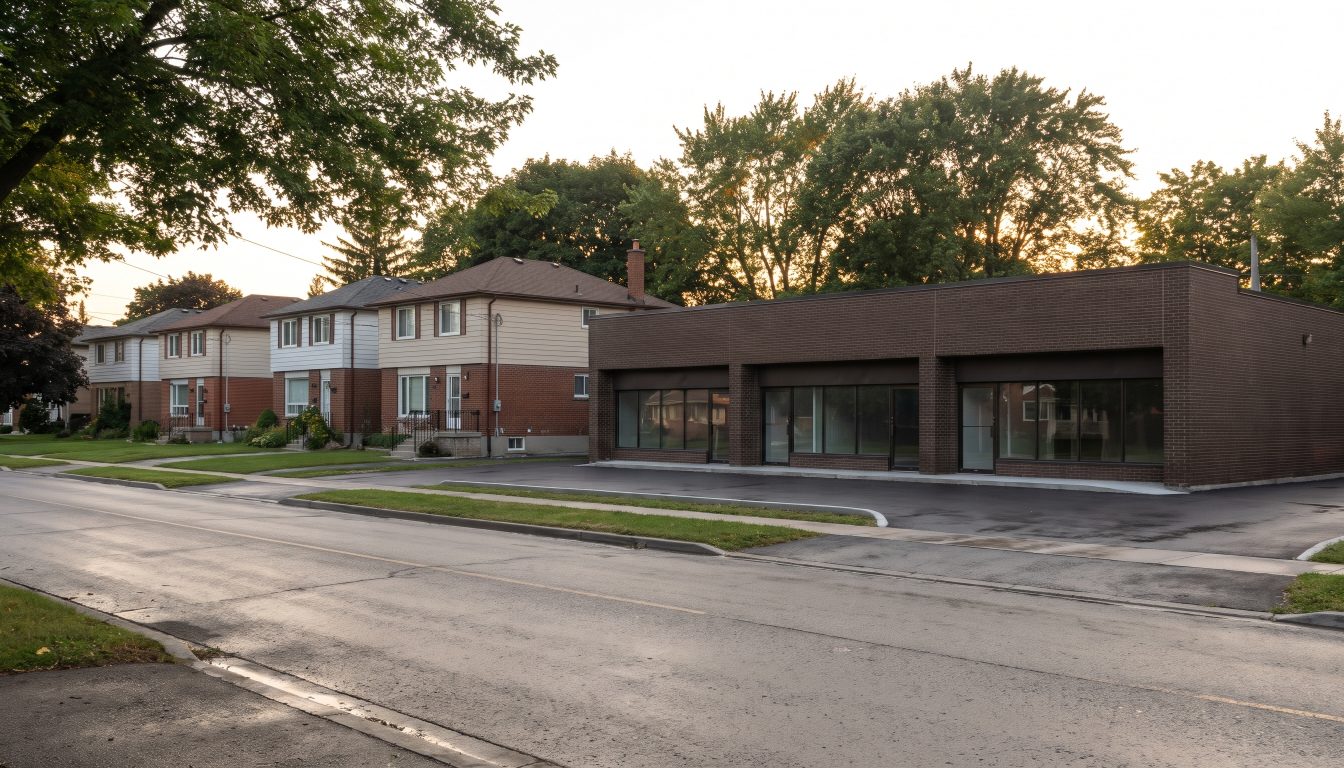
Commercial property in Toronto earns higher starting yields, with Q3 2026 average cap rates of 4.79% for industrial, 5.11% for retail and 6.73% for office versus 4.21% for apartment buildings. Residential offers steadier demand, cheaper insured financing and risk spread across many tenants. Commercial brings longer net leases but more risk when one tenant leaves.
This guide is for investors in Toronto and the GTA weighing commercial property, such as plazas, industrial units and offices, against residential property, such as multiplexes and apartment buildings. You will get a plain comparison of returns, leases, financing, taxes and risk using Q3 2026 numbers, so you can decide which fits your money and your time.
What is the difference between commercial and residential real estate investment?
Residential property is where people live: houses, condos, multiplexes and apartment buildings. Commercial property is where businesses operate: retail plazas, offices, industrial buildings and commercial condo units. Mixed-use buildings, such as shops with apartments above, are both.
One twist confuses many new investors. An apartment building with five or more units is residential under tenancy law, but lenders treat it as a commercial loan, sized on the building’s income. So “residential” in this guide means anything people live in, and “commercial” means retail, office and industrial.
| Feature | Residential (apartments, multiplexes) | Commercial (retail, office, industrial) |
|---|---|---|
| Tenants | Households | Businesses |
| Main law | Residential Tenancies Act; Landlord and Tenant Board | The lease, plus the Commercial Tenancies Act |
| Rent increases | Capped on older units (1.9% guideline for 2027) | Set by the lease |
| Lease length | Often one year, then month to month | Often several years |
| Who pays operating costs | Mostly the landlord | Often the tenant, under a net lease |
| 2026 Toronto property tax rate | 0.767311% (residential) to 1.208792% (multi-residential) | 2.301986% (commercial), 2.416774% (industrial) |
| Vacancy risk | Spread across many units | One tenant can be 100% of the income |
Source: City of Toronto 2026 property tax rates; Ontario Commercial Tenancies Act; Ontario rent increase guideline per the provincial government (2.1% for 2026, 1.9% for 2027).
Which earns more in the GTA, commercial or residential property?
On cap rates, commercial earns more. A cap rate is the property’s yearly NOI (net operating income: rent minus operating costs, before the mortgage) divided by its price. Here are the Toronto averages for Q3 2026, with the NOI each would produce on a $5 million price.
| Toronto property type | Average cap rate | NOI on $5M (illustrative) | Vacancy | Average sale price |
|---|---|---|---|---|
| Multifamily (residential) | 4.21% | $210,500 | 3.85% | $392,524 per unit |
| Industrial | 4.79% | $239,500 | 3.83% | $356 per sq ft |
| Retail | 5.11% | $255,500 | 2.34% | $514 per sq ft |
| Office | 6.73% | $336,500 | 9.53% | $390 per sq ft |
Source: Lee & Associates Toronto Q3 2026 multifamily, industrial, retail and office reports (CoStar data). NOI column is arithmetic on a $5M price, for illustration only.
A higher cap rate is the market’s way of pricing in more risk. Apartment buildings trade at the lowest cap rates because buyers see housing demand as the most dependable. Office has the highest because vacancy is highest and the recovery is still early. Avison Young’s national Q3 2026 benchmarks follow the same order: 4.55% for high-density urban multifamily, 5.85% for new single-tenant industrial and 6.90% for downtown Class A office.
Total return also depends on rent growth and value changes. Residential rents on older units are capped, while commercial rents reset when leases renew. That cuts both ways: a good renewal lifts income, and a vacant unit can sit empty for months. You can test any property with my cap rate calculator.
How do commercial and residential leases differ in Ontario?
Residential tenancies fall under the Residential Tenancies Act. Disputes go to the Landlord and Tenant Board. Rent increases on units first occupied before 15 November 2018 are capped by the guideline, 2.1% for 2026 and 1.9% for 2027, and you need 90 days’ written notice and 12 months between increases. Ending a tenancy follows strict rules and timelines.
Commercial tenancies are different. The Commercial Tenancies Act says it does not apply to tenancies covered by the Residential Tenancies Act. For businesses, the signed lease does most of the work: rent, term, renewals, who pays tax and repairs, and what happens on default. The Act deals with matters such as forfeiture and a landlord’s right to seize goods for unpaid rent.
Many commercial leases are “net” leases, where the tenant pays its share of property tax, insurance and common-area costs on top of base rent. That makes the landlord’s income more predictable, but only if the lease is well drafted. My guide to commercial lease clauses in Ontario covers the clauses I check first when a client buys a tenanted property.
To see what your own cash buys and how the cash flow compares across building types, use the calculator below; it is set to $5 million but you can change every number.
Loading the investment calculator…
How does financing differ for commercial and residential property?
For a house, condo or small multiplex of up to four units, the lender looks mostly at your personal income and credit. Homes up to $1.5 million can be insured with less than 20% down.
For apartment buildings of five or more units and for commercial property, lenders size the loan mainly on the property’s income, using DSCR (debt service coverage ratio: NOI divided by yearly mortgage payments). They also look at your net worth and experience.
Pricing differs by property type. As of early October 2026, the 5-year Government of Canada bond yield was 3.60%. Avison Young put lender spreads at 55 to 100 basis points for CMHC-insured apartment loans, 130 to 200 for conventional apartment loans and 150 to 250 for office. Adding them gives rough all-in rates of about 4.15% to 4.6%, 4.9% to 5.6% and 5.1% to 6.1%. These are my derived estimates, not lender quotes. Apartments get the cheapest money, mainly because of insured programs. My guide to commercial mortgage rates in Canada goes into terms and fees.
How do taxes and closing costs differ?
Land transfer tax is often lower on commercial and larger apartment purchases. In Toronto, homes with one or two single-family residences pay higher municipal rates above $3 million, while commercial property and buildings with more than two units stay at the 2% top band. On a $5 million purchase in Toronto, that is about $192,950 in combined Ontario and Toronto tax for a commercial property or apartment building, versus $271,450 for a house.
Property tax runs much higher on commercial property. On every $1 million of MPAC assessed value in Toronto in 2026, the total tax was about $7,673 at the residential rate, $12,088 at the multi-residential rate, $23,020 at the commercial rate and $24,168 at the industrial rate. Under a net lease, the tenant usually reimburses its share, but you carry it on any vacant space.
HST is a separate issue that often applies to commercial purchases and can be complex. Read my guide to HST on commercial property purchases, and confirm the treatment with your accountant and lawyer before you firm up.
Which has more vacancy risk, commercial or residential?
Average vacancy numbers make commercial look similar to residential, apart from office. But averages hide the real difference. A 20-unit apartment building with one empty suite is 95% full. A single-tenant industrial building with its tenant gone is 0% full, and it may take months and a leasing commission to fill.
The GTA industrial market also shows how quickly things change. Altus Group reported industrial availability rising to 5.3% in Q3 2026, with net absorption turning negative after four quarters of gains, while asking rents held at $16 to $17 per sq ft. Toronto office availability fell to 15.1%, an improvement but still high.
When you buy commercial property, the tenant’s business is part of your investment. Read every lease, check the tenant’s financial strength where you can, look at when each lease expires, and get an estoppel certificate (the tenant’s signed confirmation of the lease terms and rent) before closing. A plaza with three leases ending in the same year carries much more risk than its cap rate shows.
What is the GTA market telling investors right now?
Money flowed back into GTA real estate in 2026. Altus Group counted $15.1 billion of investment through Q3 2026, up 39% year over year. Multifamily rose 273% to $4.1 billion, industrial rose 10% to $4.4 billion, office rose 154% to $1.9 billion, and retail fell 22% to nearly $1.4 billion. Altus said capital favoured core, income-producing assets, while unentitled land and weaker secondary assets faced tougher underwriting.
Private buyers are a big part of this. Avison Young, citing CoStar data, said private investors made 48% of Q3 2026 acquisitions worth $5 million or more nationally. That is the size range many of my clients buy in.
Should you choose commercial or residential real estate?
Choose residential, especially apartment buildings and multiplexes, if you want the steadiest demand, the cheapest financing and a tenant base spread across many households. Accept lower starting yields and rent control on older units.
Choose commercial if you want a higher starting yield, longer leases and tenants who pay many of the costs, and you are comfortable reading leases and judging businesses. Industrial and retail vacancy were far lower than office vacancy in the 2026 reports above.
For a first $1 million to $5 million, I usually suggest starting with the property type you understand best. Landlords moving up from condos often do well with a small apartment building first. Business owners who already sign commercial leases often feel at home with small-bay industrial or a necessity retail plaza. Mixing one of each later is a sensible way to diversify. That is my view, and every deal needs its own underwriting.
What to do next
- Decide what matters most to you: steady demand, higher starting yield or less day-to-day work.
- Compare one real residential and one real commercial property in the calculator above, using the same leverage.
- Ask a lender for a preliminary view on loan size and rate for each type.
- Have your lawyer review the leases on any commercial property before you firm up.
- Book a call with me to walk through a specific building and compare it with the alternatives.
Need help with this? Talk to me.
I’m Jatin Dua, Broker of Record at RE/MAX Quantum Realty, and I’m the best agent to do this kind of work for you in Toronto and across the GTA. Over $100 million in GTA sales and 100+ families helped sell. Feel free to contact me any time: call or text 833-330-1925 or email [email protected].
Frequently asked questions
Is commercial or residential real estate a better investment in Canada?
Neither is better for everyone. In Toronto in Q3 2026, commercial property had higher average cap rates (4.79% industrial, 5.11% retail, 6.73% office) than apartment buildings (4.21%), per Lee & Associates. Residential offers steadier demand and cheaper financing; commercial offers higher starting yields, longer leases and tenants who often pay costs, but more vacancy risk per tenant.
Should I invest in commercial or residential property in Toronto?
Pick residential if you want dependable demand, insured financing and many tenants; pick commercial if you want higher starting income and can read leases and judge tenants. In 2026, GTA multifamily investment rose 273% and retail fell 22% through Q3, per Altus Group. Your choice should match your experience, time and how much risk one tenant can carry.
Is commercial property riskier than residential property?
Often yes, because one tenant can be most or all of the income. Toronto office vacancy was 9.53% in Q3 2026 versus 3.85% for apartments, per Lee & Associates. Industrial (3.83%) and retail (2.34%) vacancy were much lower. Commercial risk can be managed with strong tenants, staggered lease expiries and careful lease review before you buy.
Do commercial leases in Ontario have rent control?
No. Ontario’s rent increase guideline, 1.9% for 2027, applies only to residential units first occupied before 15 November 2018. Commercial rents are set by the lease. The Commercial Tenancies Act does not apply to residential tenancies, and commercial disputes go to the courts rather than the Landlord and Tenant Board.
What is a net lease in commercial real estate?
A net lease is a commercial lease where the tenant pays base rent plus its share of operating costs such as property tax, insurance and common-area maintenance. It makes the landlord’s income more predictable. The exact split depends on the lease wording, so have a lawyer review it. Residential leases in Ontario almost never work this way.
Are commercial mortgage rates higher than residential rates in Canada?
Usually, yes, except for insured apartment loans. As of early October 2026, adding Avison Young’s spreads to the 3.60% 5-year bond yield gives roughly 4.15% to 4.6% for CMHC-insured apartment loans, 4.9% to 5.6% for conventional apartment loans and 5.1% to 6.1% for office. These are derived estimates, not lender quotes.
What is the property tax rate on commercial property in Toronto?
In 2026, Toronto’s total commercial property tax rate was 2.301986% of MPAC assessed value, and the industrial rate was 2.416774%. That is about $23,020 and $24,168 a year per $1 million of assessment, compared with about $7,673 at the residential rate. Under net leases, tenants usually reimburse their share.
What are cap rates for commercial property in Toronto in 2026?
Toronto averages in Q3 2026 were 4.79% for industrial, 5.11% for retail and 6.73% for office, compared with 4.21% for apartment buildings, according to Lee & Associates using CoStar data. Individual properties vary with location, building age, tenant strength and lease length, so a specific deal can sit well above or below these averages.
Is an apartment building commercial or residential property?
Both, depending on the context. In Ontario, the tenancies are residential and follow the Residential Tenancies Act. For lending, buildings of five or more units are financed as commercial loans sized on income. For Toronto land transfer tax, buildings with more than two units use the regular rates rather than the higher luxury home bands.
Sources
- Altus Group: Toronto commercial real estate market update, Q3 2026
- Lee & Associates: Toronto multifamily market report, Q3 2026
- Lee & Associates: Toronto industrial market report, Q3 2026
- Lee & Associates: Toronto retail market report, Q3 2026
- Lee & Associates: Toronto office market report, Q3 2026
- Canadian Mortgage Professional: What persistently high bond yields could mean for the commercial mortgage market (Oct 2026)
- City of Toronto: Property tax rates and fees (2026)
- Government of Ontario: Commercial Tenancies Act, R.S.O. 1990, c. L.7
Related reading
- How to Invest $5 Million in GTA Real Estate (2027): Your Real Options
- What $5 Million Buys in GTA Real Estate in 2027: Houses, Buildings, Plazas and Land
- A $5 Million House or a $5 Million Apartment Building in Toronto? The 2027 Math
- Best Real Estate Investments in the GTA for 2027, by Property Type
About the author — Jatin Dua, Toronto and GTA real estate broker
I am Jatin Dua, Broker of Record and co-founder of RE/MAX Quantum Realty Inc., Brokerage, Unit 101, 799 The Queensway, Toronto. I work with buyers and sellers across Toronto and the GTA and have helped more than 100 families sell. Four-plus years of active GTA transactions and over $100 million in sales volume.
Reach me at [email protected] or 833-330-1925, or book a call.
More from the library
- Tutoring and Learning Centre Premises in Ontario: Zoning, Private School Rules and the Lease
- Start or Buy an Optometry Practice in Ontario? (2027)
- Restaurant Due Diligence Checklist for Ontario Buyers (2027)
- Flat Fee Realtor in Ontario: What You Save, and What You Give Up
- Buying Land to Build a Multiplex in Toronto: What the Rules Allow in 2027
- Rezen Condos, 205 Frederick St: A Quiet Mid-Rise Near St. Lawrence Market