Published 2 November 2026 · By Jatin Dua, Broker of Record, RE/MAX Quantum Realty
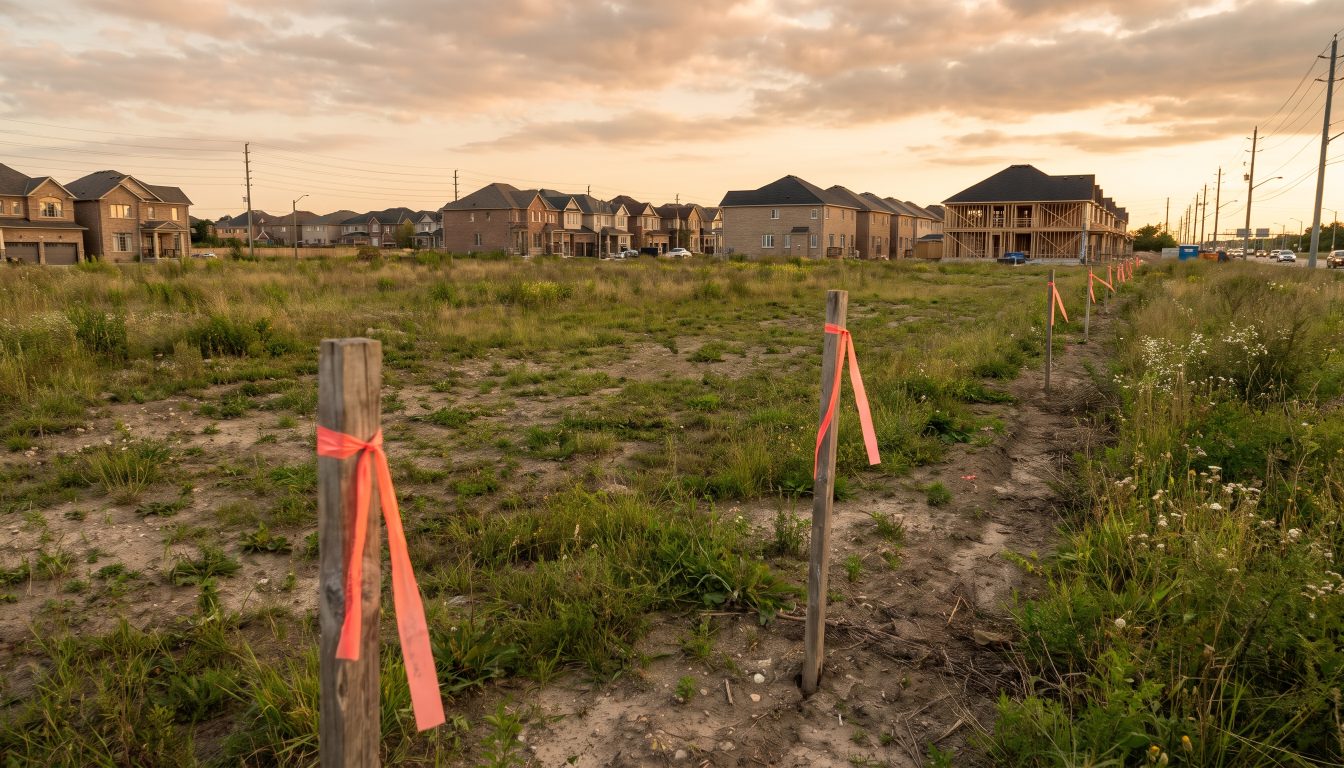
When you buy GTA development land you are mainly buying permissions, servicing and time, not soil. Toronto high-density land averaged $92 per buildable sq ft in Q2 2025, 37% below its 2021 peak, and unentitled land still faced tougher underwriting in 2026. Pay for the approvals that exist, not the ones promised.
This guide is for investors with $1 million to $10 million who are thinking about buying development land in the GTA, whether to build, to hold and sell to a builder, or to add to a portfolio. You will see what the price is really paying for, what the 2025–2026 land market has done, the Ontario approval timelines, the costs on top of the price and the checks to make first.
What are you really buying when you buy development land?
You are not mainly buying soil. You are buying a set of permissions (often called entitlements), access to water and sewer capacity, and time. Two parcels side by side can be worth very different amounts because one can be built on next year and the other may never be approved.
| Stage of the land | What it means | Risk you take on |
|---|---|---|
| Unentitled or raw | Current zoning does not allow the project you want | Highest: the approval may take years or never come |
| Official plan supports it | The city’s long-term plan designates the area for growth | High: zoning, servicing and studies still needed |
| Zoned | Zoning allows a stated use, height and density | Medium: site plan, permits and costs remain |
| Site plan or draft plan approved | Detailed design or lot layout approved | Lower: mainly cost, financing and market risk |
| Permit-ready | Building permits can be issued | Lowest approval risk; highest price |
Source: my summary of the Ontario planning process; see the City of Toronto’s July 2026 summary of planning rule changes.
The further along the ladder, the more you pay and the less can go wrong. Most losses on land come from buyers paying a “zoned” price for land that is still at the “raw” stage.
What has the GTA land market done in 2025 and 2026?
High-density land values fell sharply after the 2021 peak. A Bullpen Research and Batory report, covered by RENX in August 2025, put the City of Toronto’s average high-density land value at $92 per buildable sq ft in Q2 2025, down 37% from the 2021 peak of $146. Suburban GTA high-density land averaged $37, and zoning-approved land was down 43% from its 2021 peak. Those are the latest public per-foot figures I could verify, so treat them as a 2025 snapshot, not today’s price.
Volume has picked up since. Altus Group reported about $3.2 billion of GTA land trades through Q3 2026, including nearly $1.9 billion of residential land, up 28% from a weak 2025. But Altus also noted that high financing, approval and building costs kept land hard to sell, and that unentitled land faced tougher underwriting while buyers favoured income-producing property.
| Measure | Figure | Period |
|---|---|---|
| Toronto high-density land, average | $92 per buildable sq ft (2021 peak: $146) | Q2 2025 |
| Suburban GTA high-density land, average | $37 per buildable sq ft | Q2 2025 |
| GTA land investment, all types | About $3.2B | Jan–Sep 2026 |
| Residential land / ICI land | Nearly $1.9B / nearly $1.3B | Jan–Sep 2026 |
Source: RENX, 19 August 2025 (Bullpen Research and Batory data); Altus Group Toronto CRE update, Q3 2026. ICI means industrial, commercial and institutional.
How is development land priced in the GTA?
Builders price land backwards. They start with what the finished homes or units will sell for, subtract construction, charges, financing, fees and their profit, and what is left is what they can pay for the land. That is called the residual land value. It is usually expressed per buildable square foot for condo and rental sites, per front foot or per lot for low-rise, and per acre for raw land.
Here is an illustrative example of why density is the whole game. Say a Toronto site is expected to allow 100,000 buildable sq ft. At the Q2 2025 city average of $92 per foot, that implies about $9.2 million. If the city approves only 60,000 sq ft, the same math gives about $5.5 million. The parcel did not change; the permission did. My guide on how developers price GTA development land walks through the residual method step by step.
How long does rezoning take in Ontario, and who can appeal?
The Planning Act sets decision deadlines, after which the applicant can appeal to the Ontario Land Tribunal (OLT) for a non-decision. According to the City of Toronto’s July 2026 summary:
- Official plan amendments: 120 days.
- Zoning by-law amendments: 90 days.
- Combined official plan and zoning applications: 120 days.
- Site plan applications: 60 days.
These deadlines are not how long approval really takes. Studies, resubmissions and negotiation often stretch a rezoning well past them, and an OLT appeal adds more time.
One change helps owners. Since Bill 185 received royal assent on 6 June 2024, neighbours and ratepayer groups can no longer appeal approvals to the OLT. Appeals are limited to the owner, public bodies, the minister and a few specified parties. Bill 185 also lets municipalities add “use it or lose it” lapsing conditions to site plan and subdivision approvals if a building permit is not issued within a set period, which cannot be less than three years until a regulation sets it. If you buy approved land planning to hold it, check whether its approvals can lapse.
If you are weighing land against an income property with the same cash, the calculator below shows what that money earns today in a building; it is set to $5 million but you can change every number.
Loading the investment calculator…
What costs come on top of the land price?
- Land transfer tax. Vacant land is taxed at the standard brackets with a 2% top rate. On $5 million that is $96,475 in Ontario tax, plus another $96,475 inside the City of Toronto, for $192,950.
- HST. Land sold by a business or developer is often taxable. See my guide on when HST applies to land sales and confirm with your accountant.
- Development charges. These are often the largest cost after land and construction. Toronto secured $1.5 billion on 23 June 2026 through a development charge reduction program and committed to cut residential charges by 40% to 60% for three years. See my development charges guide for each city.
- Parkland and community benefits. Provincial changes cap parkland, with a new regulation in force from 1 July 2026, and limit community benefits charges to 4% of the land’s value.
- Affordable housing rules. Inclusionary zoning is capped at 5% of units or residential floor area, and Toronto’s program in transit station areas is paused until 1 July 2027.
- Consultants. Planner, architect, engineers, surveyor, environmental and traffic studies, and legal fees, all paid before you know the outcome.
What does it cost to hold land while you wait for approvals?
Land usually produces little or no income, so every year of waiting has a cost. One way to measure it is the return you give up by not holding a safe investment instead. The illustrative table below uses $5 million of cash, the 3.60% five-year Government of Canada bond yield reported on 2 October 2026 as the “safe” alternative, and Toronto land transfer tax. It leaves out property tax, insurance, consultants and any loan interest, which would all add to the total.
| Years until you can build or sell | Return given up at 3.60% a year | Plus Toronto LTT ($192,950) | Share of the $5M price |
|---|---|---|---|
| 2 years | $366,480 | $559,430 | 11.2% |
| 3 years | $559,673 | $752,623 | 15.1% |
| 5 years | $967,175 | $1,160,125 | 23.2% |
Source: illustrative calculation; bond yield from Canadian Mortgage Professional, 15 October 2026; land transfer tax from the City of Toronto and Ontario brackets.
In other words, a $5 million parcel held for three years needs to gain about 15% just to match a government bond after the transfer tax, before any other cost. Land can do much better than that when an approval lands. It can also do much worse, as the 2021 to 2025 price drop shows.
Which GTA land is hardest to develop?
- Greenbelt and Oak Ridges Moraine land. After the 2023 reversal, 15 areas of about 7,400 acres were returned to the Greenbelt, and boundary changes now need an act of the legislature. See what you can build on Greenbelt land.
- Land regulated by a conservation authority. Valleys, floodplains and wetlands can limit or prevent building and add a separate permit.
- Employment land. Converting industrial land to housing is possible to apply for at any time since 2024, but Toronto reports 47 removal requests since October 2024, with 9 appealed to the OLT.
- Heritage properties. A listed property can be designated, which limits demolition and changes.
Be wary of anyone selling land on the promise that it “will be rezoned soon” or sits “just outside” the urban boundary. Unless an approval is in hand, you are paying for a hope. Ask for the planning file, the official plan designation and the servicing status in writing, and have your own planner review them before you waive any condition.
How do you check development land before you buy?
- Planning status: official plan designation, zoning, any open applications, and whether the site is in a major transit station area.
- Servicing: whether water and sewer capacity exists and has been allocated. Municipalities can now pass capacity allocation by-laws.
- Environment: a Phase 1 ESA (a records-based contamination check), and a Phase 2 with soil testing if the Phase 1 finds concerns.
- Natural features: conservation authority mapping, floodplains and the Greenbelt.
- Title and access: easements, rights of way and road frontage.
- Exit: who would buy this land from you, and at what stage.
My checklist on what to check before buying land in Ontario goes through each item, and my guide to land banking in Ontario explains the risks of holding raw land for the long term.
For most private investors, I prefer land that already has the key approval, or land bought with enough time and conditions in the offer to get a planner’s opinion first. Paying a little more for certainty usually beats paying a lot for a story. If the plan is to hold, size the purchase so you can carry it for five years without a sale, because approvals and markets rarely move on your schedule.
What to do next
- Decide your goal: build yourself, hold and sell to a builder, or partner with a builder.
- Set the longest holding period you can afford, and run the carrying-cost math for it.
- Line up a land-use planner and a real estate lawyer before you make offers.
- Compare any land deal with what the same cash earns in an income property using the calculator above.
- Book a call with me to walk through a specific parcel; I search MLS and approach owners off-market, and we can test it against your plan.
Need help with this? Talk to me.
I’m Jatin Dua, Broker of Record at RE/MAX Quantum Realty, and I’m the best agent to do this kind of work for you in Toronto and across the GTA. Over $100 million in GTA sales and 100+ families helped sell. Feel free to contact me any time: call or text 833-330-1925 or email [email protected].
Frequently asked questions
Is buying development land in the GTA a good investment in 2027?
It can be, but it carries more risk than income property. Toronto high-density land fell 37% from its 2021 peak to $92 per buildable sq ft by Q2 2025, and Altus says unentitled land still faced tougher underwriting in 2026. Land bought with approvals in place, at a price that reflects the remaining risk, and held with patient cash has the best chance of working.
How much does development land cost per square foot in Toronto?
The latest public average I could verify is $92 per buildable sq ft for City of Toronto high-density land in Q2 2025, according to a Bullpen Research and Batory report covered by RENX. Suburban GTA high-density land averaged $37. Prices vary widely by approvals, location and density, so use these as context, not as a value for a specific site.
How long does it take to rezone land in Ontario?
The Planning Act gives municipalities 90 days to decide a zoning by-law amendment and 120 days for an official plan amendment or a combined application, after which the applicant can appeal for non-decision. In practice, studies, revisions and appeals often take much longer, so budget for at least a year or two on a complex GTA rezoning.
Can neighbours appeal a rezoning in Ontario?
No, not since Bill 185 received royal assent on 6 June 2024. Third parties such as neighbours and ratepayer groups can no longer appeal approvals to the Ontario Land Tribunal. Appeals are limited to the owner, public bodies, the minister and a few specified parties such as airport authorities and nearby licence holders. Neighbours can still speak at council before a decision.
What is the land transfer tax on vacant land in Toronto?
On a $5 million vacant land purchase in Toronto, the total is $192,950: $96,475 Ontario land transfer tax plus $96,475 Toronto municipal land transfer tax. Vacant land uses the standard brackets with a 2% top rate, not the higher luxury-home bands. Outside Toronto there is no municipal land transfer tax, so only the Ontario amount applies.
What is an entitled versus unentitled land parcel?
Entitled land already has the planning approvals, such as zoning or a draft plan, that allow a specific project. Unentitled land does not, so the buyer takes on the risk and cost of getting approvals. In the GTA, entitled land sells for much more, and Altus reported that unentitled land faced tougher underwriting from buyers and lenders in 2026.
How do developers decide what to pay for land?
Developers use residual land value: projected sales or rental value of the finished project, minus construction, development charges, fees, financing and target profit. What remains is the most they can pay for the land. That is why higher building costs or lower condo prices push land values down, even when the land itself has not changed.
Can I build on land in the Ontario Greenbelt?
Generally not for new urban development. The Greenbelt Statute Law Amendment Act, 2023 returned 15 areas of about 7,400 acres to the Greenbelt and made future boundary changes require legislation. Some limited uses, such as farming and certain rural buildings, may be allowed, so check the specific property’s designation with the municipality before buying.
What are the hidden costs of buying development land in the GTA?
The main ones are land transfer tax, HST on some land sales, development charges, parkland and community benefits charges, consultant studies, property tax and the cost of waiting. On a $5 million Toronto parcel held three years, land transfer tax plus the return given up at a 3.60% bond yield is about $752,600, or 15.1% of the price.
Sources
- Altus Group: Toronto commercial real estate market update Q3 2026
- RENX: High-density land values drop dramatically in Greater Toronto Area (Aug 2025)
- City of Toronto: How Ontario’s planning rules have changed (July 2026)
- Osler: Fundamental changes made to Planning Act appeals as Bill 185 receives royal assent
- Environmental Registry of Ontario: Greenbelt Statute Law Amendment Act, 2023 decision
- Canadian Mortgage Professional: What persistently high bond yields could mean for the commercial mortgage market (Oct 2026)
- City of Toronto: Municipal Land Transfer Tax rates and fees
Related reading
- How to Invest $5 Million in GTA Real Estate (2027): Your Real Options
- What $5 Million Buys in GTA Real Estate in 2027: Houses, Buildings, Plazas and Land
- A $5 Million House or a $5 Million Apartment Building in Toronto? The 2027 Math
- Commercial vs Residential Real Estate Investment in the GTA (2027)
About the author — Jatin Dua, Toronto and GTA real estate broker
I am Jatin Dua, Broker of Record and co-founder of RE/MAX Quantum Realty Inc., Brokerage, Unit 101, 799 The Queensway, Toronto. I work with buyers and sellers across Toronto and the GTA and have helped more than 100 families sell. Four-plus years of active GTA transactions and over $100 million in sales volume.
Reach me at [email protected] or 833-330-1925, or book a call.
More from the library
- Who Buys Funeral Homes in Canada? Consolidators, Independents and Family Buyers
- Is Office Real Estate a Buy in Toronto in 2027?
- Buying a Funeral Home in Ontario: Licences, Prepaid Contracts and What Actually Transfers
- Humber Bay Shores or The Kingsway? Where Your Money Goes Further
- Buying a Retirement Home in Ontario: The RHRA Licence, Controlling Interest and Timing
- Space Lofts, 255 Richmond St E: Two-Storey Lofts With Hydro in the Fee
How this estimate is produced
The estimate blends recent selling prices for comparable units in the area with the details you entered: size, bedrooms, floor, exposure, parking, locker and condition. It is a statistical estimate, not an appraisal and not a formal opinion of value.
What it cannot see
- Interior condition and upgrades beyond what you told it
- Unit-specific issues: noise, an obstructed view, a pending special assessment
- Your reserve fund and where the maintenance fee is heading
- What is competing with you in your own building right now
What moves the number most
- Floor and exposure, which can separate otherwise identical units
- Parking and locker, each priced separately by buyers
- Kitchen and bathroom condition
- Maintenance fee per square foot against the rest of the building
Treat it as a range, not a price
A single figure to the dollar would be false precision. Use the estimate to decide whether a move is worth exploring. Before you price anything for the market, the number needs checking against what is actually selling and sitting in your building this month, and that takes a person. I will do that for you at no cost and with no obligation.
Market data is sourced from the Toronto Regional Real Estate Board. Information is deemed reliable but is not guaranteed. This tool does not provide an appraisal or a formal opinion of value, and it is not a substitute for advice on your specific property. Jatin Dua, Broker of Record, RE/MAX Quantum Realty.