Published 2 November 2026 · By Jatin Dua, Broker of Record, RE/MAX Quantum Realty
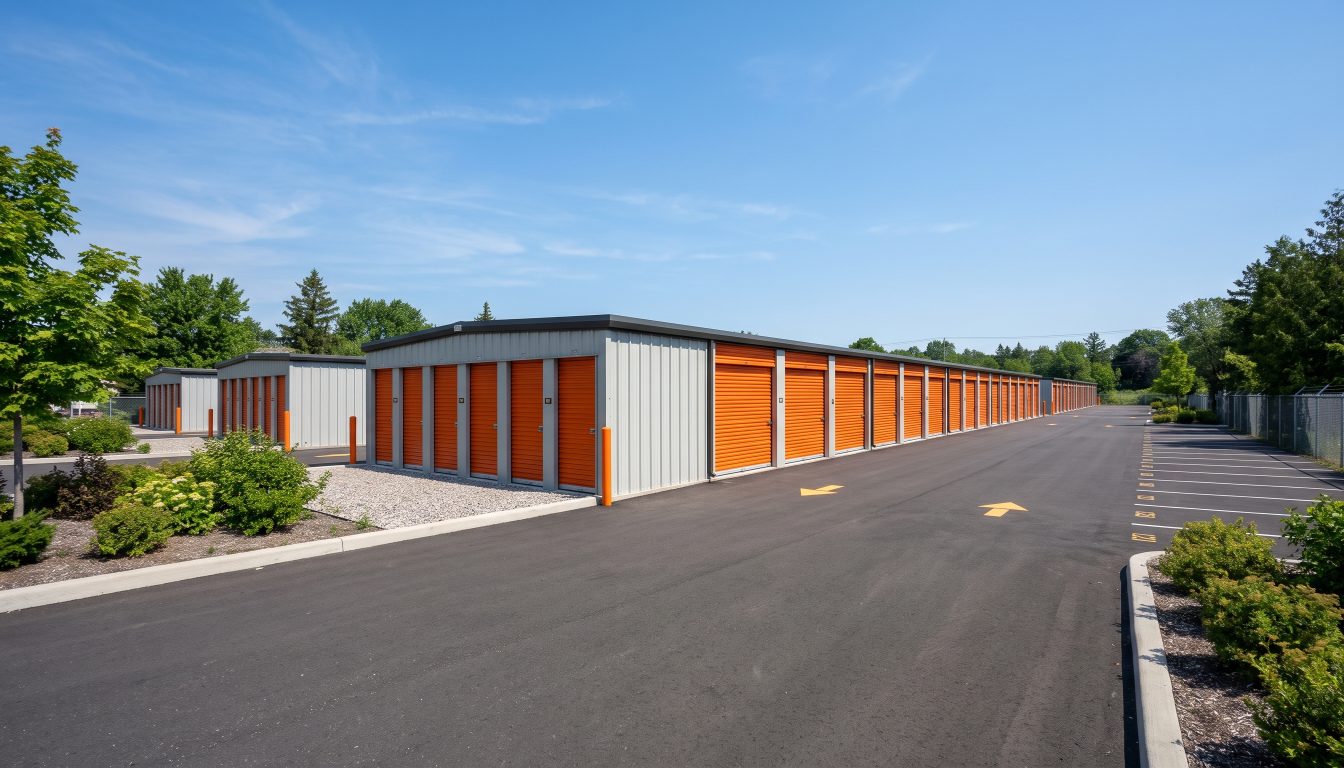
Self-storage in Ontario earns income from many short, month-to-month rentals, so it behaves like an operating business. Recent public figures show a large Canadian portfolio at 83.1% occupancy and $23.24 per occupied sq ft in Q1 2026. There is no reliable public Ontario storage cap rate, so price each facility on its actual 12-month income.
This guide is for investors with $1 million to $10 million who are looking at self-storage in Ontario and want to know how the numbers work, what the zoning allows and what can go wrong. You will see the verified market figures, a worked example and the checks I would run before making an offer.
What are you actually buying when you buy a self-storage facility?
You are buying two things at once: a piece of industrial-style real estate and a small operating business. The building earns nothing on its own. The income comes from hundreds of small, short-term rentals that the business has to fill, price and collect every month.
Most GTA facilities fall into three types:
- Drive-up, single storey: rows of units with roll-up doors, usually on larger suburban sites.
- Climate-controlled, multi-storey: heated and cooled indoor units with elevators, common in denser parts of the city.
- Conversions: older warehouses or industrial buildings fitted with interior units.
Revenue can come from unit rent, tenant insurance or protection plans, locks and boxes, and sometimes truck rental or parking. Customers usually rent month to month, so the facility can raise rates quickly when demand is strong. It can also lose customers quickly when demand is weak. That is the key difference from an apartment building or a plaza with long leases.
What do the self-storage numbers look like in Canada right now?
Public data on Ontario storage is thin, because roughly two-thirds of Canadian storage is still held by small operators who do not publish results (an industry estimate quoted in Modern Storage Media, December 2025). The best recent public numbers come from a large portfolio sale and from listed-company reporting.
| Measure | Figure | What it tells you |
|---|---|---|
| Public Storage Canada portfolio sale (June 2026) | 68 facilities, 5.3M sq ft, $1.2B | About $226 per sq ft on average (my arithmetic, portfolio level) |
| Same-store occupancy, Q1 2026 | 83.1% | Even large operators run with real vacancy |
| Same-store rent, Q1 2026 | $23.24 per occupied sq ft per year | Roughly what mature urban storage earns on space that is rented |
| Toronto industrial asking rent, Q3 2026 | $16 to $17 per sq ft | The alternative use for a storage building |
| Toronto industrial cap rate, Q3 2026 | 4.79% | Market-wide industrial average, not a storage figure |
| Storage supply per person | Under 3 sq ft in most of Canada vs 8 to 10 in the U.S. | Industry estimate; not a precise statistic |
Source: CRE Daily (23 June 2026) on the Public Storage acquisition; Altus Group Toronto CRE update Q3 2026; Lee & Associates Toronto Industrial Q3 2026 (CoStar data); Modern Storage Media, 2026 Canadian outlook.
Two cautions. The portfolio figures come from facilities in major cities, so a small facility in a secondary market may earn much less per foot. And the low supply per person is a talking point; it does not prove demand. One executive in the same outlook warned that you cannot simply copy U.S. ratios onto Canada, and another said parts of Toronto look overbuilt within a tight radius even though the wider region is undersupplied.
What is the cap rate on self-storage in Ontario?
I could not find a reliable public series of self-storage cap rates for Ontario or the GTA as of November 2026, and I will not invent one. A cap rate (capitalization rate) is the net operating income (NOI: rent and other income minus operating costs, before mortgage payments) divided by the price. For storage, the right number comes from the facility’s own trailing 12-month (T12) statements and recent sales of similar facilities, which your appraiser and I would gather for a specific deal.
Here is how the math works on an illustrative facility. The assumptions are mine, not market quotes:
- 40,000 sq ft of rentable space.
- 83.1% occupancy and $23.24 per occupied sq ft, borrowed from the portfolio figures above.
- Operating costs (staff, property tax, insurance, utilities, marketing, software, repairs) at 35% of revenue.
Revenue is 40,000 × 0.831 × $23.24 = about $772,500 a year. Operating costs at 35% are about $270,400, which leaves NOI of about $502,100. At an illustrative 5.5% cap rate the facility is worth about $9.13 million. At 6.5% it is worth about $7.72 million. One percentage point of cap rate moves the value by roughly $1.4 million, which is why the cap rate you accept matters more than almost any other number. My guide on how commercial property is valued explains NOI and cap rates in more depth, and my 2027 cap rate guide shows the published GTA figures by property type.
To see what your own cash buys and how the cash flow compares across building types, use the calculator below; it is set to $5 million but you can change every number.
Loading the investment calculator…
Where is self-storage allowed under Ontario zoning?
Zoning is set by each municipality, so the answer depends on the exact property. In the City of Toronto, Zoning By-law 569-2013 defines a “self-storage warehouse” as premises where individual enclosed areas are offered to the public for storing goods. In the by-law text I reviewed, it is listed as a permitted use in the Employment Light Industrial (EL) zone, the Employment Industrial Office (EO) zone and the Commercial Residential Employment (CRE) zone. The same by-law sets a minimum of 0.6 parking spaces for each 100 square metres of floor area for this use.
Three practical points:
- Some Toronto properties are still governed by older former-municipality by-laws, so check which by-law applies to the site.
- Mississauga, Brampton, Vaughan and the rest of the GTA each have their own by-laws, terms and parking rules.
- Ontario’s rules on employment areas changed in 2024. Toronto’s July 2026 planning summary says the “area of employment” definition now centres on manufacturing, warehousing and related uses. That can affect what an employment site may be used for later.
I cover the zoning side in detail, including building code occupancy and fire separations, in my guide to self-storage facility zoning in Ontario.
How much does it cost to build or convert storage in the GTA?
Building new is slow and expensive. In the 2026 Canadian outlook, one industry executive said development charges are rising past $50 per sq ft in most urban markets, and another said a new project typically takes three to five years from the first step to opening. Those are industry views rather than official figures, but they match what I see: land, charges, construction and lease-up all have to be funded before the facility earns its full income.
That is why many private investors look at buying an existing, stabilized facility or converting an existing industrial building instead. A conversion still needs the right zoning, building permits and fire separations. It also has to beat the alternative of simply leasing the building to an industrial tenant at $16 to $17 per sq ft. My guide to industrial real estate investment in the GTA covers that alternative.
What taxes and legal rules apply to a storage facility in Ontario?
Land transfer tax
A storage facility is non-residential, so land transfer tax runs at the standard brackets with a 2% top rate. On a $5 million purchase that is $96,475 in Ontario tax. Inside the City of Toronto the municipal tax adds another $96,475, for $192,950 in total. My commercial land transfer tax guide shows the full brackets.
HST
Commercial property is generally subject to HST. A buyer who is registered usually self-assesses rather than paying cash at closing, but the details depend on your registration, so confirm with your accountant.
Storage liens
When a customer stops paying, Ontario’s Repair and Storage Liens Act gives the storer a lien on the stored goods. Under section 4, the storer may sell the goods once 60 days have passed after payment became due. Section 15 requires written notice of the intended sale at least 15 days before it, and the sale must be commercially reasonable. Ask how the current owner handles defaults, because a sloppy lien sale is a legal risk you inherit. Confirm the process with your lawyer.
What are the biggest risks with self-storage in 2027?
- Local oversupply. A new climate-controlled facility a few blocks away can pull occupancy and rates down quickly, because customers switch easily.
- Rate pressure. In the 2026 outlook, one operator said almost every measure, including occupancy, was running weaker. Another said his company chose to hold rates and accept lower occupancy.
- Management intensity. Pricing, collections, lien sales and online marketing are daily work. A facility run well by an owner-operator can disappoint under a passive owner.
- Debt cost. The Bank of Canada raised its rate to 2.50% on 28 October 2026, and its next decision is 9 December 2026. A cap rate close to your mortgage rate leaves little room for error.
Seller packages often show “pro forma” income at full street rates and 90%+ occupancy. Underwrite the facility on what it actually collected over the last 12 months, check bank deposits against the reports, and treat any upside as a bonus, not as the price you pay for.
How do you check a self-storage facility before you buy?
- T12 and three years of statements: income by source, operating costs, and how both have trended.
- Rent roll and unit mix: occupancy by unit size, in-place rents versus current street rates, and how long customers stay.
- Collections: delinquency levels, lien notices sent and sales completed in the past year.
- Competition: every facility nearby, plus any approved or proposed projects in the planning pipeline.
- Zoning and permits: confirm the use is permitted and that past additions or conversions had building permits.
- Building and environment: a building condition assessment (BCA: an engineer’s report on roofs, paving, doors, HVAC and life-safety systems) and a Phase 1 ESA (environmental site assessment, a records-based check for contamination). Industrial sites often have history.
My checklist for buying a self-storage facility in Ontario lists the documents to request in the agreement of purchase and sale.
Self-storage can suit an investor who wants commercial income without office or retail tenant risk, but it is an operating business first. My view is to buy a facility that already has a proven 12-month record, price it on that record, and either keep experienced management in place or budget properly for a professional operator. If the numbers only work with the seller’s projections, walk away.
What to do next
- Decide whether you want to operate a facility yourself or pay for third-party management, and budget for it.
- Set a target cap rate and debt coverage based on your own financing quote, not on general market talk.
- Screen properties for zoning first, then for the competition nearby.
- Run any facility you are considering through the calculator above using its actual T12 figures.
- Book a call with me to walk through a specific facility; I search MLS and approach owners off-market, and we can test the numbers together with your lawyer and accountant.
Need help with this? Talk to me.
I’m Jatin Dua, Broker of Record at RE/MAX Quantum Realty, and I’m the best agent to do this kind of work for you in Toronto and across the GTA. Over $100 million in GTA sales and 100+ families helped sell. Feel free to contact me any time: call or text 833-330-1925 or email [email protected].
Frequently asked questions
Is self-storage a good investment in Ontario in 2027?
It can be, but only at the right price and in the right location. Industry estimates suggest Canada has far less storage space per person than the U.S., yet operators reported softer occupancy and rates in 2025, and parts of Toronto already look crowded within a small radius. A stabilized facility with a 12-month record, bought on actual income rather than projections, carries much less risk than a new build or a lease-up.
What is the cap rate for self storage in Canada?
There is no reliable public self-storage cap rate series for Ontario as of November 2026, so treat any single number you hear with caution. Pricing depends on the facility’s actual net operating income and recent comparable sales. For context, the Toronto industrial market averaged a 4.79% cap rate in Q3 2026 (Lee & Associates, CoStar data), but storage is priced on its own operating results.
How much does it cost to buy a self storage facility in Ontario?
Price depends on income, size and location, so there is no standard figure. In June 2026 Public Storage agreed to buy a 68-facility Canadian portfolio of 5.3 million sq ft for $1.2 billion, about $226 per sq ft on average. Smaller single facilities in secondary markets can trade very differently. Add land transfer tax: $192,950 on a $5 million purchase inside Toronto, or $96,475 elsewhere in Ontario.
Where is self-storage allowed in Toronto zoning?
In Toronto Zoning By-law 569-2013, a self-storage warehouse is a defined use listed as permitted in the EL, EO and CRE zones, in the by-law text I reviewed. Parking is set at 0.6 spaces per 100 square metres. Some sites still fall under older former-municipality by-laws, and every other GTA city has its own rules, so confirm the zoning of the specific property with the city or a planner.
What occupancy does a self storage facility need to make money?
There is no fixed break-even; it depends on the facility’s costs and debt. As a reference point, Public Storage Canada’s same-store portfolio ran at 83.1% occupancy in Q1 2026 with average rent of $23.24 per occupied sq ft per year. Work out your own break-even by dividing operating costs plus mortgage payments by the potential rent at full occupancy.
Can a storage facility in Ontario sell a customer’s belongings for unpaid rent?
Yes, under Ontario’s Repair and Storage Liens Act, a storer has a lien on stored goods and may sell them after 60 days have passed since payment was due. The storer must give written notice of the sale at least 15 days in advance, and the sale must be commercially reasonable. Owners should have their process reviewed by a lawyer before relying on it.
Is it cheaper to build or buy a self storage facility in the GTA?
For most private investors in 2027, buying an existing facility is simpler and faster. Industry executives say development charges in urban markets are rising past $50 per sq ft and that new projects take three to five years from start to opening. A new build also needs time to lease up, during which income is low while costs and interest run.
Do you pay HST when buying a self storage property in Ontario?
Usually yes, because a storage facility is commercial property and its sale is generally taxable. A buyer registered for HST normally self-assesses the tax instead of paying it in cash at closing. Whether that works for you depends on your registration and how you will use the property, so confirm the details with your accountant before you sign.
What documents should I ask for when buying a storage facility?
Ask for at least the trailing 12-month income statement, three years of financials, the rent roll with unit mix and street rates, delinquency and lien-sale records, property tax bills, permits for past work, a building condition assessment and a Phase 1 environmental site assessment. Check reported revenue against bank deposits, and make the purchase conditional on your review.
Sources
- City of Toronto Zoning By-law 569-2013 (Chapters 1–800)
- Ontario e-Laws: Repair and Storage Liens Act, R.S.O. 1990, c. R.25
- CRE Daily: Public Storage acquires 68-property Canada portfolio for $1.2B (June 2026)
- Modern Storage Media: 2026 Canadian self-storage outlook
- Altus Group: Toronto commercial real estate market update Q3 2026
- Lee & Associates: Toronto Industrial Market Report Q3 2026
- City of Toronto: How Ontario’s planning rules have changed (July 2026)
Related reading
- How to Invest $5 Million in GTA Real Estate (2027): Your Real Options
- What $5 Million Buys in GTA Real Estate in 2027: Houses, Buildings, Plazas and Land
- A $5 Million House or a $5 Million Apartment Building in Toronto? The 2027 Math
- Commercial vs Residential Real Estate Investment in the GTA (2027)
About the author — Jatin Dua, Toronto and GTA real estate broker
I am Jatin Dua, Broker of Record and co-founder of RE/MAX Quantum Realty Inc., Brokerage, Unit 101, 799 The Queensway, Toronto. I work with buyers and sellers across Toronto and the GTA and have helped more than 100 families sell. Four-plus years of active GTA transactions and over $100 million in sales volume.
Reach me at [email protected] or 833-330-1925, or book a call.
More from the library
- How Much Is a Funeral Home Worth in Ontario? Valuation Explained (2027)
- Investing in Commercial Condo Units in the GTA (2027): Industrial, Office and Retail
- Day Spa Premises in Ontario: Zoning, Public Health Setting Rules, Sinks, Sterilizers and the Lease
- Mimico or High Park-Swansea? Two Ways to Live Near the Lake
- Funeral Home Premises in Ontario: Zoning, Holding and Embalming Rooms, and the Building Code
- One York Quay, 77 & 99 Harbour Square: The Fee That Covers Everything