
Published 7 September 2026 · Updated 29 September 2026 · By Jatin Dua, Broker of Record, RE/MAX Quantum Realty
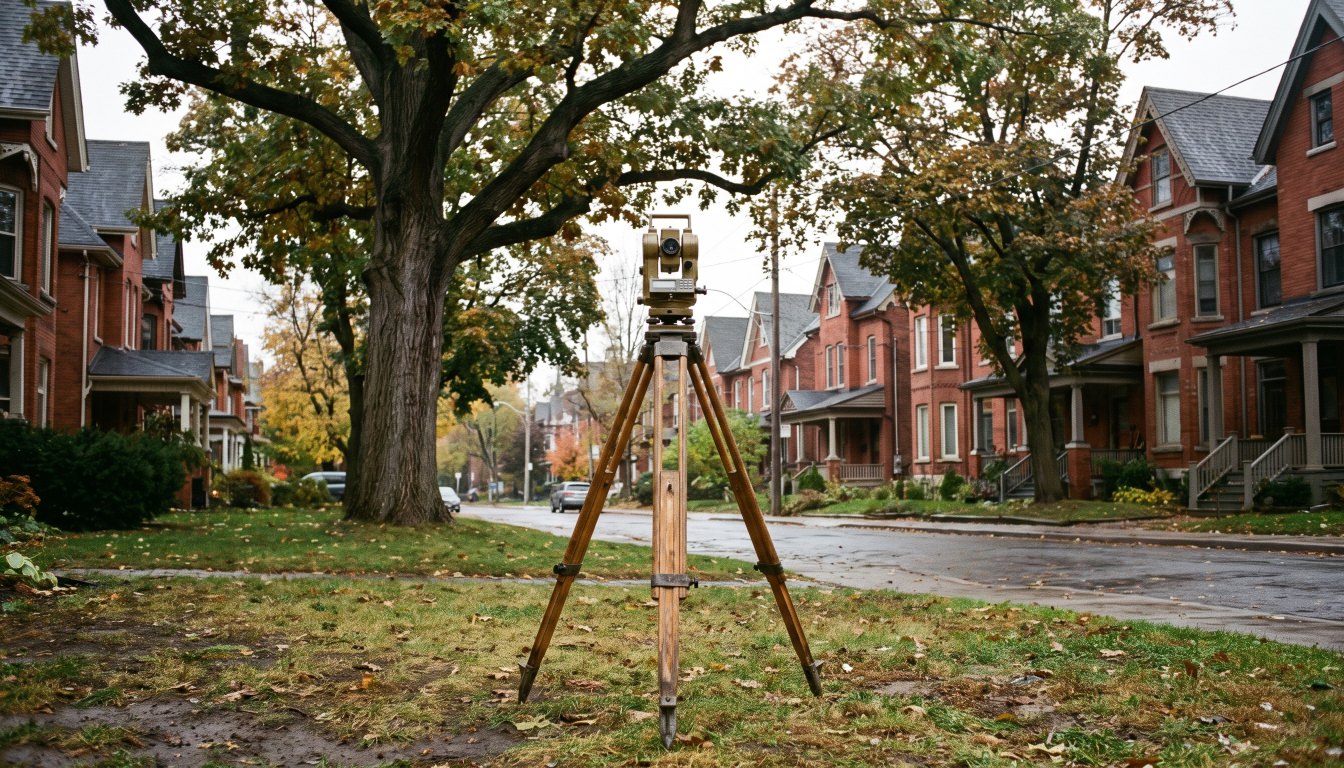
Because the boundary problems that matter almost never appear when you buy. They appear when you build — a fence two feet inside the line, a driveway shared under an arrangement nobody documented, a garage that crosses a setback, an easement running through the exact place you wanted a pool.
Title insurance is valuable and it is not a survey. A policy may respond to certain survey and encroachment matters, but what it cannot do is tell you, in advance, where your lot actually is and what you are permitted to build within it. On a property where the lot is most of the value, that is the information you are paying for.
Why this matters more at the top of the market
On a $900,000 semi, a boundary question is an inconvenience. On a $4 million property where most of the value is the lot, and where the plan involves an addition, a pool or a rebuild, it is the difference between the purchase you thought you were making and a different one.
Every constraint on a luxury lot compounds: the zoning envelope, ravine mapping under Chapter 658, TRCA regulation, heritage district rules, and trees of 30 centimetres trunk diameter or more. Add an easement or an encroachment to that list and the buildable area can shrink dramatically.
The five things a survey reveals
1. Where the boundaries actually are
Fences move. Landscaping is planted where it looks right rather than where the line is. Retaining walls get built by whoever needed one. On older lots, the fence line and the legal line are frequently different.
2. Encroachments, in both directions
Your garage over the neighbour’s line, or theirs over yours. Eaves, walls, steps and driveways. Long-standing encroachments can raise questions about rights accrued over time, which are legal questions for your lawyer.
3. Easements and rights of way
Utility easements, mutual rights of access, municipal easements for services. Each restricts what may be built or excavated over it. An easement crossing the rear garden of a large lot can eliminate the pool.
4. Setback compliance
Whether existing structures comply with current zoning, or are legally non-conforming. This matters when you renovate: work on a non-conforming structure can trigger requirements that would not otherwise apply.
5. The relationship between the lot and the slope
On a ravine property, the survey plus the ravine and TRCA mapping is what shows you how much of the registered depth is actually usable table land.
Mutual driveways deserve their own paragraph
They are common in older Toronto neighbourhoods and the arrangements vary enormously. Some are documented as mutual rights of way on title. Some rest on decades of accommodation between neighbours. The practical questions are the same in every case: who may park where, who maintains the surface, what happens if one owner rebuilds, and what is actually registered. Your lawyer should answer all four from the title, not from the listing.
What to do
- Ask the seller for the survey at the outset. Many owners have one from a previous purchase or a previous build.
- Give it to your lawyer with your title instructions.
- Commission a new one if you intend to build, if the existing plan is materially out of date, or if anything about the boundaries looks unusual.
- Read it against your plans before you commit, not after.
- Combine it with the ravine, TRCA, heritage and tree information to establish the actual buildable area.
The practical takeaway
On a property where the lot is the asset, a survey is not an optional extra — it is the description of what you are buying. Ontario provides no cooling-off period on a resale purchase, so this belongs in your conditional period or, if you are going firm, before you write the offer.
Frequently asked questions
Do I need a survey if I have title insurance?
They do different things. Title insurance may respond to certain defects, survey issues and encroachments after the fact, subject to the terms of the policy. A survey tells you the actual boundaries and the position of structures before you buy or build. Ask your lawyer what your specific policy covers.
What is an SRPR?
A Surveyor’s Real Property Report — a plan prepared by an Ontario Land Surveyor showing the boundaries of the property and the location of buildings and improvements relative to them. It is the document that answers where things actually are.
What is a mutual driveway?
A driveway shared between two properties, common in older Toronto neighbourhoods, where each owner has rights over part of the other’s land. The arrangements vary and the consequences for parking, rebuilding and access are real. Your lawyer should review how it is documented on title.
How do easements affect a luxury property?
An easement gives someone else a right over part of your land — a utility, a neighbour, the municipality. It can restrict where you may build, excavate or landscape. On a large lot, an easement running through the rear garden can eliminate the pool or the addition you had in mind.
What is an encroachment?
A structure that crosses a boundary — a fence, a wall, a garage, eaves, a retaining wall. It can run in either direction, and long-standing encroachments raise questions about rights that have accrued over time. These are legal questions for your lawyer.
Is the seller’s old survey good enough?
It is a useful starting point and it may be out of date. Structures, fences and landscaping change. If you plan to build, an up-to-date survey is worth commissioning; if you are simply buying, an older survey plus your lawyer’s review is often the practical middle ground.
Thinking about buying or selling at the top end?
Send me the address, or the shortlist you are considering. I will tell you what the property is actually worth today, what the land is worth without the house, what the transfer tax and carrying costs will be, and whether the deal makes sense. Confidential, always.
[email protected] · 833-330-1925 · Book a free consultation
Confidential. Read personally and answered within 24 hours. I never share, sell or distribute your information.
Related reading
- Surveys, SRPRs and title insurance in Ontario
- Mutual and shared driveways in Toronto and Etobicoke
- Easements and rights of way in Ontario
- Encroachments and possessory claims under Land Titles in Ontario
- Lot frontage, depth and shape: the quiet driver of luxury home value
Sources
Everything above that is a rule, a rate or a published number comes from these. Verify anything that matters to your own deal.
- City of Toronto — Zoning By-law 569-2013, residential provisions
- City of Toronto — Municipal Code Chapter 658, Ravine and Natural Feature Protection
About the author — Jatin Dua, Broker of Record
I’m the Broker of Record at RE/MAX Quantum Realty, 799 The Queensway in Etobicoke, and I work with buyers, sellers and investors across Toronto and the west GTA. A large part of my work sits in the upper end of the market, where the comparables are thin, the rules are heavier and the cost of a wrong number is measured in hundreds of thousands of dollars.
The free estimators on this site are mine. I built them because the first question every owner asks is “what is it worth?” and the honest answer starts with a number you can check yourself. [email protected] or 833-330-1925.
Title questions get sharper in an estate sale: selling a house after a death in Ontario.