
Published 7 September 2026 · Updated 29 September 2026 · By Jatin Dua, Broker of Record, RE/MAX Quantum Realty
What's Your Home Worth Right Now?
Get a free AI-powered price range for your property in under 90 seconds, based on recent GTA comparable sales. No name or address required.
Get My Free Estimate →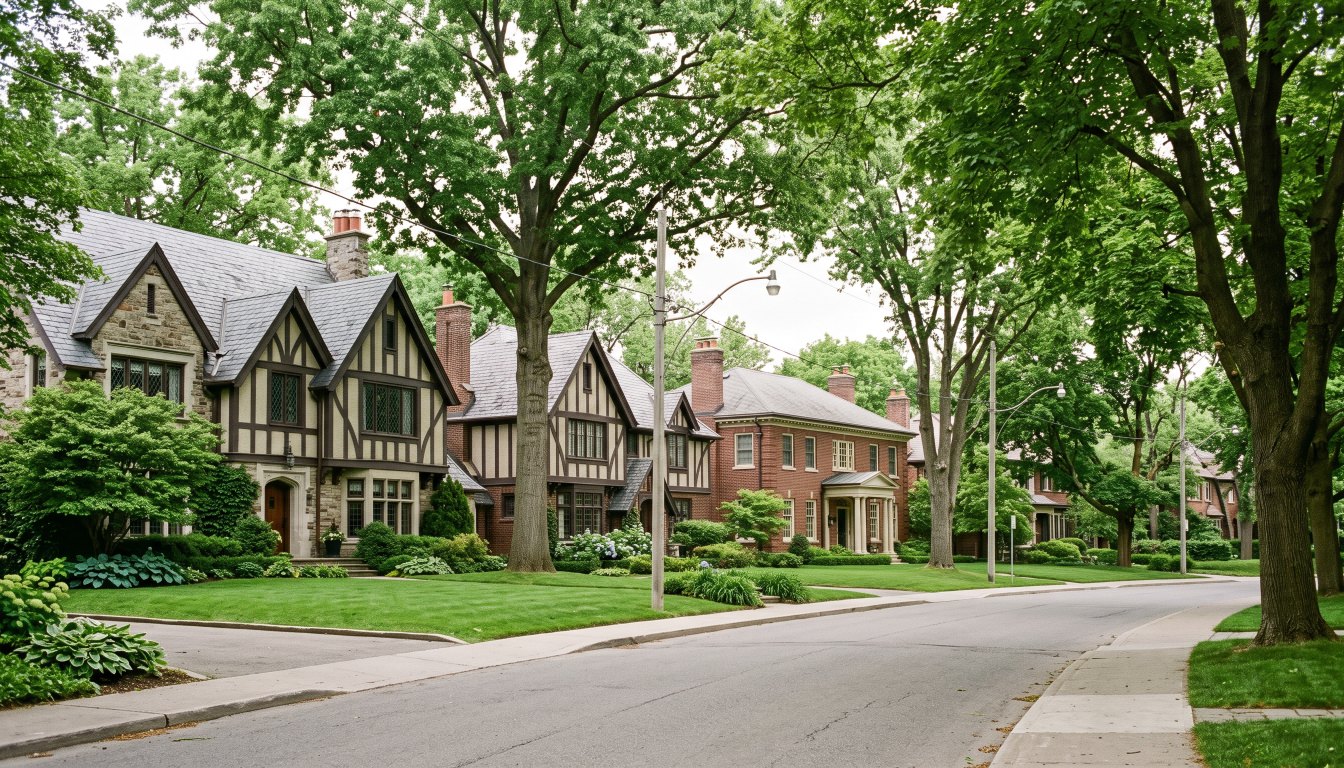
Forest Hill was an independent village from 1923 until 1967, and in the 1920s and 1930s its building rules required that homes be architect-designed and that a tree be planted in every front yard. Those two requirements are why the neighbourhood looks the way it does a century later, and why it still commands what it does.
In August 2026 a Forest Hill South residence sold for $23,500,000 against a $22 million asking price with three competing offers — a 9,856 square foot house completed in 2025. RE/MAX recorded 11 sales above $3 million in Forest Hill South between January and April 2026.
A village that made its own rules
Forest Hill was originally called Spadina Heights. It incorporated as an independent village in 1923 and remained one until amalgamation into the City of Toronto in 1967. During the 1920s and 1930s the village imposed two requirements that shaped everything since:
- Homes had to be architect-designed.
- A tree had to be planted in every front yard.
Forty-four years of self-government with those rules produced an unusually consistent streetscape — Tudor, Georgian and French Colonial houses, manor-scale properties with porte-cochères and gated entries, under a mature canopy that exists because it was required.
The growth years
The population rose from 5,207 in 1931 to 11,757 in 1941, a period in which many wealthy Jewish families moved into the neighbourhood and shaped its institutions.
The other decisive date is 1971, when Premier Bill Davis cancelled the Spadina Expressway. Had it proceeded, the neighbourhood would have been bisected. It is difficult to overstate how much of Forest Hill’s current value rests on that single decision.
The 2026 sale, and what it demonstrates
| Sale price | $23,500,000 |
| Asking price | $22,000,000 |
| Competing offers | Three |
| Size | 9,856 sq ft |
| Completed | 2025 |
| Sale date | 26 August 2026 |
The listing brokerage described it as the highest MLS residential sale in the City of Toronto in close to five years. That is the brokerage’s own characterisation, and it would not include off-market transactions or the $27,325,000 combined-lot sale on Park Lane Circle in 2025 — but the transaction itself is well documented and instructive.
What it teaches
Recent, resolved, correctly priced. A house completed in 2025 with current systems and full documentation, listed at a number the market could support, attracted three buyers and closed $1.5 million above asking. Competition at the very top is produced by a defensible price, not by an ambitious one.
The market, in numbers
RE/MAX recorded 11 sales above $3 million in Forest Hill South between January and April 2026, behind Rosedale and Lawrence Park at 20 each and Bridle Path–Sunnybrook–York Mills at 14. Separately, 228 Dunvegan Road sold for $11,900,000 in 2025, placing it among the ten largest publicly reported GTA transactions of that year.
Schools
Upper Canada College and The Bishop Strachan School are both in or adjacent to the neighbourhood — the original village boundary ran to Upper Canada College on the east. Proximity to these institutions is part of the neighbourhood’s identity, though it matters less to price than most buyers assume, since families travel across the city for them.
What to check before buying here
- Heritage status for the specific address. A heritage study has been carried out for the Forest Hill area but the district has not been designated. Individual properties can still be designated under Part IV, and the position can change — confirm with the City.
- The tree inventory. A neighbourhood built under a front-yard tree requirement now has a mature canopy, and anything 30 centimetres or more in trunk diameter needs a permit under Chapter 813, with fines to $100,000 per tree.
- The zoning envelope, since much of the market here contemplates substantial renovation or replacement.
- Land transfer tax. At $5,000,000 in Toronto that is $271,450 in cash on closing.
Frequently asked questions
What were Forest Hill’s original building rules?
In the 1920s and 1930s the village required that homes be architect-designed and that a tree be planted in every front yard. It was formerly known as Spadina Heights, incorporated as a village in 1923, and amalgamated into the City of Toronto in 1967.
Which schools are in Forest Hill?
Upper Canada College and The Bishop Strachan School both sit within or adjacent to the neighbourhood. The original village boundaries ran from Bathurst Street on the west to Upper Canada College on the east, Eglinton Avenue on the north and Lonsdale Road and Montclair Avenue on the south.
What was the 2026 Forest Hill record sale?
A Forest Hill South residence sold on 26 August 2026 for $23,500,000, listed at $22 million, with three competing offers. It was 9,856 square feet and completed in 2025. The listing brokerage described it as the highest MLS residential sale in Toronto in close to five years — that is the brokerage’s characterisation rather than an independently verified statistic.
Is Forest Hill a heritage conservation district?
A heritage study has been carried out for the Forest Hill area but the district has not been designated. Heritage status can change, so confirm the current position for any specific address with the City of Toronto before relying on it.
How did the neighbourhood grow?
Population rose from 5,207 in 1931 to 11,757 in 1941. In 1971 Premier Bill Davis’s cancellation of the Spadina Expressway prevented the neighbourhood from being bisected — one of the more consequential planning decisions in Toronto’s residential history.
What architectural styles dominate?
Tudor, Georgian and French Colonial, together with large manor-style houses featuring porte-cochères, gated entries and formal gardens. The architect-designed requirement of the 1920s and 1930s produced an unusually consistent standard of design for the era.
Thinking about buying or selling at the top end?
Send me the address, or the shortlist you are considering. I will tell you what the property is actually worth today, what the land is worth without the house, what the transfer tax and carrying costs will be, and whether the deal makes sense. Confidential, always.
[email protected] · 833-330-1925 · Book a free consultation
Confidential. Read personally and answered within 24 hours. I never share, sell or distribute your information.
Related reading
- Toronto’s record home sales: what the biggest deals tell you
- Private schools and Toronto real estate: what proximity is worth
- Toronto’s luxury neighbourhoods compared
- Does an architect-designed house hold its value in Toronto?
Sources
Everything above that is a rule, a rate or a published number comes from these. Verify anything that matters to your own deal.
- Sotheby’s International Realty Canada — Forest Hill sale release, 26 August 2026
- RE/MAX Canada — 2026 Spotlight on Luxury Real Estate, Greater Toronto
- City of Toronto — Heritage Conservation Districts and planning studies
- Canadian Mortgage Professional — 2025 most expensive GTA home sales, ranked
About the author — Jatin Dua, Broker of Record
I’m the Broker of Record at RE/MAX Quantum Realty, 799 The Queensway in Etobicoke, and I work with buyers, sellers and investors across Toronto and the west GTA. A large part of my work sits in the upper end of the market, where the comparables are thin, the rules are heavier and the cost of a wrong number is measured in hundreds of thousands of dollars.
The free estimators on this site are mine. I built them because the first question every owner asks is “what is it worth?” and the honest answer starts with a number you can check yourself. [email protected] or 833-330-1925.