
Published 7 September 2026 · Updated 29 September 2026 · By Jatin Dua, Broker of Record, RE/MAX Quantum Realty
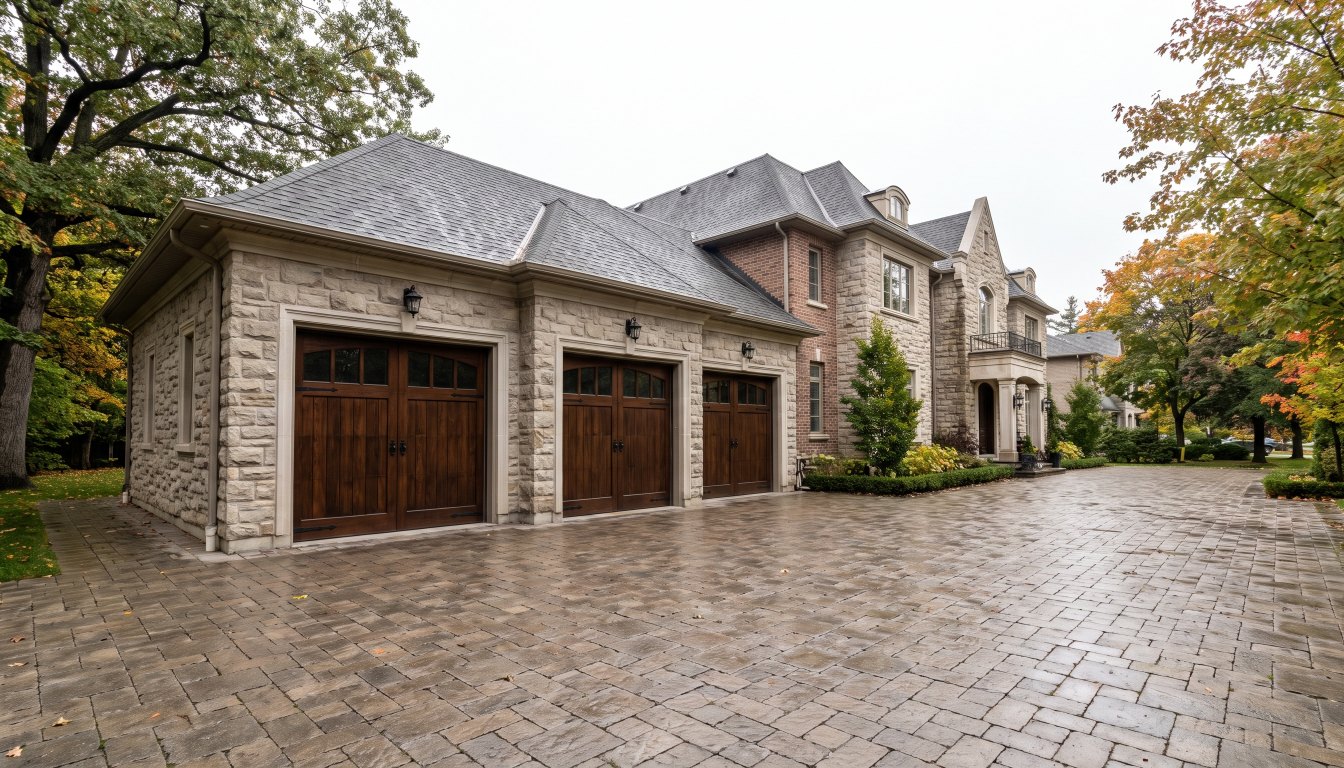
More than most people expect, and for a reason that has nothing to do with cars: garage capacity in Toronto is constrained by frontage and the zoning envelope, so it functions as a proxy for the size and shape of the lot. On a 40-foot frontage, a genuine two-bay garage with usable turning space is difficult. On 75 feet it is straightforward. Buyers read the garage and infer the land.
In condominiums, parking is valued separately and legally structured in different ways — owned, exclusive-use common element, or leased. Which one applies is set by the declaration and matters both for value and for whether you can sell it separately.
Why parking is really a lot-size signal
In a suburb where lots are wide, a three-car garage says something about the house. In Toronto’s established neighbourhoods, where frontages are constrained and the zoning envelope is tight, it says something about the land — and land is what buyers at this level are really buying.
| Frontage | What is realistically achievable |
|---|---|
| Around 30–40 ft | A single garage, often tandem or integral, with a narrow drive |
| Around 50 ft | Two bays possible, usually at the cost of house width |
| Around 60–75 ft | Two or three bays with genuine turning space |
| Estate lots | Three or more bays plus a motor court, without compromising the house |
None of these are rules — Zoning By-law 569-2013 sets lot coverage, floor space and setbacks by zone, and older neighbourhoods are full of site-specific exceptions. The point is directional: the garage a house can have is decided by the land long before it is decided by the budget.
What buyers actually value
- Independent access. Two cars that can leave in either order. Tandem spaces count on a listing and do not count in life.
- Turning space. A drive that lets you leave forwards rather than reversing onto a busy street.
- A direct, covered connection to the house, ideally into a mudroom.
- Ceiling height and door width sufficient for a large vehicle.
- Electrical capacity — a dedicated circuit and panel headroom for charging.
- Guest parking on the property rather than on the street.
Condominium parking is a different legal question
In a condominium, how parking is owned is set by the declaration, and there are three common structures:
- A separately owned parking unit. Has its own legal description and can generally be dealt with separately, subject to the declaration and any restriction on selling to non-residents.
- An exclusive-use common element. Attached to your unit, yours to use, but not a separate property you can sell on its own.
- Leased from the corporation. A contractual right rather than an ownership interest.
These are not interchangeable, and the difference matters at resale. Have your lawyer confirm the structure from the declaration rather than from the listing.
EV charging
In a house, the valuable thing is capability: a dedicated circuit to the garage and panel capacity behind it. The specific charger will be replaced by the next owner. In a condominium it is a corporation question — what the building permits, what infrastructure exists, and how the cost is allocated. Ask the property manager and check the status certificate.
The practical takeaway
Judge parking by function rather than by count, and remember that in Toronto the garage is partly a proxy for the lot. If you are building or renovating, put the money into usable width, a real turning area and electrical capacity rather than into a third bay that only works on paper.
Frequently asked questions
Does a third garage bay add value in Toronto?
On a lot wide enough to accommodate it without compromising the house, yes — and part of what it signals is the width of the lot itself. On a narrow lot where the third bay pushes the house into an awkward plan, it can subtract.
What limits how big a garage I can build?
Zoning By-law 569-2013 controls lot coverage, floor space and setbacks, and many older neighbourhoods carry site-specific exceptions. Get a zoning review for the address before assuming what is permitted. Bill 17 and O. Reg. 462/24 removed the minor variance requirement for setback shortfalls up to 10%, which helps some projects.
Is tandem parking as good as side by side?
No. Tandem spaces count on paper but do not function as independent parking, and buyers discount them accordingly. The listing count matters far less than whether two cars can leave in either order.
How is condo parking owned?
It depends entirely on the declaration. Parking may be a separately owned unit, an exclusive-use common element attached to your unit, or leased from the corporation. Only a separately owned parking unit can generally be sold independently. Confirm with your lawyer from the declaration.
Do buyers pay for EV charging?
They pay for the capability more than the equipment. A dedicated circuit and panel capacity to the garage is the valuable part; a specific charger will be replaced. In condominiums, EV charging is governed by the corporation and is a question for the board and the status certificate.
Does front-yard parking help or hurt?
It is regulated in Toronto and, where permitted, it is generally treated as a compromise rather than an amenity at the top end. On a street of houses with proper drives and garages, a front pad reads as a deficiency.
Thinking about buying or selling at the top end?
Send me the address, or the shortlist you are considering. I will tell you what the property is actually worth today, what the land is worth without the house, what the transfer tax and carrying costs will be, and whether the deal makes sense. Confidential, always.
[email protected] · 833-330-1925 · Book a free consultation
Confidential. Read personally and answered within 24 hours. I never share, sell or distribute your information.
Related reading
- Lot frontage, depth and shape: the quiet driver of luxury home value
- 7 things luxury buyers in Toronto pay extra for (and 5 they do not)
- Buying a luxury condo in Toronto: the 2026 buyer’s guide
- What is my condo worth? Floor, view and parking, priced
Sources
Everything above that is a rule, a rate or a published number comes from these. Verify anything that matters to your own deal.
- City of Toronto — Zoning By-law 569-2013, residential provisions
- Condominium Authority of Ontario — Status certificates
About the author — Jatin Dua, Broker of Record
I’m the Broker of Record at RE/MAX Quantum Realty, 799 The Queensway in Etobicoke, and I work with buyers, sellers and investors across Toronto and the west GTA. A large part of my work sits in the upper end of the market, where the comparables are thin, the rules are heavier and the cost of a wrong number is measured in hundreds of thousands of dollars.
The free estimators on this site are mine. I built them because the first question every owner asks is “what is it worth?” and the honest answer starts with a number you can check yourself. [email protected] or 833-330-1925.