
Published 7 September 2026 · Updated 29 September 2026 · By Jatin Dua, Broker of Record, RE/MAX Quantum Realty
What's Your Home Worth Right Now?
Get a free AI-powered price range for your property in under 90 seconds, based on recent GTA comparable sales. No name or address required.
Get My Free Estimate →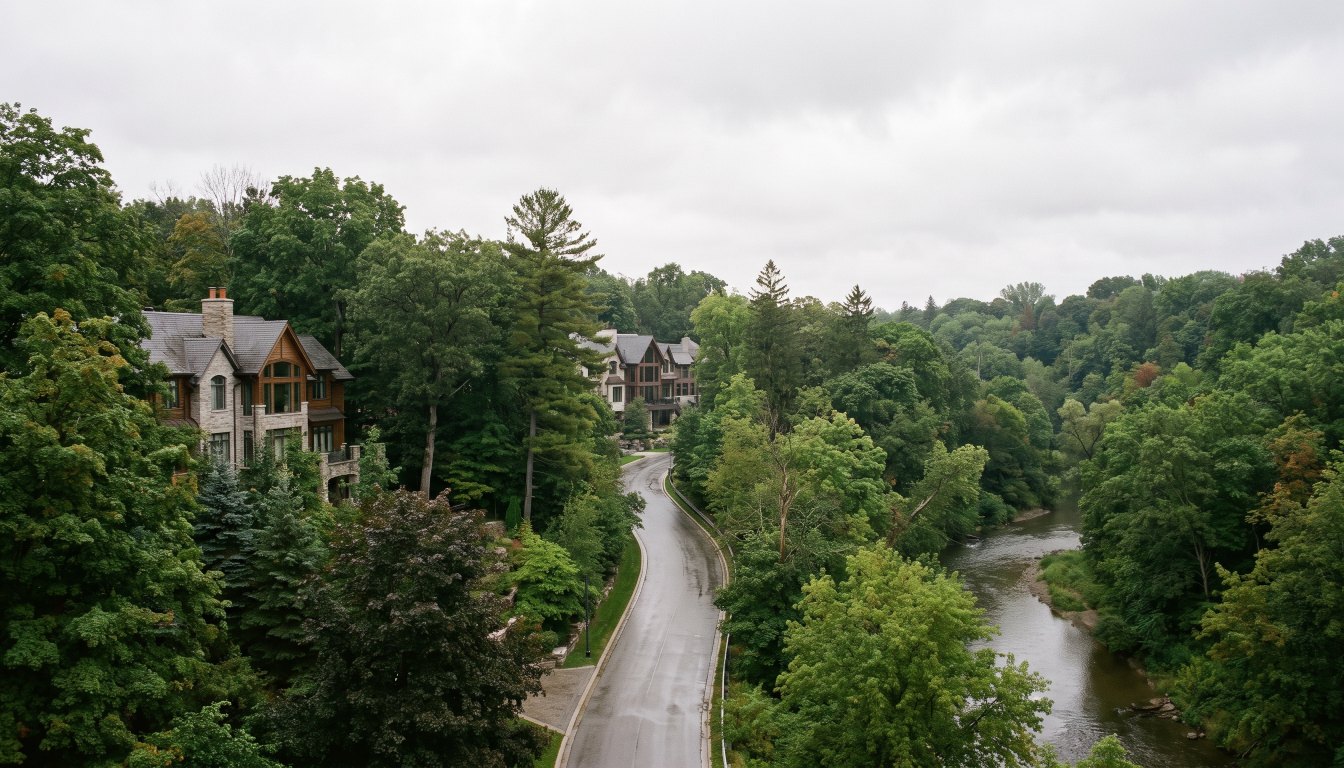
Hoggs Hollow is centred on Yonge Street and York Mills Road, in the valley of the Don River. It is named for James Hogg, a Scottish settler who arrived in 1824 and ran a mill on Yonge at the Don; his sons John and William continued milling from 1856. Much of the land was later the St. Andrew’s Golf Course, a Stanley Thompson design, from 1927 until the 1950s, when it was converted to housing.
What that history produced is large lots embedded in the valley landscape rather than laid out on a grid. It is among the most attractive settings in Toronto and among the most heavily regulated: ravine protection under Municipal Code Chapter 658 and, where applicable, TRCA regulation under O. Reg. 41/24, which requires clearance before a building permit issues.
Three layers of history in one valley
| Period | What was here |
|---|---|
| From 1824 | James Hogg arrives and operates a mill on Yonge Street at the Don River |
| From 1856 | His sons John and William continue milling |
| 1927–1950s | St. Andrew’s Golf Course, a Stanley Thompson design, first 18 holes then 27 |
| 1950s onward | Residential conversion, with houses set into the valley landscape |
The administrative history runs alongside it: York Township formed in 1850, became North York in 1922, and amalgamated into the City of Toronto in 1998.
Why a golf course origin matters
Land converted from a golf course does not arrive as a grid. It arrives as contours, mature planting and a road pattern that follows the topography. That is why houses here are described as embedded in the landscape rather than sited on lots — and it is why two properties on the same street can have completely different usable areas.
The regulatory reality
Valley living in Toronto means two authorities, not one.
- City of Toronto, Municipal Code Chapter 658. Inside a mapped ravine protected area, a permit is required to injure, destroy or remove a tree, to place or dump fill, and to alter the grade of land. Fines run from $500 to $100,000 per tree, with continuing offences at $500 to $10,000 per day and the power to order restoration at the owner’s expense.
- TRCA, O. Reg. 41/24. Where the property falls in a regulated area — valley and stream corridors, wetlands, shoreline — a TRCA permit is required, and the City will not issue a building permit until clearance is obtained.
Water deserves its own inspection
On a slope, water moves — usefully when it moves away from the house and expensively when it moves toward it. On any Hoggs Hollow or York Mills property, the inspection should specifically cover site grading on every elevation, where downspouts discharge, the condition of weeping tile, whether a backwater valve is installed, the sump and its workload, and any retaining structures on the slope. Where there is any doubt about slope stability or a retaining wall, bring in an engineer.
What you are buying
Privacy, mature canopy, quiet and a view that cannot be built on — because the same regulation that constrains you constrains everyone else. That permanence is the reason valley property in Toronto has held its position for seventy years, and it is why the constraint and the value are the same fact seen from two sides.
Before you buy
- Pull the ravine protected area mapping and the TRCA regulated area status for the address, separately.
- Establish how much of the lot is table land rather than slope.
- Count trees 30 centimetres or more in trunk diameter anywhere your plans might reach.
- Investigate water thoroughly, inside and out.
- Ask whether past work — retaining walls, fill, patios, tree removal — was permitted.
- Build the approval timeline into your closing date and your budget.
The practical takeaway
Hoggs Hollow gives you a setting that cannot be replicated and a rulebook that governs almost everything you might want to do outdoors. Buy it for the valley, do the mapping before you commit, and sequence TRCA before design rather than after.
Frequently asked questions
Where is Hoggs Hollow?
Centred on Yonge Street and York Mills Road in North York, in the valley of the Don River, generally south of York Mills Road along Yonge. It is part of the broader York Mills area.
Why is it called Hoggs Hollow?
After James Hogg, a Scottish settler who arrived in 1824 and operated a mill on Yonge Street at the Don River. His sons John and William continued milling from 1856.
What was there before the houses?
The St. Andrew’s Golf Course, a Stanley Thompson design, occupied much of the land from 1927 until the 1950s — initially 18 holes and later 27 — before residential conversion.
What does valley location mean for a buyer?
Large lots and an exceptional setting, together with two regulatory layers. Inside a mapped ravine protected area, Chapter 658 requires a permit to injure, destroy or remove a tree, place or dump fill, or alter the grade of land. Where TRCA jurisdiction applies under O. Reg. 41/24, clearance is required before the City will issue a building permit.
Are there drainage issues in the valley?
Water is the question to investigate on any sloped or valley property. Grading, downspout discharge, weeping tile and backwater valves all matter more here than on flat table land, and the fix for a grading problem is itself regulated inside a protected area.
Which schools serve the area?
York Mills Collegiate Institute is the public secondary school, with six TDSB primary schools in the area. Confirm current catchments directly with the school board.
Thinking about buying or selling at the top end?
Send me the address, or the shortlist you are considering. I will tell you what the property is actually worth today, what the land is worth without the house, what the transfer tax and carrying costs will be, and whether the deal makes sense. Confidential, always.
[email protected] · 833-330-1925 · Book a free consultation
Confidential. Read personally and answered within 24 hours. I never share, sell or distribute your information.
Related reading
- Buying a ravine lot in Toronto: what the bylaw does to your plans
- TRCA permits: the approval that comes before your building permit
- Water is the most expensive problem in a Toronto luxury home
- Toronto’s luxury neighbourhoods compared
Sources
Everything above that is a rule, a rate or a published number comes from these. Verify anything that matters to your own deal.
- City of Toronto — Municipal Code Chapter 658, Ravine and Natural Feature Protection
- Toronto and Region Conservation Authority — Replacing an existing home
- RE/MAX Canada — 2026 Spotlight on Luxury Real Estate, Greater Toronto
About the author — Jatin Dua, Broker of Record
I’m the Broker of Record at RE/MAX Quantum Realty, 799 The Queensway in Etobicoke, and I work with buyers, sellers and investors across Toronto and the west GTA. A large part of my work sits in the upper end of the market, where the comparables are thin, the rules are heavier and the cost of a wrong number is measured in hundreds of thousands of dollars.
The free estimators on this site are mine. I built them because the first question every owner asks is “what is it worth?” and the honest answer starts with a number you can check yourself. [email protected] or 833-330-1925.