
Published 18 October 2026 · By Jatin Dua, Broker of Record, RE/MAX Quantum Realty
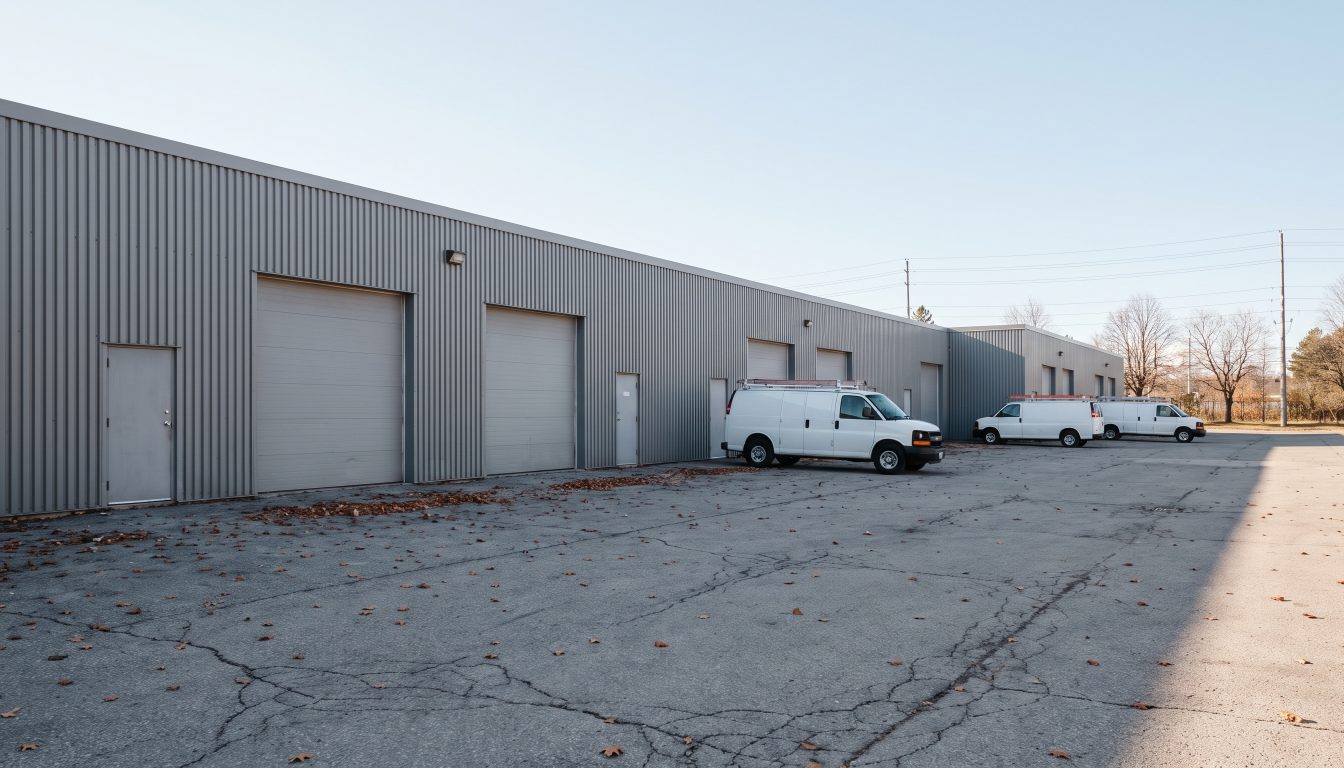
An industrial condo unit is a bay in a multi-tenant industrial building that you own under Ontario’s Condominium Act, 1998, sharing the roof, parking and loading areas with other owners. In Etobicoke, the stock sits mainly in north Etobicoke near Highway 427 and Pearson, such as 397 Humberline Drive, with a smaller pocket in Alderwood. In Mississauga, look at the Northeast (5266 General Road), Southdown (770 Southdown Road), Dixie and Mavis-Erindale employment areas. Buy for door type, clear height and zoning first, then confirm financing, 13% HST treatment and the status certificate.
Want a list of industrial condo units that match your door, height and zoning needs? Tell me what you need and I will send current options.
What is an industrial condo unit?
An industrial condo is a unit in a multi-tenant industrial building that you own outright, the same way you would own a residential condo suite. The building is registered as a condominium under Ontario’s Condominium Act, 1998. You get title to your unit, a share of the common elements (the roof, structure, parking lot, driveways and shared loading areas), and a vote in the condominium corporation that runs the building.
In practice, it is the middle step between leasing a bay and buying a freestanding building. You stop paying rent, you build equity, and you control your space, but you share the building, the board and the costs with your neighbours.
- You own: the unit itself, usually the warehouse floor plus any front office and mezzanine inside your walls.
- You share: the roof, parking, yard, driveways and anything else the declaration calls a common element.
- You pay: your mortgage (if any), your property tax, your utilities and a monthly common expense contribution, which most people call condo fees.
- You follow: the declaration, by-laws and rules, which can limit uses, outdoor storage, signage, hours and truck parking.
How big are industrial condo units, and what clear height do they have?
Most of the small-bay units buyers ask me about sit somewhere between about 1,000 and 5,000 sq ft, and many complexes let you buy two neighbouring units and combine them. Newer buildings are going much bigger. Here is what the real listings I reviewed in October 2026 actually show:
| Building | Unit sizes shown | Clear height | Loading | Source |
|---|---|---|---|---|
| 397 Humberline Drive, Etobicoke | 2,425 to 4,850 sq ft for sale (complex range 2,425 to 15,500 sq ft) | 18 ft | 1 truck-level door per 2,425 sq ft unit; 2 drive-in doors in the complex | Sales brochure |
| 5266 General Road, Mississauga | 2,016 sq ft (flex) and 6,078 sq ft (industrial) | Not stated | Dock-level loading | Public listing |
| 770 Southdown Road, Mississauga (new build) | About 16,970 to 22,884 sq ft | 32 ft | Dock and grade loading | Public listing |
Clear height is the usable height from the floor to the lowest thing hanging from the roof, such as joists, sprinkler heads or ductwork. It decides how high you can rack. An 18 ft unit suits a trade, a small manufacturer or an e-commerce seller with pallet racking a few levels high. A 32 ft building is built for serious racking and distribution.
Always measure clear height yourself or get it in writing. A listing number is often the best-case figure in the tallest part of the bay.
Truck-level or drive-in door: which do you need?
This is the question I ask every industrial condo buyer first, because the wrong door makes a good unit useless.
| Door type | Also called | How it works | Best for |
|---|---|---|---|
| Truck-level door | Dock-level, dock door | The floor of the unit sits at the height of a transport trailer bed, so a forklift or pallet jack rolls straight onto the truck | Regular 53 ft trailer or straight-truck deliveries, wholesale and distribution, palletized goods |
| Drive-in door | Grade-level, grade door | The door is at ground level, so a van, pickup or car drives right inside | Contractors, trades, auto-adjacent uses, small vehicles, equipment storage |
Many complexes have one type per unit and a shared door of the other type. At 397 Humberline Drive, for example, each smaller unit has its own truck-level door, and the brochure lists two drive-in doors across the whole complex. If a shared door is a common element, read the rules on who can use it and when.
What zoning do industrial condos have in Etobicoke?
Etobicoke is part of the City of Toronto, so the rules sit in Toronto Zoning By-law 569-2013, Chapter 60 (Employment Industrial zones). There are four zones: EL (Employment Light Industrial), E (Employment Industrial), EH (Employment Heavy Industrial) and EO (Employment Industrial Office).
- EL zone (section 60.10): permits uses including office, warehouse, self-storage warehouse, laboratory, service shop, custom workshop, wholesaling, production studio, carpenter’s shop and industrial sales and service. Some manufacturing uses are allowed with an interior floor area cap of 5,000 square metres.
- E zone (section 60.20): permits warehouse, wholesaling, contractor’s establishment, cold storage, office park, laboratory and most manufacturing uses, with 16 listed exclusions such as asphalt plants and explosives factories.
- EH zone (section 60.30): the heavy zone, which adds uses such as vehicle depot and waste transfer station.
Retail is tightly limited. In EL and E zones, a retail store must be tied to a permitted manufacturing use on the same lot and is capped at 20% of that use’s floor area, and eating establishments on a lot are capped at 500 square metres combined. So if your plan is a showroom, gym, church or event space, check the zone line by line before you fall in love with the unit. Some buildings also carry a site-specific exception, and the condo declaration can be stricter than the by-law.
What zoning do industrial condos have in Mississauga?
Mississauga uses Zoning By-law 0225-2007, Part 8 (Employment Zones). There are three base zones: E1 (Employment in Nodes), E2 (Employment) and E3 (Industrial). Here is a simplified read of Table 8.2.1 for the uses industrial condo buyers ask about most:
| Use (By-law 0225-2007 term) | E1 | E2 | E3 |
|---|---|---|---|
| Office and medical office | Yes | Yes | Yes |
| Manufacturing facility | Yes | Yes | Yes |
| Warehouse/distribution facility | Yes | Yes | Yes |
| Wholesaling facility | No | Yes | Yes |
| Contractor service shop | No | Yes | Yes |
| Self storage facility | No | Yes | Yes |
| Motor vehicle repair facility – restricted | No | Yes | Yes |
| Motor vehicle body repair facility | No | No | Yes |
| Outdoor storage/outdoor display, contractor’s yard | No | No | Yes |
Two general rules matter for condo owners. First, unless otherwise permitted, all uses in E1 and E2 zones must be wholly inside a building (section 8.1.1). Second, up to 20% of the floor area of a business activity use can be accessory retail, but only for products made, repaired, wholesaled or distributed there, and only inside the same unit (section 8.1.3.1). Footnotes and exception zones change some of these answers, so use the table as a starting point, not a final ruling.
Where are the industrial condo units in Etobicoke?
Etobicoke’s industrial condo stock is concentrated in the north, close to Pearson, Highway 427 and Highway 401, with a smaller industrial pocket in the south near the rail lines. These are the areas and buildings I could verify:
| Area | Example address | Why it matters | Best for |
|---|---|---|---|
| West Humber-Clairville (north Etobicoke) | 397 Humberline Drive, marketed as the Humberline Industrial Condos (as at 2026) | 15-unit complex, 18 ft clear, truck-level doors, units can be combined, roof replaced 2022/2024 per the brochure | Trades, light manufacturing, wholesale with regular trailer deliveries |
| West Humber-Clairville and Rexdale industrial lands | Area around Highway 427, Steeles Avenue and Albion Road | Rail, highway and Pearson access are why this became prime industrial land; much of it is warehousing and trucking | Logistics-adjacent businesses, buyers who want quick 427/401/407 access |
| Alderwood (south Etobicoke) | Industrial lands in the southeast quadrant, including Evans Avenue | A smaller, older industrial pocket close to the Gardiner and Etobicoke Creek | Businesses serving south Etobicoke, Mimico and the Queensway corridor |
One caution on 397 Humberline Drive: a public listing shows its zoning as “E1”, which is a Mississauga label, not a Toronto 569-2013 zone. That kind of mismatch is common on listing sites. Pull the zoning yourself from the City’s interactive zoning map before you rely on it.
Etobicoke has other employment pockets, but I only list what I could confirm has condo stock. Small-bay buildings come up for sale quietly and often trade between owners in the same complex, so if your target is a specific street, it is worth asking.
Where are the industrial condo units in Mississauga?
Mississauga’s Official Plan, Chapter 16 divides the city into 13 Employment Area Character Areas. Knowing which one a unit sits in tells you a lot about what the area is meant to become.
| Employment Area | Verified example | What the Official Plan says | Best for |
|---|---|---|---|
| Northeast | 5266 General Road, near Dixie Road and Matheson Boulevard East: a multi-tenant industrial condominium complex, zoned E2 | Business Employment and Motor Vehicle Commercial uses are permitted on Mixed Employment lands here | Owner-users who want Pearson, 401 and 410 access |
| Southdown | 770 Southdown Road: a new industrial condo building, zoned E2, 32 ft clear, occupancy anticipated Q4 2026 | A long-standing industrial area the Plan intends to keep as a place of employment | Larger owner-users; near Clarkson GO and the QEW/403 |
| Dixie | Area-level only | A major employment cluster with rail access; part of it is in a flood plain special policy area | Manufacturing and distribution; check flood rules |
| Mavis-Erindale | Area-level only | A major employment cluster with rail access, protected from non-compatible uses | Industrial owner-users in central Mississauga |
| Western Business Park | Area-level only | One of the areas where Business Employment uses are permitted on Mixed Employment lands | West-end businesses near the 403/407 |
| Airport Corporate Centre, Gateway, Meadowvale Corporate Centre, Sheridan Park | Area-level only | Corporate Centres with higher-density, office-heavy employment; new Industrial designations are not permitted there | Office-warehouse and flex buyers rather than heavy industrial |
Buyers often call it “Meadowvale Business Park”. The Official Plan name is the Meadowvale Corporate Centre Employment Area. The point for you: in the four Corporate Centres, the Plan does not allow new Industrial designations beyond what was already designated, so the stock leans towards office and flex. If you need heavier uses, the Northeast, Dixie, Mavis-Erindale, Southdown and Western Business Park areas are the more natural fit.
How do you finance an industrial condo?
You will usually need a commercial mortgage, not a residential one. Commercial lenders look at the property, your business financials and how the unit will be used. Terms vary widely by lender and borrower, so I only quote what a lender publishes.
BDC, for example, says on its commercial real estate loan page that it can offer financing of up to 100% of the project cost, an amortization of up to 25 years and interest-only payments for the first 36 months. The same page also says certain purchases, such as real estate, may require a down payment, and projects zoned for residential use are not covered. Treat that as a ceiling one lender advertises, not what you will be approved for.
Before you make an offer, get your lender to confirm three things in writing: the loan-to-value they will lend at on this specific unit, whether they need an appraisal and an environmental report (for industrial, many do), and how long their approval takes. That third answer sets how long your financing condition needs to be.
Do you pay HST on an industrial condo?
Usually, yes. The CRA lists sales of commercial real property as taxable supplies in its guide for GST/HST registrants, and the HST rate in Ontario is 13%. On a commercial purchase, that is a big number.
The CRA also says that in certain cases the vendor does not collect the tax and the purchaser may have to pay it directly to the CRA. Purchasers report that tax using Form GST60 when they buy taxable real property. If your business is registered for GST/HST and uses the unit in its commercial activities, your accountant may be able to claim it back as an input tax credit. Get that advice before you waive conditions, and make sure the HST clause in the agreement says clearly whether the price is plus HST.
What should you check about condo fees and the condo corporation?
Condo fees in an industrial building pay for the shared items: roof, paving, snow, landscaping, building insurance, management and the reserve fund. I do not quote typical fees, because they swing with the age of the building, what is a common element, and how well the reserve fund has been managed. A brochure that leaves fees blank is normal; you get the real number from the status certificate.
The Condominium Authority of Ontario explains that a status certificate is set out in section 76 of the Condominium Act, 1998, must be provided within 10 days, and is capped at $100 including taxes. It includes the declaration, by-laws and rules, the budget, the last audited financial statements, the latest reserve fund study, the unit’s common expenses and any arrears, special assessments, insurance certificates and any legal action.
For an industrial unit, I read the declaration and rules for these before anything else:
- Permitted and prohibited uses, which can be narrower than zoning.
- Outdoor storage, truck and trailer parking, and overnight parking.
- Hours of operation, noise and odour rules.
- Who maintains the overhead door, the rooftop HVAC unit and the electrical service to your unit.
- Signage rights on the building and the pylon.
- Whether the reserve fund study flags a roof, paving or structural project coming up.
The roof is the big one. At 397 Humberline Drive, the brochure notes the roof was replaced in 2022/2024, which is exactly the kind of detail that should show up, and be confirmed, in the reserve fund study.
Watch out
Do not assume a business is allowed in a unit because the unit next door has it. The neighbour may be a legal non-conforming use, may have a minor variance, or may simply be in breach. Your three checks are the zoning by-law, any site-specific exception, and the condo declaration and rules. Also confirm the electrical service (amps and voltage) and the floor load before you buy for manufacturing; those are expensive or impossible to change in a shared building.
How do you buy an industrial condo, step by step?
- Write your use down in by-law words. “Cabinet shop with spray booth” and “warehouse for online orders” are treated very differently.
- Pick door type, clear height and power first, then size. Those three are hard to change; floor area is not, if you can combine units.
- Talk to a commercial lender early so you know your real budget and how long approval takes.
- Shortlist by employment area, using the tables above, and confirm each unit’s zone on the City map.
- Make an offer with conditions: financing, status certificate review, lawyer and accountant review (HST), inspection, and environmental if your lender wants it.
- Review the status certificate and reserve fund study with your lawyer before conditions come off.
- Close, then check permits for any fit-out. A change of use inside the unit may need a building permit.
I help owner-users and investors buy, sell and lease industrial condos across Etobicoke, Mississauga and the rest of the GTA, and I am happy to pull current units that match your door, height and zoning needs.
My take
For a business paying rent on 2,000 to 5,000 sq ft, an industrial condo is often the cleanest path to owning your space. The buyers who do well pick the unit for the door, the clear height and the zoning, then the price. North Etobicoke and Mississauga’s Northeast give you the best highway and airport access, while new buildings like 770 Southdown Road show where larger, taller stock is heading. Read the declaration as closely as the zoning, and get your HST advice in writing before you firm up.
For the bigger picture, see my guides to warehouse and industrial space in Ontario and buying a warehouse in Ontario. If you are comparing a unit’s price to its income as an investment, my explainer on how commercial property is valued (cap rate, NOI and DSCR) will help, and this one covers what a status certificate tells you.
Send me industrial condo units for sale or lease
Tell me your use, size and area and I will shortlist units and check the zoning, doors and clear height.
I will come back to you personally, usually the same day. If it is urgent, call 833-330-1925.
Frequently asked questions
What is an industrial condo?
It is a unit in a multi-tenant industrial building registered as a condominium under Ontario’s Condominium Act, 1998. You own the unit and share the common elements, such as the roof, parking and driveways, with the other owners through a condominium corporation.
How big are industrial condo units in the GTA?
Small-bay units commonly run from about 1,000 to 5,000 sq ft, and many complexes let you combine units. For example, 397 Humberline Drive in Etobicoke markets units from 2,425 sq ft, while the new 770 Southdown Road building in Mississauga lists units of about 17,000 to 23,000 sq ft.
What is the difference between a truck-level and a drive-in door?
A truck-level (dock) door sits at trailer-bed height so forklifts can load a transport truck directly. A drive-in (grade-level) door is at ground level so a van or pickup can drive inside. Choose based on how your deliveries actually arrive.
What zoning do I need for an industrial condo in Etobicoke?
Etobicoke uses Toronto Zoning By-law 569-2013, where industrial units are usually in the EL, E or EH Employment Industrial zones. Each zone has its own permitted use list in Chapter 60, and retail and restaurant uses are capped, so check the exact zone and any site-specific exception.
What do E1, E2 and E3 mean in Mississauga?
They are the employment zones in Mississauga Zoning By-law 0225-2007: E1 is Employment in Nodes, E2 is Employment and E3 is Industrial. E2 and E3 allow more industrial uses, such as wholesaling and contractor service shops, and E3 adds outdoor storage and contractor’s yards.
Do I pay HST when I buy an industrial condo?
Generally yes. The CRA treats sales of commercial real property as taxable, and Ontario’s HST rate is 13%. In some cases the purchaser pays the tax directly to the CRA using Form GST60, and a registered business may be able to claim an input tax credit, so get accounting advice before you firm up.
How much down payment do I need for an industrial condo?
It depends on the lender, the property and your business. BDC says its commercial real estate loan can finance up to 100% of the project cost with up to 25 years of amortization, but also that real estate purchases may require a down payment. Ask your lender for a written loan-to-value on the specific unit.
Sources
- City of Toronto — Zoning By-law 569-2013, Chapter 60.10 Employment Light Industrial (EL) Zone — EL permitted uses, retail and manufacturing caps
- City of Toronto — Zoning By-law 569-2013, Chapter 60.20 Employment Industrial (E) Zone — E zone permitted uses and conditional uses
- City of Mississauga — Zoning By-law 0225-2007, Part 8 Employment Zones — E1/E2/E3 permitted uses, sections 8.1.1 and 8.1.3.1
- City of Mississauga — Official Plan Chapter 16, Employment Areas (March 2026) — 13 Employment Area Character Areas and Corporate Centre policies
- Humberline Industrial Condos — 397 Humberline Drive sales brochure — Unit sizes, 18 ft clear height, door counts, roof replacement
- Cityfeet — 5266 General Road, Mississauga listing — Multi-tenant industrial condominium complex, E2 zoning, unit sizes
- Cityfeet — 770 Southdown Road, Mississauga listing — New industrial condo, 32 ft clear, E2, Q4 2026 occupancy
- BDC — Commercial real estate loan — Financing up to 100% of project cost, 25-year amortization, down payment note
- Canada Revenue Agency — General information for GST/HST registrants (RC4022) — Commercial real property sales are taxable; purchaser may remit tax
- Condominium Authority of Ontario — Status certificates — Status certificate contents, 10-day deadline, $100 cap, s.76
Related reading
- Warehouse and industrial space in Ontario
- Buying a warehouse in Ontario
- How commercial property is valued in the GTA
- Change of use permits for commercial space
- HST clauses in an Ontario agreement of purchase and sale
About the author — Jatin Dua, Toronto and GTA real estate broker
I am Jatin Dua, Broker of Record and co-founder of RE/MAX Quantum Realty Inc., Brokerage, Unit 101, 799 The Queensway, Toronto. I work with buyers, sellers, investors and business owners across Toronto and the GTA. Four-plus years of active GTA transactions, over $100 million in sales volume and 100+ families helped sell. Every rule and fact here is linked to a source below, so you can check it without asking me.
Reach me at [email protected] or 833-330-1925, or book a call.