
Published 2 November 2026 · By Jatin Dua, Broker of Record, RE/MAX Quantum Realty
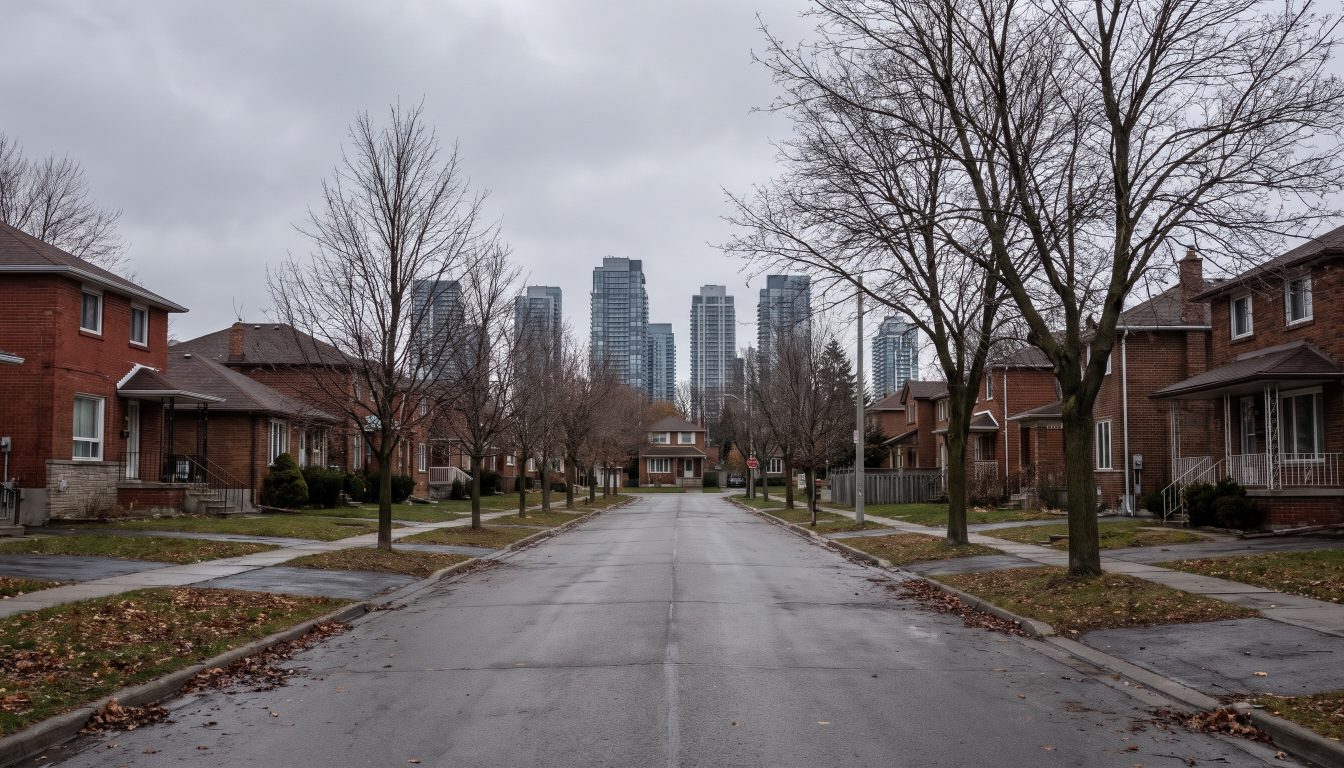
A crash in 2027 is not what forecasters expect. CMHC’s baseline has the Toronto-area average price edging up to about $1,050,000 in 2027, and GTA prices are already about 23% below the February 2022 average of $1,334,544. Condos remain the weak spot, and job losses or more rate hikes are the main risks.
This guide is for GTA homeowners, buyers and condo investors who keep hearing the word “crash” and want a straight answer for 2027. You will get what a crash would actually look like, how today compares with the last real one, what the data and forecasters say, and where the real risks are.
Will the GTA housing market crash in 2027?
None of the forecasts I read for this guide expects a crash in 2027. CMHC and the Bank of Canada both describe a weak or slow housing market, not a collapse. CMHC’s baseline even has the Toronto-area average price edging up in 2027.
The bigger point: GTA prices have already fallen a long way. TRREB’s average price was $1,334,544 in February 2022, at the height of the boom. In October 2026 it was $1,024,108, about 23% lower. Much of the correction people fear may already be behind us. That does not mean prices cannot fall further. It means a further drop would come on top of four years of declines, not from a peak.
What would a housing crash actually look like?
There is no official definition. When I use the word, I mean three things happening together:
- Prices fall fast, roughly 20% or more within a year or two.
- Many owners are forced to sell, through job loss, missed payments or power of sale.
- Listings pile up because there are far more sellers than buyers.
The GTA in 2026 has the first one in slow motion, mainly in condos. It does not yet show the second or third at a large scale. A slow, grinding decline is painful, but it is not the same thing as a crash.
How does today compare with past GTA housing crashes?
TRREB’s yearly averages go back to 1980. Three periods are worth comparing.
| Period | Peak average | Low point | Change | Recovery |
|---|---|---|---|---|
| 1989 to 1996 | $273,698 (1989) | $198,317 (1996) | -27.5% over 7 years | Passed the 1989 level only in 2002 |
| 2017 to 2018 | $823,422 (2017) | $784,118 (2018) | -4.8% in 1 year | Above the 2017 level by 2020 |
| 2022 to 2026 | $1,193,766 (2022) | $1,025,156 (Jan-Oct 2026) | -14.1% so far | Not yet |
Source: TRREB historic annual statistics and TRREB Market Watch, October 2026 (year-to-date average). Yearly average selling prices, all home types, not adjusted for inflation.
The early 1990s is the only true GTA crash in TRREB’s records. Prices kept sliding for seven years, and it took 13 years for the average to beat its 1989 level. Today’s decline is already four years long, and by yearly averages it is about half as deep. Measured from the February 2022 monthly high instead, the drop is about 23%, which is closer to the size of the 1990s fall.
What is the GTA market doing right now?
The October 2026 numbers, released by TRREB on 4 November 2026, show a slow market, not a panic:
| Measure, October 2026 | Number | Change from Oct 2025 |
|---|---|---|
| Home sales | 5,603 | -7.9% |
| New listings | 14,173 | -11.9% |
| Active listings at month end | 25,098 | -10.0% |
| Average selling price | $1,024,108 | -2.7% |
| Composite benchmark price | $916,400 | -4.3% |
| Months of inventory | 4.6 | n/a |
Source: TRREB Market Watch, October 2026. All TRREB areas, all home types.
The key line is listings. In a crash, sellers rush out and listings jump. Here, new and active listings are both lower than a year ago. Owners who do not have to sell are mostly waiting. TRREB also said that, on a seasonally adjusted basis, both sales and prices edged up from September to October.
Could the October 2026 rate hike trigger a crash?
On 28 October 2026, the Bank of Canada raised its policy rate by 0.25 points to 2.50%, its first hike in more than three years, to keep high energy prices from spreading into wider inflation. Prime rose to 4.70%. The Bank said a further increase could be needed. As of 28 October, markets priced about a 43% chance of another hike on 9 December, and some economists expect more than one.
One quarter point is small. A few more would hurt, mostly through renewals. The Bank also said it expects housing to remain relatively weak while the wider economy grows about 2% in 2027.
The bigger danger is jobs. Desjardins economists found that mortgage arrears have moved closely with unemployment for decades. Toronto’s unemployment rate was 6.9% in September 2026. A sharp rise in job losses would worry me far more than one rate hike.
Instant Home Valuation
What’s your home
worth today?
Answer six quick questions and get an instant value range built from current Toronto & GTA sale data — property type, size, condition, lot and location all weighted the way a real pricing conversation weighs them. Takes about ninety seconds.
Reading recent GTA sale data…
Building your estimate
Estimated market value
—
$0–$0
Most likely value $0 · roughly $0 per square foot
What moved the number
Starting from the area baseline for your property type, here’s what each answer added or subtracted.
Market context
Recent local averages for comparison.
—
A range is a starting point.
A strategy is what sells.
This model doesn’t know that your neighbour’s identical semi went $80,000 over asking last month, or which two upgrades actually pay back in your area. That conversation is free and takes twenty minutes.
Are GTA homeowners falling behind on their mortgages?
Some are, but the numbers are still low. A Desjardins report from July 2026 says the share of Canadian mortgages at least 90 days overdue had risen to 0.28%, up from a pandemic low of 0.14%, but still below the long-run average. Ontario moved from the lowest arrears rate in Canada to above the national average.
Two more points from that report matter:
- Most missed payments do not end in a forced sale. Desjardins cites Teranet data showing fewer than 3,000 Ontario properties changed hands under power of sale in 2025.
- The renewal shock for owners of five-year fixed mortgages is expected to taper off through 2027, and many three-year borrowers are likely already renewing at lower payments.
The report was written before the October hike, so treat its outlook with some caution. If you are worried about your own payment, my guide to 2027 mortgage renewal options after the rate hike lays out the choices.
What is the Toronto condo apocalypse?
“Condo apocalypse” is a media and social media phrase, not a technical term. It usually describes the collapse in new pre-construction condo sales. The numbers behind it are real:
- Urbanation counted 1,599 new condo sales in the GTA and Hamilton area in 2025, the lowest since 1991 and 60% below 2024, as reported by CP24.
- Completed but unsold new condos hit a record 3,897 units at the end of 2025.
- Developers cancelled 28 projects with 7,243 units in 2025, more than double 2024’s total.
- In Q3 2026, only 60 pre-construction units sold. Total new condo sales did double to 760, but investment groups bought 45% of them in bulk.
Urbanation’s president called this the condo market’s “largest ever correction.” In the resale market, TRREB’s GTA apartment benchmark was down 7.3% year over year in October 2026, more than any other home type. So yes, condos are in a deep slump, especially for investors who bought pre-construction years ago. But it is a condo story, not a whole-market collapse, and detached prices have fallen far less. For condo owners deciding what to do, see my post on Toronto condo sales at a 35-year low.
There is also a twist. Condo construction starts fell 63% in 2025, and Urbanation expects new completions to dry up by the end of the decade. Today’s glut could turn into a shortage later.
What do forecasters expect for GTA prices in 2027?
CMHC is the only major forecaster I found that publishes Toronto-area numbers with a downside case.
| Toronto area (CMHC) | 2025 actual | 2026 forecast | 2027 forecast | 2028 forecast |
|---|---|---|---|---|
| Average price, baseline | $1,067,846 | $1,020,000 | $1,050,000 | $1,100,000 |
| Average price, downside case | $1,067,846 | $1,015,000 | $1,030,000 | $1,060,000 |
| MLS sales, baseline | 62,322 | 63,500 | 71,500 | 77,000 |
Source: CMHC, Summer Update: 2026 Housing Market Outlook (information as of 23 June 2026). Forecasts, not guarantees; made before the October 2026 rate hike.
Even CMHC’s downside case, built on high inflation from the war and trade tensions, has prices rising slightly in 2027. That case looks closer to today’s reality than it did in June, which is why I would treat the baseline as optimistic. More detail is in my GTA housing market forecast for 2027.
What should buyers, sellers and owners do if a crash is possible?
- Buyers: buy only what you can carry at a rate one or two points higher than today, and plan to hold for at least five years. If you do that, a further dip hurts on paper, not in your bank account.
- Sellers: if you need to sell in 2027, price off recent sales, not hopes of a spring rebound. Waiting has cost most GTA sellers money since 2022.
- Owners renewing: start talking to your lender or a broker four to six months before your renewal date.
- Condo investors: check your rent against your full carrying cost at today’s rates. If it does not cover the gap, decide early whether to hold, sell or refinance.
My view, and it is only a view: a crash in 2027 is unlikely, but a flat-to-soft year is likely, with condos weaker than houses. The GTA’s biggest risk is not one more rate hike; it is a jump in job losses. If unemployment climbs sharply and rates keep rising together, I would change my view. Until then, I would treat 2027 as a buyer’s window for houses and a patience test for condo owners.
If you bought a pre-construction condo years ago and it closes in 2027, the lender’s appraisal may come in below your purchase price. You would have to cover that gap in cash. CP24 reported in October 2026 that some buyers who cannot close are defaulting on their deals. Get a realistic value and talk to your lender and lawyer well before your closing date.
What to do next
- Check your own numbers: payment at renewal, job security and how long you plan to stay.
- Look up what similar homes near you sold for in the last 90 days.
- Watch the Bank of Canada decision on 9 December 2026 and TRREB’s monthly reports.
- If you are behind on payments, act early; my guide on what happens if you can’t pay your mortgage in Ontario explains the timeline.
- Use the estimator on this page to see what your home is worth today.
Need help with this? Talk to me.
I’m Jatin Dua, Broker of Record at RE/MAX Quantum Realty, and I’m the best agent to do this kind of work for you in Toronto and across the GTA. Over $100 million in GTA sales and 100+ families helped sell. Feel free to contact me any time: call or text 833-330-1925 or email [email protected].
Frequently asked questions
Will Toronto house prices crash in 2027?
No major forecaster expects a crash in 2027. CMHC’s July 2026 baseline sees the Toronto-area average price rising from about $1,020,000 in 2026 to $1,050,000 in 2027, and even its downside case shows a small rise. GTA prices are already about 23% below February 2022, when TRREB’s average hit $1,334,544. Further declines are possible, especially for condos.
How much have GTA house prices dropped since the peak?
TRREB’s GTA average selling price fell from $1,334,544 in February 2022 to $1,024,108 in October 2026, a drop of about 23%. Using yearly averages, prices are down about 14%, from $1,193,766 in 2022 to $1,025,156 for January to October 2026. The October 2026 composite benchmark was down 4.3% year over year.
What does Toronto condo apocalypse mean?
It is a popular phrase for the collapse in new condo sales in the Toronto area. Urbanation counted only 1,599 new condo sales in the GTA and Hamilton area in 2025, the lowest since 1991, a record 3,897 completed unsold units and 7,243 cancelled units. Resale condo prices also fell, with TRREB’s GTA apartment benchmark down 7.3% in October 2026.
Is the GTA housing market going to crash because of the rate hike?
Unlikely on its own. The Bank of Canada’s 28 October 2026 hike raised its policy rate by just 0.25 points to 2.50%, and prime to 4.70%. The Bank said more hikes could be needed, which would add pressure at renewal. Job losses matter more: Desjardins found mortgage arrears have tracked unemployment closely for decades.
When was the last housing crash in Toronto?
The last true crash was from 1989 to 1996. TRREB’s average GTA price fell from $273,698 in 1989 to $198,317 in 1996, about 27.5%, and did not pass the 1989 level until 2002. There was a shorter drop of about 4.8% from 2017 to 2018, and the current decline began after 2022.
Are more people losing their homes to power of sale in Ontario?
Arrears are rising but forced sales are still limited. Desjardins reported in July 2026 that Canada’s 90-day mortgage arrears rate rose to 0.28%, up from a pandemic low of 0.14% but below the long-term average, and that Ontario is now above the national rate. It cited Teranet data showing fewer than 3,000 Ontario power of sale transfers in 2025.
Should I wait for a crash to buy a house in the GTA?
Waiting for a crash is a gamble. GTA prices are already about 23% below the February 2022 average, and TRREB’s October 2026 data shows listings falling, not piling up. If you find the right home at a price you can carry at higher rates and plan to stay five years or more, waiting may not save you money.
Will condo prices crash in Toronto in 2027?
Condos are the weakest part of the market, but a sudden crash is not the forecast. TRREB’s City of Toronto apartment benchmark was $540,100 in October 2026, down 7.0% from a year earlier. Completed but unsold new condos hit a record at the end of 2025, so further softness in 2027 is possible. Construction starts have collapsed, which could tighten supply later.
Is it a buyer’s market in the GTA right now?
Buyers have more power than at any point since 2021. In October 2026, TRREB reported 4.6 months of inventory across the GTA, sales down 7.9% from a year earlier and prices down 2.7%. TRREB said buyers had substantial negotiating power over the past year. Some areas, such as Toronto’s east end, still see homes sell above asking.
Sources
- TRREB Market Watch, October 2026
- TRREB historic annual statistics
- TRREB Market Watch, February 2022
- Bank of Canada: policy rate raised to 2.5%, 28 October 2026
- CMHC: Summer Update, 2026 Housing Market Outlook
- Desjardins Economic Studies: The Outlook for Mortgage Arrears in a Higher-Rate World (9 July 2026)
- CP24: New condo sales in the GTHA plummet to the lowest seen since 1991 (21 Jan 2026)
- CP24: Bulk purchases now account for nearly half of new condo sales (21 Oct 2026)
Related reading
- GTA Housing Market Forecast 2027: City-by-City Numbers
- Mississauga Housing Market 2027: Prices, Sales and What to Expect
- Brampton Housing Market 2027: Prices, Sales and What to Expect
- Markham and Richmond Hill Housing Market 2027
About the author — Jatin Dua, Toronto and GTA real estate broker
I am Jatin Dua, Broker of Record and co-founder of RE/MAX Quantum Realty Inc., Brokerage, Unit 101, 799 The Queensway, Toronto. I work with buyers and sellers across Toronto and the GTA and have helped more than 100 families sell. Four-plus years of active GTA transactions and over $100 million in sales volume.
Reach me at [email protected] or 833-330-1925, or book a call.