
Published 7 September 2026 · Updated 29 September 2026 · By Jatin Dua, Broker of Record, RE/MAX Quantum Realty
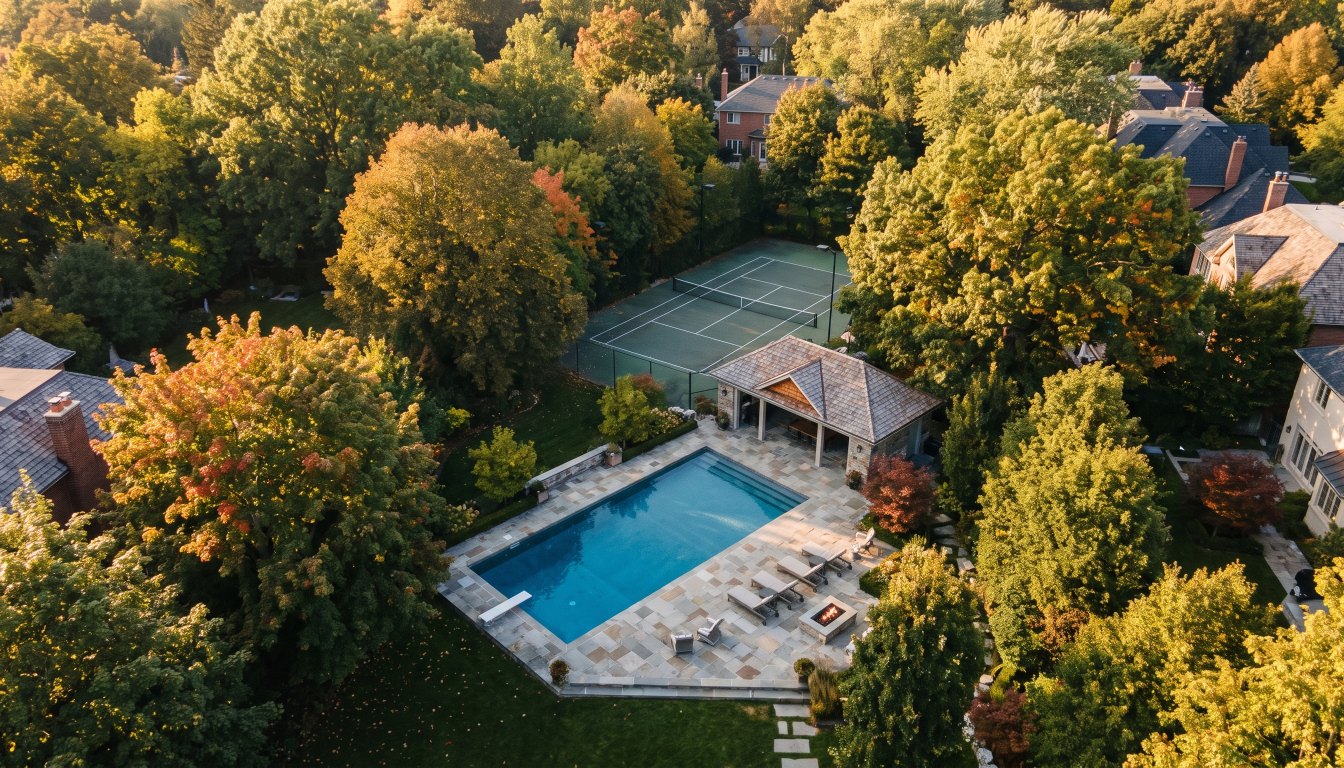
A pool adds value when the lot is large enough that the pool does not consume the garden, and subtracts value when it does. On a 200-foot lot with table land to spare, a well-built pool is an amenity. On a 100-foot lot where it fills the rear yard, it removes options from a buyer with young children and becomes a negotiating point rather than a feature.
The bigger issue at the top of the Toronto market is whether you can build one at all. Any privately owned tree of 30 centimetres trunk diameter or more requires a permit under Chapter 813, with fines up to $100,000 per tree. Inside a mapped ravine protected area, excavation, fill and grade alteration all require a Chapter 658 permit, and where TRCA jurisdiction applies under O. Reg. 41/24, clearance is required before a building permit issues.
The question is not the pool. It is the lot.
Every honest answer about outdoor amenities in Toronto starts with what is left over. A pool occupies a fixed footprint plus a surround plus equipment. On a large lot, that footprint is a fraction of the garden. On a modest one, it is the garden.
| Situation | Typical effect on the buyer pool |
|---|---|
| Large lot, generous table land, pool plus lawn remaining | Widens it. The pool is a bonus, not a constraint |
| Modest lot, pool consumes the rear yard | Narrows it. Buyers with young children price the removal |
| Ravine lot, pool sited on limited table land | Depends entirely on whether the garden still functions |
| Older pool with dated finishes and aging equipment | Reads as a liability regardless of lot size |
| Indoor pool | Narrows the market sharply in almost all cases |
Note what is missing from that table: a percentage. There is no reliable published figure for what a pool is worth in Toronto, and any agent quoting you one to two decimal places is guessing with confidence.
Before value, permission
At the top of the Toronto market, the more common problem is not whether a pool adds value but whether you are permitted to build one.
Trees
A pool needs excavation access and a clear footprint. On a mature lot in Lawrence Park, the Kingsway, Rosedale or Humber Valley Village, that frequently means removing trees. Chapter 813 requires a permit for any privately owned tree with a trunk diameter of 30 centimetres or more. Fines run from $500 to $100,000 per tree, with a possible additional special fine of up to $100,000 under the City of Toronto Act. Replacement trees must be planted and maintained in good condition for two years; where replanting on site is not feasible, cash in lieu is calculated at 120% of replanting plus two years of maintenance.
Ravine and conservation
Inside a mapped ravine protected area, Chapter 658 requires a permit to place or dump fill, alter the grade of land, or injure, destroy or remove a tree. All three are inherent to pool construction. And where the property falls inside a TRCA regulated area under O. Reg. 41/24, TRCA clearance is required before the City will issue a building permit.
What each amenity actually does to your market
Swimming pool
The clearest case for a pool is a lot large enough that the garden survives it, plus a build recent enough that a buyer is not immediately budgeting a liner, a heater and a new surround. The clearest case against is a small lot, an old pool, or both.
Tennis or sport court
A large single-purpose surface. Buyers who play value it highly; buyers who do not price it as demolition, drainage and landscaping. It works on genuinely large parcels — the two-acre minimum lots of Bridle Path–Sunnybrook–York Mills are the obvious example — and rarely elsewhere.
Coach house, guest house or pool house
Often the best value of the three, because it is flexible. Extended family, live-in help, a separated home office, and a place for guests are all uses a wide range of buyers can imagine. Two conditions: it must be properly permitted, and it must have plumbing. A shed with a sofa is a shed.
Outdoor kitchen, fire feature, cabana
Presentation value more than price value. They photograph well and help a house feel resolved, which matters in a market where the buyer pool is small and first impressions carry weight. Do not expect a line-item return.
The practical takeaway
If you are buying: check permits and count trees before you plan anything, and judge the pool by what garden is left rather than by the pool itself. If you are selling: a well-maintained pool on a big lot is an asset you should present properly, and a tired pool on a small lot is something to address with a price adjustment rather than a hopeful listing photo.
Frequently asked questions
Does a swimming pool add value to a Toronto home?
It depends on lot size more than anything else. On a large lot where garden remains after the pool, it generally adds value. On a modest lot where the pool consumes the usable outdoor space, it typically narrows the buyer pool and becomes a discount rather than a premium. There is no reliable published figure for pool value in Toronto and anyone quoting a percentage is estimating.
Can I build a pool on a ravine lot?
Sometimes, and it is heavily regulated. Inside a mapped ravine protected area, Chapter 658 requires a permit to place or dump fill, alter the grade of land, or injure or remove a tree. Where the property also falls in a TRCA regulated area under O. Reg. 41/24, TRCA clearance is required before a City building permit will issue. Confirm both before you commit to a pool.
How many trees will a pool cost me?
That is exactly the right question. Every privately owned tree with a trunk diameter of 30 cm or more needs a permit to injure, destroy or remove, and fines run from $500 to $100,000 per tree, plus a possible special fine of up to $100,000 under the City of Toronto Act. Replacement trees must be maintained for two years, or cash in lieu is charged at 120% of replanting plus two years of maintenance.
Do tennis courts add value?
Only on very large lots, and even then to a narrow group of buyers. A court is a large, single-purpose surface that a buyer who does not play will price as a demolition and landscaping cost. On a two-acre Bridle Path parcel it makes sense. On anything smaller it usually does not.
What about a coach house or guest house?
A properly permitted secondary structure with its own bathroom is genuinely useful to a wide range of buyers — extended family, staff, a home office away from the house. The word that matters is permitted. An unpermitted structure is a liability that transfers to you on closing.
Does an indoor pool help or hurt?
It narrows the market considerably. Indoor pools bring humidity management, mechanical complexity, high running cost and a large volume of space that cannot be repurposed. Buyers who want one really want one; everyone else prices the conversion.
Thinking about buying or selling at the top end?
Send me the address, or the shortlist you are considering. I will tell you what the property is actually worth today, what the land is worth without the house, what the transfer tax and carrying costs will be, and whether the deal makes sense. Confidential, always.
[email protected] · 833-330-1925 · Book a free consultation
Confidential. Read personally and answered within 24 hours. I never share, sell or distribute your information.
Related reading
- 7 things luxury buyers in Toronto pay extra for (and 5 they do not)
- The Toronto tree bylaw can cost you $100,000. Here is how it works
- Buying a ravine lot in Toronto: what the bylaw does to your plans
- Luxury renovation ROI in Toronto: where the money comes back
Sources
Everything above that is a rule, a rate or a published number comes from these. Verify anything that matters to your own deal.
- City of Toronto — Municipal Code Chapter 813, Trees
- City of Toronto — Municipal Code Chapter 658, Ravine and Natural Feature Protection
- City of Toronto — When to apply for a tree or ravine permit
About the author — Jatin Dua, Broker of Record
I’m the Broker of Record at RE/MAX Quantum Realty, 799 The Queensway in Etobicoke, and I work with buyers, sellers and investors across Toronto and the west GTA. A large part of my work sits in the upper end of the market, where the comparables are thin, the rules are heavier and the cost of a wrong number is measured in hundreds of thousands of dollars.
The free estimators on this site are mine. I built them because the first question every owner asks is “what is it worth?” and the honest answer starts with a number you can check yourself. [email protected] or 833-330-1925.