

Published 26 September 2026 · By Jatin Dua, Broker of Record, RE/MAX Quantum Realty
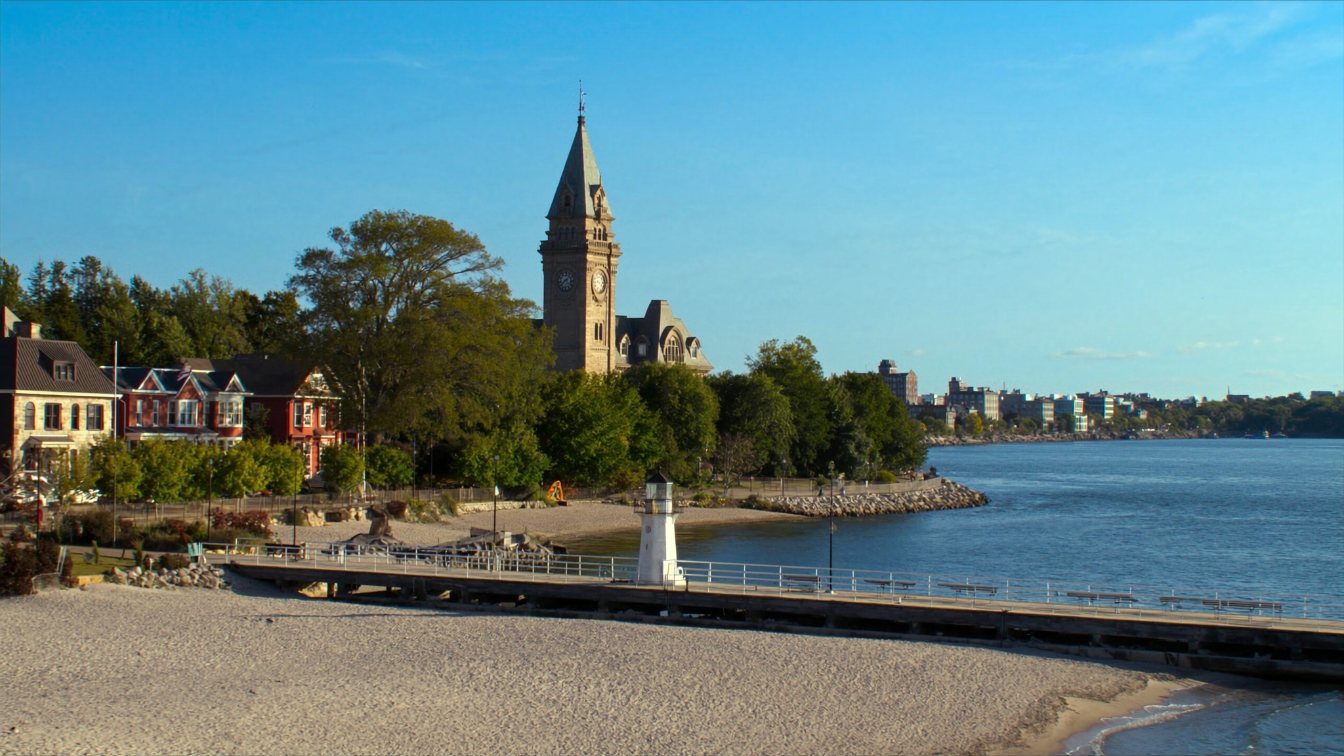
Port Hope and Cobourg are the two Northumberland lake towns east of Clarington, about ten kilometres apart, with some of the best-preserved nineteenth-century main streets in Ontario and a shore the Ganaraska Region Conservation Authority describes as 34 percent armoured and 66 percent natural, eroding at 0.17 to 1.2 metres a year with a 100-year flood level of 76.01 metres. Cobourg has a kilometre of white sand at Victoria Beach, no lifeguards in 2026, a harbour whose East Pier has been closed to vehicles since 2018, and a short-term rental licence in force since February 2026. Port Hope is midway through the Port Hope Area Initiative, a federal cleanup of about 1.2 million cubic metres of low-level radioactive waste from a century of radium and uranium refining, with sixteen of nineteen major sites done and a facility to be sealed in 2032; a buyer can request a Radiological Status Letter for any property. Neither town has GO; both have VIA. The Central Lakes association recorded 118 Northumberland sales in August 2026 at an average of $709,023.
Ten kilometres of shore
The Ganaraska Region Conservation Authority’s Lake Ontario Shoreline Management Plan calls the stretch from Port Hope to Cobourg Reach 7: about 10.2 kilometres, 34 percent armoured and 66 percent natural, with the armouring concentrated in the two towns and largely undeveloped bluff and marsh between them around Carr’s Marsh. It puts erosion at the waterline at 0.17 to 1.2 metres a year, highest at Carr’s Marsh, and notes Port Hope’s East Beach as stable. Its 100-year flood level is 76.01 metres, and the flood hazard limit with wave uprush is 77.77 metres on the west end and 77.86 on the east. Those are the numbers a lakefront buyer here can actually work with, which is more than most shores offer, and the conservation authority administers Ontario Regulation 41/24 with them.
Cobourg: the beach, the pier and the licence
Cobourg’s Victoria Beach is more than a kilometre of white sand beside Victoria Park, with a splash pad and food trucks, monitored from June to August by Lakelands Public Health for E. coli and blue-green algae. The Town says plainly that there were no lifeguards on duty in 2026, with the towers kept for emergencies, and the parks by-law bans alcohol, dogs on the sand, fires and overnight use. The harbour is a working marina, and its 400-metre East Pier was closed to vehicles in 2018 for structural reasons and became project one of the 2018 waterfront plan; I could not verify from the Town whether the rebuild is complete, so ask before you buy on the strength of the harbour.
Cobourg licenses short-term rentals under By-law 006-2025, effective April 2025, with a zoning amendment in December 2025 and applications open since 2 February 2026. The 2026 fees are a $150 operator application, $500 for a Class A licence, $750 or $1,000 for Class B, $1,500 for Class C, $250 renewals and a $150 fire inspection; the class definitions, including which classes are owner-occupied, are in the by-law, and you should read it. Lakefront houses line the shore east of the harbour and west toward Port Hope on the streets south of the town’s main east–west roads; I have no inventory and will not name them.
Port Hope: the cleanup, and the letter to ask for
Port Hope’s downtown on the Ganaraska River is one of the best-preserved nineteenth-century commercial streetscapes in Ontario, with more than 200 designated properties and two heritage conservation districts, Walton Street, designated in October 1997, and John, Ontario and Queen Streets. The river meets the lake at the harbour between East Beach and West Beach. And beneath all of it is the town’s other history: radium refining from the 1930s and uranium from the 1940s left low-level radioactive waste across the urban area, identified in 1975 and addressed by a March 2001 legal agreement that became the Port Hope Area Initiative.
The initiative is moving roughly 1.2 million cubic metres of waste, plus harbour sediment, into an engineered long-term facility south of Highway 401 and west of Baulch Road. About 5,700 urban properties were surveyed and most did not need cleanup; those remediated receive a Compliance Letter. As of 2026, sixteen of nineteen major sites were complete and roughly 400 private properties cleaned up, the remaining three major sites are projected for 2027, and the facility is designed to be sealed in 2032 once active community targets are met. A June 2026 agreement extended post-closure waste acceptance for up to 100 years and confirmed that owners may remediate now or defer, that participation is voluntary, that records are kept of any material left in place, and that buyers and agents can request a Radiological Status Letter summarising a property’s file, which takes up to six business days.
So the buyer’s checklist in Port Hope has one line other towns lack. Ask the seller for the Compliance Letter or request a Radiological Status Letter from the project office; ask whether any material was left in place and where; ask whether the owner deferred remediation, because deferral ends eligibility for funded cleanup later; and note that excavation on affected lots falls under the initiative’s construction monitoring program. Read the due diligence checklist and add this at the top.
Heritage, taxes and services
Port Hope’s designated buildings are protected from demolition and must be maintained in fair condition, with a heritage permit process for changes; Cobourg’s Victoria Hall of 1860 anchors its own historic downtown. Port Hope’s 2026 residential tax rate is 2.065866 percent in the urban area, which pays for municipal special services, and 1.728745 percent in the rural area, each including Northumberland County and education; Cobourg’s 2026 rate had not been published when I checked, and its 2025 rate on a non-official source was about 1.79 percent. Both are well above GTA lower-tier rates on much lower assessed values, and assessments remain on January 2016 values. Urban Port Hope and Cobourg run their own municipal water and wastewater; the rural lakeshore in Hope and Hamilton townships is commonly on wells and septic.
VIA, not GO
Neither town has GO service and none is planned; the Bowmanville GO extension, which broke ground in January 2026, ends in Clarington. Both towns have VIA Rail stations on the Toronto–Ottawa and Toronto–Montreal corridor. Cobourg’s station, rebuilt in 2011, had roughly eight trains a day toward Toronto as of 2023 and no local transit to the station; Port Hope’s station on Hayward Street opens an hour before trains and has an accessible platform without a lift. Check VIA’s current timetable rather than my dated counts. Highway 401 is the road, and Highway 407 East ends at 35/115 in Clarington, so Northumberland is 401-only. If your work is in Toronto five days a week, this shore is a different life, not a longer commute.
History in brief
Port Hope began as a fur post at Smith’s Creek in 1778, was briefly named Toronto from 1817 to 1819, took its present name for Colonel Henry Hope and incorporated in 1834; Trinity College School arrived in 1865 and the town merged with Hope Township in 2001. Cobourg’s harbour company formed on 20 March 1829 and its first wooden East Pier was finished in 1832; the Cobourg–Peterborough Railway of 1854 lost its Rice Lake bridge in 1861; from 1866 an American summer colony built grand hotels and staged regattas; and from 1907 to 1950 car ferries ran from Cobourg to Rochester. The Ganaraska’s June 1890 cloudburst took out every bridge in Port Hope, and the 1943 Ganaraska watershed report led to one of Ontario’s first conservation authorities.
What the boards show
The Central Lakes Association of REALTORS reported 118 sales in Northumberland County in August 2026, unchanged from a year earlier, at an average of $709,023, up year over year, with 288 new listings and 49 days on market, against 568 Durham sales averaging $823,153. It published no Port Hope or Cobourg split. TRREB’s community reports for April to June 2026, based only on its own members’ listings, show Cobourg with 107 sales at an average of $659,740 and a median of $630,000, detached houses averaging about $729,000; Port Hope 55 sales at $694,175 and a $710,000 median, detached about $701,000; and Rural Port Hope 9 sales at $847,478.
Those are town-wide figures for towns where most houses are nowhere near the water. Lakefront houses in Cobourg and Port Hope are a thin market priced against each other over years, and in Port Hope the radiological file is a pricing input alongside the survey and the shoreline. Read how to price a lakefront house.
The takeaway
Port Hope and Cobourg are heritage towns on a shore with published erosion rates and flood levels, a sand beach without lifeguards, a harbour pier under long repair, a new rental licence in Cobourg and a federal radioactive-waste cleanup in Port Hope that gives every buyer a letter to request. VIA runs; GO does not. Prices are Northumberland prices, and taxes are high on low assessments. Ask for the Radiological Status Letter and the GRCA mapping before the beach walk.
Where I fit
I work across Toronto and the GTA and I am candid with clients that Northumberland is a lifestyle move rather than a commute. If you are weighing it against Clarington or the Scarborough shore, book a call, or run the estimator below on the home you own now.
Free tool — AI home value estimator
Instant Home Valuation
What’s your home
worth today?
Answer six quick questions and get an instant value range built from current Toronto & GTA sale data — property type, size, condition, lot and location all weighted the way a real pricing conversation weighs them. Takes about ninety seconds.
Reading recent GTA sale data…
Building your estimate
Estimated market value
—
$0–$0
Most likely value $0 · roughly $0 per square foot
What moved the number
Starting from the area baseline for your property type, here’s what each answer added or subtracted.
Market context
Recent local averages for comparison.
—
A range is a starting point.
A strategy is what sells.
This model doesn’t know that your neighbour’s identical semi went $80,000 over asking last month, or which two upgrades actually pay back in your area. That conversation is free and takes twenty minutes.
Frequently asked questions
Is Port Hope safe to buy in given the radioactive waste?
The Port Hope Area Initiative has surveyed about 5,700 urban properties, most of which needed no cleanup, and remediated about 400 private properties, with sixteen of nineteen major sites complete in 2026. Request a Radiological Status Letter for any property before you buy and ask whether material was left in place or remediation deferred.
Does Cobourg’s beach have lifeguards?
Not in 2026. The Town states there were no lifeguards on duty at Victoria Beach that summer, with the towers kept for emergencies. Water quality is monitored by Lakelands Public Health from June to August.
Is there a GO train to Cobourg or Port Hope?
No. Both towns have VIA Rail stations on the Toronto–Ottawa and Montreal corridor. The GO network ends at Bowmanville once the extension under construction since January 2026 opens.
How fast is the shoreline eroding between Port Hope and Cobourg?
The Ganaraska Region Conservation Authority’s Reach 7 plan puts erosion at 0.17 to 1.2 metres a year at the waterline, highest at Carr’s Marsh, with Port Hope’s East Beach noted as stable. The 100-year flood level is 76.01 metres.
Does Cobourg license short-term rentals?
Yes. By-law 006-2025 took effect in April 2025 and applications opened on 2 February 2026, with 2026 licence fees from $500 for Class A to $1,500 for Class C plus a $150 operator application and $150 fire inspection.
What is the property tax rate in Port Hope?
For 2026, 2.065866 percent for urban residential properties and 1.728745 percent for rural, each including Northumberland County and education. Cobourg’s 2026 rate had not been published when this was written.
What are house prices in Cobourg and Port Hope?
The Central Lakes association reported a Northumberland average of $709,023 in August 2026. TRREB’s April to June 2026 reports show Cobourg averaging $659,740 and Port Hope $694,175, town-wide figures that are not waterfront-specific.
Sources
- Ganaraska Region Conservation Authority — Lake Ontario Shoreline Management Plan, Reach 7 — erosion rates, flood levels
- Town of Cobourg — Beach — no lifeguards 2026, monitoring
- Engage Cobourg — Waterfront plan: East Pier — 2018 closure
- Town of Cobourg, 2 Feb 2026 — Licensing for short-term rental accommodations — By-law 006-2025, fees
- Port Hope Area Initiative — About the Port Hope Project — scope
- Port Hope Area Initiative — How did we get here — 2026 status, 2032 target
- Port Hope Area Initiative — Radiological Status Letter — buyer request process
- Brighton Today, 19 June 2026 — CNL clarifies details of Port Hope waste agreement — voluntary participation, deferral
- Municipality of Port Hope — Heritage designations — 200+ properties, two HCDs
- Municipality of Port Hope — Tax rates — 2026 urban and rural rates
- Cobourg and District Historical Society — Waterfront history, part 1 — harbour and ferry history
- Brighton Today, 3 Sept 2026 — CLAR reports August slowdown — Northumberland figures
- TRREB — Community Housing Market Reports, Cobourg and Port Hope, Q2 2026 — town averages
Related reading
- Waterfront homes in the GTA: the complete guide
- Oshawa and Clarington lakefront homes
- Heritage designation under the Ontario Heritage Act
- Waterfront house due diligence checklist
- Buying a cottage or second home in Ontario
- What $600,000 buys on the GTA waterfront
About the author — Jatin Dua, Toronto and GTA real estate broker
I am Jatin Dua, Broker of Record and co-founder of RE/MAX Quantum Realty Inc., Brokerage, Unit 101, 799 The Queensway, Etobicoke. I work with buyers and sellers across Toronto and the GTA, with deep local knowledge of the west end and the Lake Ontario shoreline. Four-plus years of active GTA transactions and over $100 million in sales volume. Every market figure here comes from TRREB’s published tables and every rule from the regulator or the legislation, so you can check all of it without asking me.
Reach me at connect@jatindua.com or 833-330-1925, or book a call.