
Published 7 September 2026 · Updated 29 September 2026 · By Jatin Dua, Broker of Record, RE/MAX Quantum Realty
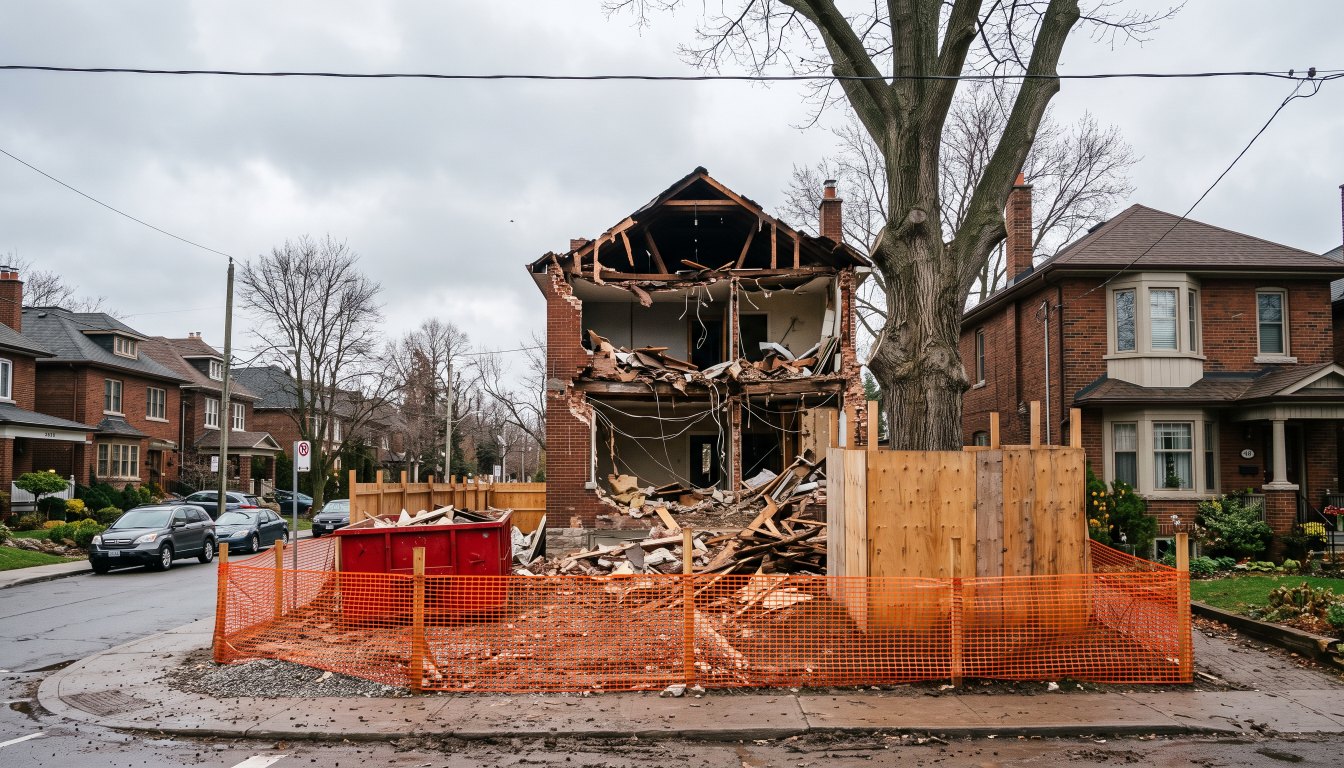
Start with one question: what would this lot sell for with nothing on it? If the answer is close to the asking price, you are buying land and the building is a rounding error — renovate only if you love it, because the market has already written the house off. If the land is worth substantially less than the asking price, the house is carrying real value and demolishing it destroys money.
Then check what you are actually allowed to do. Four constraints decide most Toronto rebuild questions before economics ever get a vote: the zoning envelope under By-law 569-2013, ravine and TRCA regulation, heritage designation, and trees of 30 centimetres trunk diameter or more under Chapter 813.
The land value test
Every teardown decision starts in the same place. Establish what the lot alone would sell for, and compare it with the price of the property as it stands.
| If land value is… | What that means | What to do |
|---|---|---|
| Roughly equal to the asking price | The market has already written off the house | You are buying a lot. Rebuild, or renovate only for your own enjoyment |
| 70–90% of the asking price | The house carries modest residual value | The decision is genuinely close and depends on the specific building |
| Well under half the asking price | The house is most of the value | Demolishing destroys money. Renovate |
On many streets in Toronto’s established neighbourhoods, an older house on a good lot sits squarely in the first row. The building is fifty or seventy years old, the systems are original, and every buyer in the price band is evaluating it as a site.
The constraints come before the arithmetic
None of the economics matter if you are not permitted to do the thing. Work through these in order.
1. Heritage
Is the property individually designated under Part IV of the Ontario Heritage Act, or inside a Part V Heritage Conservation District? Toronto has 27 designated HCDs, including South Rosedale (2002), North Rosedale (2004), Wychwood Park (1985), Yorkville–Hazelton (2002), East Annex (1994), West Annex Phase 1 Madison Avenue (2015) and Teiaiagon–Baby Point.
Inside a district, demolition of a contributing building is strongly resisted and new construction must be compatible in scale, massing, materials and window patterns. Interiors are generally outside the heritage permit process. That combination steers most projects in those neighbourhoods toward a thorough interior renovation with a modest, compatible rear addition.
2. Ravine and conservation
Inside a mapped ravine protected area, Chapter 658 requires a permit before you remove a tree, place fill or alter the grade. Where the property also falls in a TRCA regulated area under O. Reg. 41/24, TRCA clearance is required before the City will issue a building permit. Sequence matters: TRCA first, then the municipal permit.
3. Trees
Chapter 813 requires a permit for any privately owned tree of 30 centimetres trunk diameter or more. On a mature lot in Lawrence Park, the Kingsway or Humber Valley Village, a dozen trees over that threshold is normal. Fines run to $100,000 per tree, and where replanting on site is not feasible, cash in lieu is charged at 120% of replanting plus two years of maintenance. Count them before you draw anything.
4. Zoning envelope
Zoning By-law 569-2013 controls floor space index and lot coverage by zone, and older neighbourhoods carry a thicket of site-specific exceptions. Do not assume a number. Get a zoning review for the address.
One genuinely helpful recent change: under Bill 17 and O. Reg. 462/24, setback shortfalls of up to 10% no longer require a minor variance, and multiplexes are exempt from floor space index limits. Projects that would previously have gone to the Committee of Adjustment now sometimes do not.
The costs people forget in the teardown column
- Demolition and disposal, including any designated substances survey and abatement for asbestos or lead in an older house
- Tree protection, replacement planting or cash in lieu
- Permit and approval timelines, including TRCA where applicable and Committee of Adjustment where still required
- Services: upgrading water, sewer and electrical from the street, and dealing with a lead water service line if one exists
- Carrying costs for the entire design, approval and construction period — property tax, insurance and, critically, Toronto’s Vacant Home Tax at 3% of Current Value Assessment if the property is unoccupied and not properly declared
- HST on a newly built home, with the federal new housing rebate entirely unavailable above $450,000
That vacant home tax line catches people. A property sitting empty through an eighteen-month design and build cycle needs its annual occupancy declaration filed correctly; failure to declare defaults the property to vacant, and a false declaration or failure to provide required information carries a penalty of up to $10,000.
The costs people forget in the renovation column
- Structure that has to be opened before it can be priced
- Knob-and-tube wiring, undersized electrical service, galvanised plumbing
- Asbestos in plaster, tile, insulation and duct wrap
- Foundations never designed to carry an addition
- Ceiling heights that cannot be raised, which is the constraint most likely to leave you disappointed with the result
The practical takeaway
Do the land-value test first and the constraints second, and get both answers in writing before you commit. The single most expensive outcome in Toronto is a deep renovation of a house that should have been replaced, or a demolition of a house that was carrying most of the value. Both happen every year, and both are avoidable with two weeks of proper diligence.
Frequently asked questions
How do I find out what the land alone is worth?
Look at recent bare-lot and teardown sales of similar frontage, depth and zoning in the same pocket, then adjust for constraints — ravine mapping, TRCA regulation, heritage district status, protected trees and the actual zoning envelope. Where those sales are scarce, an appraiser experienced in the neighbourhood is worth the fee.
Can I demolish a house in a Heritage Conservation District?
Generally it is strongly resisted. A Part V district plan governs demolition as well as exterior alterations and additions, and demolition of contributing buildings is opposed. Interior work, in-kind repairs, painting and landscaping are typically exempt from a heritage permit, which is why interior-led renovation is the usual route in those districts.
What happens to the trees when I demolish?
Chapter 813 requires a permit to injure, destroy or remove any privately owned tree of 30 centimetres trunk diameter or more. Fines run from $500 to $100,000 per tree, plus a possible special fine of up to $100,000 under the City of Toronto Act. Replacement trees must be maintained for two years, or cash in lieu is charged at 120% of replanting plus two years of maintenance.
Do I always need a Committee of Adjustment hearing?
Less often than before. Under Bill 17 and O. Reg. 462/24, setback shortfalls of up to 10% no longer require a minor variance, and multiplexes are exempt from floor space index limits. Whether your specific project needs a hearing depends on the zone and the design, and should be confirmed by a planner or zoning consultant for the actual address.
Is renovating cheaper than rebuilding?
Not reliably. A deep renovation of an older house frequently uncovers structure, knob-and-tube wiring, asbestos, undersized services and foundations that were never meant to carry a modern addition. Rebuilding costs more per square foot at the start and less in surprises. The honest comparison requires a builder to price both against real drawings.
What if the property is on a ravine?
Then TRCA clearance under O. Reg. 41/24 may be required before the City will issue a building permit, and any tree removal, fill placement or grade alteration inside a mapped ravine protected area needs a permit under Chapter 658. Sequence the approvals before you commission full design drawings.
Thinking about buying or selling at the top end?
Send me the address, or the shortlist you are considering. I will tell you what the property is actually worth today, what the land is worth without the house, what the transfer tax and carrying costs will be, and whether the deal makes sense. Confidential, always.
[email protected] · 833-330-1925 · Book a free consultation
Confidential. Read personally and answered within 24 hours. I never share, sell or distribute your information.
Related reading
- Buying a ravine lot in Toronto: what the bylaw does to your plans
- Building a custom home in Toronto: the real timeline and the real costs
- The Toronto tree bylaw can cost you $100,000. Here is how it works
- Lot frontage, depth and shape: the quiet driver of luxury home value
Sources
Everything above that is a rule, a rate or a published number comes from these. Verify anything that matters to your own deal.
- City of Toronto — Zoning By-law 569-2013, residential provisions
- City of Toronto — Municipal Code Chapter 813, Trees
- City of Toronto — Municipal Code Chapter 658, Ravine and Natural Feature Protection
- City of Toronto — Heritage Conservation Districts
About the author — Jatin Dua, Broker of Record
I’m the Broker of Record at RE/MAX Quantum Realty, 799 The Queensway in Etobicoke, and I work with buyers, sellers and investors across Toronto and the west GTA. A large part of my work sits in the upper end of the market, where the comparables are thin, the rules are heavier and the cost of a wrong number is measured in hundreds of thousands of dollars.
The free estimators on this site are mine. I built them because the first question every owner asks is “what is it worth?” and the honest answer starts with a number you can check yourself. [email protected] or 833-330-1925.
Before you rebuild, check whether the lot could be split: severing a lot in Ontario: consent, cost and timeline.