
Published 7 September 2026 · Updated 29 September 2026 · By Jatin Dua, Broker of Record, RE/MAX Quantum Realty
What's Your Home Worth Right Now?
Get a free AI-powered price range for your property in under 90 seconds, based on recent GTA comparable sales. No name or address required.
Get My Free Estimate →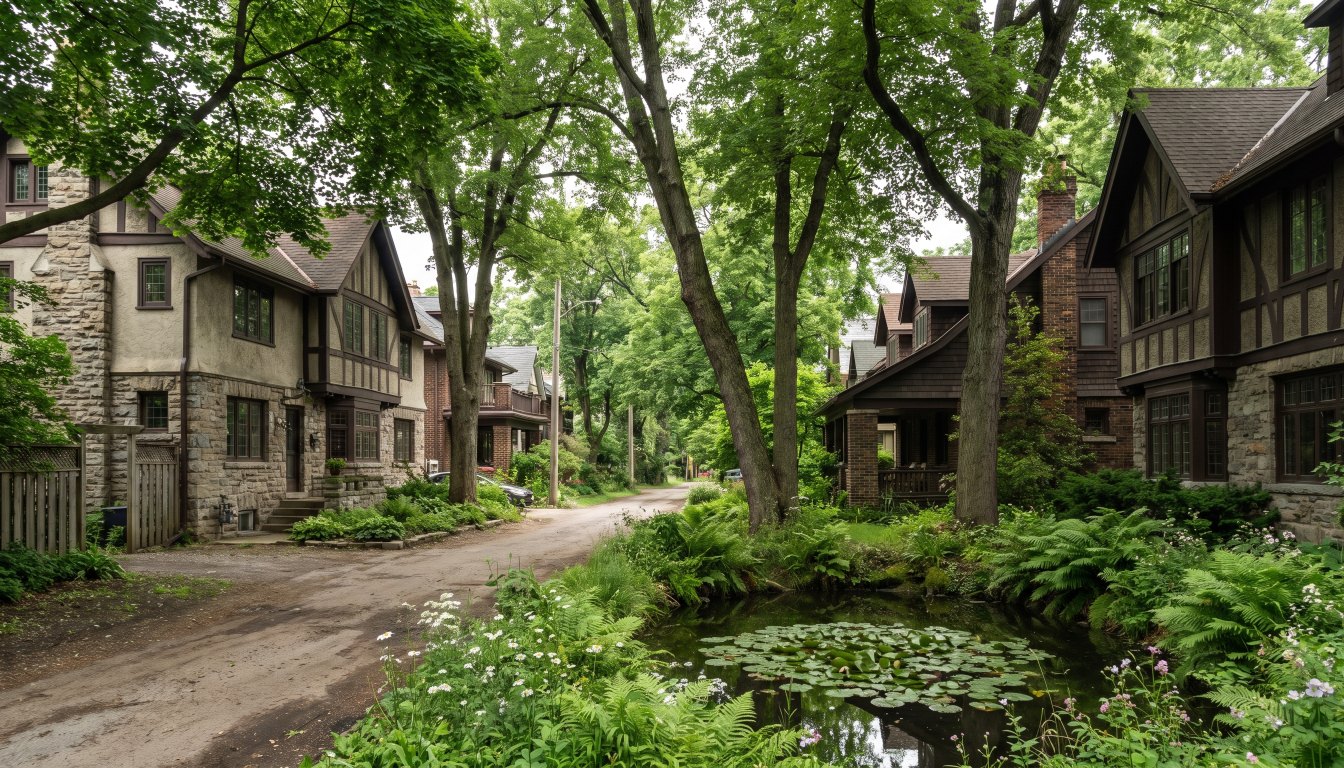
Wychwood Park was founded in the late nineteenth century as an artists’ colony by the painter Marmaduke Matthews and businessman Alexander Jardine, named after Wychwood forest in Oxfordshire, and amalgamated into Toronto in 1909. In 1985 it became the first residential zone in Ontario to be granted heritage status — roughly seventeen years before Toronto’s modern heritage conservation district programme reached Rosedale.
It contains about sixty houses on irregularly shaped lots with build restrictions, arranged around a central park with a pond and tennis courts designed by architect Arthur Edwin Whatmough. The roads and amenities are private and self-governed by a resident executive council, and the pond is a dammed remnant of Taddle Creek — one of very few places the creek is still visible above ground.
The most unusual residential enclave in Toronto
| Founded | Late nineteenth century, as an artists’ colony |
| Founders | Marmaduke Matthews, painter, and Alexander Jardine, businessman |
| Named after | Wychwood forest, Oxfordshire |
| Amalgamated into Toronto | 1909 |
| Heritage status | 1985 — the first residential zone in Ontario to receive it |
| Number of houses | About 60 |
| Roads and amenities | Private, governed by a resident executive council |
| Central park | Designed by Arthur Edwin Whatmough, with a pond and tennis courts |
| Notable house | 5 Wychwood Park, Eden Smith’s own house, c. 1906 |
Why 1985 matters
Toronto’s designated heritage conservation districts largely date from the 1990s and 2000s — East Annex in 1994, South Rosedale in 2002, Yorkville–Hazelton in 2002, North Rosedale in 2004, West Annex Phase 1 in 2015. Wychwood Park received heritage status in 1985, well before that programme matured.
Sources describe the 1985 instrument in different ways, and it is worth confirming the exact form with the City rather than assuming it works identically to a modern district plan. What is not in doubt is the effect: the enclave has been protected for forty years and looks it.
The private roads are the thing to understand
The lots
Irregularly shaped, with build restrictions, arranged around the central park rather than on a grid. That combination — irregular geometry plus restrictions plus heritage status plus a mature canopy where every tree of 30 centimetres or more requires a permit under Chapter 813 — means the buildable envelope on any given property is a question with several parts to it.
Get the survey, get a zoning review, read the heritage requirements, and understand the council’s position before you plan anything.
The pond
The central pond is a dammed remnant of Taddle Creek, one of the few places the buried creek is still visible above ground in Toronto. It is part of the enclave’s identity and, like everything else here, part of the shared responsibility.
What you are actually buying
Not simply a house. A share in a small, forty-year-protected, self-governed enclave of about sixty properties with private roads and a communal park. That is either exactly what you want or entirely wrong for you, and the documents tell you which.
The practical takeaway
Do the legal diligence here before the property diligence. The house, the lot and the heritage requirements matter, but the private road and resident council arrangements are what make Wychwood Park different from every other address in the city — and they are the part most buyers do not read closely enough.
Frequently asked questions
When was Wychwood Park designated?
In 1985, described in the sources as the first residential zone in Ontario to be granted heritage status. Sources are inconsistent about whether the instrument is technically a Part IV or a Part V designation, so confirm the exact form with the City of Toronto before relying on it.
How many houses are in Wychwood Park?
About sixty, on irregularly shaped lots with build restrictions, arranged around a central park designed by architect Arthur Edwin Whatmough with a pond and tennis courts.
Are the roads private?
Yes. The roads and amenities are private and self-governed by a resident executive council. That arrangement carries obligations and costs that a buyer should have their lawyer review in detail, since it is unusual in Toronto.
Who founded Wychwood Park?
The painter Marmaduke Matthews and businessman Alexander Jardine, in the late nineteenth century, as an artists’ colony. It was named after Wychwood forest in Oxfordshire and amalgamated into Toronto in 1909.
What is the pond?
A dammed remnant of Taddle Creek, one of the few places the buried creek remains visible above ground in Toronto.
What architecture will I find there?
Predominantly Arts and Crafts, including architect Eden Smith’s own house at 5 Wychwood Park, built around 1906.
Thinking about buying or selling at the top end?
Send me the address, or the shortlist you are considering. I will tell you what the property is actually worth today, what the land is worth without the house, what the transfer tax and carrying costs will be, and whether the deal makes sense. Confidential, always.
[email protected] · 833-330-1925 · Book a free consultation
Confidential. Read personally and answered within 24 hours. I never share, sell or distribute your information.
Related reading
- Buying a heritage home in Toronto: Part IV vs Part V
- Casa Loma and the Annex: buying on the Davenport escarpment
- Toronto’s luxury neighbourhoods compared
- Buying a luxury home without a survey: what can go wrong
Sources
Everything above that is a rule, a rate or a published number comes from these. Verify anything that matters to your own deal.
- City of Toronto — Heritage Conservation Districts
- City of Toronto — Municipal Code Chapter 813, Trees
About the author — Jatin Dua, Broker of Record
I’m the Broker of Record at RE/MAX Quantum Realty, 799 The Queensway in Etobicoke, and I work with buyers, sellers and investors across Toronto and the west GTA. A large part of my work sits in the upper end of the market, where the comparables are thin, the rules are heavier and the cost of a wrong number is measured in hundreds of thousands of dollars.
The free estimators on this site are mine. I built them because the first question every owner asks is “what is it worth?” and the honest answer starts with a number you can check yourself. [email protected] or 833-330-1925.