
Published 7 September 2026 · Updated 29 September 2026 · By Jatin Dua, Broker of Record, RE/MAX Quantum Realty
What's Your Home Worth Right Now?
Get a free AI-powered price range for your property in under 90 seconds, based on recent GTA comparable sales. No name or address required.
Get My Free Estimate →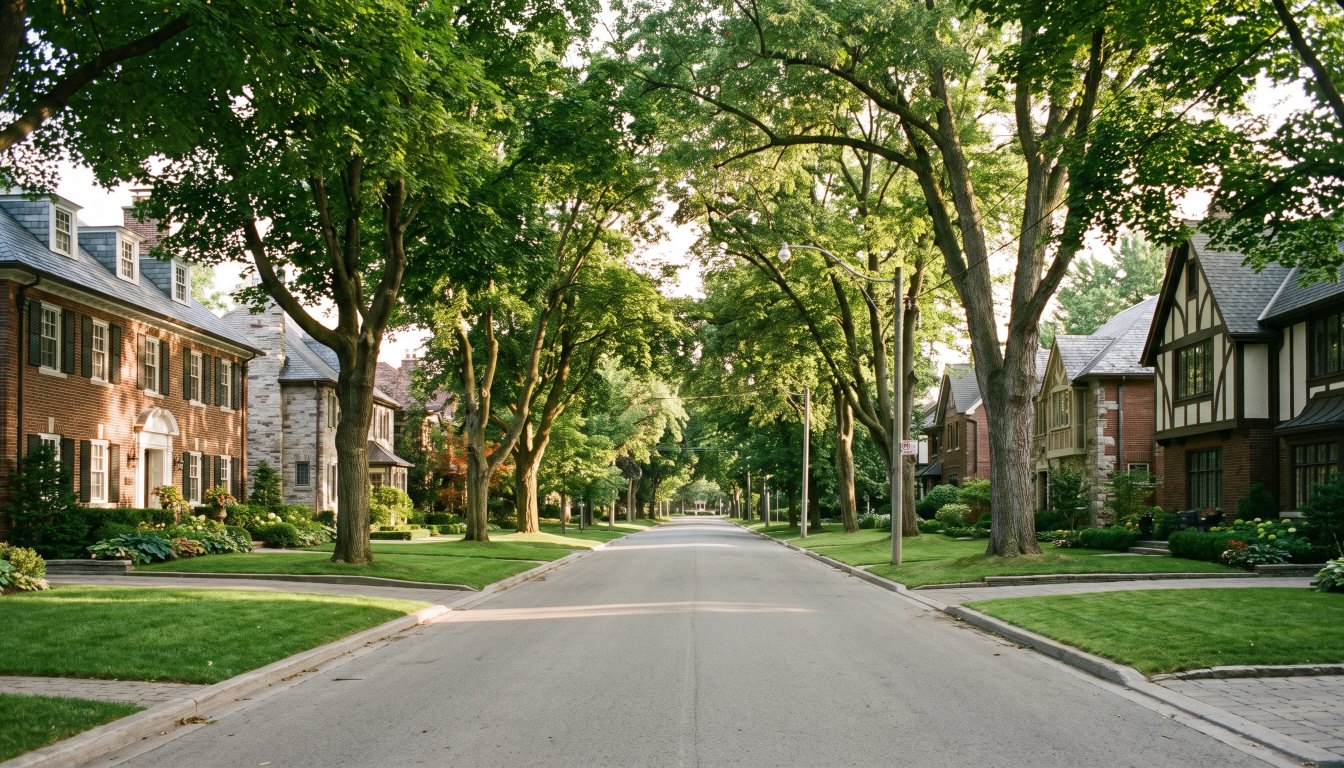
Lytton Park runs from Mona Drive west to Yonge Street east, Lawrence Avenue West north to Briar Hill Avenue south. Development followed the arrival of Metropolitan Street Railway service in 1886, the area was annexed to the City of Toronto in 1912, and most homes were built between 1890 and 1930 — predominantly Georgian and Tudor, on large lots with mature gardens.
That combination — substantial land, houses now approaching a century old, and no heritage conservation district — makes it one of the more active rebuild and deep-renovation markets in central Toronto. The binding constraints are the zoning envelope and the tree canopy rather than a district plan.
How it came to be
Metropolitan Street Railway service reached the area in 1886, which is what made development possible. The area was annexed to the City of Toronto in 1912, and most of the housing stock was built between 1890 and 1930.
What resulted is predominantly Georgian and Tudor architecture on large lots with mature, well-established gardens, bounded by Mona Drive, Yonge Street, Lawrence Avenue West and Briar Hill Avenue.
Why it is a rebuild market
Three facts combine:
- The land is substantial. Large lots, in a central location, with a mature canopy.
- The houses are old. A house built in 1915 has had a century of alterations, and its systems, ceiling heights and plan reflect a different era of living.
- There is no district plan. Lytton Park does not appear among Toronto’s 27 designated Heritage Conservation Districts, so exterior alterations and demolition are governed by zoning and the tree bylaw rather than by heritage compatibility requirements.
The result is a steady stream of full rebuilds and deep renovations — and a market where land value frequently accounts for most of the price.
Running the land value test
On a property here, the first question is what the lot alone is worth:
- Land value close to the asking price — the market has written off the house. You are buying a site.
- Land value at two thirds to three quarters — a genuine mix; the building’s condition and plan matter.
- Land value well under half — unusual here, and typically indicates a recent rebuild.
Because so many properties fall into the first category, comparables in Lytton Park need to be read carefully: a sale of a tired 1920s house and a sale of a 2023 rebuild on the same street are not measuring the same thing.
Schools
John Ross Robertson Junior Public School, Glenview Senior Public School and Lawrence Park Collegiate Institute serve the area on the public side, with Havergal College and St. Clement’s School among the private options nearby. Confirm current catchments with the school board rather than the listing.
What to verify
- A zoning review for the specific address, including site-specific exceptions.
- Heritage status — no district applies, but individual Part IV designation is possible.
- A measured tree inventory of everything 30 centimetres or more.
- The survey, for frontage, depth and any encroachments on a century-old lot.
- Permit history for the alterations a hundred-year-old house has certainly had.
- Land transfer tax, at $122,950 on a $3 million Toronto purchase and $191,950 at $4 million.
The practical takeaway
Lytton Park is a land market with a tree constraint. Establish the lot value and the tree inventory before you decide whether you are buying a house or a site — and be precise about which of those any comparable sale represents.
Frequently asked questions
Where is Lytton Park?
Mona Drive to the west, Yonge Street to the east, Lawrence Avenue West to the north and Briar Hill Avenue to the south.
When were the houses built?
Mostly between 1890 and 1930, predominantly Georgian and Tudor in style, following the arrival of Metropolitan Street Railway service in 1886 and annexation to the City of Toronto in 1912.
Is Lytton Park a heritage conservation district?
It does not appear among Toronto’s designated Heritage Conservation Districts. That means rebuilds and exterior alterations are governed by zoning and the tree bylaw rather than by a district plan — but individual properties can still be designated under Part IV, so confirm the status of any specific address with the City.
What limits a rebuild here?
The zoning envelope under By-law 569-2013 for the specific address, and the tree bylaw. Chapter 813 requires a permit for any privately owned tree 30 centimetres or more in trunk diameter, with fines from $500 to $100,000 per tree and a two-year replacement maintenance obligation.
Which schools serve the area?
John Ross Robertson Junior Public School, Glenview Senior Public School and Lawrence Park Collegiate Institute on the public side, with Havergal College and St. Clement’s School among the private options in the area. Confirm catchments with the school board.
How does it compare with Lawrence Park?
They adjoin and are often discussed together. Lawrence Park was a planned garden suburb from 1907 with narrow, deep lots; Lytton Park developed organically from 1890 and is characterised by larger, more variable lots. RE/MAX recorded 20 sales above $3 million in Lawrence Park between January and April 2026.
Thinking about buying or selling at the top end?
Send me the address, or the shortlist you are considering. I will tell you what the property is actually worth today, what the land is worth without the house, what the transfer tax and carrying costs will be, and whether the deal makes sense. Confidential, always.
[email protected] · 833-330-1925 · Book a free consultation
Confidential. Read personally and answered within 24 hours. I never share, sell or distribute your information.
Related reading
- Lawrence Park: Toronto’s garden suburb and why the lots are shaped that way
- Teardown or renovate? How to judge a $3M Toronto lot
- The Toronto tree bylaw can cost you $100,000
- Toronto’s luxury neighbourhoods compared
Sources
Everything above that is a rule, a rate or a published number comes from these. Verify anything that matters to your own deal.
- City of Toronto — Municipal Code Chapter 813, Trees
- City of Toronto — Zoning By-law 569-2013, residential provisions
- City of Toronto — Heritage Conservation Districts
- RE/MAX Canada — 2026 Spotlight on Luxury Real Estate, Greater Toronto
About the author — Jatin Dua, Broker of Record
I’m the Broker of Record at RE/MAX Quantum Realty, 799 The Queensway in Etobicoke, and I work with buyers, sellers and investors across Toronto and the west GTA. A large part of my work sits in the upper end of the market, where the comparables are thin, the rules are heavier and the cost of a wrong number is measured in hundreds of thousands of dollars.
The free estimators on this site are mine. I built them because the first question every owner asks is “what is it worth?” and the honest answer starts with a number you can check yourself. [email protected] or 833-330-1925.