
Published 18 October 2026 · By Jatin Dua, Broker of Record, RE/MAX Quantum Realty
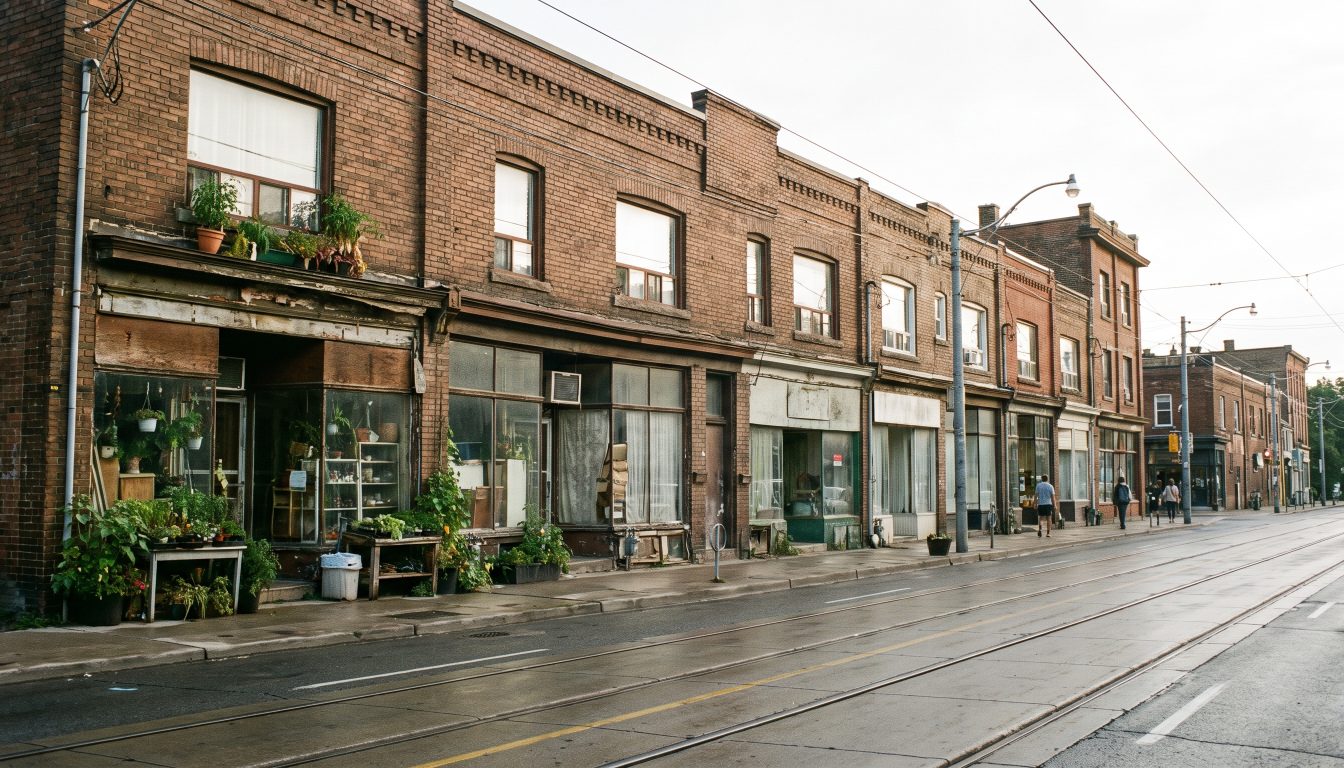
A store with an apartment above is a mixed use building: a commercial unit at grade with one or more dwelling units upstairs, usually in a CR zone under Chapter 40.10 of Toronto Zoning By-law 569-2013. In Etobicoke and west Toronto the stock sits on main streets such as Lake Shore Blvd W, The Queensway, Dundas St W, Bloor St W, Roncesvalles Ave and Queen St W. Each floor is treated separately. The flat falls under the Residential Tenancies Act and the store under the Commercial Tenancies Act, and the commercial part of a sale is generally subject to HST. Financing depends on the commercial share.
Looking for a main-street building with a shop below and a flat above? Tell me your plan and budget and I will send you buildings that fit as they come up.
What is a store with an apartment above, legally?
On a Toronto main street, the “store with an apartment above” is usually a two- or three-storey building with a shop at grade and one or two flats upstairs, often with a separate street door to the stairs. In zoning terms it is a mixed use building: Toronto Zoning By-law 569-2013 defines that as a building with a dwelling unit and a non-residential use. Lenders, insurers, the tax rules and the tenancy rules all treat the two floors differently, and that split is what makes this property type both useful and tricky.
Buyers usually fall into one of three groups: owner-operators who want to run their own shop downstairs, owner-occupiers who want to live upstairs and rent out the store, and investors who want two rent streams. Each plan changes the financing, the HST and the tenancy law, so pick yours before you start viewing.
Which Etobicoke and west Toronto main streets have this stock?
The west end’s store-and-apartment stock sits mostly on the old streetcar and village main streets. A good way to map it is by Business Improvement Area (BIA), because the City publishes each BIA’s boundaries. The table uses the City’s own BIA descriptions (as at October 2026). It shows where the frontage is, not what is for sale or how any lot is zoned.
| Main street | Area | BIA stretch (City of Toronto description) | Character | Who it tends to suit |
|---|---|---|---|---|
| Lake Shore Blvd W | Mimico | Mimico by the Lake BIA: Allen Ave to Alexander St | Retail, restaurants and cafes, health and wellness, professional services | Service businesses and cafes; owner-occupiers who want the lake nearby |
| Lake Shore Blvd W | New Toronto | Lakeshore Village BIA: Dwight Ave to Twelfth St | Older main street; its business association dates to 1948 | First-time commercial buyers and investors who want two rent streams |
| Lake Shore Blvd W | Long Branch | Long Branch BIA: Twenty Second St to Long Branch Ave | Retail, service businesses and restaurants; hosts Long Branch Fest | Owner-operators with a local customer base |
| Royal York Rd | Mimico | Mimico Village BIA: Evans Ave to Judson St (Mimico GO) | Retail, food service and service providers | Businesses that want GO-station foot traffic |
| The Queensway | Stonegate-Queensway | Shop The Queensway BIA: Parklawn Rd to just west of Kipling Ave | Restaurants, cafes, retail and personal services | Owner-operators; buyers who want parking-friendly retail |
| Dundas St W | Islington Village | Village of Islington BIA: Montgomery Rd to Kipling Ave | Retail, health and wellness, restaurants, pubs, professional offices | Professional practices and clinics |
| Bloor St W | The Kingsway | The Kingsway BIA: Prince Edward Dr to Mimico Creek | Specialty shops, restaurants, pubs, a preserved theatre, professional offices | Premium retail and professional users |
| Bloor St W | Bloor West Village | Bloor West Village BIA: Glendonwynne Rd to South Kingsway | Retail shops and restaurants, bakeries, delis, tea rooms and coffee shops | Food and specialty retail; long-hold investors |
| Roncesvalles Ave | Roncesvalles | Roncesvalles Village BIA: Queen St W to Boustead Ave | Retail, restaurants and delis, some reflecting the area’s Polish heritage | Food businesses and boutique retail |
| Queen St W | Parkdale | Parkdale Village BIA: Dufferin St to Roncesvalles Ave | Retail including a cluster of antique stores, restaurants, cafes, services | Investors and creative businesses |
| Dundas St W | The Junction | The Junction BIA: centred on Dundas St W and Keele St, Quebec Ave to Indian Grove | The original commercial strip of the old West Toronto railway community | Independent retail, studios and restaurants |
| Dundas St W | Little Portugal | Little Portugal Toronto BIA: Shaw St to the CNR tracks just west of Lansdowne | Merged BIA formed in 2019 | Restaurants and independent retail |
For The Queensway in more detail, see my guide to The Queensway in Etobicoke. If you mainly want to work from home rather than own a storefront, my post on live/work units in Etobicoke and what zoning allows covers that side.
What does CR zoning allow on these streets?
Most traditional main-street frontage in the old city and inner Etobicoke is zoned Commercial Residential (CR) under Chapter 40.10 of Toronto Zoning By-law 569-2013. Always confirm the zone label for the exact lot. Here is what the chapter says that matters for a store-and-apartment building:
- Building types for dwelling units (40.10.20.40): an apartment building, a mixed use building or (outside Policy Areas 3 and 4) a townhouse, but only on a lot whose zone label has an “r” value greater than 0.0. If the label reads r0.0, no new dwelling units are allowed.
- Non-residential uses (40.10.20.10): office, medical office, personal service shop, artist studio, financial institution, pet services, production studio and others are permitted outright. Retail stores, eating establishments, custom workshops and similar uses are permitted with conditions in 40.10.20.20 and 40.10.20.100.
- Where the homes go (40.10.40.1(1)): in a CR mixed use building, dwelling units must be above the first storey. There are narrow exceptions for ground-floor units behind the store, for example on some corner lots, or where access is through a common inside area and the commercial space is at least 15.0 metres deep from the front wall.
Also check Chapter 900 for a site-specific exception. If you plan to change the store’s use (say a shop to a restaurant), you may need a permit. My guide to change of use permits for commercial tenants covers when that applies.
How do you finance a store with an apartment above?
This is where most deals get decided. Your lender will look at how much of the building is commercial and who occupies it.
- CMHC-insured multi-unit loans are for bigger buildings. CMHC’s Standard Rental Housing product requires at least five rental units and that the project be at least 70% residential by both floor area and total loan value, with a maximum loan-to-value of 85%. A typical two-flat-over-a-store building does not qualify.
- CMHC Income Property covers 2-to-4-unit rental properties with a 20% minimum down payment. According to CMHC’s product page, the property must not be owner-occupied. The body of that page does not say how commercial space is treated, so ask your lender before you count on it.
- Lender mixed-use rules. As an example of how lenders draw the line, First National says CMHC considers a mixed-use property where the non-residential part is under 30% of the floor space and under 30% of gross income. Once the store is a bigger share than that, expect conventional commercial terms.
- Owner-operator loans. If your business will occupy the store, the BDC commercial real estate loan advertises financing of up to 100% of project cost, amortization up to 25 years and loans that typically start at $100,000. It looks for about 24 months of operating history, and the page excludes projects zoned for residential use. Ask BDC directly how it treats a CR mixed use building.
On small main-street buildings, every lender has its own rules. Some banks will write a residential mortgage if the store is small and you live upstairs. Others send the file to their commercial desk: a larger down payment, a shorter term and an appraisal based on the rents. Get a mixed-use pre-approval before you offer. My post on cap rates, NOI and DSCR shows how a commercial underwriter will look at the rents.
Do you pay HST on a store with an apartment above?
Often, on part of it. The CRA’s GST/HST Memorandum 19.4.1 says that when real property is used partly for commercial purposes and partly for residential purposes and is sold, it is treated as two separate supplies. Its example is an apartment building with a mall on the first floor. Paragraph 8 says a sale of commercial real property is generally a taxable supply, while used residential complexes are generally exempt. Memorandum 19.2.1 applies the same separate-supply rule from the residential side.
- The price has to be allocated between the commercial part and the residential part. That allocation sets the HST.
- Under paragraph 12 of 19.4.1, a purchaser who is registered for GST/HST generally self-assesses and remits the tax rather than paying it to the seller. Buyers who are not registered usually pay it on closing.
- The wording in the agreement matters. “HST included” and “plus HST, if applicable” put the cost on different parties. See my notes on HST clauses in an Ontario agreement of purchase and sale.
Have your accountant settle the allocation and your registration status before you sign.
Which law governs the tenants on each floor?
Two different statutes.
- Apartment upstairs: the Residential Tenancies Act, 2006 applies. That brings the standard lease, Landlord and Tenant Board process, notice rules and the rent increase guideline. Section 6.1 exempts units in buildings where no part was occupied for residential purposes on or before November 15, 2018 from the guideline. Most older main-street flats were occupied long before that, so the guideline usually applies.
- Store at grade: the Commercial Tenancies Act and the written lease govern. Section 2 says the Act does not apply to tenancies the RTA covers. Section 18(1) lets a landlord re-enter if rent stays unpaid for fifteen days, unless the lease says otherwise. Most of the deal lives in the lease. Read my guide to commercial lease clauses before you take one over.
- One tenant, both floors: RTA section 5(j) exempts “premises occupied for business or agricultural purposes with living accommodation attached if the occupancy for both purposes is under a single lease and the same person occupies the premises and the living accommodation.” Separate leases for the store and the flat, or different occupants, usually put the flat back under the RTA.
Watch out
Buying with vacant possession of the apartment is not simple. If a residential tenant is in the flat, you take the building subject to that tenancy. The seller cannot just hand you an empty unit unless the tenant has left lawfully. And a “single lease for shop and home” only falls outside the RTA if the same person really occupies both. Get copies of every lease, the rent ledger and any notices served before your conditions expire.
What fire safety rules apply to an apartment over a store?
The Ontario Fire Code (O. Reg. 213/07) applies to existing buildings, whatever the zoning says.
- Smoke alarms (2.13.2.1): required outside sleeping areas and on each storey of a dwelling unit. Under 2.13.1.2, for a rental suite the landlord is the owner responsible.
- Carbon monoxide alarms (2.16.2.1(2)): if a fuel-burning appliance (say a furnace or a restaurant’s equipment) sits outside the apartment, CO alarms are required in the service room and next to each sleeping area of any suite that shares a wall or floor with it. In a store-and-flat building this catches a lot of people.
- Retrofit, Section 9.5: applies to buildings of six storeys or less with more than two dwelling units where, for example, one unit is above another with shared exits. It sets minimum fire separations (30-minute floor assemblies for buildings up to 3 storeys and 600 m², under 9.5.2.2), including where the store affects residents’ life safety.
Adding or splitting a unit needs a building permit, and the CR rules above still apply. Before you pay for upside that has not been built, ask for the permit history and any Toronto Fire Services orders.
How do you insure a mixed-use building?
A standard home policy is not written for a building with a commercial tenant. In my files, most main-street owners carry a commercial property policy with liability and loss-of-rents coverage for both tenancies. The store tenant carries their own liability and contents insurance naming you as an additional insured, and the flat tenant carries tenant insurance. The store’s use drives the price: a restaurant with cooking equipment costs far more to insure than an office. Get a quote during your conditional period. My guide to landlord insurance in Ontario covers the residential side.
Does Toronto’s Vacant Home Tax apply to the apartment?
It can. On the City’s Vacant Home Tax page, no declaration is needed only if a property is “assessed fully as multi-residential, commercial or industrial.” A building with a residential part generally has to be declared each year by the deadline (April 30). Beginning with the 2024 tax year, the rate is 3% of the property’s Current Value Assessment.
The property counts as occupied if it is your principal residence for at least six months of the year, or if tenants have written agreements of at least 30 days and at least six months in total during the year. The City says “tenant” includes business tenants. Buying mid-year? Ask the seller for their filed declaration. See my Vacant Home Tax 2026 guide for the deadline traps.
What does a Business Improvement Area mean for an owner?
The City says a BIA is made up of commercial and industrial property owners and their non-residential tenants in a defined area. BIA operating budgets are paid for by a special levy on the commercial and industrial properties within the boundary. As the owner, you pay that levy on your property tax bill for the commercial portion. Most commercial leases pass it to the store tenant as part of additional rent. Read the lease to see whether yours does.
BIAs fund streetscaping, festivals and promotion. Owners on these streets can also apply to the City’s Commercial Façade Improvement Grant Program. It covers buildings that are commercial at street level with residential uses above. As at October 2026 applications are closed, and work started before approval is disqualified.
My take
A store with a flat above is one of the few ways to own a piece of a busy Toronto main street for less than a detached house on the side streets nearby, and the two rent streams make it more resilient than a pure retail unit. The buyers who do well pick their plan first, line up a mixed-use lender before they offer, and spend the conditional period on the leases, the zone label and the fire file. I help buyers and sellers with these buildings across Toronto and the GTA, and I will tell you if a building’s numbers only work on paper.
What should you check before you make an offer?
| Item | What to get | Why it matters |
|---|---|---|
| Zone label and exceptions | City zoning map; Chapter 40.10 for CR; any Chapter 900 exception | Confirms the store use and the apartment are allowed, and whether more units are possible |
| Permit and fire history | Building permit records; any Fire Code or property standards orders | Unpermitted units or open orders become your cost on closing |
| Residential lease and ledger | Lease, rent history, deposits, any notices served | The RTA tenancy carries over; rent increases follow the guideline |
| Commercial lease | Full lease, amendments, renewal options, estoppel certificate | Term, rent, additional rent and the tenant’s renewal rights set the value |
| Single-lease set-up | Proof of who occupies the shop and the flat | Decides whether RTA section 5(j) actually applies |
| HST allocation | Accountant’s allocation; your GST/HST registration status | The commercial portion is generally taxable |
| Financing | Written approval from a lender that does mixed use | The commercial share of floor area and income decides the product |
| Insurance | Commercial property quote naming the store use | Some uses (cooking, for example) are expensive or hard to insure |
| Vacant Home Tax | Seller’s last declaration and occupancy evidence | Avoids a 3% of CVA bill on the residential part |
| Property tax split | MPAC assessment showing the residential and commercial portions | Commercial-class tax and the BIA levy affect your net income |
| Building condition | Inspection of the roof, rear stairs, egress, electrical, HVAC and CO alarms | Old main-street buildings often need rear exits and services brought up to date |
Send me store-and-apartment buildings for sale
Tell me whether you will run the store, live upstairs or rent both, and I will send buildings on the streets that fit.
I will come back to you personally, usually the same day. If it is urgent, call 833-330-1925.
Frequently asked questions
Can I live in the apartment above my own store in Toronto?
Yes, if the building is a lawful mixed use building with a dwelling unit. In a CR zone, dwelling units in a mixed use building generally have to be above the first storey under regulation 40.10.40.1 of Zoning By-law 569-2013. Living upstairs can also help with financing and keeps the unit occupied for Vacant Home Tax purposes.
Does the Residential Tenancies Act apply to the apartment above a store?
Usually, yes. The exception in section 5(j) of the Residential Tenancies Act, 2006 applies only where the business premises and the attached living accommodation are rented under a single lease and the same person occupies both. Separate leases or different occupants generally mean the flat is a normal RTA tenancy.
Is there HST when I buy a building with a store and an apartment?
Generally on the commercial part. CRA GST/HST Memorandum 19.4.1 treats property used partly for commercial and partly for residential purposes as two separate supplies. The commercial portion is generally taxable, and a registered buyer usually self-assesses it. Have your accountant settle the price allocation before you sign.
Can I get a CMHC-insured mortgage on a store with an apartment above?
Rarely, on a small building. CMHC’s Standard Rental Housing product needs at least five rental units and a project that is at least 70% residential by floor area and loan value. Most two-flat-over-a-store buildings are financed with a conventional residential or commercial mortgage, depending on the lender and the commercial share.
Do I have to file a Toronto Vacant Home Tax declaration for a mixed-use building?
Usually, yes. The City exempts only properties assessed fully as multi-residential, commercial or industrial, so a building with a residential portion is generally declared every year. Tenants with written agreements of at least 30 days and six months in total, including business tenants, count as occupancy. See my Vacant Home Tax guide.
Who pays the BIA levy on a main-street building?
The levy is charged on the commercial and industrial properties inside the BIA boundary, so it appears on the owner’s tax bill for the commercial portion. Many commercial leases pass it through to the store tenant as additional rent. Check the lease to see if yours does.
Can I add a second apartment behind or above the store?
Only if zoning and the building code allow it. The lot’s CR zone label needs an “r” value above 0.0, new dwelling units generally have to be above the first storey, and the work needs a building permit. Once there are more than two dwelling units, Section 9.5 of the Ontario Fire Code retrofit rules can apply.
Sources
- City of Toronto — Zoning By-law 569-2013, Chapter 40.10 Commercial Residential (CR) Zone — Permitted uses, building types for dwelling units, residential uses above the first storey (40.10.40.1)
- CMHC — Standard Rental Housing mortgage loan insurance — Minimum 5 units, at least 70% residential by floor area and loan value, 85% max LTV
- CMHC — CMHC Income Property — 2-to-4-unit rental, 20% minimum down payment, non-owner-occupied
- First National Financial — Mixed-use CMHC financing — Lender description of CMHC mixed-use thresholds (non-residential under 30% of floor space and income)
- BDC — Commercial real estate loan — Up to 100% of project cost, 25-year amortization, eligibility and exclusions
- Canada Revenue Agency — GST/HST Memorandum 19.4.1, Commercial Real Property: Sales and Rentals — Mixed residential/commercial property treated as separate supplies; commercial sales generally taxable; purchaser self-assessment
- Government of Ontario — Residential Tenancies Act, 2006 — Section 5(j) single-lease business-plus-living exemption; section 6.1 post-2018 rent rule exemption
- Government of Ontario — Commercial Tenancies Act — Section 2 (does not apply to RTA tenancies); section 18 re-entry after fifteen days’ unpaid rent
- Government of Ontario — Fire Code, O. Reg. 213/07 — Smoke and CO alarm rules (2.13, 2.16) and Part 9 retrofit for multi-unit residential buildings (9.5)
- City of Toronto — Vacant Home Tax — 3% of CVA from 2024, declaration exemptions, occupancy rules including business tenants
Related reading
- Commercial lease use clauses in Ontario
- Buying a tenanted property in Ontario: the rent clauses
- Drafting a commercial lease review condition
- The Queensway, Etobicoke: a reference guide
- How commercial property is valued in the GTA
About the author — Jatin Dua, Toronto and GTA real estate broker
I am Jatin Dua, Broker of Record and co-founder of RE/MAX Quantum Realty Inc., Brokerage, Unit 101, 799 The Queensway, Toronto. I work with buyers, sellers, investors and business owners across Toronto and the GTA. Four-plus years of active GTA transactions, over $100 million in sales volume and 100+ families helped sell. Every rule and fact here is linked to a source below, so you can check it without asking me.
Reach me at [email protected] or 833-330-1925, or book a call.