
Published 2 November 2026 · By Jatin Dua, Broker of Record, RE/MAX Quantum Realty
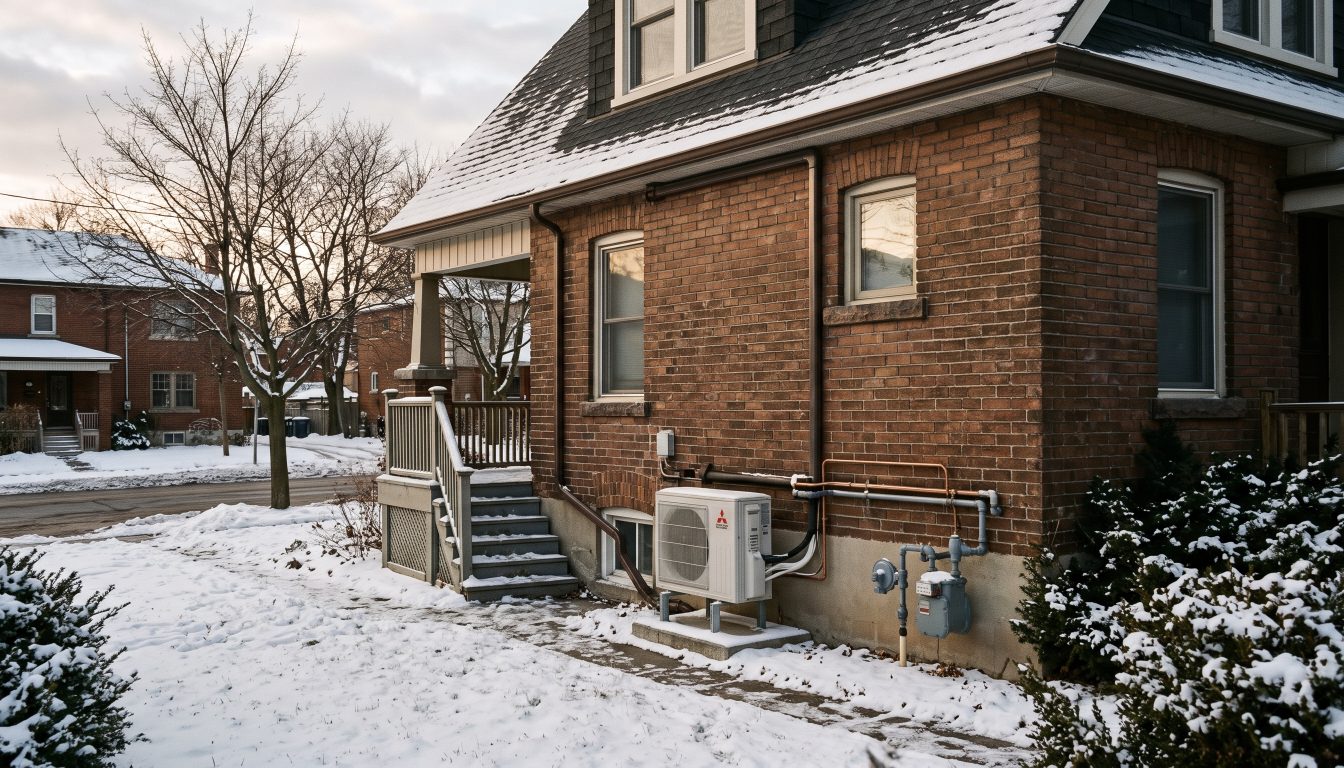
At November 2026 Toronto rates, a 95% gas furnace delivers heat for about 3.2 cents per kilowatt-hour, while a cold-climate heat pump costs about 5 to 6 cents. So a heat pump alone usually costs more to run than gas, but far less than electric baseboards, and a hybrid system can come close to gas while adding efficient cooling.
This is for Toronto homeowners deciding between a new gas furnace and a heat pump in 2027 who want the running-cost math done with real Toronto rates rather than a sales pitch. I use the Enbridge Gas and Toronto Hydro rates in effect in November 2026, show every assumption, and explain what changes in 2027 could move the answer.
Is a heat pump cheaper to run than a gas furnace in Toronto?
Usually not, if you already heat with natural gas. At late-2026 Toronto rates, heat from a 95% efficient gas furnace costs about 3.2 cents per kilowatt-hour of heat. A good cold-climate heat pump delivers heat for about 5 to 6 cents per kilowatt-hour over a season. So a heat pump on its own typically costs more to run than a new gas furnace.
The answer flips if you heat with electric baseboards. Then a heat pump can cut the heating bill by more than half. It also tends to favour heat pumps for oil and propane homes, which is why the official rebates are much bigger for those fuels.
Two official sources say the same thing about gas. A Natural Resources Canada test of a cold-climate heat pump in Ottawa found it far more efficient than gas equipment, yet more expensive to operate where natural gas is cheap. And the federal National Heat Pump Rebate page warns natural gas users that switching may not lower their heating bills.
What do natural gas and electricity cost in Toronto right now?
Energy bills have fixed charges and per-unit charges. For comparing heating systems, only the per-unit charges matter, because they are what grows when you use more. Here are the main ones.
| Charge | Rate | Effective |
|---|---|---|
| Enbridge gas supply charge plus cost adjustment | 9.47¢ + 0.53¢ per m³ | 1 Oct 2026 |
| Enbridge delivery, use above 170 m³ a month | 12.29¢ per m³ | 1 Oct 2026 |
| Enbridge transportation | 5.48¢ per m³ | 1 Oct 2026 |
| Federal carbon charge | 0 (removed 1 Apr 2025) | — |
| Enbridge customer charge (fixed) | $27.69 a month | 1 Oct 2026 |
| Electricity, Tiered winter price | 11.2¢ (first 1,000 kWh a month), 13.2¢ above | 1 Nov 2026 |
| Electricity, Time-of-Use winter price | 9.1¢ off-peak, 14.6¢ mid-peak, 18.9¢ on-peak | 1 Nov 2026 |
| Toronto Hydro transmission, riders and wholesale market charge | About 2.9¢ per kWh combined | 1 Jan 2026 |
| Ontario Electricity Rebate | 15.7% credit (down from 23.5%) | 1 Nov 2026 |
Source: Ontario Energy Board, Enbridge Gas EGD rate zone notice effective 1 October 2026 and electricity prices effective 1 November 2026; Toronto Hydro residential rates page; Enbridge Gas residential rates page. HST of 13% applies to both bills.
Put together, winter gas costs about 27.8 cents per cubic metre before tax, or about 31.4 cents with HST. Electricity on the Tiered plan works out to roughly 13.8 cents per kWh within the first 1,000 kWh and about 15.7 cents above it, after the transmission and market charges, HST and the 15.7% rebate. A Time-of-Use household lands in a similar range. These are my approximations and leave out a small line-loss adjustment.
How do you compare heat pump and furnace running costs?
Turn everything into the cost of one kilowatt-hour of heat delivered to your rooms.
- Gas furnace: one cubic metre of gas holds about 10.3 kWh of energy, using the Canada Energy Regulator’s conversion (26.853 m³ per gigajoule). A 95% furnace turns that into about 9.8 kWh of heat. At 31.4 cents per cubic metre, that is about 3.2 cents per kWh of heat.
- Heat pump: divide the electricity price by the coefficient of performance (COP), which is how many units of heat it delivers per unit of electricity. The NRCan Ottawa test measured an average COP of about 3.0 at +4.9°C, falling to about 1.5 at -21.1°C.
- Electric baseboard: COP of 1. Every kWh of electricity gives one kWh of heat.
| System | Cost per kWh of heat (electricity at 15¢) |
|---|---|
| Gas furnace, 95% AFUE | About 3.2¢ |
| Heat pump, mild day (COP 3.0) | About 5.0¢ |
| Heat pump, seasonal average (COP 2.5) | About 6.0¢ |
| Heat pump, deep cold (COP 1.5) | About 10.0¢ |
| Electric baseboard or electric furnace | About 15.0¢ |
Source: my calculation from the rates above; COP values from Natural Resources Canada’s cold-climate heat pump test at the Canadian Centre for Housing Technology. The seasonal COP of 2.5 is an assumption for illustration, not a measured Toronto figure.
For a heat pump to match gas at these prices, it would need a seasonal COP of about 4.7. That is far above what cold-climate units achieve through a Toronto winter, which is why the gas comparison comes out the way it does.
What does heating a Toronto house cost each year with each system?
Take a house that burns 2,000 cubic metres of gas a year for heat. That is an example, not an average; check your own Enbridge bills for the real number. That gas delivers about 19,650 kWh of heat. Here is what the same heat costs from each system.
| System | Energy used | Approximate yearly cost |
|---|---|---|
| 95% gas furnace | 2,000 m³ | About $628, plus $375 a year in fixed gas customer charges with HST |
| Heat pump, seasonal COP 3.0 | About 6,550 kWh | About $900 to $1,030 |
| Heat pump, seasonal COP 2.5 | About 7,860 kWh | About $1,080 to $1,230 |
| Electric baseboard | About 19,650 kWh | About $2,700 to $3,090 |
Source: my calculation using OEB-approved Enbridge (EGD) rates from 1 October 2026 and Toronto Hydro, OEB and Ontario Electricity Rebate rates from 1 November 2026, with electricity at 13.75¢ to 15.7¢ per kWh all-in. Excludes cooling, water heating and equipment maintenance.
Read it this way. If you keep gas for anything else, such as a water heater or stove, the fixed customer charge stays and a heat pump costs roughly $270 to $600 more a year to heat than the furnace in this example. If the heat pump lets you drop gas completely, the $375 customer charge disappears and the result ranges from about $100 cheaper to about $230 dearer. Against baseboards, the heat pump saves about $1,600 to $2,050 a year.
Instant Home Valuation
What’s your home
worth today?
Answer six quick questions and get an instant value range built from current Toronto & GTA sale data — property type, size, condition, lot and location all weighted the way a real pricing conversation weighs them. Takes about ninety seconds.
Reading recent GTA sale data…
Building your estimate
Estimated market value
—
$0–$0
Most likely value $0 · roughly $0 per square foot
What moved the number
Starting from the area baseline for your property type, here’s what each answer added or subtracted.
Market context
Recent local averages for comparison.
—
A range is a starting point.
A strategy is what sells.
This model doesn’t know that your neighbour’s identical semi went $80,000 over asking last month, or which two upgrades actually pay back in your area. That conversation is free and takes twenty minutes.
How well do heat pumps work in a Toronto winter?
Cold-climate models keep working well below freezing. The Home Renovation Savings program describes them as designed to operate down to -30°C, and it only rebates models on Natural Resources Canada’s cold-climate qualified products list. In the NRCan field test, the unit kept the house comfortable below -21°C with a COP above 1.5, though indoor temperature swings were larger than with a standard system and a backup electric heater helped during defrost cycles.
The practical points: efficiency falls as it gets colder, most installs include backup heat, and sizing matters. A unit sized only for cooling will lean on expensive backup heat in January. Ask for a heat-loss calculation and a written explanation of when the backup turns on.
What is a hybrid heat pump system and when does it make sense?
A hybrid, or dual-fuel, system pairs a heat pump with a gas furnace. The heat pump heats on mild days and cools in summer. The furnace takes over when it gets cold enough that gas heat is cheaper. Ontario’s rebate rules allow the heat pump to be paired with a new or existing gas furnace, though only the heat pump earns the rebate.
A hybrid makes the most sense when your air conditioner needs replacing anyway. You were going to buy a cooling unit; a heat pump is a cooling unit that also heats, it earns rebates an air conditioner does not, and the furnace protects you from the high cost of deep-cold heat. Because a heat pump is efficient in mild weather, a hybrid can run close to the furnace’s cost while giving you modern cooling. Ask your installer how the switchover temperature is set, and whether it can be adjusted as prices change.
What changes in 2027 could shift the math?
- Ontario Electricity Rebate cap. Ontario’s 2026 fall economic statement says that from 1 May 2027, the rebate will only apply to the first 1,200 kWh a month for residential customers. Electric-heated homes often use more than that in winter, so from the 2027–28 heating season, electricity above 1,200 kWh would cost about 18 cents per kWh all-in on the higher tier instead of about 15.7.
- A smaller rebate already. Toronto Hydro reports the rebate fell from 23.5% to 15.7% on 1 November 2026, which raised the after-rebate electricity price this winter.
- Gas prices move quarterly. Enbridge resets its rates in January, April, July and October. The gas supply charge is only one part of the per-cubic-metre cost, so even a large swing in gas prices moves the furnace side less than you might expect.
- Bigger rebates for the heat pump. The federal National Heat Pump Rebate opens in early 2027 at $2,000, or up to $10,000 below median income, for eligible installs from 1 November 2026. That changes the upfront comparison, not the running cost.
Be careful with the Ultra-Low Overnight electricity plan if you heat with a heat pump. Its overnight price is very low at 3.7 cents, but its weekday on-peak price from 4 p.m. to 9 p.m. is 37.7 cents, which is when a cold house calls for the most heat. Run the Ontario Energy Board’s bill calculator with your own usage before you switch plans.
What about the upfront cost and rebates?
A new standard gas furnace installed in Ontario is listed at roughly $4,900 to $8,000 before tax in one national installer’s published guide. I have not found an official, current price list for heat pump installs, so get quotes; they vary with size, ducts and electrical work.
The rebates are clearer. Under Home Renovation Savings, a gas-heated home gets $500 per ton of heat pump capacity, up to $2,000. A home heated by electricity, oil, propane or wood gets $1,250 per ton, up to $7,500. In Toronto, the City’s Home Energy Loan Program finances heat pumps over up to 20 years, at 5.12% for that term under the rates valid to 31 December 2026, plus a 2% charge. My guide to heat pumps in Toronto and resale value covers the rebate steps.
Which is better for your Toronto home: heat pump or furnace?
- Electric baseboards, electric furnace, oil or propane: a heat pump, almost always. The running savings are large and the provincial rebate is at its highest.
- Gas heat, air conditioner also near the end: a hybrid. You get rebated cooling, good mild-weather efficiency and the furnace for deep cold.
- Gas heat, newer furnace and AC, tight budget: keep what you have and spend on insulation and air sealing first, which lowers costs whichever system you end up with. See my guide to winter maintenance jobs for GTA homeowners.
- Selling within a year: do not start a big system change. Service what you have and keep the records; my notes on renovation payback before you sell explain why.
I would not switch a working gas furnace to an all-electric heat pump in Toronto purely to save money at today’s rates; the numbers do not support it yet. Where I do see owners come out ahead is the hybrid route at the moment the air conditioner dies, and the full heat pump route in electrically heated houses. If you own a rental, the comfort and cooling also matter: the 2026 rules on tenants installing air conditioners make central cooling more relevant for landlords.
What to do next
- Pull 12 months of Enbridge and Toronto Hydro bills and note your yearly gas use in cubic metres.
- Multiply that by about 31 cents to estimate your current heating gas cost, then compare it with the heat pump scenarios above.
- Ask two or three participating contractors for a heat-loss calculation and quotes for both a hybrid and a full heat pump.
- Check rebate eligibility and get written pre-approval from Home Renovation Savings before any install.
- Revisit the numbers in spring 2027, after the federal rebate opens and before the May 2027 rebate cap takes effect.
Need help with this? Talk to me.
I’m Jatin Dua, Broker of Record at RE/MAX Quantum Realty, and I’m the best agent to do this kind of work for you in Toronto and across the GTA. Over $100 million in GTA sales and 100+ families helped sell. Feel free to contact me any time: call or text 833-330-1925 or email [email protected].
Frequently asked questions
Is a heat pump cheaper than gas in Toronto?
Usually not, at November 2026 rates. In Toronto, heat from a 95% gas furnace costs about 3.2 cents per kilowatt-hour, while a cold-climate heat pump with a seasonal COP of 2.5 to 3.0 costs about 5 to 6 cents. A heat pump would need a seasonal COP of about 4.7 to match gas, which Toronto winters do not allow.
Is a heat pump worth it in Ontario?
It is worth it in Ontario homes heated by electric baseboards, oil or propane, where running costs drop sharply and the 2026 provincial rebate reaches $7,500. In gas-heated homes it mainly pays off as a hybrid installed when the air conditioner needs replacing, adding efficient cooling and rebates. Switching a working gas furnace purely for savings rarely pays at current rates.
How much does it cost to heat a house with a heat pump in Toronto?
For a Toronto house that would burn 2,000 cubic metres of gas a year, a heat pump with a seasonal COP of 2.5 to 3.0 would cost roughly $900 to $1,230 a year to heat at November 2026 electricity rates. The same heat costs about $628 in gas plus fixed charges, or about $2,700 to $3,090 with electric baseboards.
Do heat pumps work in Toronto winters?
Yes, cold-climate models do. Ontario’s Home Renovation Savings program says they are designed to work down to -30°C, and a Natural Resources Canada field test in Ottawa measured an average COP above 1.5 below -21°C. Efficiency drops in deep cold, so most Toronto installs include backup heat from a gas furnace or electric elements.
What is a hybrid heat pump system in Toronto?
A hybrid system pairs a heat pump with a gas furnace. In Toronto the heat pump handles cooling and mild-weather heating, and the furnace takes over in deep cold when gas heat is cheaper. Ontario’s Home Renovation Savings program allows pairing with a new or existing furnace, and in 2026 pays gas homes $500 per ton, up to $2,000.
How much is natural gas per cubic metre in Toronto?
For Enbridge Gas customers in the Toronto-area EGD rate zone, winter use above 170 cubic metres a month costs about 27.8 cents per cubic metre before tax from 1 October 2026, or about 31.4 cents with 13% HST. That combines gas supply, cost adjustment, delivery and transportation, plus a fixed customer charge of $27.69 a month.
What is the electricity rate in Toronto for winter 2026–27?
From 1 November 2026, the Ontario Energy Board’s winter Tiered price is 11.2 cents per kWh for the first 1,000 kWh a month and 13.2 cents above. Time-of-Use prices are 9.1, 14.6 and 18.9 cents. After Toronto Hydro’s per-kWh charges, HST and the 15.7% Ontario Electricity Rebate, most Toronto homes pay roughly 14 to 16 cents per kWh.
How will the 2027 Ontario Electricity Rebate change affect heat pump costs?
Ontario’s 2026 fall economic statement says that from 1 May 2027 the Ontario Electricity Rebate will only apply to the first 1,200 kWh a month for residential customers. Homes heated mainly by electricity often use more in winter, so from the 2027–28 heating season their extra kilowatt-hours would cost roughly 18 cents each on the higher tier.
Should I replace my gas furnace with a heat pump in Toronto in 2027?
Only in certain cases. In Toronto in 2027, replacing a working gas furnace with an all-electric heat pump usually raises heating costs at current rates. A hybrid makes sense when your air conditioner needs replacing, and a full heat pump makes sense in homes heated by electricity, oil or propane, especially with provincial and federal rebates.
Sources
- Ontario Energy Board — Electricity rates (prices effective 1 November 2026)
- Ontario Energy Board — Enbridge Gas EGD rate zone, rates effective 1 October 2026
- Toronto Hydro — Residential rates
- Enbridge Gas — Residential rates and charges
- Natural Resources Canada — Cooling and heating season performance assessment of a cold climate air source heat pump (CCHT)
- Ontario — 2026 Ontario Economic Outlook and Fiscal Review, Chapter 1, Section B
- Canada Energy Regulator — Energy conversion tables
- Environment and Climate Change Canada — National Heat Pump Rebate
Related reading
- Biggest Condo Developers in Toronto: Track Records Buyers Should Check
- Is It a Good Idea to Buy a Condo in Toronto in 2027?
- Buying a House in Ontario on a Work Permit (2027): What the Foreign Buyer Ban Allows
- Can You Buy a House With No Down Payment in Ontario?
About the author — Jatin Dua, Toronto and GTA real estate broker
I am Jatin Dua, Broker of Record and co-founder of RE/MAX Quantum Realty Inc., Brokerage, Unit 101, 799 The Queensway, Toronto. I work with buyers and sellers across Toronto and the GTA and have helped more than 100 families sell. Four-plus years of active GTA transactions and over $100 million in sales volume.
Reach me at [email protected] or 833-330-1925, or book a call.
More from the library
- How Much Is My Land Worth? How Developers Actually Price Development Land in the GTA
- Flat Fee Realtor in Ontario: What You Save, and What You Give Up
- West Oakville Lakefront Homes: Bronte to Coronation Park
- Living Near Kipling Station: Subway, GO and MiWay Together
- Hamilton Beach Strip and Burlington Beachway: Buying a House on the Sandbar
- Casa II, 42 Charles St E: The Tall Casa With the Fritted Glass
