
Published 7 September 2026 · Updated 29 September 2026 · By Jatin Dua, Broker of Record, RE/MAX Quantum Realty
What's Your Home Worth Right Now?
Get a free AI-powered price range for your property in under 90 seconds, based on recent GTA comparable sales. No name or address required.
Get My Free Estimate →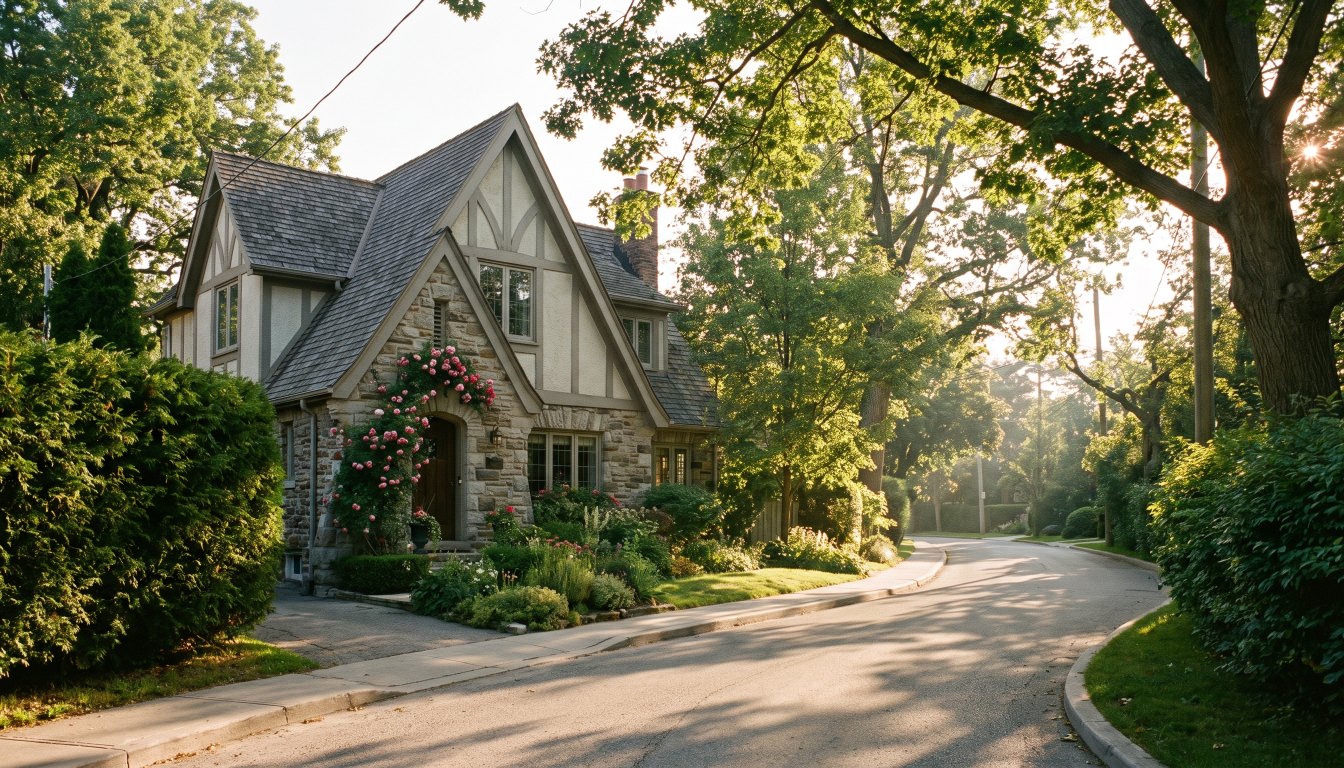
Lawrence Park was assembled from 1907 by the Dovercourt Land Building and Saving Company and named for the original landowner, John Lawrence. It was marketed as one of Toronto’s first planned garden suburbs, and the build-out was interrupted by two world wars and the Depression, running all the way to the 1950s.
The practical legacy is the lot pattern: medium-sized houses on narrow but deep lots, on curving streets, bounded by Yonge Street to the west, Bayview Avenue to the east, the Blythwood ravine to the south and Lawrence Avenue to the north. Lawrence Park tied with Rosedale for the most $3 million-plus sales of any Toronto neighbourhood at 20 between January and April 2026.
A suburb designed on paper in 1907
The Dovercourt Land Building and Saving Company began assembling the land in 1907, naming the neighbourhood for the original landowner, John Lawrence. It was marketed as one of Toronto’s first planned garden suburbs — curving streets, houses set in gardens, a deliberate contrast to the grid.
Then history intervened. The First World War, the Depression and the Second World War each interrupted construction, and the build-out was not completed until the 1950s. That is why a single street can contain a 1912 Tudor, a 1928 Georgian and a 1949 Colonial without any of them looking out of place — they were all built to the same plan, decades apart.
The lot pattern is the whole neighbourhood
Lawrence Park is characterised by medium-sized houses on narrow but deep lots, centred on Mount Pleasant Road. That was a design decision, and it has consequences a buyer feels immediately:
- Frontage is usually the binding constraint on any rebuild or addition, not depth.
- Rear additions are the natural direction for expansion, and they are what the lot pattern supports.
- Garage capacity is constrained by width, which is why parking is a genuine differentiator between properties here.
- Corner lots behave very differently, gaining light and a second exposure while carrying a second front-yard setback.
The boundaries and the ravine
Yonge Street west, Bayview Avenue east, the Blythwood ravine south, Lawrence Avenue north. Land west of Mildenhall Road formed part of the Toronto–North York boundary until 1998.
Properties along the ravine edge carry the usual double layer: Municipal Code Chapter 658 requires a permit inside a mapped ravine protected area to injure, destroy or remove a tree, place or dump fill, or alter the grade of land, and where TRCA jurisdiction applies under O. Reg. 41/24, clearance is required before a building permit issues.
The market, in numbers
RE/MAX recorded 20 sales above $3 million in Lawrence Park between January and April 2026 — tied with Rosedale for the highest count of any Toronto neighbourhood in that window, and ahead of Bridle Path–Sunnybrook–York Mills at 14 and Forest Hill South at 11.
Twenty sales in four months. Filter those for similar frontage, similar era and similar condition and you are quickly down to a handful — which is why pricing here relies on land value and replacement cost as much as on comparables.
Schools
Havergal College sits in the neighbourhood, and Lawrence Park Collegiate Institute is the public secondary school. Catchment boundaries change and should be confirmed directly with the school board rather than taken from a listing.
What to check before buying
- The survey, with particular attention to frontage and to how usable the depth is.
- A zoning review for the address, since older neighbourhoods carry site-specific exceptions.
- Ravine and TRCA status if the property is near the Blythwood ravine.
- A tree count of anything 30 centimetres or more in trunk diameter, given the mature canopy.
- Whether past additions were permitted, since many houses here have been extended more than once over a century.
The practical takeaway
Lawrence Park is a frontage market. The depth is generous almost everywhere, so what separates a $3 million house from a $5 million one is usually width, corner position, ravine proximity and how well the rear addition was handled. Judge properties on the survey, not the listing.
Frequently asked questions
What are the boundaries of Lawrence Park?
Yonge Street to the west, Bayview Avenue to the east, the Blythwood ravine to the south and Lawrence Avenue to the north. The land west of Mildenhall Road formed part of the Toronto–North York boundary until 1998.
Why are Lawrence Park lots narrow and deep?
It was laid out from 1907 as a planned garden suburb, with curving streets and a lot pattern designed for medium-sized houses set in gardens. That pattern was fixed then and has not changed, which is why frontage is often the binding constraint on what can be built.
When were the houses built?
Predominantly from the 1910s to the late 1940s, in English Cottage, Tudor Revival, Georgian and Colonial styles. Construction was interrupted by both world wars and the Depression, so the build-out was not completed until the 1950s.
Which schools serve Lawrence Park?
Havergal College is described as sitting in the neighbourhood, and Lawrence Park Collegiate Institute is the public secondary school. Confirm current catchment boundaries directly with the school board, since they change.
How active is the top end here?
Twenty sales above $3 million between January and April 2026 — tied with Rosedale for the highest count of any Toronto neighbourhood in that window.
What limits a rebuild in Lawrence Park?
Frontage more than anything, because of the narrow-and-deep lot pattern, together with the zoning envelope under By-law 569-2013 and the tree bylaw. Properties along the Blythwood ravine may also be subject to Chapter 658 ravine protection and TRCA regulation.
Thinking about buying or selling at the top end?
Send me the address, or the shortlist you are considering. I will tell you what the property is actually worth today, what the land is worth without the house, what the transfer tax and carrying costs will be, and whether the deal makes sense. Confidential, always.
[email protected] · 833-330-1925 · Book a free consultation
Confidential. Read personally and answered within 24 hours. I never share, sell or distribute your information.
Related reading
- Lot frontage, depth and shape: the quiet driver of luxury home value
- Toronto’s luxury neighbourhoods compared
- Private schools and Toronto real estate: what proximity is worth
- Teardown or renovate? How to judge a $3M Toronto lot
Sources
Everything above that is a rule, a rate or a published number comes from these. Verify anything that matters to your own deal.
- RE/MAX Canada — 2026 Spotlight on Luxury Real Estate, Greater Toronto
- City of Toronto — Zoning By-law 569-2013, residential provisions
- City of Toronto — Municipal Code Chapter 813, Trees
- City of Toronto — Municipal Code Chapter 658, Ravine and Natural Feature Protection
About the author — Jatin Dua, Broker of Record
I’m the Broker of Record at RE/MAX Quantum Realty, 799 The Queensway in Etobicoke, and I work with buyers, sellers and investors across Toronto and the west GTA. A large part of my work sits in the upper end of the market, where the comparables are thin, the rules are heavier and the cost of a wrong number is measured in hundreds of thousands of dollars.
The free estimators on this site are mine. I built them because the first question every owner asks is “what is it worth?” and the honest answer starts with a number you can check yourself. [email protected] or 833-330-1925.