

Published 26 September 2026 · By Jatin Dua, Broker of Record, RE/MAX Quantum Realty
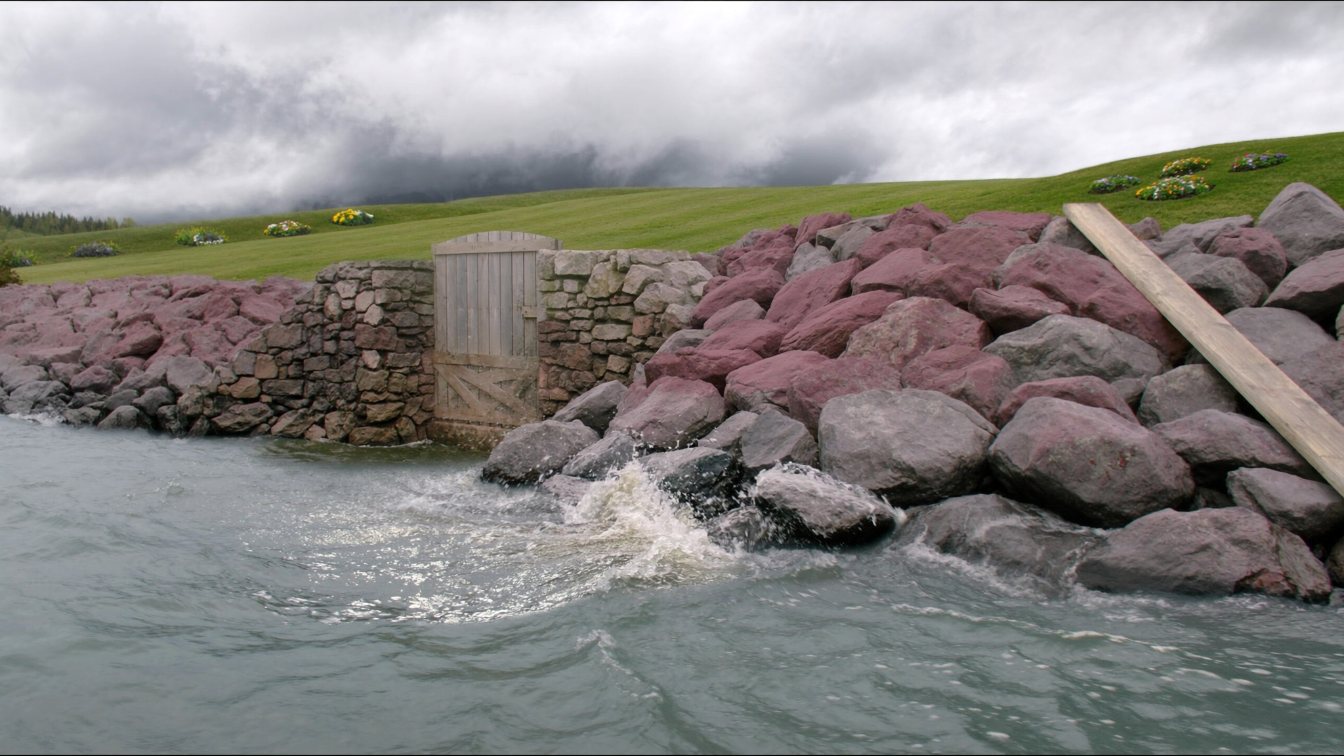
Every private lot on the GTA shoreline has one of five things at the edge: nothing, a sloped stone revetment, a vertical seawall or bulkhead, gabion baskets, or groynes reaching into the lake. They behave differently. A revetment of armour stone on a slope dissipates wave energy and is what conservation authorities now expect; a vertical wall deflects energy, scours its own toe and can worsen erosion on the lots beside it; groynes trap sand on one side and starve the next. None is permanent, all need inspection and maintenance, and the owner pays for all of it: TRCA has said plainly that its assistance programs exclude Lake Ontario waterfront properties. New work needs a conservation authority permit under Ontario Regulation 41/24 and, for anything in the water that could harm fish habitat, a federal review. A buyer should read the wall the way an inspector reads a roof: what is it, who built it, when, with what permit, and how long does it have left.
The five things you will see
| Structure | What it does | What goes wrong |
|---|---|---|
| Revetment (armour stone, rip-rap) | Sloped layers of large stone over filter and toe layers; dissipates wave energy | Stones displaced by storms and ice; toe scour if the filter and toe are under-built; needs periodic resetting |
| Vertical seawall or bulkhead (concrete, steel sheet pile, timber) | Holds the bank in place behind a wall | Deflects rather than absorbs energy; scours its own toe; increases erosion on adjacent lots; suited only to low or moderate wave action |
| Gabions | Wire baskets of stone used as armour units | Baskets corrode and split; stones spill; relatively short life on an exposed shore |
| Groynes | Structures perpendicular to shore that slow sand movement | Trap sediment updrift and starve the downdrift neighbour; the Beach’s 1930 groynes are the public example |
| Nothing | Natural bank or beach | Erodes at the local rate; may be the cheapest option where the setback is generous |
The United States FEMA guidance on shorelines puts the vertical-wall problem plainly: vertical seawalls often deflect wave energy instead of dissipating it, which can make the shoreline more subject to erosion, and bulkheads suit only low to moderate wave action. Canadian inspection references describe precast concrete walls as lasting roughly 60 years on average and note that all hard structures need periodic inspection and ongoing maintenance, repair or replacement. Lake Ontario’s north shore, with open-water fetch and winter ice, is not low wave action.
What the old walls taught
The GTA shoreline is a museum of failed protection. A study of ten kilometres of Stoney Creek shoreline from 1934 to 1979 found that as owners armoured their frontage, from 30 to 64 percent of the shore, 71 percent of the structures were damaged or destroyed within ten years and 87 percent within twenty, with failures peaking in high-water years. The authors blamed poor design and construction and a lack of coordination between adjacent owners. That last point is the one buyers miss: a wall that protects your lot by reflecting waves onto the neighbour’s makes their erosion your problem when their bank fails behind your wall’s end. Read the Stoney Creek guide.
Who pays: you
There is no public program that funds private shoreline protection on Lake Ontario in the GTA. TRCA states that its ability to support private landowners is limited to funding from municipal partners, that its current assistance is confined to Toronto ravine properties and explicitly excludes waterfront properties adjacent to Lake Ontario, and that where it does work benefiting private land the owner signs a binding agreement and contributes to the cost. The $84 million Toronto Waterfront Erosion Hazard Mitigation Project announced in 2019 covers roughly ten kilometres of public shoreline and 80 public structures. The Town of Oakville protects the eight kilometres it owns; Hamilton is planning for Confederation Beach. Your frontage is yours. A Canadian home inspection reference puts typical shoreline repair projects at $40,000 to $200,000 and notes insurance does not cover the damage in most cases; treat that as an order of magnitude, not a quote.
The permits a new structure needs
Shoreline protection is development within a conservation authority’s regulated area under Ontario Regulation 41/24, so a permit from TRCA, Credit Valley Conservation, Conservation Halton or the Hamilton Conservation Authority is required before any municipal permit. The authority will want a site plan, a survey showing the top of bank or flood line, and for anything substantial a coastal engineer’s design. Conservation Halton, for example, requires a five-metre unobstructed maintenance access and assesses works over a 35-year design life. The authority will also ask whether the work simply transfers erosion to the neighbour. Where the structure enters the water, Fisheries and Oceans Canada requires an authorization if the project is likely to cause the harmful alteration, disruption or destruction of fish habitat; proponents self-assess and can request a DFO review. Allow months, not weeks.
Reading a wall as a buyer
- What is it? Sloped stone or vertical wall; stone size; whether there is a visible toe and filter layer.
- Who built it and when? Ask for the contractor, the engineer and the date.
- Is it permitted? Ask the seller for the conservation authority permit and, if none, ask the authority. Unpermitted work can be ordered removed at the owner’s cost.
- How is it doing? Displaced stones, cracks, toe scour, sinkholes behind the wall, leaning sheet pile and rusted gabion wire are all signs.
- What did 2017 and 2019 do to it? Ask for photographs from the high-water years.
- What are the neighbours’ structures? A vertical wall next door is a load on your bank.
- What would replacement involve? Access for machinery, the authority’s current standard, and an engineer’s estimate.
For anything on a bluff or with an ageing structure, a coastal engineer’s inspection before you waive is cheap relative to the asset. Read the full due diligence checklist.
Reading a wall as a seller
If your shoreline is engineered and permitted, it is one of the most valuable things on the lot; put the permit, the drawings and the inspection record in the listing package. If it was built without a permit, find out from the authority what regularizing it would take before you list, because the buyer’s lawyer will find out anyway. If it is failing, price for it or fix it; do not photograph around it. Read what buyers will ask for.
The lake itself
Protection is designed against water levels, and the levels have moved. The International Joint Commission’s record monthly means are 75.88 metres in 2017 and 75.92 metres in 2019, with daily gauge readings reported higher, and the 2019 high was driven by record Lake Erie outflow, record Ottawa River flows and heavy precipitation rather than by the regulation plan. Conservation Halton issues a shoreline hazard warning when the static level passes 75.9 metres. A wall built for the levels of the 1990s has met water it was not designed for twice in three years. Ask the engineer what level the structure was designed to, and whether it matches the ones the lake has actually reached.
The takeaway
A sloped armour stone revetment dissipates waves; a vertical wall deflects them onto its own toe and the neighbours; groynes starve the downdrift lot; gabions rust. All of it needs a conservation permit, possibly a federal review, an engineer, and the owner’s money, because no public program funds private Lake Ontario frontage. Read an existing wall for type, builder, date, permit, condition and what 2017 and 2019 did to it, and price the lot on what you learn.
Where I fit
I sell on the water from Hamilton to Scarborough and I ask about the wall before I ask about the kitchen. If you are buying or selling a lot with shoreline structures, book a call and I will tell you what to ask the engineer, or run the estimator below on your current home.
Free tool — AI home value estimator
Instant Home Valuation
What’s your home
worth today?
Answer six quick questions and get an instant value range built from current Toronto & GTA sale data — property type, size, condition, lot and location all weighted the way a real pricing conversation weighs them. Takes about ninety seconds.
Reading recent GTA sale data…
Building your estimate
Estimated market value
—
$0–$0
Most likely value $0 · roughly $0 per square foot
What moved the number
Starting from the area baseline for your property type, here’s what each answer added or subtracted.
Market context
Recent local averages for comparison.
—
A range is a starting point.
A strategy is what sells.
This model doesn’t know that your neighbour’s identical semi went $80,000 over asking last month, or which two upgrades actually pay back in your area. That conversation is free and takes twenty minutes.
Frequently asked questions
What is the best shoreline protection for a Lake Ontario house?
Conservation authorities generally expect sloped armour stone revetments, which dissipate wave energy, rather than vertical walls, which deflect it and can worsen erosion on their own toe and on neighbouring lots. The right design depends on the specific shore and needs a coastal engineer.
Does the government pay for shoreline protection on private property?
No. TRCA’s assistance excludes Lake Ontario waterfront properties, and public erosion funding in Toronto, Oakville and Hamilton covers public shoreline only. The owner pays.
Do I need a permit to build a seawall or armour stone on Lake Ontario?
Yes, from the conservation authority under Ontario Regulation 41/24 before any municipal permit, and for in-water work a federal fisheries review may be required.
How long does shoreline protection last?
It depends on design, construction, exposure and maintenance. Inspection references cite roughly 60 years for well-built precast concrete, but all hard structures need periodic inspection and eventual repair or replacement, and the Stoney Creek record shows poorly built walls failing within ten to twenty years.
Does home insurance cover a failed seawall?
Generally no. Earth movement is excluded from standard policies and the structure itself is rarely covered. Budget for it as a capital item.
Can my neighbour’s seawall damage my shoreline?
Yes. Vertical walls deflect wave energy sideways and groynes trap sand updrift, both of which can increase erosion on adjacent lots. Look at what the neighbours have built before you buy.
What water level should shoreline protection be designed for?
Ask the engineer. Lake Ontario’s record monthly means were 75.88 metres in 2017 and 75.92 metres in 2019, above what many older structures were designed to withstand.
Sources
- FEMA P-2181 — Fact sheet 5.4, Shorelines — structure types and behaviour
- Canadian Home Inspection Services — Breakwalls — materials, life, cost range
- TRCA — Erosion risk management — private waterfront excluded
- Journal of Great Lakes Research — Stoney Creek shoreline 1934–1979 — structure failure rates
- Conservation Halton — Policies and Guidelines (amended June 2024) — maintenance access, design life
- Fisheries and Oceans Canada — Projects near water — fish habitat authorization
- International Joint Commission — Impacts of extreme 2019 high water levels — record levels and causes
- Government of Canada, 4 September 2019 — Toronto waterfront erosion hazard mitigation — public program scope
Related reading
- Niagara-on-the-Lake waterfront homes
- Port Perry and Lake Scugog waterfront homes
- What $3 million buys on the GTA waterfront
- What $5 million and up buys on the GTA waterfront
- Shoreline erosion and your property line
- Stoney Creek lakefront homes
- Scarborough Bluffs: buying on the edge
- Conservation permits on shoreline property
- Waterfront house due diligence checklist
About the author — Jatin Dua, Toronto and GTA real estate broker
I am Jatin Dua, Broker of Record and co-founder of RE/MAX Quantum Realty Inc., Brokerage, Unit 101, 799 The Queensway, Etobicoke. I work with buyers and sellers across Toronto and the GTA, with deep local knowledge of the west end and the Lake Ontario shoreline. Four-plus years of active GTA transactions and over $100 million in sales volume. Every market figure here comes from TRREB’s published tables and every rule from the regulator or the legislation, so you can check all of it without asking me.
Reach me at connect@jatindua.com or 833-330-1925, or book a call.