
Published 2 November 2026 · By Jatin Dua, Broker of Record, RE/MAX Quantum Realty
The best realtor in Applewood for 2027 handles both older condo towers and 1950s-to-1970s houses: they read a status certificate line by line and price houses from real sales. Mississauga condo apartment medians fell 9.3% to $485,000 (Jan–Oct 2026) and took 42 days to sell, so ask for written pricing evidence.
This guide is for Applewood owners who may sell in 2027 and for buyers weighing a condo or a house in east Mississauga. You will get verified city price data by home type, the checks that matter in older buildings and older houses, the questions to ask an agent, and the red flags that should end an interview.
What is Applewood, and what kinds of homes are there?
Applewood is a district in east Mississauga made up of several neighbourhoods that carry the name, including Applewood Acres, Applewood Heights and Applewood Hills. It runs roughly between Burnhamthorpe Road, Cawthra Road, the Queen Elizabeth Way and Etobicoke Creek, and it is named for the apple orchards that once covered the land.
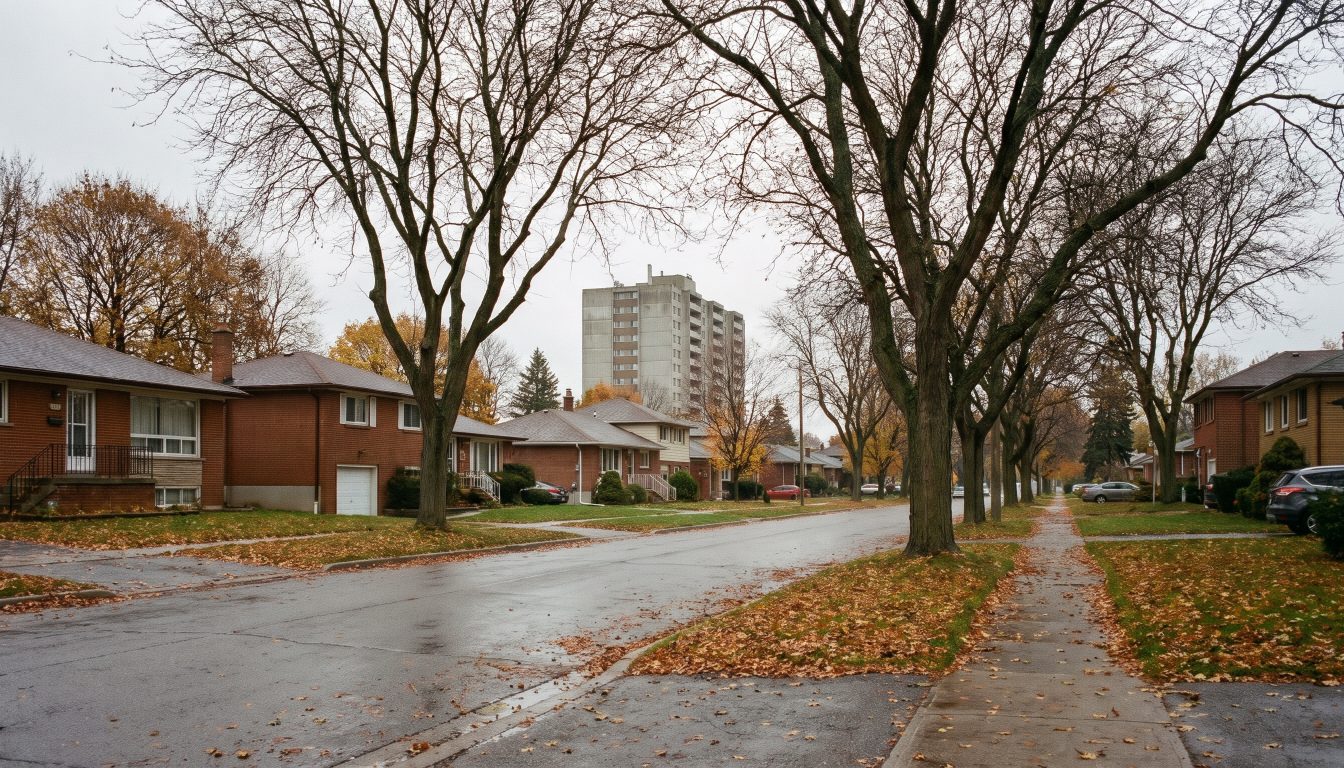
The City of Mississauga’s community profile says the area grew from two small villages, Dixie and Burnhamthorpe, and stayed mostly rural until the mid-1950s. That is when G.S. Shipp & Sons began building the Applewood Heights subdivision at Dundas Street and Tomken Road. Around the same time, the Dixie industrial area south of Dundas Street was being promoted for business. The City describes today’s Applewood as an established community with detached and semi-detached houses, townhouses, apartments and even mobile homes.
The mix is what makes Applewood unusual. Here is what the City published from the 2001 census:
| Measure (2001 census) | Applewood | Mississauga |
|---|---|---|
| Homes in apartment buildings of 5+ storeys | 45.8% | 24.7% |
| Single-detached houses | 23.6% | 44.6% |
| Semi-detached houses | 12.3% | 12.4% |
| Row houses | 11.1% | 13.1% |
| Homes that were rented | 46.0% | 28.2% |
| Homes built 1961 to 1980 | 78.3% | 40.7% |
Source: City of Mississauga, Applewood Community Profile (February 2004), 2001 census data. The last row adds the 1961–1970 and 1971–1980 rows.
The figures are old, but the buildings have not moved. Most of Applewood’s homes date from the 1960s and 1970s, and nearly half sit in mid-rise or high-rise apartment buildings. That means an agent who only knows houses, or only knows condos, will miss half the picture here.
What are Mississauga condo and house prices doing heading into 2027?
No one publishes a reliable median for Applewood alone, and I will not invent one. Here are verified numbers for the whole city by home type. Use them as context, not as the price of your unit or house.
| Mississauga home type | Median, Jan–Oct 2026 | Change vs 2025 | Change vs 2024 | Sales 2026 (change vs 2025) | Avg. days on market 2026 |
|---|---|---|---|---|---|
| Condo apartment | $485,000 | −9.3% | −16.8% | 1,213 (−4.9%) | 42 |
| Condo townhouse | $689,300 | −8.1% | −13.6% | 777 (−2.6%) | 37 |
| Freehold townhouse | $880,000 | −7.4% | −11.1% | 152 (−11.1%) | 29 |
| Semi-detached | $885,000 | −7.3% | −11.5% | 662 (+0.2%) | 26 |
| Detached | $1,225,000 | −5.8% | −10.7% | 1,798 (+3.3%) | 31 |
Source: TRREB MLS data via REALM, January–October 2026 vs the same period of 2025 and 2024. City of Mississauga as a whole, not Applewood alone. Medians, not forecasts.
Three things stand out for Applewood:
- Condos fell the most. In October 2026 alone, TRREB reported 128 condo apartment sales in Mississauga at a median of $458,500, with 812 units for sale. They took 44 days on average and sold for 96% of asking.
- Houses held up better. Semi-detached sales were flat and detached sales rose, even as prices eased.
- Rates rose. The Bank of Canada raised its policy rate to 2.50% on 28 October 2026, and big-bank prime is now 4.70%. That hits condo buyers with small down payments hardest.
If you own a unit, my guide to how much your Mississauga condo is worth walks through what moves a single unit’s price.
Why does an Applewood condo sale need extra homework?
Buildings from the 1960s and 1970s are now more than 45 years old. Big parts such as roofs, windows, elevators, garages and plumbing wear out on a schedule, and the condo corporation pays for them from the reserve fund. A buyer’s lawyer will read the status certificate, and a good listing agent reads it first.
Under section 76 of Ontario’s Condominium Act, the corporation must give a status certificate within 10 days after it receives the request and the fee. Among other things, it must include:
- the common expenses (condo fees) for the unit and any amount owing;
- any fee increase the board has declared since the current budget, and why;
- any special assessment levied to boost the reserve fund, and why;
- a statement about the most recent reserve fund study, the amount in the reserve fund, and any current plans to increase it;
- major changes to the common elements the board has proposed but not yet done;
- the budget, the last audited financial statements and any outstanding legal actions.
For sellers, ordering the certificate before listing lets your agent spot a fee increase or planned project early and price for it. For buyers, it is the single best way to avoid a surprise bill. My guide on reserve funds and special assessments explains what the numbers mean.
Instant Home Valuation
What’s your home
worth today?
Answer six quick questions and get an instant value range built from current Toronto & GTA sale data — property type, size, condition, lot and location all weighted the way a real pricing conversation weighs them. Takes about ninety seconds.
Reading recent GTA sale data…
Building your estimate
Estimated market value
—
$0–$0
Most likely value $0 · roughly $0 per square foot
What moved the number
Starting from the area baseline for your property type, here’s what each answer added or subtracted.
Market context
Recent local averages for comparison.
—
A range is a starting point.
A strategy is what sells.
This model doesn’t know that your neighbour’s identical semi went $80,000 over asking last month, or which two upgrades actually pay back in your area. That conversation is free and takes twenty minutes.
What should you check on an older Applewood house?
The detached and semi-detached homes in Applewood are mostly 50 to 70 years old. Good agents look past the staging to the things that cost money.
Trees
Mature trees are part of the appeal, but in Mississauga you need a permit to injure or remove any private tree 15 cm (6 inches) or more in diameter, including dead or dying trees. The base fee is $399.77 (HST included) as of November 2026, plus $139.72 for each additional healthy tree, and the City requires replacement trees. Plan any addition, pool or driveway around them.
Basement apartments
Many buyers want income from a basement unit. In Mississauga, every second unit must meet the Building Code, Fire Code and zoning and be registered with the City. Registration is free, but permits and inspections are not. The City keeps a Second Units Registry List, updated in the second week of every month. If a unit is not on the list, it is not registered. A listing that says “legal basement apartment” should be able to point to it.
Records
Ask for the survey, permit history and receipts for big items such as the roof, windows and furnace. Buyers of older homes will ask, and having the answers ready supports your price.
A low condo fee in an older Applewood building is not always good news. It can mean the reserve fund is thin and a special assessment or a sharp fee increase is coming. Before you firm up, have a lawyer review the full status certificate, including the reserve fund study statement and any proposed projects, and make your offer conditional on that review.
What questions should you ask an Applewood realtor before hiring?
- How many condo sales and how many house sales have you handled, and can you show me how you priced each?
- For a condo: will you order and read the status certificate before we list? What would make you change the price?
- For a house: which recent sales are you using, and how did you adjust for lot size, age and updates?
- Condo apartments in Mississauga are taking about six weeks to sell. What is your plan if we have no strong offer by week four?
- Who is the likely buyer: a first-time buyer, an investor, a downsizer or a family? How will you reach them?
- Will you be my designated representative, and what happens if your brokerage also represents a buyer?
- What is your fee, what services does it include, and how long is the holdover period?
For more, see my list of questions to ask a realtor in Ontario.
In a slower condo market, the listing that wins is the one with no unanswered questions. For an Applewood unit, I want the status certificate, the last few months of fee history and a short plain-English summary of the reserve fund in the buyer’s hands from day one. Buyers who can see the numbers make firmer offers. Buyers who have to guess either walk away or bid low to cover the risk.
How do fees and representation agreements work in Ontario?
The Real Estate Council of Ontario (RECO) says you and the brokerage decide what you pay. The amount is not fixed by RECO, the government or any real estate board. It can be a fixed amount, a percentage, or both, but not an amount based on the difference between the list price and the sale price.
Your agreement must show its expiry date prominently on the first page, and there is no standard term. Most agreements include a holdover clause, which can mean you owe a fee for a sale that closes after the agreement ends. RECO says there is no minimum or set holdover period, so settle the length before you sign. If you are a buyer, check the scope of your buyer agreement too: it may cover a specific property, an area or a type of home.
If the same agent represents both buyer and seller, that is multiple representation. RECO says it is not allowed unless every client involved agrees. Ask any agent how they handle it before you sign. My guide to holdover clauses covers the fine print.
What are the red flags when choosing an Applewood agent?
- No plan to read the status certificate before listing a condo.
- A condo price based on the asking prices of other units rather than recent sales in the same or similar buildings.
- “Legal basement apartment” in the listing with no registration to back it up.
- Brushing off fee increases or special assessments as something the buyer’s lawyer will deal with.
- Pressure to sign a long agreement before you have compared anyone.
- Not registered, or a recent discipline record, on RECO’s public register, which shows enforcement activity from the past five years.
Should you hire an Applewood specialist or a GTA-wide agent?
Applewood buyers rarely shop Applewood alone. In my experience, condo buyers compare units across east Mississauga and over Etobicoke Creek into Etobicoke, while house buyers often look at Lakeview, Mineola and Cooksville too. The right agent knows Applewood’s buildings and streets and can price your home against all of those choices. For the wider city, see my guide to choosing a realtor in Mississauga.
What to do next
- Condo owners: order the status certificate and gather your last year of fee notices.
- House owners: find your survey, permit history and receipts for major work, and check the City’s second unit registry if you have a basement apartment.
- Interview two or three agents with the same questions and look each up on RECO’s public register.
- Ask each for a written price plan built on recent sales of the same home type.
- Before you sign, confirm the fee, expiry date, holdover period, services and type of representation in writing.
Need help with this? Talk to me.
I’m Jatin Dua, Broker of Record at RE/MAX Quantum Realty, and I’m the best agent to do this kind of work for you in Toronto and across the GTA. Over $100 million in GTA sales and 100+ families helped sell. Feel free to contact me any time: call or text 833-330-1925 or email [email protected].
Frequently asked questions
Who is the best realtor in Applewood, Mississauga?
No public ranking can name the best realtor in Applewood, so judge agents on evidence. In 2027, choose one who has sold both condos and houses, reads the status certificate before listing a unit, prices from recent Mississauga sales, gives you a written marketing plan, and is registered in good standing on RECO’s public register.
What is the average condo price in Mississauga?
The median condo apartment price in Mississauga was $485,000 from January to October 2026, down 9.3% from 2025, per TRREB MLS data via REALM. Units took 42 days to sell on average. Applewood’s older buildings can sell above or below that figure, so compare recent sales in the same building before you buy or sell in 2027.
What is the average house price in Applewood, Mississauga?
There is no reliable public median for Applewood alone. For Mississauga as a whole, TRREB MLS data via REALM shows a median detached price of $1,225,000 and a semi-detached median of $885,000 from January to October 2026. Applewood houses vary by lot, age and updates, so ask for comparable local sales before pricing in 2027.
Are condo prices going down in Mississauga?
Yes, compared with 2025. Mississauga’s median condo apartment price fell 9.3% to $485,000 from January to October 2026, and 16.8% from the same months of 2024, per TRREB MLS data via REALM. In October 2026 the median was $458,500. Applewood condo sellers heading into 2027 should price from recent sales, not old highs.
What does a status certificate show in Ontario?
A status certificate shows the condo’s fees, any money owing, recent fee increases and special assessments, the reserve fund study and balance, the budget and audited financials, and pending legal actions. Under section 76 of Ontario’s Condominium Act, the corporation must provide it within 10 days of a paid request. Applewood buyers in 2027 should have a lawyer review it.
How long does it take to sell a condo in Mississauga?
About six weeks on average. Condo apartments in Mississauga took an average of 42 days to sell from January to October 2026, up from 31 days in the same months of 2024, per TRREB MLS data via REALM. In October 2026 the average was 44 days, so plan an Applewood condo sale in 2027 with that timeline.
Is a basement apartment in Mississauga legal if the seller says it is?
Only if it is registered with the City. Mississauga requires every second unit to meet the Building Code, Fire Code and zoning and to be registered. The City’s Second Units Registry List is updated in the second week of every month. If an Applewood unit is not on the list in 2027, it is not registered.
Do I need a permit to cut down a tree in Mississauga?
Yes, for any private tree 15 cm (6 inches) or more in diameter, even if it is dead or dying. As of November 2026, Mississauga’s base permit fee is $399.77 with HST, plus $139.72 for each additional healthy tree, and replacement trees are required. Applewood owners should apply before any work starts.
How much commission does a realtor charge in Mississauga?
There is no set rate in Mississauga. RECO says the amount is negotiated between you and the brokerage and is not fixed by RECO, the government or any real estate board. It can be a flat fee, a percentage or both. In 2027, compare what services each Applewood agent includes before you compare the fee.
Sources
- City of Mississauga: Applewood Community Profile (February 2004)
- Wikipedia: Applewood, Mississauga (background on boundaries and neighbourhood names)
- Ontario e-Laws: Condominium Act, 1998 (section 76, status certificates)
- City of Mississauga: Tree permits
- City of Mississauga: Registering a second unit
- TRREB Market Watch, October 2026
- RECO: Signing a contract with a real estate brokerage
- RECO: Make sure your real estate agent is registered
Related reading
- Best Realtor in Lorne Park (Mississauga) for 2027: How to Choose
- Best Realtor in Port Credit (Mississauga) for 2027: How to Choose
- Best Realtor in Erin Mills (Mississauga) for 2027: How to Choose
- Best Realtor in Churchill Meadows (Mississauga) for 2027: How to Choose
About the author — Jatin Dua, Toronto and GTA real estate broker
I am Jatin Dua, Broker of Record and co-founder of RE/MAX Quantum Realty Inc., Brokerage, Unit 101, 799 The Queensway, Toronto. I work with buyers and sellers across Toronto and the GTA and have helped more than 100 families sell. Four-plus years of active GTA transactions and over $100 million in sales volume.
Reach me at [email protected] or 833-330-1925, or book a call.