

Published 8 August 2026 · Updated 7 September 2026 · By Jatin Dua, Broker of Record, RE/MAX Quantum Realty
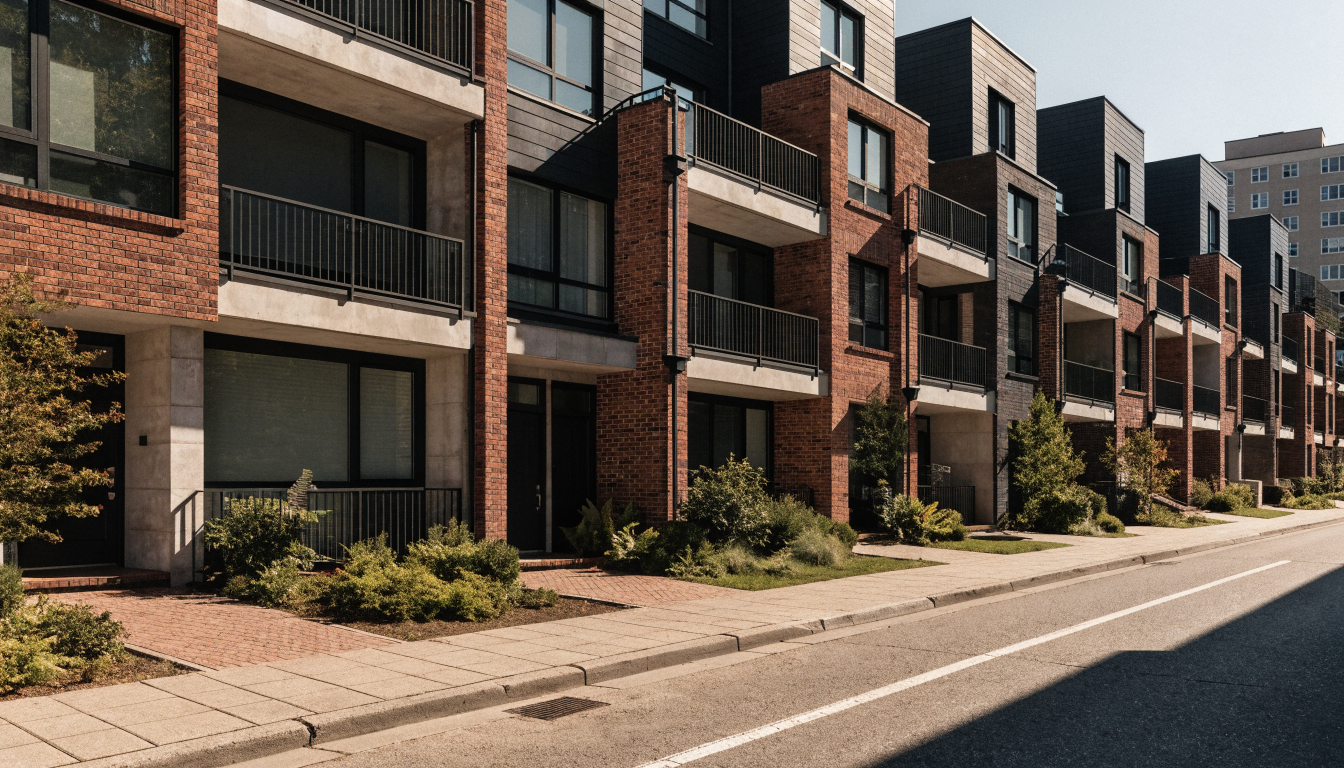
A condo townhouse gives you the house format — your own front door, usually two or three storeys, often a small yard or terrace — with condominium ownership. You pay a maintenance fee and the corporation handles exterior maintenance, roofing, landscaping and snow. It is the natural middle step between a condo apartment and a detached house, and in Etobicoke it is where a lot of families land when detached is out of reach but a one-bedroom is not enough. The three things to get right before buying: know whether it is a standard condominium, a common elements condominium (POTL), or freehold, because your obligations differ completely; read the status certificate and reserve fund study, since townhouse corporations own a lot of roof and envelope; and check the rules on pets, parking and what you may alter.
This is the most overlooked property type in Etobicoke, and the reason is that it sits awkwardly between two things buyers search for. People search “condo” or they search “house.” Condo townhouses get missed by both.
Which is a shame, because the format solves a genuine problem: you get a house layout without a house price, and without a house’s maintenance burden. For a family that needs three bedrooms and stairs but cannot reach detached, or a downsizer who wants to stop shovelling but is not ready for apartment living, it is frequently the right answer.
The complications are all in the ownership structure, and that is where buyers get caught. Here is what to know.
The three ownership structures — get this right first
Three townhouses on the same street can be owned three different ways. The listing does not always make it obvious.
Standard condominium townhouse
You own your unit; the corporation owns the exterior, roof, land and common areas. You pay a monthly maintenance fee. The corporation handles roofing, exterior repairs, landscaping and snow clearing. Most rules that apply to an apartment condo apply here too — pets, alterations, parking.
Common elements condominium — POTL
A Parcel of Tied Land. You own your house and lot freehold, but you also hold a share in a common elements corporation — typically the private road, visitor parking, landscaped areas.
You pay a smaller monthly fee covering only those common elements. You are responsible for your own roof, windows and exterior. People buy POTLs assuming the fee covers the roof and discover otherwise when it needs replacing. Ask explicitly what the fee covers.
Freehold townhouse
You own everything, no fee, no corporation. Full control and full responsibility.
Why this decides your budget
Two identical-looking townhouses can have completely different true monthly costs and completely different long-term liabilities. A standard condo with a $500 fee that covers the roof may be cheaper over fifteen years than a POTL with a $150 fee where you fund your own roof and windows.
Confirm the structure in writing before you offer, and have your lawyer review the declaration.
Who this suits: Standard condo, POTL or freehold changes what you pay and what you are liable for. Confirm which one it is before you make an offer, not after.
Thinking about buying or selling here?
I work this area every week and I will give you a straight answer, including when the answer is to wait. No pressure, and no drip campaign you cannot get out of.
Call or text 833-330-1925 Send me a message
Jatin Dua, Broker of Record — RE/MAX Quantum Realty Inc., Brokerage. Not intended to solicit buyers or sellers currently under contract with another brokerage.
Stacked towns versus traditional condo townhouses
Traditional condo townhouse
Full-height, typically two or three storeys, your own ground-floor entrance, frequently a small private yard, and usually a garage or dedicated parking. Closest thing to a house.
Stacked townhouse
Units stacked vertically — one occupying the lower levels, another the upper, each with its own exterior entrance. Upper units often have a rooftop terrace instead of a yard, and access may be by an exterior staircase.
Stacked towns are cheaper and that is the appeal. They are common along The Queensway corridor and in newer Etobicoke infill.
What to actually check on a stacked unit
Stairs. An upper stacked unit can mean carrying groceries up an exterior staircase in February. Fine at 30, less fine at 70, and a real consideration for anyone with mobility issues or young children.
Noise. You have neighbours above or below, so it behaves more like an apartment than a house acoustically. Ask about the construction between units.
The terrace. Often exclusive-use common element rather than owned — which affects what you may put on it and who repairs the membrane underneath. Membrane failure on a rooftop terrace is expensive.
Who this suits: Traditional towns feel like houses; stacked towns are cheaper but behave more like apartments. Check the stairs, the acoustics and who owns the terrace.
The status certificate matters more here than you think
People treat status certificate review as an apartment-condo thing. On townhouses it matters more, not less.
Why
A townhouse corporation typically owns a lot of roof, siding, windows and private road relative to the number of units. Those are big, lumpy, predictable expenses that all come due around the same time — because the whole complex was built at once.
An apartment tower spreads its roof across hundreds of units. A 40-unit townhouse complex spreads the same category of cost across forty. Special assessments hit harder in small corporations.
What to look for
The reserve fund balance against what the reserve fund study says is required — not the balance in isolation. Any special assessment levied or contemplated. The age of roofs, windows, siding and the private road, and when they are scheduled for replacement. The fee increase history. Any litigation.
The age question
Complexes built in the 1980s and 1990s are reaching the point where roofs, windows and roads all need doing. A well-run corporation has been funding for it. A poorly run one has kept fees artificially low and will assess.
A low maintenance fee is not automatically good news — it is often a warning sign. Compare the fee against the reserve fund study, not against other complexes.
Get a lawyer to read it
Not you, skimming it. This document is the largest financial risk in the transaction and it is written to be reviewed by someone who does it professionally.
Who this suits: Townhouse corporations own a lot of roof across few units, so special assessments bite harder. Read the reserve fund study, not just the fee.
Who condo townhouses genuinely suit in Etobicoke
Families priced out of detached
The strongest case. You get three bedrooms, stairs, a front door and often a small yard, at a price well below detached in the same area. In Stonegate-Queensway that can mean the Norseman catchment — a school rated 8.1/10 and ranked 313th of 3,052 in Ontario — at a townhouse price rather than a detached one. That is the single best value trade for a family in Etobicoke.
Downsizers
You stop maintaining a roof and shovelling a driveway without moving into an apartment. For people leaving a detached home in Alderwood or Markland Wood but not ready for tower living, this is often the right step.
If mobility is a consideration, favour a traditional town over a stacked upper unit, and check whether the main floor works.
Pet owners
Ground-floor access and often a small yard make townhouses genuinely better for dogs than apartments. But condominium pet rules still apply — size restrictions, breed restrictions and number limits are common. Get the rules in writing from property management; do not assume a townhouse means no restrictions.
Who should look elsewhere
Renovators. You cannot alter the exterior, and interior alterations may need corporation approval. If your plan involves changing windows, adding a rear extension or altering the facade, buy freehold.
Anyone wanting full control. You are governed by a declaration, by-laws and rules, and by a board. If that prospect irritates you, it will keep irritating you.
Who this suits: The best value trade in Etobicoke for a family needing three bedrooms in a strong catchment — provided you do not want to alter the exterior.
Townhouse ownership structures compared
| Standard condo townhouse | Common elements (POTL) | Freehold townhouse | |
|---|---|---|---|
| You own | Unit | House and lot | Everything |
| Corporation owns | Exterior, roof, land, commons | Private road, visitor parking, commons | Nothing |
| Monthly fee | Higher | Lower | None |
| Who pays for the roof | Corporation | You | You |
| Snow and landscaping | Corporation | Common areas only | You |
| Rules apply? | Yes — full | Limited | No |
| Status certificate | Essential | Essential | N/A |
| Best for | Low maintenance, predictable costs | Lower fee, more control | Full control, full responsibility |
Looking at a townhouse? Let me check the structure first.
Send me the listing and I will confirm whether it is a standard condominium, a POTL or freehold, what the fee actually covers, and what the reserve fund position looks like — before you commit. That is the check that decides whether the monthly cost you were quoted is the real one.
Talk to JatinFree home valuationNet proceeds calculatorConfidential. Reviewed personally and answered within 24 hours. I never share, sell or distribute your information.
Free tool — AI condo value estimator
Condo Valuation
What’s your condo
worth today?
Three quick steps. Condos don’t price like houses — your floor, your view, and whether you own parking move the number more than anything else. This weighs all of them.
Reading recent condo sales…
Estimated market value
—
$0–$0
Most likely $0 · about $0 per square foot
What moved the number
Starting from what comparable units in your area sell for, here’s what your specifics added or subtracted.
Market context
—
—
Two units, same floor plan,
$90,000 apart.
That happens constantly in condos — one has the parking, the right exposure, or a board that keeps the reserve fund healthy. A model can’t see your status certificate. I can.
Frequently asked questions
What is the difference between a condo townhouse and a freehold townhouse?
In a standard condominium townhouse you own your unit while the corporation owns the exterior, roof, land and common areas, and you pay a monthly maintenance fee covering exterior repairs, landscaping and snow clearing. In a freehold townhouse you own everything, pay no fee and have full control and full responsibility. There is also a middle structure — a common elements condominium or POTL — where you own the house and lot freehold but hold a share in a corporation owning the private road and common areas, paying a smaller fee that typically does not cover your roof or windows.
What is a POTL townhouse?
A Parcel of Tied Land. You own your house and lot freehold, but ownership is tied to a share in a common elements condominium corporation that owns shared infrastructure such as the private road, visitor parking and landscaped areas. You pay a smaller monthly fee than a standard condominium, but you remain responsible for your own roof, windows and exterior. Buyers frequently assume the fee covers the roof and discover otherwise when it needs replacing — always ask explicitly what the fee covers and have a lawyer review the declaration.
Are condo townhouses a good buy for families in Etobicoke?
They are often the best value trade available. You get three bedrooms, stairs, your own front door and frequently a small yard, at a price well below detached in the same area. In Stonegate-Queensway that can put you in the Norseman Junior Middle School catchment — a school rated 8.1 out of 10 and ranked 313th of 3,052 Ontario elementary schools — at a townhouse price rather than a detached one. The main limitation is that you cannot alter the exterior, so renovators should buy freehold instead.
What should I check in a townhouse status certificate?
The reserve fund balance measured against what the reserve fund study says is required, not the balance in isolation. Any special assessment levied or under discussion. The age and replacement schedule of roofs, windows, siding and the private road. The maintenance fee increase history, and any litigation involving the corporation. This matters more in townhouse complexes than apartment buildings because the corporation owns a great deal of roof and envelope across relatively few units, so major expenses hit each owner harder. A low maintenance fee is frequently a warning sign rather than good news.
What is the difference between a stacked townhouse and a traditional one?
A traditional condo townhouse is full-height, typically two or three storeys with its own ground-floor entrance and often a small private yard and garage — closest to a house. A stacked townhouse has units above and below one another, each with its own exterior entrance, with upper units often having a rooftop terrace instead of a yard and access by exterior staircase. Stacked towns are cheaper and common along The Queensway corridor, but they behave acoustically more like apartments, the stairs are a genuine consideration for mobility, and rooftop terraces are often exclusive-use common element rather than owned.
Can I have a dog in an Etobicoke condo townhouse?
Usually, and ground-floor access plus a small yard makes townhouses genuinely better suited to dogs than apartments. However, condominium pet rules still apply in standard condominium townhouses — size restrictions, breed restrictions and limits on the number of animals are all common. Do not assume that a townhouse format means no restrictions. Obtain the declaration, by-laws and rules in writing from property management before you commit, and have your lawyer confirm the position.
Condo townhouses in Etobicoke, Toronto provide a house format — own front door, typically two or three storeys, often a small yard or terrace — under condominium ownership with a monthly maintenance fee. Three ownership structures exist and differ substantially: a standard condominium townhouse where the corporation owns the exterior, roof, land and common areas; a common elements condominium or Parcel of Tied Land (POTL) where the owner holds the house and lot freehold but pays a smaller fee for shared infrastructure and remains responsible for their own roof and windows; and a freehold townhouse with no fee and full owner responsibility. Stacked townhouses have units above and below one another, are cheaper, are common along The Queensway corridor, and behave acoustically more like apartments, with rooftop terraces often being exclusive-use common element rather than owned. Status certificate and reserve fund review is particularly important for townhouse corporations because they own substantial roof and building envelope across relatively few units, making special assessments proportionally heavier; a low maintenance fee can indicate underfunding rather than efficiency. Condo townhouses suit families priced out of detached homes — including access to the Norseman Junior Middle School catchment in Stonegate-Queensway at townhouse pricing — and downsizers, but not buyers intending to alter the exterior.
Thinking about buying or selling here?
I work this area every week and I will give you a straight answer, including when the answer is to wait. No pressure, and no drip campaign you cannot get out of.
Call or text 833-330-1925 Send me a message
Jatin Dua, Broker of Record — RE/MAX Quantum Realty Inc., Brokerage. Not intended to solicit buyers or sellers currently under contract with another brokerage.
Sources and further reading
Ontario Condominium Act, 1998 — standard condominium and common elements condominium structures, status certificate and reserve fund study requirements · Fraser Institute Report Card on Ontario’s Elementary Schools (Norseman rating and provincial ranking) · Toronto District School Board catchment information. Ownership structures, fees, reserve fund adequacy and corporation rules are property-specific and must be verified for each individual property.
Looking at Etobicoke more broadly? Start with my Etobicoke community guide — the neighbourhoods, what each pocket is like, and where they sit relative to one another.
General information prepared August 2026. This is not legal advice. Townhouse ownership structures, what a maintenance fee covers, reserve fund adequacy, pet and alteration rules, and terrace and parking ownership all vary by property and are governed by the individual declaration, by-laws and rules — obtain these in writing from property management and have a real estate lawyer review the status certificate before waiving conditions. A low maintenance fee may indicate an underfunded reserve. School catchments are reviewed and can be redrawn; verify any specific address with the TDSB. Jatin Dua is a Realtor with RE/MAX Quantum Realty and is not a lawyer.