
Published 30 August 2026 · Updated 29 September 2026 · By Jatin Dua, Broker of Record, RE/MAX Quantum Realty
What's Your Home Worth Right Now?
Get a free AI-powered price range for your property in under 90 seconds, based on recent GTA comparable sales. No name or address required.
Get My Free Estimate →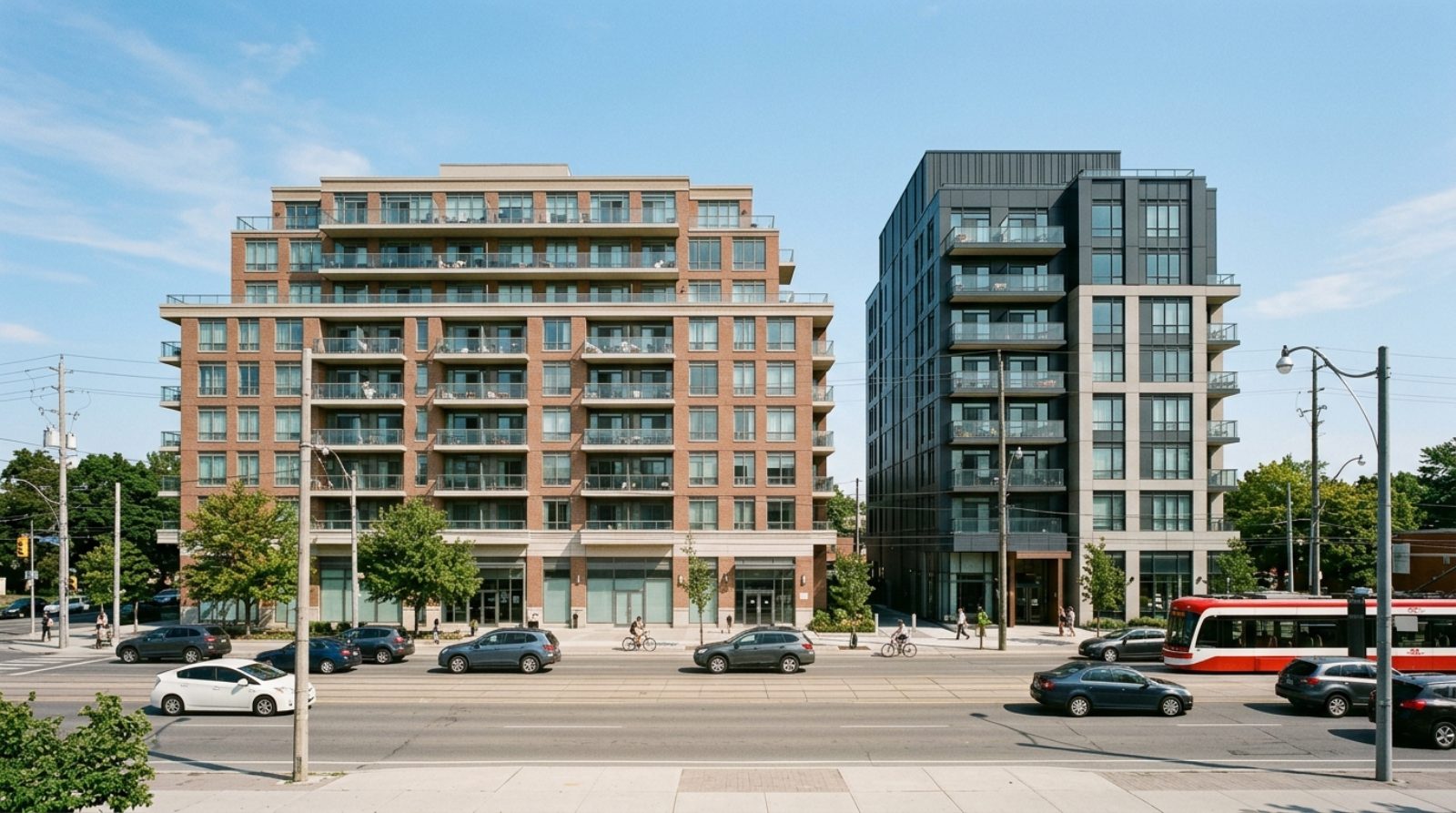
Loggia and Loggia II sit side by side at 1040 and 1050 The Queensway, share a name and went up around the same time. They are two separate condominium corporations, and that distinction matters more than anything about the finishes.
These two sit side by side, share a name, went up around the same time, and are constantly confused with each other in listings. They are two separate condominium corporations, and that distinction matters more than anything about the finishes.
Side by side
| Loggia | Loggia II | |
|---|---|---|
| Address | 1040 The Queensway | 1050 The Queensway |
| Storeys | 10 | 9 |
| Suites | 174 | 142 |
| Built | 2008 | 2008 |
| Condo corporation | Its own | Its own — separate |
| Indoor pool | Yes | Yes, its own |
The thing most people get wrong
Because they look like a pair, buyers assume shared amenities and shared costs. They do not share. Each building has its own condominium corporation, its own board, its own reserve fund and its own indoor pool.
Practically: a special assessment at one has nothing to do with the other. Reserve fund health can differ. Maintenance fees can drift apart over time even though the buildings are twins. If you are comparing a suite in each, you must read both status certificates — the numbers from one tell you nothing about the other.
Density: 174 over ten floors versus 142 over nine
That works out to roughly 17 suites per floor at Loggia and roughly 16 at Loggia II. Close enough that it will not change your daily life. This is not a case where one is meaningfully quieter than the other.
The real difference is scale of the corporation. A 142-unit building spreads major repairs across fewer owners than a 174-unit one. On a big-ticket item — garage membrane, elevators, pool mechanical — the per-unit share is higher in the smaller building. That is a genuine consideration on two buildings now approaching twenty years old.
What I would ask about both
- Reserve fund study date and funding level. Buildings from 2008 are entering the window where garage, roof and mechanical work comes due.
- Any special assessment in the last five years, and any planned.
- What the fee actually covers, and whether hydro and water are separately metered. On this corridor they usually are.
- Pool status. Two pools between two small corporations is a lot of mechanical to maintain. Ask whether either has been out of service and why.
My read
There is no clear winner here, and anyone telling you one is definitively better is guessing. Choose on the specific suite, the specific view, and — most of all — on which status certificate reads better. Two buildings this similar are decided by their finances, not their floor plans.
How to compare two buildings properly
Two phases of one development are not automatically one thing. Separate phases are frequently separate condominium corporations with their own budgets, reserve funds, boards and rules, and the fee in one tells you little about the fee in the other. Establish which corporation each unit belongs to before you compare anything.
Buyers comparing two buildings on the same street almost always compare the wrong things — lobby finishes, amenity lists and the headline maintenance fee. None of those decide whether the purchase works out. Six things do.
- The reserve fund against the age of the corporation. Both of these buildings are young enough that the fund is still accumulating and the budget has not been tested by a full operating cycle. Ask whether the first reserve fund study update has happened and what it did to the required contribution.
- What each fee includes, and what is separately metered. Add your own estimated utility bills to whichever excludes them before comparing. Then divide by real usable square footage rather than the marketing number.
- Three years of fee history for each. A young building whose fees have already jumped twice is telling you something the current number is not.
- Whether the corporation is party to litigation. Construction deficiency claims are not unusual in newer corporations and they affect both fees and lender appetite.
- Parking and locker ownership form. An owned unit, an exclusive-use common element, or a rental — only the first two convey with the sale.
- What is proposed on the adjacent parcels. The corridor is still developing. The City of Toronto’s development application records are public, and a view or a quiet aspect that a filed application would remove is not something to pay for today.
And then the unit, not the building
Once the corporations are understood, the remaining variables are unit-level and they are the ones that move price most: exposure, floor, whether the outlook is protected, layout efficiency and whether every bedroom has a real exterior window, balcony depth, and where the unit sits relative to the elevators and the garbage chute. Two units with the same floor plan in the same building can differ substantially on these alone.
The status certificate answers the corporation questions definitively and the fee for it is capped at $100 including taxes under the Condominium Act, 1998. Order one for whichever building you choose, and have a lawyer read it — with ten to fifteen business days on the condition, because the corporation has statutory time to produce it.
Thinking about buying or selling here?
I work this area every week and I will give you a straight answer, including when the answer is to wait. No pressure, and no drip campaign you cannot get out of.
Call or text 833-330-1925 Send me a message
Jatin Dua, Broker of Record — RE/MAX Quantum Realty Inc., Brokerage. Not intended to solicit buyers or sellers currently under contract with another brokerage.
Frequently asked questions
How do I compare two condo buildings on the same street?
Not on lobby finishes or amenity lists. Compare the reserve fund against the age of each corporation, what each fee includes and what is separately metered, three years of fee history, whether either corporation is party to litigation, the ownership form of parking and lockers, and what is proposed on the adjacent parcels.
Is a lower maintenance fee better?
Not on its own, and in this corridor it is frequently misleading. Buildings here are young, so a low fee usually reflects a reserve fund still accumulating and utilities that are separately metered rather than good management. Add your own utility estimate and read the reserve fund position before judging the number.
What does the status certificate tell me about a building?
The reserve fund balance and the study’s funding plan, any special assessment levied or contemplated, common expense arrears on the unit, legal proceedings the corporation is party to, the insurance and its deductible, any lien, and the declaration, by-laws and rules. The fee is capped at $100 including taxes.
How long should my status certificate condition be?
Ten to fifteen business days. The corporation has ten days from receiving the request and the fee to produce the certificate, so a five-business-day condition can leave your lawyer with almost no time to read it. Pay the fee immediately so the clock starts.
Does the specific unit matter more than the building?
Both matter and they answer different questions. The corporation decides your fee trajectory and your exposure to assessments; the unit decides what daily life is like and how it resells. Exposure, floor, protected outlook, layout efficiency and balcony depth move price more than anything inside the unit.
Are two phases of the same development identical?
Rarely. Separate phases are frequently separate corporations with their own budgets, reserve funds, boards and rules, even where they share a name, an architect and an address range. Read each corporation’s documents separately rather than assuming what is true of one is true of the other.
Sources
- City of Toronto — Planning and Development — current and proposed development along The Queensway corridor. Accessed 10 September 2026.
- Toronto Transit Commission — surface routes serving The Queensway and connections to Line 2. Accessed 10 September 2026.
- TRREB Market Watch, August 2026 — the Etobicoke average sale price of $1,049,793 across 243 sales. Accessed 10 September 2026.
- Condominium Act, 1998 — status certificates and the prescribed fee cap, reserve funds and reserve fund studies. Accessed 10 September 2026.
Related reading
- Loggia Condos, 1040 The Queensway — the full building guide
- Loggia II, 1050 The Queensway — the full building guide
- Reserve funds and special assessments explained
- How to compare Etobicoke maintenance fees
Building specifications from the City of Toronto planning record, condominium registrations and developers’ published material — believed accurate but not guaranteed. Verify everything against the status certificate and disclosure statement before you sign. Not intended to solicit buyers or sellers under contract with another brokerage. E.&O.E.
Thinking about buying on The Queensway?
Tell me which building or stretch of the corridor you are looking at and I will send the actual sold and lease comparables from TRREB, an honest read on the location, and what the status certificate is likely to show. No obligation, and I will tell you if the answer is don’t buy it.
Tell me what you are planning
Three quick answers so I come back with something useful, usually the same day.
Or call Jatin Dua, Broker of Record, RE/MAX Quantum Realty · 833-330-1925
About the author — Jatin Dua, Etobicoke real estate agent
I am Jatin Dua, Broker of Record at RE/MAX Quantum Realty Inc., Brokerage, Unit 101, 799 The Queensway in Etobicoke, with more than four years of active GTA transactions and over $100M in sales volume. My office is on this street, so the local detail here comes from walking it rather than from a directory.
Reach me at [email protected] or 833-330-1925.