
Published 18 October 2026 · By Jatin Dua, Broker of Record, RE/MAX Quantum Realty
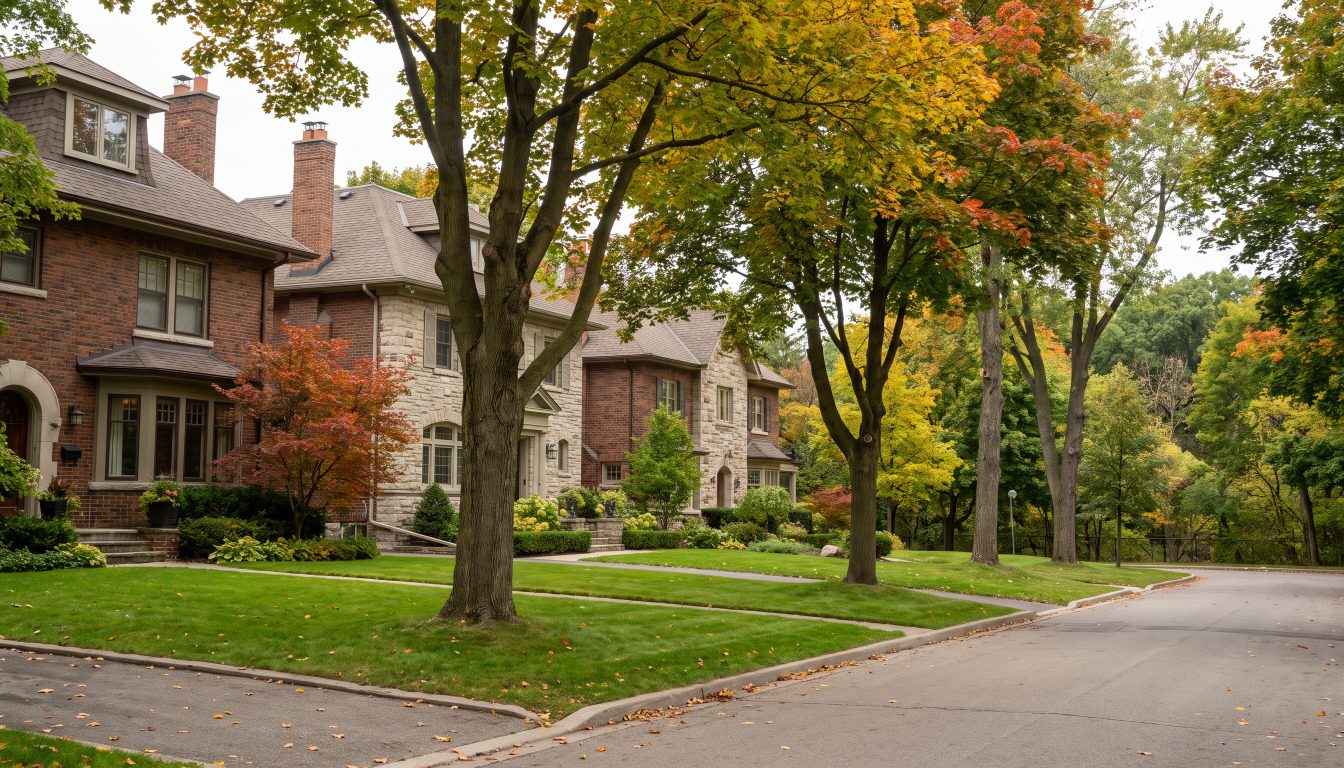
Thornhill’s luxury market centres on Uplands, Thornhill Woods, Old Thornhill, Royal Orchard and Bayview Glen, and it is split by Yonge Street between Vaughan (west) and Markham (east). Uplands and Bayview Glen offer large mature lots for estate homes and rebuilds. Thornhill Woods, north of Highway 407, has newer family homes. Old Thornhill is covered by two heritage conservation districts, so renovations and demolitions need heritage permits. The side of Yonge decides your city tax rate (0.749217% in Vaughan vs 0.722889% in Markham for 2026), zoning by-law and tree rules. Neither city charges a municipal land transfer tax.
Looking at a street in one of these pockets? Tell me what you need and I will send you Thornhill luxury homes that fit, including ones not yet widely marketed.
Which parts of Thornhill do luxury buyers actually shortlist?
When buyers ask me about high-end homes in Thornhill, the conversation usually lands on five areas: Uplands and the estate streets around it on the Vaughan side, Thornhill Woods north of Highway 407, Old Thornhill along Yonge Street, Royal Orchard on the Markham side, and Bayview Glen in the southeast corner by the Toronto border. German Mills, the easternmost part of Markham’s Thornhill, comes up as well.
This is my shortlist, not an official ranking. Rules below link to their official source.
Thornhill is not a city. It is a community split between two cities, and the side of Yonge a house sits on changes your tax bill, zoning and tree rules.
Is Thornhill in Vaughan or Markham?
Both. Yonge Street forms the boundary between Vaughan and Markham through Thornhill. Everything west of Yonge is in the City of Vaughan. Everything east of Yonge is in the City of Markham. The community is usually described as running from Dufferin Street to Highway 404, and from Steeles Avenue (the Toronto border) up to Highway 7, with Thornhill Woods extending north of the 407 on the Vaughan side.
Your mailing address will say “Thornhill” either way. A quick clue is the postal code: addresses on the Vaughan side generally start with L4J, while the Markham side uses L3T. Always confirm the municipality on the MPAC assessment or the tax bill, because that is what decides which by-laws apply.
What does the Vaughan/Markham split mean for taxes, by-laws and services?
Both cities sit inside York Region, so a lot is shared. The regional levy is identical, the school boards are the same, and regional services such as transit run across Yonge without a seam. What changes is the city portion of the tax rate and every city by-law.
| Item | Vaughan side (west of Yonge) | Markham side (east of Yonge) |
|---|---|---|
| 2026 total residential tax rate | 0.749217% (By-law 103-2026) | 0.722889% (2026 Final Tax Brochure) |
| City portion | 0.203805% | 0.177477% |
| York Region portion | 0.392412% | 0.392412% |
| Education portion | 0.153000% | 0.153000% |
| Tax on a $1,000,000 assessment (illustration) | About $7,492 | About $7,229 |
| Zoning by-law | Comprehensive Zoning By-law 001-2021, in effect except lands still under appeal | Comprehensive Zoning By-law 2024-19, deemed in force January 31, 2024, with some areas still under older parent by-laws |
| Private tree permit | Trees 20 cm or more in diameter at 1.4 m (By-law 052-2018) | Trees 20 cm or more at 1.37 m (By-law 2023-164); $20.50 processing fee from January 16, 2026 |
| Heritage district | Thornhill-Vaughan Heritage Conservation District | Thornhill Markham Heritage Conservation District |
| Municipal land transfer tax | None (only Toronto charges one) | None (only Toronto charges one) |
Tax is charged on your MPAC assessed value, not your purchase price, so the dollar figures only illustrate the rate gap. The bigger point for luxury buyers is the last row: because Thornhill is outside the City of Toronto, you pay only the provincial land transfer tax. On a multi-million-dollar purchase, that difference against a comparable Toronto house is large. My luxury land transfer tax guide walks through the maths.
How do the Thornhill luxury pockets compare at a glance?
| City | Where it is | Character | Best for | |
|---|---|---|---|---|
| Uplands and the estate streets | Vaughan | West of Yonge, around the Uplands Golf and Ski Centre on Uplands Avenue, plus enclaves such as Thornbank Road and Westmount | Mid-century bungalows and large two-storey homes on spacious, mature lots; some of the largest gated homes in the area | Buyers who want land, privacy and a rebuild or estate home close to Yonge |
| Thornhill Woods | Vaughan | North of Highway 407, between Bathurst Street and Dufferin Street | Newer subdivision homes, many with large floor plans | Families who want a newer house, newer schools and parks |
| Old Thornhill | Both | The old village on both sides of Yonge Street, roughly between Centre Street and John Street | Heritage homes, mature trees and the East Don ravine | Buyers who want character and accept heritage permit rules |
| Royal Orchard | Markham | East of Yonge, north of Steeles and south of Highway 407 | Mostly detached homes built in the 1970s and 1980s, with Don Valley ravine views | Buyers who want space and a future subway station nearby |
| Bayview Glen | Markham | Around Bayview Avenue, with its southern edge on the Toronto border | Very large lots built 1960 to 1980, with custom infill replacing original homes; Bayview Golf and Country Club in the Don ravine | Buyers who want a large lot and a custom build next to Toronto |
| German Mills | Markham | Along the Don Mills Road corridor north of Steeles | Mostly single-family homes from the 1970s and 1980s | Buyers who want a quieter, greener pocket at a lower entry point |
What is Uplands like, and what is happening with the Uplands golf course?
Uplands takes its name from the Uplands golf course, which opened in 1922 and was designed by Stanley Thompson. The City of Vaughan bought the club in 1988, and the Uplands Ski Centre opened on part of the former course in 1989. Today the site at 46 Uplands Avenue operates as a nine-hole course in summer and a small ski and snowboard hill in winter.
The housing around it is a mix of mid-century bungalows and large two-storey homes on spacious lots under mature trees. Nearby, Thornbank Road has gated homes that local guides describe as among the largest in the GTA, and the Westmount and Olde Thornhill enclaves have executive homes on generous lots.
Because the course is City-owned, its future is a municipal decision. Local press reported in 2025 that the City was exploring options for how Uplands is managed. If you are buying a house that backs onto the course, ask about any current City plans for the site, and do not assume a golf view is protected forever.
Why do families choose Thornhill Woods?
Thornhill Woods sits north of Highway 407 between Bathurst Street and Dufferin Street. It is the newest of the pockets in this guide, which is the main reason buyers choose it: larger modern floor plans, newer schools and planned parks.
The community’s signature green space is Sugarbush Heritage Park, where the Jonathan Baker House at 91 Thornhill Woods Drive was built in 1853 by a family of early Vaughan maple syrup pioneers. The park has a forest trail, a paved path around a pond and a community garden. Stephen Lewis Secondary School at 555 Autumn Hill Boulevard opened in 2006 to serve the newer Vaughan subdivisions in this area.
The trade-off is land. If you want a big newer house close to the 407, it suits. If you want a large lot, look at Uplands or Bayview Glen.
What does it mean to buy in the Old Thornhill heritage district?
Old Thornhill is the original village along Yonge Street. It is protected by two separate heritage conservation districts under Part V of the Ontario Heritage Act, one in each city.
- Markham side: the Thornhill Markham Heritage Conservation District was set up by By-law 269-86 and approved by the Ontario Municipal Board on November 23, 1986. It was Markham’s first district, and its plan was reviewed and renewed in 2007. Eight properties inside it are also individually designated under Part IV.
- Vaughan side: the Thornhill-Vaughan Heritage Conservation District was established by By-law 306-88 and its plan was updated in 2007. Vaughan is now running a Thornhill Heritage Conservation District Plan update, so expect revised policies.
In Markham, every property in the district is classed A, B or C. Class A buildings are of major importance, mostly pre-1900; Class C covers mostly post-1939 buildings. The class matters a great deal when you want to renovate or rebuild. Markham says exterior alterations, new construction and demolition all need a minor or major heritage permit, and demolition requests go to Council.
The village is also where the East Don River runs through ravine parkland. The heritage rules and the ravine rules can apply to the same lot, so give yourself time for both reviews.
Watch out
Do not buy a house in either Thornhill heritage district on the assumption that you can tear it down. Ask the seller for the property’s heritage class or designation status, read the district plan for your side of Yonge, and if a rebuild is the plan, make your offer conditional on a conversation with the City’s heritage staff. A rejected demolition permit can leave you owning a house you never wanted to keep.
What are Royal Orchard and Bayview Glen like on the Markham side?
Royal Orchard sits east of Yonge, north of Steeles and south of Highway 407. Most homes are detached and were built in the 1970s and 1980s, with high-rise apartments along Yonge. Its big draw is the ravine: Pomona Mills Park, a 4.7-hectare nature park, has trails with views of the East Don Valley. Royal Orchard is also the pocket most directly affected by the subway, because a future station is planned at Royal Orchard Boulevard.
Bayview Glen, also called Bayview Fairways or Bayview Country Club Estates, is in Markham with its southern edge on the Toronto border. It was built over about 20 years from 1960 to 1980. Lots are very large, houses sit well back from wide curving streets, and the original Colonial, Tudor Revival and ranch homes are steadily being replaced by large custom infill. The private Bayview Golf and Country Club at 25 Fairway Heights Drive sits in the Don River ravine valley in the middle of the neighbourhood.
German Mills, east of Bayview Glen along the Don Mills Road corridor, is mostly 1970s and 1980s single-family housing. Its 26-hectare German Mills Settlers Park was a sand pit from the 1940s to the 1960s and then the Sabiston Landfill from 1960 to 1975. If you are backing onto it, raise that history with your lawyer and inspector.
If you are comparing Thornhill’s Markham side with the rest of the city, my Markham luxury guide to Angus Glen, Unionville and Cachet covers the northern pockets.
Which golf clubs anchor Thornhill’s luxury streets?
The Thornhill Club at 7994 Yonge Street opened in 1922 on the west side of Yonge and hosted the 1945 Canadian Open. It offers golf, tennis, curling, fitness and a pool. The Ladies’ Golf Club of Toronto opened in 1924 on the opposite side of Yonge, also designed by Stanley Thompson.
A golf-course lot gives you open views, but also stray balls, maintenance noise and sometimes an easement. Read the survey and title carefully.
Which schools do Thornhill buyers ask about?
Both sides of Thornhill are served by the York Region District School Board and the York Catholic District School Board, so crossing Yonge does not change your board. It does change your boundary school. The ones buyers raise with me most:
- Thornhill Secondary School, 167 Dudley Avenue (Markham side), grades 9 to 12. A full high school since 1956, it offers Advanced Placement courses and a drama program dating to 1976.
- Westmount Collegiate Institute, 1000 New Westminster Drive (Vaughan side). Opened in the mid-1990s and known for ArtsWest, its arts program started in 2009.
- Stephen Lewis Secondary School, 555 Autumn Hill Boulevard (Vaughan side), opened 2006.
- Other Thornhill high schools include Thornlea Secondary School, Hodan Nalayeh Secondary School (formerly Vaughan Secondary School until 2021), St. Elizabeth Catholic High School and St. Robert Catholic High School.
- Bayview Glen School is a private, co-ed school from preschool to Grade 12. Despite the name, its main campus is at 85 Moatfield Drive in North York, Toronto, not in the Bayview Glen neighbourhood. It was founded in 1962.
Boundaries change, so confirm the boundary school for the exact address with the board before you waive conditions.
Where will the Yonge North Subway Extension stop in Thornhill?
Metrolinx is extending Line 1 about 8 km north from Finch Station with five stations: Steeles, Clark and Royal Orchard (underground), and Bridge and High Tech (at surface along the rail corridor). Steeles, Clark and Royal Orchard are the three on Thornhill’s stretch of Yonge. Bridge, between Highway 7 and Highway 407, is planned as a hub connecting to GO and Viva.
The timeline so far: the tunnelling contract was awarded in July 2025, a request for qualifications for the stations contract went out in October 2025, and a request for proposals followed in May 2026. Excavation of the tunnel launch shaft was scheduled for July 2026. Metrolinx has not published an opening date and says service will start after the Ontario Line is complete.
A station within walking distance can help resale, but construction and new towers along Yonge are real. Near Clark or Royal Orchard, check the City’s corridor plans as well as the station map.
What ravine rules apply to Thornhill lots?
Thornhill sits on the Don River system. The East Don rises at the south edge of the Oak Ridges Moraine and flows through ravine forests in Richmond Hill and Thornhill. German Mills Creek joins it at Steeles Avenue. The West Don starts in Maple and flows south through the G. Ross Lord Reservoir.
The Toronto and Region Conservation Authority regulates valleys, stream corridors, wetlands and hazard lands under Ontario Regulation 41/24. On a regulated lot, building or replacing a home, additions, garages, decks, pools and even major landscaping may need a TRCA permit on top of the city building permit. Flood plains are not always obvious from the street, so use TRCA’s Regulated Area Search before you firm up. My TRCA permit guide explains the process.
My take
Pick your side of Yonge as deliberately as your street. If you want a large lot to rebuild on, start with Uplands and Bayview Glen and check the tree, ravine and heritage rules early. If you want a newer house with less paperwork, Thornhill Woods is the simpler buy. If you want character, Old Thornhill is special, but budget time for heritage approvals. In every pocket, the lack of a municipal land transfer tax is a real saving compared with Toronto. I help buyers and sellers across Thornhill, Vaughan and Markham, and I am happy to pull recent pocket-level data for any street you are considering.
What should be on my Thornhill luxury buyer checklist?
| Check | Why it matters | Where to confirm |
|---|---|---|
| Which city the lot is in | Sets your tax rate, zoning by-law, tree by-law and permit office | MPAC assessment or tax bill; postal code is only a clue |
| Zoning for the address | Decides coverage, height and setbacks for any addition or rebuild | Vaughan By-law 001-2021 or Markham By-law 2024-19 zoning maps |
| Heritage district or designation | Alterations, new builds and demolitions need heritage permits | The Thornhill district plan for your side of Yonge; City heritage staff |
| TRCA regulated area | Ravine and flood plain lots may need a TRCA permit for pools, additions or a new house | TRCA Regulated Area Search |
| Trees 20 cm or larger | Removing or injuring them needs a city permit | Vaughan By-law 052-2018 or Markham By-law 2023-164 |
| Boundary school | Boundaries and specialized programs change | YRDSB or YCDSB school locator for the exact address |
| Subway and Yonge corridor plans | Construction and new towers can affect streets near Steeles, Clark and Royal Orchard | Metrolinx project page; City planning applications |
| Golf course or park backing | Easements, stray balls, future City decisions and site history | Survey, title search and City records |
If you are still deciding between Thornhill and the cities around it, compare it with my Richmond Hill luxury neighbourhood guide and my Vaughan vs Richmond Hill comparison.
Instant Home Valuation
What’s your home
worth today?
Answer six quick questions and get an instant value range built from current Toronto & GTA sale data — property type, size, condition, lot and location all weighted the way a real pricing conversation weighs them. Takes about ninety seconds.
Reading recent GTA sale data…
Building your estimate
Estimated market value
—
$0–$0
Most likely value $0 · roughly $0 per square foot
What moved the number
Starting from the area baseline for your property type, here’s what each answer added or subtracted.
Market context
Recent local averages for comparison.
—
A range is a starting point.
A strategy is what sells.
This model doesn’t know that your neighbour’s identical semi went $80,000 over asking last month, or which two upgrades actually pay back in your area. That conversation is free and takes twenty minutes.
Send me Thornhill luxury homes
Tell me the pocket, budget and must-haves, and I will send you matching Thornhill homes as they come up.
I will come back to you personally, usually the same day. If it is urgent, call 833-330-1925.
Frequently asked questions
Is Thornhill part of Vaughan or Markham?
Both. Yonge Street is the boundary: Thornhill west of Yonge is in the City of Vaughan and Thornhill east of Yonge is in the City of Markham. Both are in York Region, so the regional tax levy and school boards are the same, but city tax rates and by-laws differ.
Is property tax lower in the Markham or Vaughan part of Thornhill?
For 2026, Markham’s total residential rate is 0.722889% and Vaughan’s is 0.749217%, so the same assessed value pays a little less on the Markham side. On a $1,000,000 assessment that is about $7,229 in Markham versus about $7,492 in Vaughan. Tax is based on your MPAC assessment, not your purchase price.
Do you pay the Toronto land transfer tax when buying in Thornhill?
No. Thornhill is in Vaughan and Markham, outside the City of Toronto, so only the Ontario land transfer tax applies. On a luxury purchase that can be a large saving compared with a similar house south of Steeles. See my luxury land transfer tax guide.
Can I demolish a house in Old Thornhill?
Not without approval. Old Thornhill is covered by the Thornhill-Vaughan and Thornhill Markham heritage conservation districts. In Markham, demolition requests must be considered by Council, and exterior alterations and new construction need a heritage permit. Check the property’s heritage class before you buy.
Where are the Yonge North Subway Extension stations in Thornhill?
Metrolinx plans five stations on the roughly 8 km extension from Finch: Steeles, Clark and Royal Orchard (underground) and Bridge and High Tech (at surface). Steeles, Clark and Royal Orchard are along Thornhill’s stretch of Yonge. Metrolinx has not set an opening date and says service will begin after the Ontario Line is complete.
Is Bayview Glen School in the Bayview Glen neighbourhood?
No. Bayview Glen School is a private preschool to Grade 12 school whose main campus is at 85 Moatfield Drive in North York, Toronto. Bayview Glen the neighbourhood is in Markham’s Thornhill, and its local public school is Bayview Glen Public School.
Do I need a permit to remove a tree in Thornhill?
Usually, for larger trees. Vaughan’s By-law 052-2018 requires a permit for private trees 20 cm or more in diameter measured 1.4 m above grade. Markham’s By-law 2023-164 requires one for trees 20 cm or more at 1.37 m, with a $20.50 processing fee from January 16, 2026.
Sources
- Wikipedia — Thornhill, Ontario — Yonge Street as Vaughan/Markham boundary; general boundaries; Uplands, Thornhill Club and Ladies’ Golf Club history; schools list
- City of Markham — Thornhill Markham Heritage Conservation District Plan (overview) — By-law 269-86, OMB approval November 23, 1986, 2007 plan review, Part IV properties, Class A/B/C
- City of Vaughan — Thornhill-Vaughan Heritage Conservation District Plan (2007), Part 1 — By-law 306-88, 1984 study, 2007 plan update
- City of Vaughan — By-law 103-2026 (2026 tax rates) — 2026 residential city, region, education and total rates
- City of Markham — 2026 Final Tax Brochure — 2026 residential city, region, education and total rates
- Metrolinx — Yonge North Subway Extension — Five stations, about 8 km, 2025-2026 milestones, opening after the Ontario Line
- Metrolinx — First look: new station designs for Yonge North Subway Extension — Station names Steeles, Clark, Royal Orchard, Bridge, High Tech; underground vs surface
- City of Vaughan — Tree Protection By-law 052-2018 (consolidated) — 20 cm diameter at 1.4 m permit threshold
- City of Markham — Tree Permit Application — By-law 2023-164, 20 cm at 1.37 m, $20.50 fee from January 16, 2026
- TRCA — Planning and Permits — Ontario Regulation 41/24 regulated areas and works that need a permit
Related reading
- Best realtor in Vaughan: how to choose
- Best realtor in Markham: how to choose
- How much is my house worth in Vaughan?
- How much is my house worth in Markham?
- Ravine lots: what to know before buying
About the author — Jatin Dua, Toronto and GTA real estate broker
I am Jatin Dua, Broker of Record and co-founder of RE/MAX Quantum Realty Inc., Brokerage, Unit 101, 799 The Queensway, Toronto. I work with buyers, sellers, investors and business owners across Toronto and the GTA. Four-plus years of active GTA transactions, over $100 million in sales volume and 100+ families helped sell. Every rule and fact here is linked to a source below, so you can check it without asking me.
Reach me at [email protected] or 833-330-1925, or book a call.