
Published 31 August 2026 · Updated 29 September 2026 · By Jatin Dua, Broker of Record, RE/MAX Quantum Realty
What's Your Home Worth Right Now?
Get a free AI-powered price range for your property in under 90 seconds, based on recent GTA comparable sales. No name or address required.
Get My Free Estimate →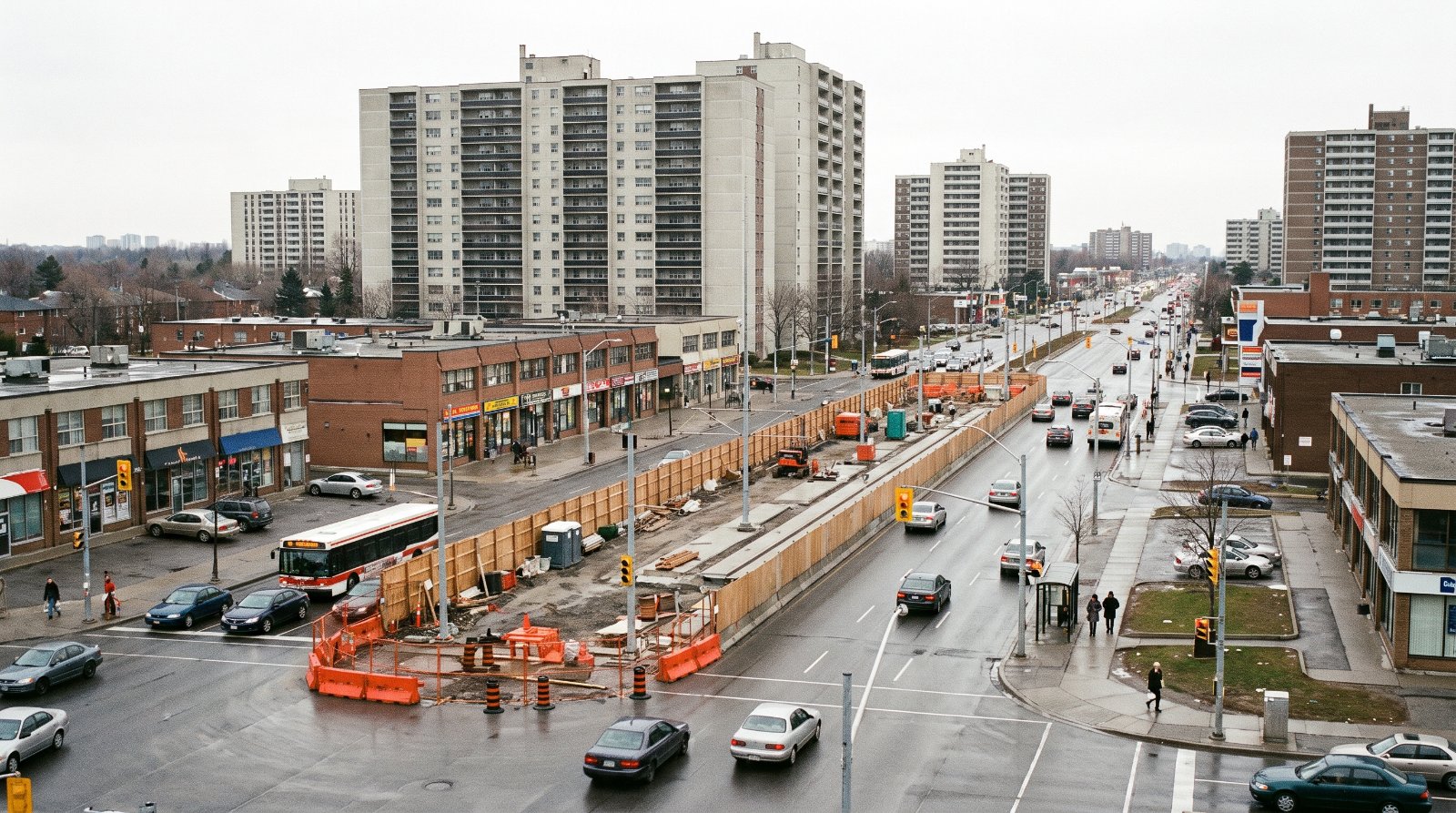
The ten things buyers in Cooksville are least often told, all of them documented: the Cooksville Local Area Plan no longer exists, because Mississauga Official Plan 2051 was approved on 24 March 2026 with only two local area plans in it, Lakeview and Port Credit; the Official Plan caps the Hurontario and Dundas corner at 18 storeys while proposals of 43, 43, 46, 39 and 34 storeys sit a few hundred metres north beside the GO station; 16 active applications propose 8,627 residential units in and around Cooksville, one of them at the Ontario Land Tribunal; Cooksville GO was rebuilt with 8 bus bays and 750-plus parking spaces for a Milton line that runs weekday rush hour, peak direction only; Metrolinx publishes no opening date at all for the Hazel McCallion Line, and in February 2026 the City was still asking the Province for a timeline for the Downtown Loop and $2 million to fund a Dundas bus rapid transit business case; the City’s own flood study says 304 buildings can be inundated in a regulatory flood on Cooksville Creek and 119 in a 100-year flood; your stormwater charge arrives on a Region of Peel water bill, not your tax bill, in five tiers from $64.45 to $219.13 a year; a one per cent annual hospital levy is proposed to start in 2029 to fund the City’s $390 million share of the Peter Gilgan Mississauga Hospital; Cooksville has no community centre, the design is not finished until 2029 and construction is unbudgeted, while the population here is expected to double by 2041; and inside the one name “Cooksville” the median dwelling value runs $500,000 in the downtown core against $1,000,000 in Cooksville East.
None of that is an argument against buying here. Cooksville is the best-connected value pocket left in central Mississauga and much of what is coming is genuinely good. It is an argument for buying here with the documents open.
Every item is traced to a primary source — the approved Official Plan, a Metrolinx project page, a City news release, a Budget Committee recap, a Municipal Class Environmental Assessment, a City open dataset, a bill record at the Legislative Assembly — and each is listed at the bottom with the date I read it. A few figures on this page are my own calculations from official open data rather than published statistics, and they are labelled where they appear. Six things I deliberately left off because I could not source them properly: any opening date, capital cost or delay figure for the Hazel McCallion Line; the freight-ownership constraint on the Milton corridor, which is real but which Metrolinx does not state on any page I read; every school fact, because the Ministry’s enrolment files carry no addresses and the boards publish no capacity tables I could reach, so there are no school names, enrolments, capacities or portable counts on this page; the construction start and opening date for the new hospital; a dollar comparison against Toronto’s municipal land transfer tax; and the July 2013 storm, for which I found no Cooksville-specific primary record. I will publish those when I can cite them.
Cooksville is the oldest part of Mississauga and the part being rebuilt hardest. It is the crossroads the city grew out of, at Hurontario and Dundas, and it is now a provincial growth target with light rail being tested down the middle of it, a rebuilt GO station, the largest hospital project in Canadian history a kilometre south, and roughly eight and a half thousand homes proposed inside a few blocks. If you are buying here you are buying into a construction site with a very specific plan behind it.
One definition note before the list, because it changes every number. “Cooksville” is not one place. The City counts three neighbourhoods — Downtown Cooksville, Cooksville East and Cooksville West — and the Official Plan lays a fourth geography over them, the Cooksville Growth Centre, defined as the lands along Hurontario Street between Eglinton Avenue and the Queen Elizabeth Way. The Hospital Growth Centre sits immediately south. Where I quote a statistic below I say which of those it is for.
1The Cooksville Local Area Plan you were shown does not exist any more
Mississauga Official Plan 2051 was adopted by Council on 16 April 2025 and approved with modifications by the Ministry of Municipal Affairs and Housing on 24 March 2026. It is the operative plan for every property in Cooksville today. Its Part Four: Local Area Plans contains exactly two local area plans: Lakeview and Port Credit. Cooksville is not among them. Its policies were folded into the city-wide chapters.
Cooksville was also reclassified. It is no longer a community node. It is one of four Growth Centre Character Areas — Uptown, Fairview, Cooksville and Hospital — described in the Plan as “the lands along Hurontario Street between Eglinton Avenue and the Queen Elizabeth Way.” Chapter 3 says growth centres will carry “transit-supportive densities and heights that are sufficient for supporting the Hazel McCallion LRT” while having “lesser heights and densities than the Downtown Core.” Here is what the Plan actually commits to around each transit station, from the Chapter 11 protected major transit station area table:
| Protected major transit station area | Reference | Minimum residents and jobs per hectare | Minimum floor space index | Height schedule |
|---|---|---|---|---|
| Cooksville GO | HLRT-6 / MIL-5 | 300 | 1.10 | 8l |
| Dundas | HLRT-5 | 300 | 1.40 | 8l |
| Fairview | HLRT-7 | 300 | 1.00 | 8k |
| Queensway | HLRT-4 | 300 | 1.00 | 8l |
| North Service | HLRT-3 | 300 | 1.00 | 8l |
Read those as what they are. They are minimums, not caps. Chapter 3’s city structure table gives the growth centres a density of 300 or more residents and jobs per hectare with “generally tall buildings with a variation in height.” Section 13.5.4.1 then says the quiet part out loud: “The greatest building heights will be located in proximity to the Cooksville GO station.”
I queried the City of Mississauga’s published Mississauga Heritage Properties layer against a bounding box covering Cooksville and counted the returned records by status. The dataset is official; the bounding box and the arithmetic are mine, and the box is approximate rather than the City’s Character Area boundary. The layer carries no addresses, so I cannot name individual buildings.
On that query, 53 heritage properties sit in and immediately around Cooksville. Five are “designated under the terms of the Ontario Heritage Act.” The other 48 are “listed on the heritage register but not designated.” Listing and designation are not the same protection, and most of Cooksville’s old buildings have the weaker one.
How to read this as a buyer. If anyone hands you “the Cooksville Local Area Plan,” you are reading a superseded document. Ask instead which Character Area your address is in, which station area it falls inside, and which Special Site number applies to it. Those four answers govern what can be built on your street, and they are all in one plan approved five months ago.
2The busiest corner in Cooksville is capped at 18 storeys. Towers of 46 are proposed a few hundred metres away
This is the single most under-reported fact about buying here, and it is written into the Official Plan in plain language.
Special Site 115 covers what the Plan calls “Cooksville Corners,” defined at section 17.115.1 as “the lands surrounding the intersection of Hurontario Street and Dundas Street.” Section 17.115.2(a) requires “minimum building heights of three storeys and a maximum of 18 storeys directly abutting Dundas Street and Hurontario Street frontages to create an appropriate main street scale of development.” Section 17.115.2(d) adds that “a minimum of three floors of non-residential uses will be required” for mixed use and residential high-rise buildings fronting those two streets.
| Where | What the Plan or the application says |
|---|---|
| Hurontario and Dundas, Special Site 115 | Minimum 3 storeys, maximum 18 storeys on the Dundas and Hurontario frontages, plus three floors of non-residential use |
| 25 and 33 Hillcrest Ave with 3146, 3154 and 3168 Hurontario St | Five towers of 43, 43, 46, 39 and 34 storeys, 2,224 units, 21,177.8 m² of commercial and community space |
| 3085 Hurontario St | Four buildings of 31, 33, 36 and 39 storeys, 1,691 units |
| 3115 Hurontario St | 42 storeys, 520 units |
| 189 Dundas St W | Three buildings of 18, 20 and 32 storeys, 966 units |
| Hospital Growth Centre, section 13.6.2 | Maximum 35 storeys for new residential along Hurontario Street and the Queensway |
There is also a height bonus in the Plan that almost nobody mentions. Under section 13.5.4.2, on residential high-rise land outside Special Site 115, the maximum height on Schedule 8 “may be exceeded by up to three storeys without an amendment to this Plan” where a development provides additional non-residential uses including community infrastructure. The formula is exact: “One additional storey in building height may be permitted for every 900 square metres of non-residential gross floor area (GFA) provided above the first storey.” Amenity space, above-grade parking and the required ground-floor commercial do not count toward it. The identical mechanism applies in the Hospital Growth Centre at section 13.6.3.2.
How to read this as a buyer. The main street scale you can see at Hurontario and Dundas is protected by policy. The block behind it is not. If a sales office is selling you a view over the low plazas on Dundas, ask where the site sits relative to Special Site 115 and to the GO station, because the Plan directs the tallest buildings to the station and permits three storeys above schedule on top of that without an amendment. Send me the address and I will tell you which side of that line it is on.
3Sixteen live applications propose 8,627 homes, and one of them is at the Tribunal
The City publishes every active development application as open data, refreshed to 30 June 2026, with a note that where several applications exist for the same development only the most recent is shown, “preventing double counting.”
I filtered the City of Mississauga’s Growth Management – Active Development Applications dataset to the Cooksville Growth Centre, Cooksville neighbourhood east, Cooksville neighbourhood west and Hospital Growth Centre character areas, all in Ward 7, and added up the proposed unit counts. The dataset is official; the filter and the arithmetic are mine. Storey counts come from the free-text application descriptions, because the dataset’s maximum storeys field was empty on every Cooksville record.
| File | Address | Proposal | Units | Status | Submitted |
|---|---|---|---|---|---|
| OZ/OPA 22 19 | 25 & 33 Hillcrest Ave; 3146, 3154, 3168 Hurontario St | Five towers, 43, 43, 46, 39, 34 storeys | 2,224 | Appealed | 17 Aug 2022 |
| OZ/OPA 21 11 | 3085 Hurontario St | Four buildings, 31, 33, 36, 39 storeys | 1,691 | Withheld | 25 Aug 2021 |
| SP 22 162 | 189 Dundas St W | Three buildings, 18, 20, 32 storeys | 966 | Withheld | 20 Dec 2022 |
| H-OZ 26 3 | 60 Dundas St E | Holding removal, three residential buildings | 714 | Withheld | 30 Jan 2026 |
| OZ 26 8 | 2233 & 2235 Hurontario St | Two apartment buildings | 698 | Application in process | 19 May 2026 |
| OZ/OPA 25 18 | 51–55 Dundas St W, 60–78 Agnes St | Apartment with commercial and office | 559 | Withheld | 26 Aug 2025 |
| OZ/OPA 22 24 | 3115 Hurontario St | 42 storeys plus community and retail | 520 | Withheld | 8 Nov 2022 |
| SP 26 13 | 65 Agnes St | 24 storeys | 358 | Withheld | 14 Apr 2026 |
| SP 25 45 | 60 Dundas St E | Three residential towers | 316 | Withheld | 2 Sep 2025 |
| SP 25 9 | 2570 & 2590 Argyle Rd | New apartment, existing buildings remain | 255 | Withheld | 27 Feb 2025 |
| SP 23 19 | 2020–2046 Camilla Rd | 148 stacked back-to-back townhouses | 148 | Withheld | 20 Dec 2023 |
| OZ/OPA 21 5 | 3034 Kirwin Ave | 8-storey apartment | 148 | Withheld | 27 May 2021 |
| 21T-M 21 2 | 0 King St E, 0 and 2487 Camilla Rd | 9 freehold detached plus 15 on a common element road | 24 | Draft approved | 3 May 2021 |
| OZ/OPA 24 14 | 2463 & 2469 Mimosa Row | Townhouses | 6 | Zoning endorsed by Council | 21 Nov 2024 |
Two files with no residential units complete the sixteen: a gas station, convenience store and drive-through at 329 North Service Road, and a childcare addition at 2455 Cashmere Avenue. Three things about that table matter more than the totals. 60 Dundas Street East appears twice, as SP 25 45 and H-OZ 26 3, because it is one development at two stages, so do not add those rows together as separate projects. Only one file is appealed, the Hillcrest and Hurontario proposal, and that is the Ontario Land Tribunal item in Cooksville. And twelve of the sixteen carry the status “Withheld,” for which I could not find the City’s published definition, so I am not going to tell you it means rejected or stalled.
How to read this as a buyer. An application is not a building and a status word you cannot define is not a forecast. What the table does tell you is where the pressure is: Hurontario north of Dundas, the Agnes and Dundas West block, and the Camilla and Kirwin pocket. If you are buying an existing unit with a view in any of those, ask me to pull the live file for the site in front of your window before you write the offer.
4The GO station was rebuilt beautifully, for a train that only runs one way at rush hour
Cooksville GO officially reopened on 10 November 2022 after a full rebuild. What Metrolinx delivered is genuinely good, and it is the thing every listing mentions.
| What was built | What actually runs |
|---|---|
| New station building and east pavilion, public plaza, new Hurontario Street entrance | Milton line, described by Metrolinx as “running east in the morning and west in the afternoon” |
| 8 new bus bays for GO Transit and MiWay | Weekday rush-hour service between Milton and Toronto |
| Parking structure adding 750-plus spaces, accessible parking on floors one and four | No midday, evening or weekend rail service published on the corridor |
| New platforms with snowmelt systems and canopied shelters, upgraded pedestrian tunnels, a bridge from the garage to the platforms | Metrolinx says only that it is “looking to bring more trips at every stop along the line” |
A buyer told “it is on the GO train line” is not being told they cannot ride it home at one in the afternoon, at eight in the evening, or on a Saturday. Two further documents are worth putting beside that. In its 2026 Provincial Pre-Budget Submission of 2 February 2026, the City asks the Province to “Advance all-day, two-way GO service on the Milton Corridor to meet the Premier’s 2031 target.” And the Official Plan, at section 13.5.1, is carefully hedged: it refers to the “potential for two way, all-day GO Transit service at Cooksville GO Station.” Potential, not planned.
How to read this as a buyer. Price the transit you can use on the day you move in, not the transit in the brochure. If your commute is a weekday peak-direction trip to Union, Cooksville GO is excellent and the garage is a real asset. If it is anything else — shift work, a return trip at noon, a weekend into the city — the honest answer today is MiWay to a subway, and you should test that trip before you buy rather than after.
5Nobody has published an opening date for the light rail line being tested outside your window
The Hazel McCallion Line runs straight through Cooksville. As of 2026 it is in vehicle testing, with a live Metrolinx construction notice for “Light Rail Vehicle Testing Along Topflight Dr to Hurontario St” and a virtual open house dated 25 June 2026. Here is everything Metrolinx does publish:
| Hazel McCallion Line | Published figure |
|---|---|
| Length and stops | 18 kilometres, 19 stops, Port Credit GO to Brampton Gateway Terminal |
| Running way | “will operate in its own dedicated lane” |
| Frequency | “During peak periods, trains will run every 7.5 minutes. During off-peak periods, trains will run every 10-12 minutes.” |
| Connections | GO Transit Milton and Lakeshore West lines, Mississauga Transitway, Brampton Transit, ZUM and MiWay |
| Contractor | Mobilinx, responsible for design, construction and 30-year operations and maintenance |
| Cooksville construction | Three work zones: Zone 4 North Service Road to Dundas Street, Zone 5 Dundas Street to Fairview Road, Zone 6 ending at Matthews Gate |
| Cycling | Raised separated cycle tracks on both sides of Hurontario north of the Queensway; multi-use trail on the east side to the south |
| Opening date | Not published |
That last row is a finding, not an omission on my part. I read the project landing page, the frequently asked questions page and the latest updates page in full on 31 August 2026. There is no in-service date and no opening date anywhere on them. The frequently asked questions page is visibly stale: it still points to a Twitter account, still carries COVID-19 construction policy, and still says track work “is anticipated to start fall 2021.” I could not source a capital cost or a delay figure from any current primary document either, so neither appears on this page.
Two more transit promises worth checking before you price them in. In the City’s 2026 Provincial Pre-Budget Submission of 2 February 2026, recommendation 2 asks the Province to work with Metrolinx to establish a “clear implementation plan and timeline” for completing the Downtown Loop of the Hazel McCallion Line, “in addition to operating funding for the first three years.” The same submission asks the Province to “Invest $2 million to fund the business case and further studies for the Dundas Bus Rapid Transit (BRT) east to Kipling and west to UTM.” The Dundas BRT is a 48-kilometre concept from Highway 6 in Hamilton to the Kipling Transit Hub with “more than 20 kilometres” in separated lanes and a 2020 initial business case behind it, and Metrolinx publishes no environmental assessment completion date, no construction start and no opening date for it.
How to read this as a buyer. A city asking the Province for a timeline in February 2026 does not have one. That does not mean the line will not open; the vehicles are being tested on the street. It means you should not pay a premium today for a service date nobody has written down, and you should ask which of the three Cooksville work zones your building sits in, because that determines what the next construction season looks like from your balcony.
6The City’s own flood study says 304 buildings can be inundated
The document is the Cooksville Creek Flood Evaluation Master Plan Environmental Assessment, prepared for the City of Mississauga by Aquafor Beech Ltd. in July 2012 under reference 65109. It is a Municipal Class Environmental Assessment master plan, it is published on the City’s website, and its executive summary states this:
“According to the Cooksville Creek Flood Remediation Plan (EWRG, 2002), approximately 304 buildings can be inundated in the middle and lower part of the watershed for the regulatory flood (i.e. Hazel Storm) and 119 buildings for the 100-year flood.”
| Reach | Buildings at risk in the regulatory storm | Why |
|---|---|---|
| CNR crossing to the Queen Elizabeth Way | About 108 | CNR crossing capacity 130 m³/s against a regional flow of 295 m³/s |
| Queen Elizabeth Way to King Street East | 108 | QEW crossing capacity 110 m³/s against a regional flow of 295 m³/s |
| CPR crossing to Central Parkway East | — | CPR crossing capacity 125 m³/s against a regional flow of 250 m³/s |
The study describes the watershed as exhibiting “a flashy hydrologic response typical of highly urbanized watersheds developed without the benefits of updated stormwater management infrastructure,” and records that a storm on 4 August 2009 “caused flood damages that impacted buildings, municipal infrastructure, pedestrian bridges and channel protection measures along Cooksville Creek.” Its recommended plan includes upstream flood storage, channel capacity upgrades, a berm in the King Street and Paisley Road areas where “homes are more susceptible,” and a berm adjacent to Cooksville Creek to protect homes along Rhonda Valley.
None of this is theoretical in the Official Plan either. Section 13.6.4 establishes an Environmental Planning Area on lands “generally between the North Service Road and where the Cooksville Creek crosses Camilla Road,” subject to the “two-zone flood plain management concept,” which splits the regulatory flood plain into a floodway and a flood fringe. Floodway lands are to be zoned in a hazard category. Flood fringe development may be permitted only where it is “flood proofed to the regulatory flood level as required by the conservation authority” and where ingress and egress are such that “emergency vehicular and pedestrian movement is not prevented during times of flooding.” Special Site 117, on Shepard Avenue between King Street East and Paisley Boulevard East, additionally requires conservation authority approval for any alteration of the creek’s natural alignment.
How to read this as a buyer. Cooksville Creek runs behind a great many ordinary houses here and it is not decorative. Before you buy anywhere near King Street East, Paisley, Rhonda Valley, Camilla Road or the creek corridor, ask which zone the property is in, whether the lot carries a hazard zoning category, and what the insurer says about overland water on that address. The City is spending money on this — there are live erosion control projects at Camilla Road, from Mississauga Valley Boulevard to the CP railway, and south of Lakeshore Road — but the underlying constraint is a set of undersized rail and highway crossings that no homeowner can fix.
7Your stormwater charge is not on your tax bill, and if you are in a condo you may never see it
Almost everyone assumes the Mississauga stormwater charge is a line on the property tax bill. It is not. The City states it plainly: “If you’re a property owner in Mississauga, a stormwater charge appears on your Region of Peel water bill.”
The mechanics are worth knowing because they are unusual. A billing unit is “the average hard surface area on a single detached residential property” — 267 square metres. Residential properties are sorted into five tiers by rooftop area. The annual rate is set every year through the City’s User Fees and Charges By-law, then divided into a daily rate, which is why the amount moves from bill to bill.
| Tier | Typical property | Rooftop area | 2025 estimate | 2026 estimate | Increase |
|---|---|---|---|---|---|
| Smallest | Freehold townhouses and row houses | 26.7–99 m² | $61.95 | $64.45 | $2.50 |
| Small | Semi-detached, linked, small single detached | 99.1–151 m² | $86.73 | $90.23 | $3.50 |
| Medium | Medium single detached | 151.1–194 m² | $123.90 | $128.90 | $5.00 |
| Large | Large single detached | 194.1–242 m² | $148.68 | $154.68 | $6.00 |
| Largest | Very large single detached | 242.1 m² and above | $210.63 | $219.13 | $8.50 |
Now the part that matters most in a neighbourhood where more than half the homes are apartments. The City states that “buildings owned and operated by a condominium corporation will receive one assessment,” and that “the condominium board or the property manager will determine how the charge is divided among all of the individual unit owners.” You will not find it itemised on anything addressed to you. It is inside your maintenance fee, allocated by a decision you did not make. Separately, low-income seniors and persons with disabilities who qualify for tax assistance “automatically qualify” for a stormwater subsidy, with no separate application needed.
How to read this as a buyer. If you are comparing a Cooksville condo to a freehold townhouse on carrying cost, the freehold buyer can see the charge and the condo buyer cannot. Ask the property manager how the corporation allocates the stormwater assessment, because it is a real operating cost inside the fee. And if you are buying a large detached house in Cooksville East, budget the top tier, not the average.
8A one per cent hospital levy is proposed to start in 2029, and it is not in your tax bill yet
On 28 May 2025 Mississauga Council unanimously approved a motion from Mayor Carolyn Parrish committing a municipal contribution to the local share of the new Peter Gilgan Mississauga Hospital, which the City describes as “the largest hospital project in Canadian history.”
| The commitment | Figure |
|---|---|
| City of Mississauga contribution | $390 million, to be paid by 1 January 2033 |
| Reduction from the original request | $60 million, down from $450 million |
| New hospital | “the largest community-based teaching hospital in Canada at 2.8 million square feet, 950 beds and 23 operating rooms” |
| Shah Family Hospital for Women and Children | 200,000 square feet, Ontario’s first hospital dedicated to women’s and children’s health, with one of the largest neonatal intensive care units in the province |
| Staffing | 2,400 more health care workers and about 400 additional doctors |
| Construction economy | About 3,000 construction jobs and about $1 billion to the local economy over a decade |
| Current demand | Trillium Health Partners cares for about 335,000 patients a year and employs more than 17,000 people |
The May 2025 release said the $390 million would be funded “through the implementation of an annual hospital levy of up to 1 per cent per year, and the issuance of a debenture to cover any remaining shortfalls.” The status of that levy is the thing nobody is telling buyers, and it comes from the Budget Committee recap of 13 January 2026, word for word:
“The new one per cent annual Hospital Levy is proposed to start in 2029 to support the City’s $390-million municipal contribution for the construction of the Peter Gilgan Mississauga Hospital. Council cannot commit to the start and amount of the levy until the applicable budget year.”
I then checked the adopted 2026 budget and the hospital levy does not appear in it. The 2026 tax measures were a one-year cut to the Capital Infrastructure and Debt Repayment Levy from three per cent to one, and a one-year pause of the one per cent Public Safety Fire Program. So the levy is proposed, targeted at 2029, and not enacted. Nobody in Mississauga is paying it today. Meanwhile the Official Plan is already building around the hospital: section 13.6.2 designates the Hospital Growth Centre as “a health district, anchored by the hospital,” with maximum heights of 35 storeys for new residential along Hurontario Street and the Queensway.
How to read this as a buyer. If you are running a twenty-five-year hold or a rental pro forma on a Cooksville unit, the 2029 line item is a proposed one per cent on top of the ordinary annual increase, for a commitment that has to be paid off by 1 January 2033. It is not certain, because Council cannot bind a future budget year. It is also not a rumour, because it is in a published Budget Committee record. Model it as a proposal with a date on it.
9Cooksville has no community centre, and the City says the population will double by 2041
This one is in the City’s own words, on its own project page, and it surprises almost everyone: “Cooksville currently does not have a community centre.”
The City has a project to build one, together with a library. Here is the published schedule:
| Milestone | Published timing |
|---|---|
| Public engagement 1, community survey | Summer 2026 |
| Design work begins | Summer 2027 |
| Public engagement 2 | Spring 2028 |
| Design work completed | Summer 2029 |
| Construction and redevelopment | “Timing to be determined” |
| Work complete | “Timing to be determined” |
| Budget | “Construction costs are not yet budgeted.” |
Set that against the demand the City states on the same page: “By 2041, the population in this area is expected to double, making it one of the fastest growing parts of the city.” The City also cautions that the map it shows “does not represent development boundary, land acquisition or confirmed project footprint” and that “no final decisions have been made regarding location, size or design.” In the 2026 Provincial Pre-Budget Submission the City asks the Province to invest in the construction of the Mississauga Valley and Cooksville community centres and libraries, which tells you where the money is expected to come from.
There is a second gap alongside it. The Official Plan sets the ambition for Cooksville as a “15 minute city” at section 13.5.2, with a “vibrant main street focus… and a human scaled built form” at Hurontario and Dundas, while describing what is actually there today with unusual candour: “Hurontario Street and Dundas Street are generally characterized by retail plazas that are one to two storeys… surrounded with surface parking.” Section 13.3.2.6 targets those surface parking areas for redevelopment.
How to read this as a buyer. Population doubling, design finishing in 2029, construction unfunded and undated. If community recreation matters to your household, do not buy on the promise of the Cooksville community centre; buy within reach of one that exists today and treat the new one as upside. It is a genuinely good project and I hope it gets built. It has no construction budget as at 31 August 2026, and the City says so itself.
10Cooksville is a renter, high-rise neighbourhood inside a homeowner city, and its two halves are not one market
The City publishes 2021 Census figures for each of its neighbourhoods, and Cooksville is three of them: Downtown Cooksville, Cooksville East and Cooksville West. Treating them as one market is a category error.
The three neighbourhood columns below are the City’s published 2021 Census figures. The combined Cooksville column and the Mississauga comparator column are my own sums across the City’s neighbourhood rows in the same official file, not a Statistics Canada published municipal total. Same source, same rounding, so they compare cleanly to each other. If you need an official Mississauga number, take it from the Statistics Canada census profile instead.
| 2021 Census | Downtown Cooksville | Cooksville East | Cooksville West | Cooksville combined | Mississauga |
|---|---|---|---|---|---|
| Population in private households | 9,570 | 8,405 | 14,665 | 32,640 | 712,520 |
| Households | 3,950 | 3,010 | 5,240 | 12,200 | 244,430 |
| Median age | 38.0 | 43.6 | 44.8 | — | — |
| Renter households | 60.1% | 25.9% | 27.9% | 37.8% | 29.6% |
| Apartments of 5 storeys or more | 88.2% | 20.8% | 17.6% | 41.2% | 27.3% |
| All apartment forms | 94.3% | 27.2% | 38.2% | 53.6% | 37.7% |
| Single detached | 0.8% | 53.0% | 32.2% | 27.1% | 37.1% |
| In core housing need | 28.7% | 15.0% | 13.7% | 18.8% | 14.9% |
| Immigrants | 65.7% | 41.3% | 57.9% | 55.9% | 53.2% |
| Median value of dwellings | $500,000 | $1,000,000 | $900,000 | — | — |
| Median monthly shelter cost, owners | $1,640 | $1,660 | $1,800 | — | — |
| Median monthly shelter cost, renters | $1,440 | $1,290 | $1,300 | — | — |
Three readings of that table. First, Downtown Cooksville is 88.2 per cent high-rise apartment and 60.1 per cent renter, which makes it one of the most tenure-inverted pockets in a city that is 29.6 per cent renter on the same numbers. Second, 28.7 per cent of downtown Cooksville households are in core housing need, nearly double the city figure of 14.9 per cent, and that is the single most striking statistic I found in any document for this page. Third, Cooksville East and Cooksville West are actually more owner-occupied than the city average. The renter concentration is the core, not the neighbourhood.
The Official Plan puts the same fact in words rather than percentages, describing Cooksville as having “a rich history as a destination for newcomers to Canada” and noting that “immigrant programs and services in Cooksville Growth Centre provide an important function in helping families transition to a new country.” These are 2021 figures. The 2026 Census was taken in May 2026 and its results are not published.
How to read this as a buyer. When someone quotes you “Cooksville prices,” ask which Cooksville. A median dwelling value of $500,000 in the core and $1,000,000 in the east is a two-to-one spread inside a single neighbourhood name, and any average that blends a Hurontario high-rise unit with a detached house off Camilla is not a comparable, it is an average of two markets. Give me the address, not the neighbourhood, and I will give you the comparables that actually apply.
Four more, because they come up every week
There is no municipal land transfer tax in Mississauga, and your 2026 tax bill went up 5.21 per cent. A Toronto buyer pays a second, municipal land transfer tax on top of the provincial one. A Mississauga buyer does not. I did not retrieve Toronto’s by-law for this page, so I am not going to print a dollar comparison, but the absence on this side of the boundary is real: no municipal land transfer tax appears anywhere in the City’s tax pages or by-law listings, and the City’s own 2026 Pre-Budget Submission asks the Province for first-time homebuyer rebates on the Ontario land transfer tax, which is the only one in play. The provincial rates, quoted from the Ministry of Finance, are 0.5 per cent up to $55,000, 1.0 per cent to $250,000, 1.5 per cent to $400,000, 2.0 per cent above that, and 2.5 per cent above $2 million where the land contains one or two single family residences. The first-time buyer refund is a maximum of $4,000, so that “no land transfer tax would be payable by qualifying first-time purchasers on the first $368,000.” On the annual side, the City reports a total 2026 property tax increase of 5.21 per cent — a 1.61 per cent City share within a 4.39 per cent City budget increase, plus 3.60 per cent from the Region of Peel — which the City works out as $53.91 more for every $100,000 of assessed value, or $377.37 on a $700,000 home. Of every property tax dollar you pay, the City keeps 37 cents, 48 cents goes to the Region of Peel and 15 cents to the Province for education. I also searched the City’s site for a vacant home tax and a vacant unit tax and found no such tax and no by-law establishing one.
Peel Region did not dissolve, but roads and stormwater moved to the City two months ago. Bill 112, the Hazel McCallion Act (Peel Dissolution), 2023, received Royal Assent on 8 June 2023 as Chapter 13 of the Statutes of Ontario, 2023, and provided for the Region of Peel to dissolve on 1 January 2025. It did not happen. The replacement statute is Bill 45, the Peel Transition Implementation Act, 2025, Royal Assent 11 December 2025, Statutes of Ontario 2025 Chapter 23. Under it, waste collection transferred to Mississauga, Brampton and Caledon effective 1 January 2026, with the Region prohibited from reversing that transfer through 31 December 2035, and highways and stormwater utilities transferred to the three municipalities by geographic location effective 1 July 2026. That is two months ago. So in Cooksville today the road and stormwater jurisdiction is the City’s, the Region still exists and still takes 48 cents of every tax dollar, and the stormwater charge still arrives on a Region of Peel water bill. If you have been bounced between two call centres about a road or a catch basin this summer, that is why.
The old rental buildings on Camilla and Kirwin are not simply redevelopable. Chapter 5 of Mississauga Official Plan 2051 contains a full rental replacement regime, and the Plan states the risk in plain language: “Older rental stock, which is a prime source of affordable market housing for moderate-income households, is vulnerable to demolition and redevelopment.” Section 5.3.4.2 says conversion or demolition of rental properties “exceeding six dwelling units” will not be permitted if it adversely affects the supply of affordable rental housing. Section 5.3.4.5 sets the test: “The rental vacancy rate of 3 percent for the preceding three years as reported by the Canada Mortgage and Housing Corporation (CMHC) shall be used” as the minimum threshold, unless replacement units are provided. Where replacement is permitted, section 5.3.4.6 requires “the same or higher number of units of comparable sizes,” 20-year retention, and replacement units held at similar rents for 10 years, with similar rents defined as the tenant’s last rent plus no more than the annual provincial guideline and a one-time capital allowance of 3 per cent. That is the correct frame for the Camilla Road and Kirwin Avenue rental cluster, and it may be part of why the application at 3034 Kirwin Avenue for an 8-storey, 148-unit building has sat at “Withheld” since 27 May 2021, more than five years.
You cannot buy a Cooksville condo and run it on Airbnb. The City’s short-term rental licence is for “a place you live in,” and the City states flatly: “You can’t get this licence for additional or investment properties.” A short-term rental is defined as renting all or part of your primary residence “for no more than 30 days in a row, up to a total of 180 days a year.” The licence costs $283 a year and expires annually. Requirements include proof of principal residence from the last 12 months, a Level 1 criminal record check issued in the last 60 days by Peel Regional Police only — the City does not accept third party checks, including from the OPP or the RCMP — commercial general liability insurance of at least $2 million per occurrence naming the City as additional insured, an emergency contact, written owner authorisation if you rent, and condo board permission if the unit is in a condominium. A by-law enforcement inspection happens before the licence issues, and the City warns you “may be fined up to $100,000, as per the Short-Term Rental Accommodation Licensing By-law.” In a neighbourhood where 53.6 per cent of homes are apartments, the condo board gate is the one that ends most of these plans. I did not capture the by-law number, so I am not citing one.
What this list is not
It is not an argument against buying here. Cooksville has a rebuilt GO station with a 750-space garage and 8 bus bays, light rail vehicles being tested down the middle of Hurontario Street on a line with 19 stops and 7.5-minute peak service, the largest hospital project in Canadian history rising a kilometre south with 950 beds and 23 operating rooms, a business improvement area with a real boundary, 53 heritage properties, and an Official Plan that names its own history as “a destination for newcomers to Canada” and plans it as a 15 minute city. You can still buy into central Mississauga here at a median dwelling value that is half what it is a few streets east. Very few places in the region can say all of that.
The point is that every one of the ten items above is knowable before you sign. Most buyers find out afterwards. That is the entire difference between working with someone who has read the Official Plan and working with someone who has read the listing.
Thinking about a specific building or street in Cooksville?
A neighbourhood list is the right frame for understanding a market and the wrong frame for a decision. What a home is worth here depends on which Character Area it sits in, what is approved on the block in front of it, how close the creek is, and what has really sold nearby. Send me the address and I will give you the comparable sales that apply to it, the live applications around it, and a straight answer on whether to move now or wait.
[email protected] · 833-330-1925 · Book a free consultation
Confidential. Read personally and answered within 24 hours. I never share, sell or distribute your information.
Ask the local expert
Ask me anything about Cooksville
Send me the building, the block or the question. You get a straight answer from someone who works this pocket every week, including when the answer is that you should wait. No drip campaign you cannot get out of.
Got it.
I read these personally and answer within 24 hours. If it is urgent, call or text 833-330-1925.
Confidential. Read personally and answered within 24 hours. I never share, sell or distribute your information. Not intended to solicit buyers or sellers currently under contract with another brokerage.
Frequently asked questions
Is there still a Cooksville Local Area Plan?
No. Mississauga Official Plan 2051, adopted on 16 April 2025 and approved by the Ministry of Municipal Affairs and Housing on 24 March 2026, contains exactly two local area plans, Lakeview and Port Credit. Cooksville is not one of them; its policies were folded into the city-wide chapters, and Cooksville is now a Growth Centre Character Area alongside Uptown, Fairview and Hospital. Anyone quoting you the old Cooksville plan is quoting a superseded document.
How tall can they build at Hurontario and Dundas?
Special Site 115 of Mississauga Official Plan 2051 covers those lands, known as Cooksville Corners, and requires minimum building heights of three storeys and a maximum of 18 storeys directly abutting the Dundas Street and Hurontario Street frontages. It also requires a minimum of three floors of non-residential uses in mixed use and residential high-rise buildings fronting those streets. The tallest proposals in Cooksville sit near the GO station instead, not at the main intersection.
How many new homes are proposed in Cooksville?
On the City’s Growth Management active development applications dataset, current to 30 June 2026, I counted 16 active applications proposing 8,627 residential units across the Cooksville Growth Centre, the two Cooksville neighbourhood character areas and the Hospital Growth Centre. The dataset is official and the filter and the sum are mine. The largest single file proposes five towers of 43, 43, 46, 39 and 34 storeys with 2,224 units, and it is under appeal.
Does the GO train from Cooksville run all day?
No. Metrolinx describes the Milton line as running east in the morning and west in the afternoon, offering weekday rush-hour service between Milton and Toronto. Cooksville GO reopened on 10 November 2022 with 8 new bus bays and a garage adding more than 750 parking spaces, but the rail service is peak-direction and weekday only. The City is asking the Province to advance all-day two-way service to meet a 2031 target.
When does the Hazel McCallion Line open?
Metrolinx does not say. I read the project page, the frequently asked questions page and the latest updates page on 31 August 2026 and none of them publishes an in-service or opening date. What is published: 18 kilometres, 19 stops, Port Credit GO to Brampton Gateway Terminal, a dedicated lane, trains every 7.5 minutes at peak and every 10 to 12 minutes off peak, and Mobilinx contracted for 30 years of operations and maintenance.
Is the Dundas bus rapid transit project funded through Cooksville?
Not for construction. Metrolinx describes a 48-kilometre corridor from Highway 6 in Hamilton to the Kipling Transit Hub, with more than 20 kilometres in separated lanes and a 2020 initial business case behind it. In its 2 February 2026 pre-budget submission the City asked the Province to invest $2 million to fund the business case and further studies east to Kipling and west to UTM. Metrolinx publishes no construction start and no opening date.
Does Cooksville Creek flood?
The City’s Cooksville Creek Flood Evaluation Master Plan, prepared by Aquafor Beech in July 2012, records that approximately 304 buildings can be inundated in the middle and lower watershed in a regulatory flood and 119 buildings in a 100-year flood, mainly because of undersized rail and highway crossings. The Official Plan applies two-zone flood plain management to lands between the North Service Road and where the creek crosses Camilla Road, splitting the flood plain into floodway and flood fringe.
Where does the Mississauga stormwater charge appear?
On your Region of Peel water bill, not your property tax bill. A billing unit is 267 square metres of hard surface, the average for a single detached home, and residential properties fall into five tiers by rooftop area, running in 2026 from about $64.45 a year for a freehold townhouse to about $219.13 for the largest single detached homes. A condominium corporation receives one assessment and its board or manager decides how it is divided among unit owners.
Is there a hospital levy in Mississauga?
Not yet. Council unanimously approved a $390 million municipal contribution to the Peter Gilgan Mississauga Hospital on 28 May 2025, payable by 1 January 2033 and reduced by $60 million from an original request of $450 million. The Budget Committee recap of 13 January 2026 states that a one per cent annual hospital levy is proposed to start in 2029, and that Council cannot commit to the start and amount of the levy until the applicable budget year.
Does Cooksville have a community centre?
No. The City states that Cooksville currently does not have a community centre. Its published schedule for the Cooksville community centre and library runs from a summer 2026 community survey to design work completed in summer 2029, with construction and completion both listed as timing to be determined, and it says construction costs are not yet budgeted. The City expects the population in this area to double by 2041, making it one of the fastest growing parts of the city.
Related reading
- Top 10 things no one will tell you about Port Credit, Mississauga
- Top 10 things no one will tell you about Lakeview, Mississauga
- Top 10 things no one will tell you about Islington and Etobicoke Centre
- Top 10 things no one will tell you about The Kingsway, Etobicoke
- Top 10 things no one will tell you about Mimico and Humber Bay Shores
- Top 10 things no one will tell you about Alderwood, Etobicoke
- Toronto West market report, July 2026
Sources
Every figure on this page traces to one of these, and each was read on 31 August 2026. Primary sources only — the approved Official Plan, a Council decision or Budget Committee record, a transit agency project page, a Municipal Class Environmental Assessment, a bill record at the Legislative Assembly, or the agency that administers the thing being described. A few figures are my own calculations from official open data and are labelled where they appear. Where I could not verify something from a primary source, it is not on the page.
- Mississauga Official Plan 2051. City of Mississauga; adoption by Council 16 April 2025, approval with modifications by the Ministry of Municipal Affairs and Housing 24 March 2026, and the Part Four table of contents showing only the Lakeview and Port Credit local area plans. mississauga.ca
- Mississauga Official Plan 2051, Chapter 13 — Growth Centres. Sections 13.1 and 13.1.1 on the four Growth Centre Character Areas, 13.5.1 to 13.5.4 on Cooksville including the 15 minute city, the greatest heights near the GO station and the three-storey height bonus at 900 m² per storey, 13.6.2 on the 35-storey Hospital Growth Centre, and 13.6.4 on two-zone flood plain management. mississauga.ca
- Hazel McCallion Line. Metrolinx project page; 18 kilometres, 19 stops, Port Credit GO to Brampton Gateway Terminal, the dedicated lane, the six connecting transit systems, and the absence of any published in-service or opening date. metrolinx.com
- Hazel McCallion Line — frequently asked questions. Metrolinx; the 7.5-minute peak and 10 to 12 minute off-peak frequencies, and Mobilinx as the contractor for design, construction and 30 years of operations and maintenance. metrolinx.com
- Hazel McCallion Line — Mississauga Cooksville. Metrolinx; the three Cooksville work zones, zone 4 from North Service Road to Dundas Street, zone 5 from Dundas Street to Fairview Road and zone 6 ending at Matthews Gate, and the cycle track and multi-use trail treatment on Hurontario Street. metrolinx.com
- The Hazel McCallion Line virtual open house, 25 June 2026. Metrolinx event record, and the live construction notice for light rail vehicle testing along Topflight Drive to Hurontario Street, confirming the line was in vehicle testing in 2026. metrolinx.com
- Dundas Bus Rapid Transit. Metrolinx project page; 48 kilometres from Highway 6 in Hamilton to the Kipling Transit Hub, more than 20 kilometres in separated lanes, the 2020 initial business case, the ICIP-funded 7.5 kilometre Mississauga East segment, and the absence of any construction or opening date. metrolinx.com
- Milton Line GO Expansion. Metrolinx; the description of service running east in the morning and west in the afternoon, weekday rush-hour service between Milton and Toronto, and the statement that Metrolinx is looking to bring more trips at every stop along the line. metrolinx.com
- Cooksville GO Station. Metrolinx; the new station building and east pavilion, public plaza, 8 new GO and MiWay bus bays, the parking structure adding more than 750 spaces, the snowmelt platforms, the pedestrian tunnels and the bridge from the garage to the platforms. metrolinx.com
- Video: Cooksville GO officially opens today. Metrolinx, 10 November 2022; the station opening date. metrolinx.com
- Making more possible for Mississauga — 2026 Provincial Pre-Budget Submission. City of Mississauga news release, 2 February 2026; the request for an implementation plan, timeline and three years of operating funding for the Downtown Loop, the $2 million for a Dundas bus rapid transit business case, the 2031 Milton corridor target, the community centre and library ask, and the Ontario land transfer tax first-time buyer rebate ask. mississauga.ca
- Cooksville Creek Flood Evaluation Study — Master Plan Environmental Assessment. Aquafor Beech Ltd. for the City of Mississauga, July 2012, reference 65109. The 304 buildings in the regulatory flood and 119 in the 100-year flood, the CNR, QEW and CPR crossing capacities against regional flows, the flashy hydrologic response, the 4 August 2009 storm damage, and the recommended berms at King Street, Paisley Road and Rhonda Valley. mississauga.ca
- Cooksville Creek Erosion Control at Camilla Road. City of Mississauga city project page, one of the live capital works on the creek alongside the Mississauga Valley Boulevard to CP Railway reach and the reach south of Lakeshore Road. mississauga.ca
- Stormwater charge. City of Mississauga; the statement that the charge appears on your Region of Peel water bill, the 267 square metre billing unit, the five residential tiers with 2025 and 2026 estimated annual rates, the annual User Fees and Charges By-law process, the single condominium assessment rule and the automatic subsidy for qualifying low-income seniors and persons with disabilities. mississauga.ca
- Mississauga Council supports the Peter Gilgan Mississauga Hospital with historic financial contribution. City of Mississauga news release, 28 May 2025; the unanimous Council approval, the $390 million contribution payable by 1 January 2033, the $60 million reduction from $450 million, the 2.8 million square feet, 950 beds and 23 operating rooms, the 200,000 square foot Shah Family Hospital for Women and Children, the staffing and economic figures, and the up to one per cent annual hospital levy plus debenture funding model. mississauga.ca
- Budget Committee recap, 13 January 2026, 9:30 a.m. meeting. City of Mississauga; the statement that the new one per cent annual Hospital Levy is proposed to start in 2029 and that Council cannot commit to the start and amount of the levy until the applicable budget year. mississauga.ca
- Mississauga’s 2026 Budget adopted. City of Mississauga news release, 28 January 2026; the 5.21 per cent total property tax increase, the 4.39 per cent City budget increase and 1.61 per cent City share, the 3.60 per cent Region of Peel increase, the $53.91 per $100,000 of assessed value and $377.37 on a $700,000 home, the 37, 48 and 15 cent split of every tax dollar, the $17.4 million in savings, and the one-year measures on the Capital Infrastructure and Debt Repayment Levy and the Public Safety Fire Program. mississauga.ca
- Cooksville Community Centre and Library development. City of Mississauga project page; the statement that Cooksville currently does not have a community centre, the milestone schedule from summer 2026 engagement to summer 2029 design completion with construction and completion timing to be determined, the statement that construction costs are not yet budgeted, and the expectation that the population will double by 2041. mississauga.ca
- Apply for a short-term rental accommodation licence. City of Mississauga; the principal residence requirement, the 30 consecutive day and 180 day annual caps, the $283 annual fee, the Peel Regional Police Level 1 criminal record check, the $2 million commercial general liability insurance, the condominium board permission requirement, the pre-licence inspection and the fine of up to $100,000. mississauga.ca
- Bill 112, Hazel McCallion Act (Peel Dissolution), 2023. Legislative Assembly of Ontario; First Reading 18 May 2023, Third Reading 6 June 2023, Royal Assent 8 June 2023 as Statutes of Ontario 2023 Chapter 13, and the provision for dissolution of the Regional Municipality of Peel on 1 January 2025. ola.org
- Bill 45, Peel Transition Implementation Act, 2025. Legislative Assembly of Ontario; First Reading 4 June 2025, Third Reading 9 December 2025, Royal Assent 11 December 2025 as Statutes of Ontario 2025 Chapter 23, the transfer of waste collection effective 1 January 2026 with reversal prohibited through 31 December 2035, and the transfer of highways and stormwater utilities effective 1 July 2026. ola.org
- Calculating Land Transfer Tax. Ontario Ministry of Finance; the 0.5, 1.0, 1.5, 2.0 and 2.5 per cent brackets for land containing one or two single family residences under agreements entered after 14 November 2016. ontario.ca
- Land transfer tax refunds for first-time homebuyers. Government of Ontario; the maximum $4,000 refund for conveyances on or after 1 January 2017, the eligibility criteria including the nine-month occupancy requirement, and the statement that no land transfer tax is payable by qualifying first-time purchasers on the first $368,000. ontario.ca
- City of Mississauga open data. Growth Management — Active Development Applications, data as at 30 June 2026, for the file numbers, addresses, unit counts and statuses in this page’s pipeline table and the Cooksville BIA flags; and 2021 Census Data by Neighbourhoods, published by the City from the Statistics Canada 2021 Census, for the Downtown Cooksville, Cooksville East and Cooksville West figures. The filters and sums on this page are mine. data.mississauga.ca
- Mississauga Heritage Properties. City of Mississauga open data feature service; the designated and listed-but-not-designated status values behind the 53 and 5 counts on this page, which come from my own approximate bounding-box query rather than the City’s Character Area boundary. arcgis.com
What this page is and is not. This is general information about public documents affecting a Mississauga neighbourhood, not legal, tax, engineering, environmental or financial advice, and not an opinion on the value or condition of any particular property. Statutes, by-laws, tax rates, transit schedules, project schedules and municipal policies change; every figure here is dated to 31 August 2026 and should be re-checked against the source before you rely on it. Note in particular that Cooksville is in Mississauga, not Toronto: Toronto’s Municipal Land Transfer Tax and Toronto’s Vacant Home Tax do not apply to a purchase here, and I found no municipal land transfer tax and no vacant home tax by-law in Mississauga, which is a reported absence rather than a legal opinion. Several figures on this page are my own calculations from official open datasets and are labelled as such; they are not City-published statistics, and boundary-based figures depend on the boundary used. Development applications described here are proposals or decisions as recorded on the dates stated and may since have changed; a proposed or appealed application is not a built building, and the status word “Withheld” is reproduced from the City’s dataset without a definition because I could not find one published. For advice on a specific transaction, consult a lawyer, an accountant and a qualified professional as applicable. Jatin Dua is a Broker of Record with RE/MAX Quantum Realty Inc., Brokerage. Not intended to solicit buyers or sellers currently under contract with another brokerage.
About the author — Jatin Dua, Etobicoke and Toronto real estate expert
I am the Broker of Record and co-founder of RE/MAX Quantum Realty at 799 The Queensway in Etobicoke, with more than $100 million in GTA sales volume. I write these pages the same way I work a file: read the primary source, quote it, date it, and say plainly where the source is silent or where two documents disagree. If a figure on this page has no citation beside it, that is a mistake and I want to hear about it.
I work with buyers, sellers, renters and investors across Cooksville, Port Credit, Lakeview, Islington, Etobicoke Centre, The Kingsway, Stonegate-Queensway, Mimico, Humber Bay Shores, Alderwood and the wider west end. [email protected] or 833-330-1925.